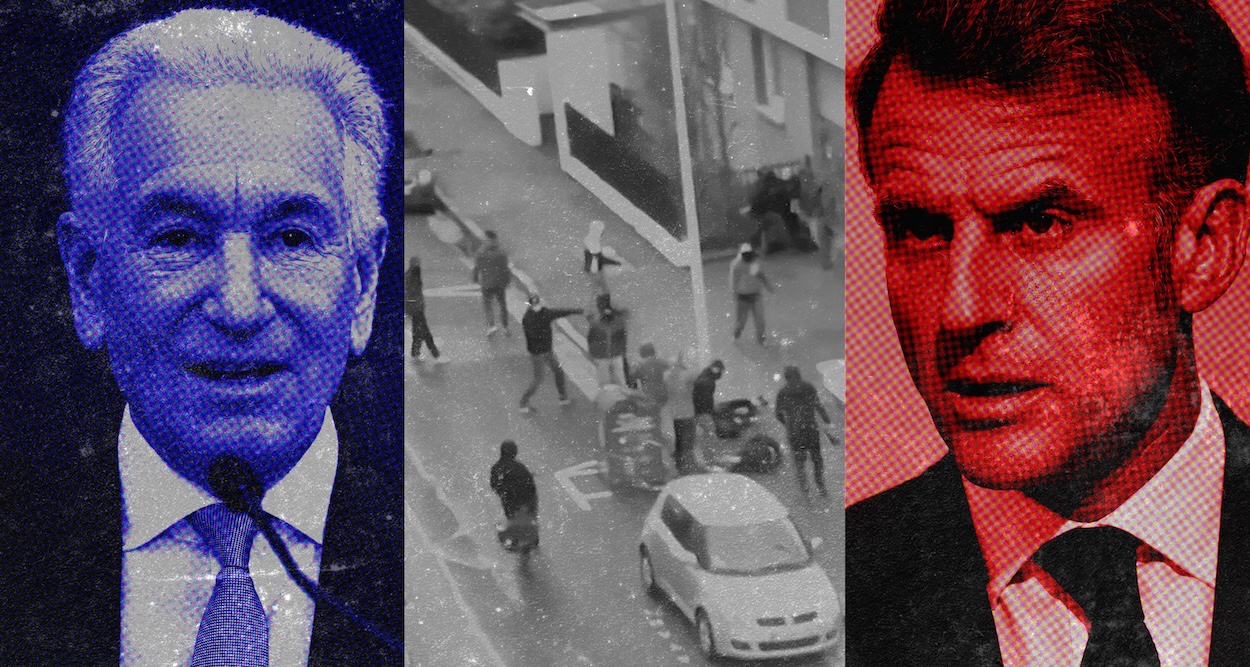
Washington’s warning last week about the spread of far-left violence in France did not go down well in Paris. In an interview on Sunday, France’s Foreign Minister Jean-Noël Barrot accused America of wading into a matter that “concerns only our national community”.
This doesn’t surprise conservative commentators in France who have coined the phrase “Red Privilege”
The diplomatic spat began at the end of last week when Sarah Rogers, the US State Department under-secretary for public diplomacy, posted on X. Referring to the murder of a young nationalist student, Quentin Deranque, allegedly kicked to death by members of a far-left organization called the Young Guard, Rogers said his death demonstrated why in America “we treat political violence – terrorism – so harshly.” She continued: “Once you decide to kill people for their opinions instead of persuade them, you’ve opted out of civilization. We will continue to watch this case.”
To underline their anger, Paris summoned US ambassador Charles Kushner for a meeting on Monday evening. But Kusher didn’t show because of “personal commitments.” He sent a lacky in his place. A furious French foreign ministry has said that Kushner will no longer have direct access to government ministers, although he will be allowed to perform some diplomatic duties.
The State Department’s bureau of counter-terrorism also commented on the murder that occurred close to a university in the southern city of Lyon: “Violent radical leftism is on the rise and its role in Quentin Deranque’s death demonstrates the threat it poses to public safety,” posted the Department. Barrot accused Washington of trying to make political capital out of Deranque’s death and he said France has “no lessons to receive” from outsiders on political violence.
This may also be construed as a swipe at Giorgia Meloni. Last week the Italian Prime Minister expressed her grief at the death of Deranque, which she said was a “wound for the whole of Europe.” An angry Emmanuel Macron retorted that people “should stay in their lane.”
It is not the first time that Meloni and Macron’s government have clashed over the issue of far-left violence. In 2023 France’s top court refused the extradition of ten member of Italy’s Red Brigade. They had been convicted in absentia of kidnappings and murder in the 1970s, but for decades they had been living in France, protected by what is known as the Mitterrand Doctrine.

This was a policy introduced in 1985 by Francois Mitterrand, the first socialist president of the Fifth Republic. He said that acts of terrorism committed in the 1970s – which included the murder of former Prime Minister Aldo Moro in 1978 – would be forgiven and the perpetrators allowed a “second phase of their lives…integrated into French society.”
In her social media post Sarah Rogers said that political violence in America is treated “harshly.” The same cannot be said in France. Eric Zemmour is a frequent target of far-left thugs, as are members of Marine Le Pen’s National Rally. During campaigning for the 2024 parliamentary elections, one of Le Pen’s candidates was assaulted by four Antifa activists. The candidate, Nicolas Conquer, said: “It’s as if political violence has been normalized by the far left, which is seeking to dehumanize its opponents and refuses to engage in genuine debate.”
Last year Jordan Bardella, Le Pen’s deputy, was attacked twice during a promotional tour for his recently published book. On the surface they were minor incidents: doused in flour and then hit with an egg. Earlier this month an effigy of Bardella was burned during a village carnival in the south-west of France. Many on the left snigger and says it’s just harmless fun, like the comedian who recently cracked a joke about the death of Bardella on public service radio.
They have drawn no lessons from the murder of Charlie Kirk in America, vilified and insulted by many on the left before being assassinated. After the death of Kirk, Trump designated Antifa a “major terrorist organisation” and Bardella has said if his party comes to power they will do likewise.
The Young Guard was proscribed by the government last summer at the behest of the interior minister Bruno Retailleau. But it continues to operate openly with the support of Jean-Luc Melenchon’s La France Insoumise.
This doesn’t surprise conservative commentators in France who have coined the phrase “Red Privilege” to describe what they regard as the political bias of the Establishment. The public share this scepticism; a poll last week found that 77 percent of respondents believe the far-left extremists charged with murdering Quentin Deranque will be treated leniently because of their political ideology.
The demonisation of Deranque is already well underway by some on the left; not just by radicals but also figures from the centre-left. Last Friday Ségolène Royal, who reached the second round of the 2007 presidential election, described the dead student as a “suspected neo-Nazi and anti-Semitic activist.” There is no evidence he was either. She also warned against banning any left-wing organisation because that’s what Hitler did in 1933, “accelerating the rise of Nazism.”
The “Nazism” that one sees today in France – such as kicking to death political adversaries, assaulting Jews and burning synagogues – comes overwhelmingly from the far-left and Islamists. It is this “Islamo-Gauchism” that is the greatest threat facing France. America, Italy and all those who care about the future of France are right to call it out.





Comments