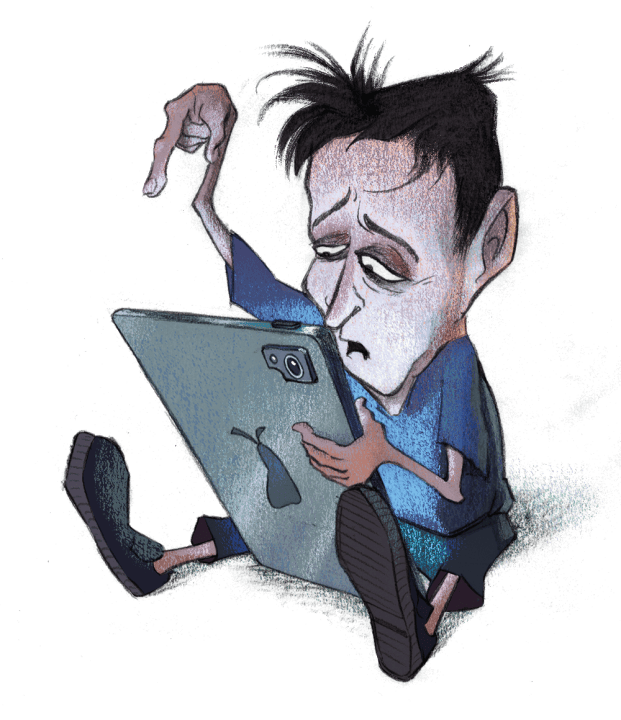

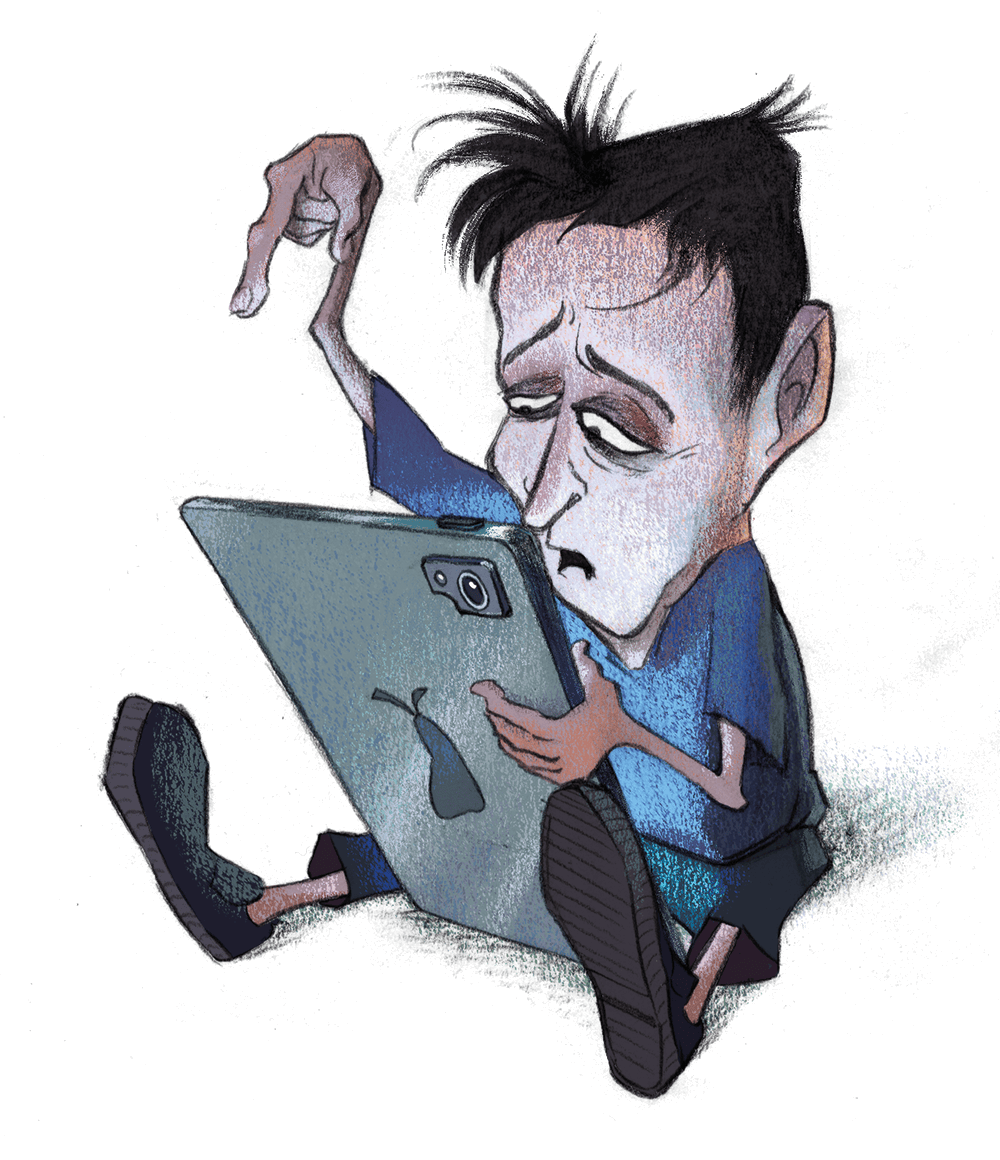
In the late 17th century, Europe’s greatest intellectuals were consumed by the quarrel of the ancients and the modern, satirised by Jonathan Swift in The Battle of the Books. In the 18th century, Jean-Jacques Rousseau asked whether education should nurture children’s natural capacities or mould them to society’s expectations. The great educational dispute of the 21st century is rather less august: should children be reading books or collecting coins for cartoon robots?
In the past decade, a new divide has opened in Britain’s classrooms. Not between rich and poor, clever and dull, or private and state schools, but between children still taught by teachers using whiteboards, pens and paper and those being instructed by an avatar on a screen.
The great Educational Technology (EdTech) revolution began in Britain’s top private schools. Head teachers boasted to parents that they were creating the next generation of digital natives. Just months after Apple released the first iPad, a small independent school in Greenock in Scotland had already equipped every pupil with one. For a long time, governors fought to become ‘Apple Distinguished Schools’ in a bid to attract fee-paying parents.
Increasingly, parents are reluctant to sign an old-fashioned reading journal or check children’s reading homework
This instinct soon spread into the state system. In 2014, Google Classroom was launched, a free platform enabling teachers to hand out homework online. Cheap Google Chromebooks soon offered state schools an affordable means of putting a computer in every child’s hands. By 2019, UK schools were spending an estimated £900 million every year on EdTech. Things accelerated during the pandemic, when schools had no option but to move learning online. Now, long after classrooms have reopened, the trend has stuck.
Around 960,000 pupils in the UK now use an individual device in nearly every lesson, according to polling commissioned by SafeScreens. This includes approximately 270,000 primary pupils. A further 2.6 million are estimated to use screens daily in school.
It starts young. On Mumsnet, a parent asks for advice after receiving a message from her reception-aged daughter’s school informing her that the practice of sending children home with physical reading books has been phased out. Instead, children have been furnished with log-in details for the Collins Hub app so they can read picture books on a tablet or phone.
The app is wildly unpopular with parents. In the app store it has a rating of 1.8 stars out of five. Reviewers describe it as ‘unpractical and user unfriendly’ with reports of regular crashes, failure to display pages in order and a series of bugs far too complex for a four-year-old to figure out.
Teachers know this. But they tell me they’ve faced huge pressure from both head teachers and the government to move reading online. Parental involvement is waning. Increasingly, parents are reluctant to sign an old-fashioned reading journal or check their children’s reading homework. Hundreds of pounds’ worth of books go missing or get left at home every year. An app, which offers the teacher a dashboard showing how long is spent on each page and who is reading what, is held up as the solution.
Parents concerned about their children’s screen time might try to circumvent the system by buying the books themselves. But even this is no guarantee of escape. One parent, whose daughter Alice (not her real name) was assigned reading homework on Sparx Reader, told me they had bought physical versions of the set books instead. The following day, Alice was reprimanded at school for failing to complete her homework.

On Sparx, the text disappears after a set number of words, and students must then answer multiple choice questions about what has happened in the passage. If you get the answers correct, you get ‘Sparx Reader Points’ which count towards homework targets and move you up your classroom leaderboard. Make a mistake and you’ll be forced to re-read. Alice tried to protest that she had read for several hours that night. But Sparx’s policy is that ‘physical book logs don’t award Sparx Reader Points or contribute towards completing homework’ and so she failed the task.
Even where physical books remain, EdTech is transforming reading. A volunteer in a state primary tells me that while children are, for now, actually given books in her school, they are still required to pass an online quiz on an iPad in order to move on. Many children, who don’t understand how to log in, or simply forget, are left re-reading the same book week after week.
In many schools, homework has moved almost entirely online. For maths, Monster Math and NumBots have become popular at the primary level. Both of these platforms attempt to gamify learning and resemble the game Moshi Monsters more than anything approaching homework. The interface in all these apps boils down to the same principle: the more sums you get right, the more rewards you receive.
I had a go at Monster Maths and NumBots, and after a short session started to fear that I was developing ADHD. A significant portion of my time on NumBots was spent designing my own panda-themed animatronic so that I could turn a rusty scrap metal robot into a diamond. I could then collect coins, badges and trophies and was repeatedly offered the chance to purchase blingy new gear for my robotic companion with coins I’d earned in the app. Fortunately, not too much of my time was wasted on anything boring like addition or subtraction.
Once I managed to get the Monster Math app to stop crashing, the experience was much the same – except now I could play monster-themed parkour. One parent remarks that the first time they saw their child doing ‘homework’ on this platform they accused them of skiving and playing video games. Another notes that while her son excelled at NumBots, he recently scored poorly in a physical maths exam, as it turned out none of the scrap metal crafting skills he learned in the app could be transferred into the world of numeracy.
Education Technology platforms have almost universally failed to provide evidence that they contribute to durable learning gains. Only 7 per cent of British EdTech companies have ever conducted randomised controlled trials. Those that have been conducted are not conclusive. A trial of Accelerated Reader, a popular reading platform, showed it contributed to no additional progress, while GraphoGame Rime, a phonics computer game, was found to set students back by a month when compared with the control group.
For some schools, widespread EdTech adoption has had devastating consequences. In 2021, Farndon Fields Primary School in Market Harborough, Leicestershire, joined Microsoft’s Showcase School programme. In 2023 (the first-year SATs were published after Covid) 81 per cent of its pupils achieved the expected standard in English and maths. By last year that had fallen to 47 per cent. Children are using Oxford Reading Buddy, NumBots and Century AI on their personal devices. Year 3 are using virtual reality headsets to learn about ancient Greece. None of it is contributing to better results.
Will Ellis, a former teacher of 20 years and independent researcher into EdTech, fears these platforms are actually harmful. He notes many feature the ‘manipulative design’ strategies deployed by social media companies in order to create lifelong users.
DoodleMaths attempts to encourage children to return through the ‘streak system’ popularised by apps such as Duolingo and Snapchat. Other platforms, such as Blooket, give children the chance to gamble in-game currency to try to win in-game avatars.
Children might enjoy these games, but even they know they aren’t really learning. Ellis notes that we are already seeing ‘a breakdown of trust between teachers and pupils’ as children realise their work is being marked by machine, not man. Sophie Winkleman, arguably Britain’s forefront campaigner against EdTech, tells me that ‘the best and most impactful learning is relational – children tend to do their best pieces of work for the [human] teachers they most respect. The anticipation of said teachers’ feedback on a proffered piece of homework is a far more powerful motivator than any AI-generated “aid”, however “personalised” it pretends to be.’ Ultimately, children care far more about a smiley face next to a written answer than any amount of coins and badges on a screen.
We are already seeing ‘a breakdown of trust’ as children realise their work is being marked by machine, not man
Child psychologists hate EdTech. Many parents can see that these tools are shortening their children’s attention spans and producing adverse behaviour and compromised sleep. Doctors are now sounding the alarm, with 150 leading clinicians recently writing to Lucy Powell, the Education Secretary, to warn that we are seeing a ‘crisis unfold with children presenting earlier and more severely’ with physical and developmental health issues, including language and eyesight problems, due to screen time in class. So why are tablets, monsters and gaming taking over schools across the country?
At first, it was the promise of futuristic tech for the digital age. But there’s more at play. One former teacher tells me it’s the only way for staff to cope. Class sizes in secondary schools are getting bigger and classrooms are harder to control. The admin load is more burdensome. A lot of children have English as a second language and need extra support, while much of the teacher’s free time will be spent on things like safe-guarding or filling out behavioural reports. Something had to give, and teachers decided that marking homework was the best sacrifice. The Department for Education and Ofsted are both on board, having pushed schools to move away from ‘excessive marking practices’.
And so we are outsourcing more of teaching to the computer. First, it was homework, set and marked on an app, then in-class exercises, which can be marked by AI. And now lesson plans. The government’s own Oak National Academy features Aila, an AI-powered lesson assistant, which can build lesson plans and resources in minutes. The computer can do the teaching, leaving the actual teacher free to deal with behaviour management instead.
But the rebellion has started. The best schools are throwing out tablets and going ‘paper first’. Winchester College recently abandoned laptops. Katharine Birbalsingh, who runs the successful Michaela Community School in north London, is proud that ‘we only have one computer room – and we don’t use it’.
Parents are also pushing back. Globe Primary School in east London recently abolished screen-based maths homework and removed iPads and laptops from ordinary lessons after surveying parents. Throckley Primary School in Newcastle upon Tyne has reinstated optional paper homework in response to parental requests, and Eton has restricted iPads after more than 100 parents signed a petition.
These schools will thrive. But at the same time, we are pushing children with no one to advocate for them into increased screen time. The government recently announced plans to introduce AI-powered personal tutors into English secondary schools, hoping to reach 450,000 disadvantaged pupils a year by the end of 2027.
The Battle of the Books is now a battle for the books. In the future there will be two types of education: one which cultivates the mind and one which keeps it occupied. The privileged will get teachers, tuition and parental help. The poor will have chatbots.






Comments