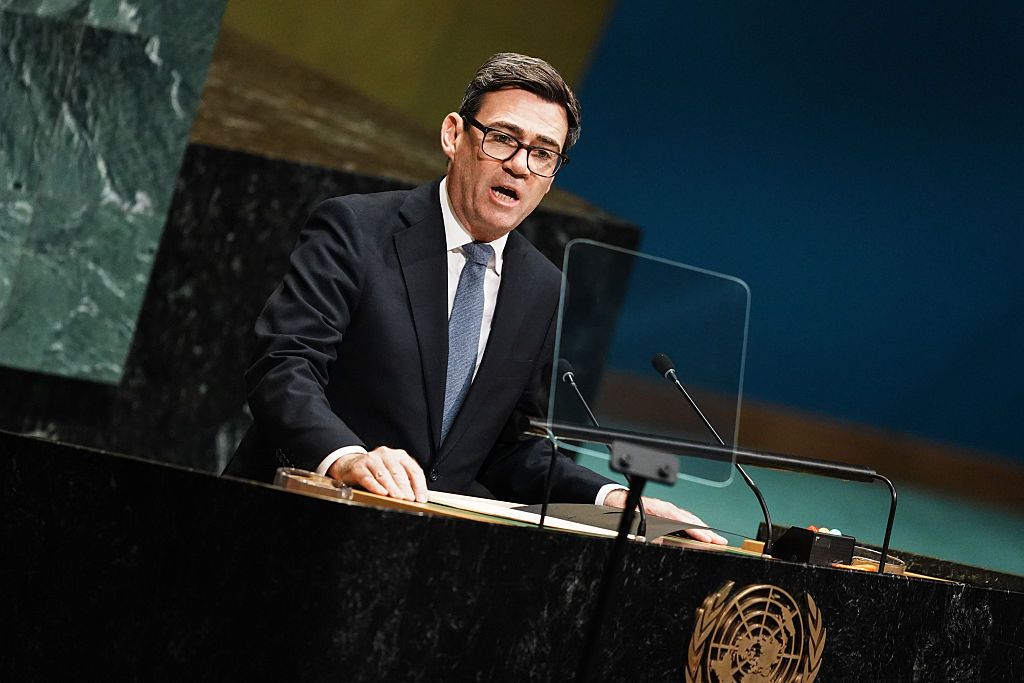
‘Britain is back,’ Burnham declared in his big speech to the UN yesterday. We have been laid low by ten years of Brexit disruption, he told the world. We’ve heard this before: just last year Starmer was announcing ‘Britain is back on the world stage’. Heck, Cameron was insisting Britain was ‘back’ even before that fateful referendum had taken place.
There is something unpatriotic about cementing this narrative of a lost decade. UN functionaries lap it up but it doesn’t do our soft power, which Burnham is so keen to make a national priority, any good. And curiously, having informed the General Assembly that Britain had returned to the world, Burnham then spent several minutes listing all the institutions and alliances from which we have never departed.
Burnham comes across as such a lightweight he could have levitated over to New York
What else did he have to say? ‘We are going to be much prouder in standing up for our values and the rule of law’. Really? Starmer’s two-tier justice was of course a strange perversion of the law, but arguing our last PM was insufficiently zealous in talking up our ‘values’ and the rule of law is a bit of a stretch.
At times Burnham was almost comically vaunting in his ambition: ‘In a divided world, we have the ability to bring people together – and we will. We are going to step into that role.’ The UK would be an ‘honest broker’ on AI and pretty much anything else where word leaders wanted to call on handy Andy.
But it was the announcement on countering Russian disinformation which generated the headlines. No doubt a clever special adviser had told the PM that majoring on disinformation was a neat way of championing a foreign policy issue (and appearing tough on Russia) that chimed with his domestic narrative about ending division and encouraging all of us to get along like one big happy family.
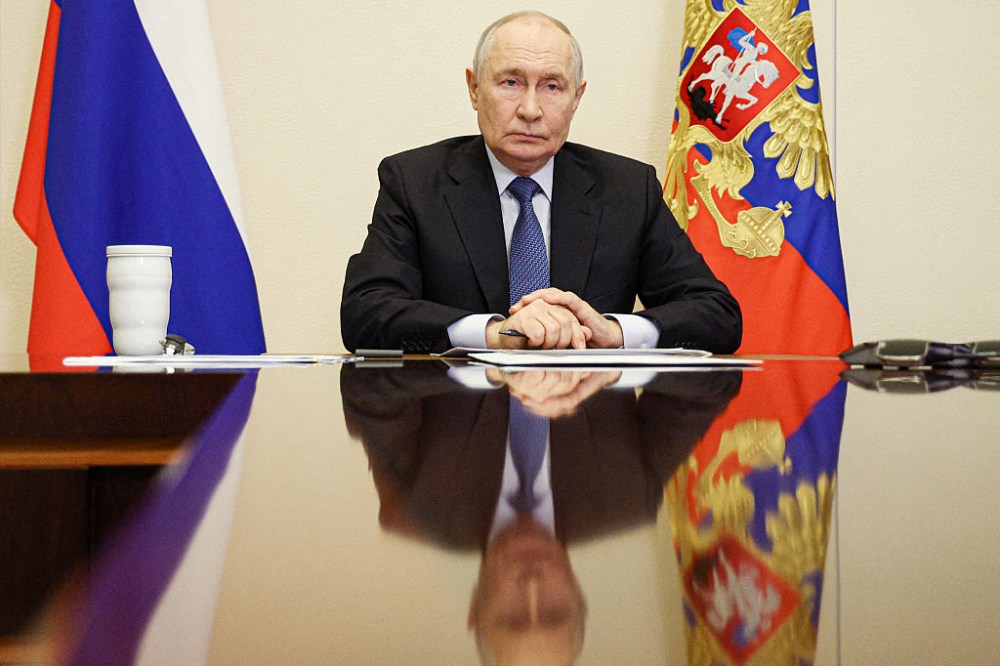
The problem is this: Putin’s regime of course does employ the dark arts of information operations, delights in anything that causes divisions in Western societies, and seeks to do everything it can to amplify and exploit those cleavages to undermine the cohesion and morale of what it regards as its enemies. But Burnham’s proposed solution risks doing more harm than good. The cliché may be tired, but it is hard to ignore the Orwellian overtones of his new ‘National Centre for Information Defence’. I am not sure I trust this government to confine its functions solely to removing bot-farm content, and not stray into policing free speech in the name of national cohesion. We have seen this already in spades with the likes of the Counter Disinformation Unit (now the National Security Online Information Team), and the Research, Information and Communications Unit (Ricu).
Besides, Burnham’s mistake (which one suspects is deliberate) is conflating foreign manipulation with pessimism about Britain. A democracy ought to distinguish between a hostile state using clandestine means to deliberately manufacture division and its own citizens gloomily concluding that their great country has never been so badly governed.
There were references also to continuing to back Ukraine, and turning the screws on Israel to get a two-state solution back on track (fat chance). The briefest of refences also to the Falklands. But what was striking was the sheer emptiness of it all. Kumbaya utopianism (‘Count on us to bring people together… count on us to meet fear and division with unity and hope.’) was punctuated only by more ominous signs of do-goodery: ‘Count on us to fight racism’. This was foreign policy as group therapy. I am surprised he didn’t ask the assembled statesman to all hold hands.
One can forgive Burnham for trying to gee up the half-empty hall with some stirring rhetoric but a statement of coherent foreign policy doctrine this was not. I am told the conversation in the corridors was, sensibly, more preoccupied with President Xi’s imminent visit to the US than anything Burnham had to say. And no wonder. The speech had plenty about the kind of country Burnham thinks Britain should be, rather less about what he thinks Britain should actually do. Most of the media commentary has instead focused on how nervous the PM looked in his bilateral with Trump (very), and Trump’s denouncing of the Chagos deal as ‘terrible’ (it is, not that Burnham or Jonathan Powell agree). Burnham comes across as such a lightweight he could have levitated over to New York.
As a speech it was pretty lousy. In its references to devolution and doing ‘more to help people with the everyday cost of living’, it was clearly aimed as much at a domestic audience as at world leaders. There were parts of it that gave a strong whiff of having been written by AI: ‘we will be prepared, but not panicked. Clear-eyed, but cool headed.’ Though it is not clear the Labour speechwriters would have done a better job than ChatGPT.
And there were constant – excruciating – references to Manchester. Manchester’s cotton workers, Manchester (inevitably) as the government’s chosen venue for Britain’s G20 summit next year. He even managed to mention No. 10 North, leaving African leaders looking nervous at the thought of being so far from Harrods. Can you imagine a President of France harping on about how everyone needs to come visit him in Lyon?
Palmerston had the ‘civis Romanus sum’ principle. Churchill had collective security and the Anglosphere. Thatcher had Atlanticism. Burnham, so far, has group-hug harmony, good vibes and a statue of Abraham Lincoln outside his office in Manchester. It’s not exactly grand strategy.




Comments