Misery, it seems, cranks up my kinship for chimpanzees. Famously, we share 98.8 percent of our DNA with them, but I don’t recall feeling it when I saw them in the wild. Content in the gloom of a primordial Ugandan forest, they shook tree branches and threw poop at me. “Quels sauvages,” I thought.
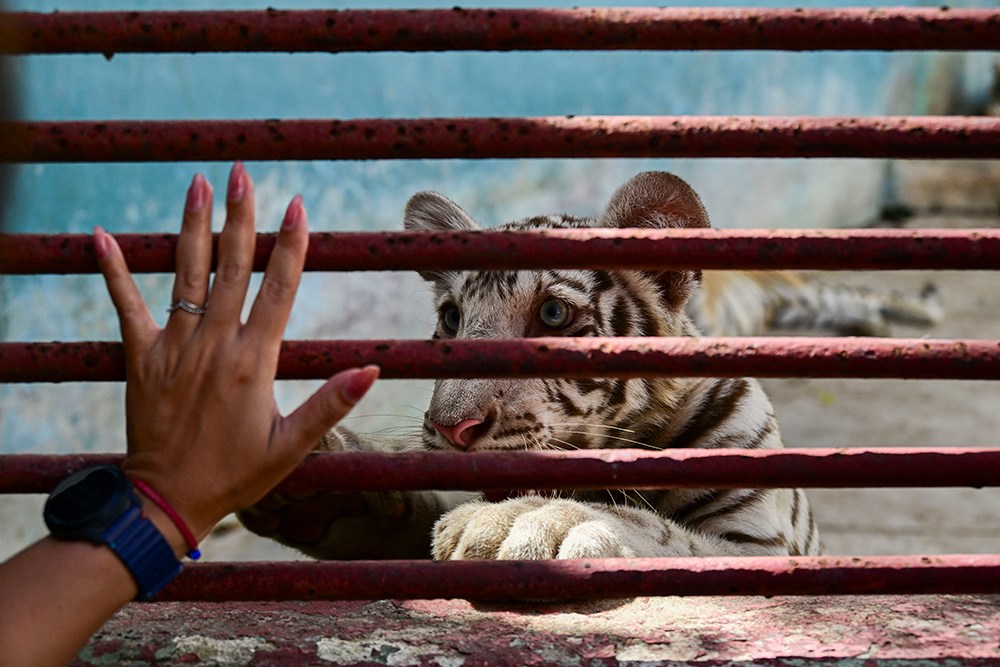
But looking into the eyes of a chimp in Havana zoo as he reached through rusting bars in the hope I’d give him some food cut deep, especially when, after realizing I didn’t have anything, he turned his back in a grump. An old lady chimp was worse. Her eyes followed my four-year-old son Santiago as he ran about, twisting her head against the bars to follow him as he moved out of sight. Of course, she might have just been thinking, “snack” – but the effect was of a concerned grandmother. Havana Zoo is a place I’ve avoided until now, knowing it would be depressing. But for the past three weekends, Santiago has been begging to visit. And so, finally, I gave in.
Havana Zoo is a place I’ve avoided until now, knowing it would be depressing
Cuba is collapsing. Nearly seven decades of communist rule and US imposed trade embargo, accelerated by ten months of the current outright fuel blockade, has paralyzed the state. Such circumstances are never good for the animals in zoos, but it seems crass to go on about it when people are suffering so badly.
There are some amazing animals on the island, though. During his decades in power, Fidel Castro was an ally to many countries full of toothy critters. Gifts flooded in: nilgai from India; water buffalo from China; lions, rhinos, hippopotamuses and elephants from multiple nations across the African continent. As recently as 2012, Namibia sent 23 different species.
In July, a rare Bengal tiger was born, thankfully at the National Zoo, which at least occupies 850 acres outside the capital. There is also Cayo Saetia at the eastern end of the island. It operated as a safari park, with zebra, ostriches and giraffes running free. Antelope steaks used to be on the menu at the hotel.
Santiago ran ahead as soon as we entered the city zoo. Although it is set in a lush tropical park, it is designed like a Victorian jail. Baboons and macaques sat at the rusting bars of crumbling concrete bunkers like trusty old felons. A jaguar marched back and forward across her tiny pen as if planning an escape.
A condor hunched in an apiary. “Imagine,” said my wife. “It is meant to soar above the Andes.” In an algae-covered pool, a hippo emerged by the wall, open-jawed so visitors could drop bread and biscuits into its gaping mouth.
To be fair to the hard-pressed animal keepers, all the beasts seemed to be in good physical shape. Their mental state is another matter. Junior, a black bear, sat in a pit surrounded by beer cans, gazing up at the sky and shaking.
I don’t know the names of the chimps, but if they were born in captivity then it’s likely they were raised until the age of one by zoologist Marta Llanes in her central Havana apartment. She has been doing it since 1983, and has fostered ten chimps this way. Imagine: starting out with all that love and ending up in a place like this.
At the National Zoo, staff have warned that they are reducing their breeding program due to shortages. It’s not a surprise. With state salaries reduced to barely more than $8 a month by hyperinflation, only the most committed are still working.
At the hippo pond, it was notable there were no staff to tell visitors off for feeding the animals, despite signs warning against exactly that. And Junior the bear hadn’t been partying – the beer cans in his pit had been thrown by people trying to get his attention.
Of course, Santiago loved it. He’s four and is just excited to see the animals he loves looking at in his books. As we left, he restated his commitment to become a protector of animals when he is bigger. I replied: “It’s harder than it looks.”





Comments