
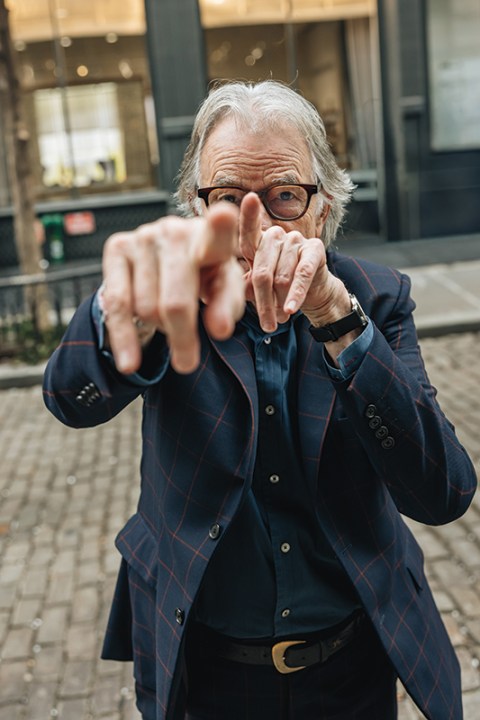
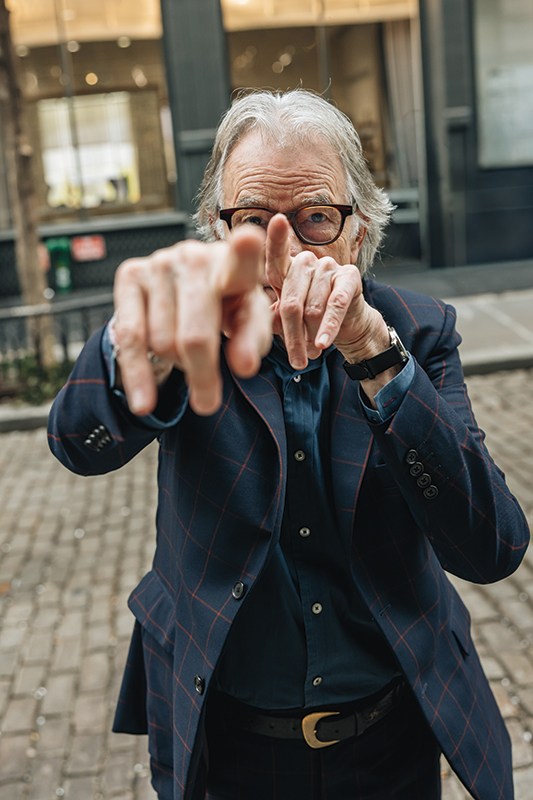
My first proper job when I graduated was with Paul Smith. I had met him while working in his shop in London in the holidays, and when it came time to enter the real world, he kindly took me on in a role that we made up together. I remember him saying he wasn’t sure what I was going to do, but he was expanding and he needed people. It was 1986 and I became what Smith called his “projects manager.”
At that stage, Paul Smith was a company on the move, having been founded by the designer in 1970 when he opened a tiny, windowless, second-floor store in Nottingham, open only on Fridays and Saturdays. He called it Paul Smith Vêtements Pour Homme. By the mid ’80s Smith had two shops in London, one in Nottingham, and a burgeoning wholesale business around the world. But he still worked with his partner Pauline on the shop floor at weekends.
In 1987, he decided to open in New York, the firm’s first retail venture abroad. With characteristic aplomb, Smith found a site on Fifth Avenue on the corner of West 16th Street, a location that in some ways had the quiet feel of London’s Covent Garden when he opened there in 1979. It’s hard to imagine now, but at the time, that stretch of Fifth Avenue had no fashion retail.
“I couldn’t afford to be on the big shopping streets, but also, the few shops I had then were always sort of slightly off-piste,” Smith explains today, sitting surrounded by his collected cycling jerseys, books, artworks, and toys in his studio office in Covent Garden. “I always try to have shops that are not in the obvious place. And when I went down there, it was mostly a Chinese restaurant, a laundry, and a beautiful shop that was there for years called B. Shackman & Co. that sold reproductions of Victorian Christmas cards. But there was no fashion there. Later on, Matsuda came, Armani came, a lot of people came.”
For me, an English kid from South London, the Big Apple was both exhilarating and dauntingly alien. On the first Saturday of opening, a guy walked in wearing jogging pants. Being used to people dressing up to go shopping in London, I assumed he wasn’t a serious prospect. However, it turned out he probably worked on Wall Street, as he got very involved with the collection, including the more expensive tailored pieces. I felt suitably admonished.
As Smith recalls, “New York [in the ’80s] was so exciting, so full of energy, and so full of modernity – with great cafés and restaurants and clubs. Indochine and Keith McNally at Café Luxembourg and The Odeon, and Elaine’s, a great literary place, and Area nightclub.” But growing up, he’d had no concept of a place like this. “I didn’t know anything about America when I was a kid. Bear in mind my age, and also that I’m from Nottingham with a mum and dad that never traveled anywhere. They only went abroad once, and that was on their wedding anniversary when I took them to Majorca! There was no foreign language spoken at home; I had a sister that was a secretary and a brother that worked for the GPO [General Post Office]. So, we were a family that wasn’t worldly.”
He recounts a story of coming home from his local cycle club and telling his father that he really liked Jacques Anquetil, the famous French road racer. “My father said, ‘What are those words?’ rather than, ‘Who’s that?’ – just to put this all into context.” But on November 22, 1963, when Smith was 17, America finally made an impression. “I was at the Beeston Cycling Club dinner and dance, and the news came through that Kennedy had been shot. That, with the Cuban Missile Crisis the year before, made up the two punctuation marks of me knowing a little bit about the USA.”
Smith’s worldview was to change completely after a bad cycling crash put paid to his dreams of becoming a competitive athlete. During his rehabilitation, he met his future wife, Pauline Denyer, who was then lecturing at the local art school in Nottingham. A Graduate of the Royal College of Art, Pauline introduced him to a new, arty crowd, and also to the idea of style. “I got into fashion and became aware of Jacqueline Kennedy and her amazing style, and Audrey Hepburn, and particularly Katharine Hepburn, who was Pauline’s hero. She loved the fact that Katharine thought you had to dress like a man to be a modern woman. In other words, put trousers on and a shirt and wear clothes that allow you to have movement.”
‘The thing about our shop, without question, will be you’ll get a smile on your face and you’ll think, gosh, that’s interesting’
He was also getting into American music. “I liked Miles Davis and Santana, and the bands that played at the Fillmore in San Francisco like the Grateful Dead; I was very attracted to the amazing graphic design of all the posters. And then, of course, the Beatles and the Stones, Rod Stewart and the Faces and Zeppelin all toured the States. Later I knew those people, so I understood the whole connection with British music and particularly the West Coast.” Here, Smith excitedly mentions that he’s about to release a collaboration with Fender guitars, where his house Signature Stripe will appear on a reproduction of a 1974 Telecaster. “That’s the year I went to Haight Ashbury [the center of US counterculture],” he explains.
It was Pauline who encouraged the young Smith to think about a career in fashion, and after gaining experience working for clothing factories and warehouses, the pair opened his small store. Initially she did the designs, and continued to do so for several years while Smith learned ropes. Then, in 1974, Paul and Pauline crossed the Atlantic for the first time.
The couple landed in New York before heading to California: “The main thing we did was visiting SoHo. We knew a few British artists, in fact we were having some food in Fanelli’s on Prince Street when we’d just arrived, and we ran into [sculptor] Richard Wentworth, which was quite a coincidence. We visited all the big public galleries like the Met and MoMA and the Guggenheim and Frick, of course, but we hung out in the smaller ones too like Pace Gallery and OK Harris. I met the gallerist Leo Castelli, and he had a downtown space. We were there at the time when artists like Robert Rauschenberg, who had traditionally been shown uptown, were starting to show downtown. A lot of those guys were downtown, like Jasper Johns. What was wonderful about SoHo for artists and galleries was you could find these huge lofts because it had been the garment district. Canal Street also had the famous Pearl Paint, which was this entire building that sold all sorts of different paints and brushes, and not just artist materials, but industrial supplies too. For the sculptors, there were places you could get bits of wire and bolts and nails and hardware.”
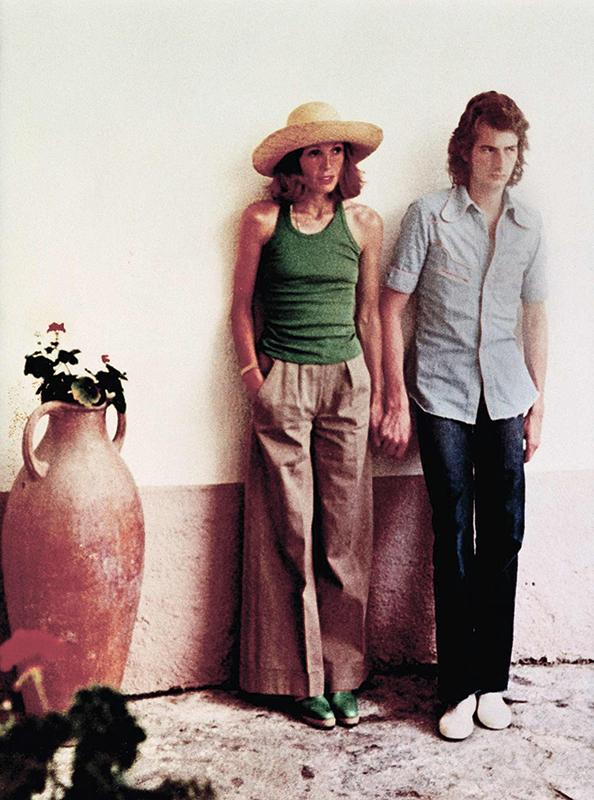
The couple visited the city regularly from then on, and Smith remembers days spent “just walking in Central Park and the big, long, wonderful streets and the eye-opening view when you go across the Brooklyn Bridge – seeing the skyline, which has changed so enormously now. They were exciting times, very exciting.” He recalls one trip in particular when “we were nocturnal for a week because of Studio 54.” The famous nightclub made quite an impression. “Studio 54 was 1977 to ’80, and last week I found a badge in a draw where the lips pucker in a kiss as you turn it – it’s a lenticular. It’s dated February the 14th, Studio 54. So obviously Pauline and I were there on Valentine’s Day!”
He says that there, they saw the likes of Woody Allen, Liza Minnelli, Andy Warhol, and the fashion designer Halston. “We only got in because of Pauline’s smile,” he reveals. “There were 500 people outside, it was very hard to get in. So, we used to go and have a corned beef sandwich or something because we didn’t have much money, and then we’d hang around, and Pauline with her red hair and nice smile would catch the doorman’s eye, and I’d hide behind her.” He gets up and shows how he folded his six-foot-four frame into a crouch, slowly creeping in a cartoon tip-toe. “And then the doorman would say, ‘Oh, there’s two of you!’ But we were in! With Grace Jones and everyone! There was an Issey Miyake party and a Karl Lagerfeld party there – they were heady, heady times. The famous people all went off to these little secret rooms, but we were on the dance floor.”
And what’s his dancing like?
“Marvelous, absolutely marvelous!” he says, affecting a luvvy, theatrical tone. “And they had a trapeze artist, dressed in a G-string; and there was this one time where suddenly in the middle of all the music, these sort of really long, colorful velvet things came down from the ceiling like a forest of sausages, and then you were dancing in the middle of them.”
All this time, Smith was working for fashion companies like London’s Browns store, which brought Ralph Lauren and Calvin Klein to the UK. But he was also developing his own collections, and on his travels had made the acquaintance of the Pressman family who owned luxury fashion department store Barneys New York. Hearing that Gene Pressman, the grandson of Barneys’ founder, was in London, Smith got in touch and went to see him in his suite at Claridge’s, bringing with him a small collection of knitwear and shirts.
“Gene and his assistant buyer were on the floor doing sit-ups,” he says. “So, I got my shirts out, and I was holding them out in front of them as they were crunching up.” He mimes swaying back and forth with the garments. “And Gene said, ‘Yeah, I’ll have 20 of those. I’d love 20 of those. Give me a size scale. Yeah, 40 of those, yeah,’ and that’s how I sold my first designs to America.” The two are still in touch. Smith says that Pressman texts him occasionally, calling him his “wacky English friend.”
Barneys would stock Paul Smith until it closed in 2020, and other US stores like Neiman Marcus and Bloomingdale’s (“I remember going to Bloomingdale’s and having something called frozen yogurt, which was great excitement”) would follow suit, along with a host of independent retailers. Smith would show his clothes to them twice a year at an exhibition called the Designers Collective that was hosted at The Barclay hotel on Lexington Avenue. When he first attended, his was one of only two non-American brands on show, the other being Porter-Yoshida bags, which led to Smith’s introduction to Japan. Today he has around 200 outlets there and, when he visits, he’s treated like a rock star.
“I used to always get told off [at The Barclay] for messing around. Because the door to my room was always closed rather than propped open [as was required] during the show. And then, all the clothes were just on the bed, which Pauline and I slept in at night, and we had a little rail that you rented.” He’s amused to tell me that the Designers Collective described him as “playful but proper.”
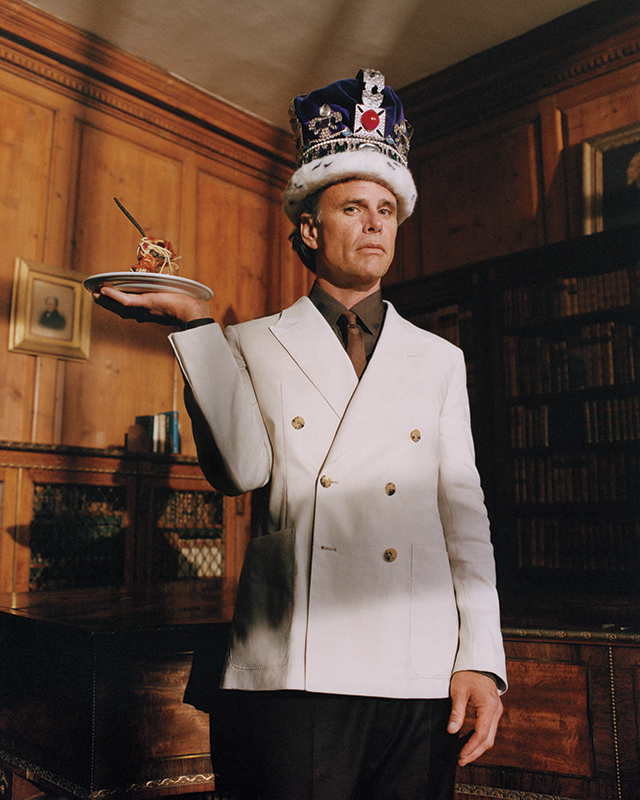
“We were on something like the 42nd floor,” he recalls, “and one of my tricks was that I had a shirt on a piece of string tied to the leg of the bed, and I had the window open (which you wouldn’t be able to do today). When people came in, I’d say something like, ‘You don’t like the shirt? Oh, never mind.’ And I’d throw it out of the window, and they would scream. Then I’d pull it back in.”
By 1987, when I was working with him, Smith had established a loyal fan base in the States, along with a reputation for being decidedly “playful but proper.” He says New York was the obvious place for the venture. “It just felt right. I didn’t know much about the rest of America, and I had friends in New York, like Grace Coddington, who had moved there from British Vogue who I knew would help me to get to know some of the interesting people there.”
The shop on Fifth Avenue and 16th made a splash. “It was really, really beautiful; fantastic,” says Smith today. “People still talk about that shop, because it had books, it had objects, it had antiquities, it had Fornasetti decorated plates from Milan… and also something called clothes!” It created, he says, a genuine community of visitors and had a neighborhood feel. “You know, after the horror of 9/11 one of the most amazing things was that we had so many people who just wanted to come into the shop and have a hug. There was some sort of emotional connection where our customers were like mates. We were not trading, but open for those who wanted to share their anxiety and fear and be with people they knew.”
Two decades later, Smith opened up downtown, in SoHo, in the area that he had fallen in love with when he first discovered the city. His stores have been fixtures there ever since and he currently has a large, 5,000-square-foot space on Wooster Street that has the vibe of a downtown art gallery and indeed displays artwork by local artists. And, as he would say, “something called clothes.”
But now, for the first time, he is making the journey uptown to the swanky heights of Madison Avenue. He has just opened a two-story boutique at number 929. I wonder what lies behind this decision?
“Well, it’s life, isn’t it? You know, things keep moving. Areas have always moved around. People say I have a good sense of humor, and humor has always been very much about timing. And I just felt it was the right time to open a different type of store,” he says. “It’s a bit more grown-up on Madison, but you can be playful and polite, you know. And it’s a nice area. You’ve got the Carlyle Hotel, which has got the lovely Bemelmans cocktail bar and Café Carlyle restaurant, and then you’ve got Robin Birley’s bakery and coffee shop, and his club [Maxime’s], from London. The Met and the Frick are nearby, too.”
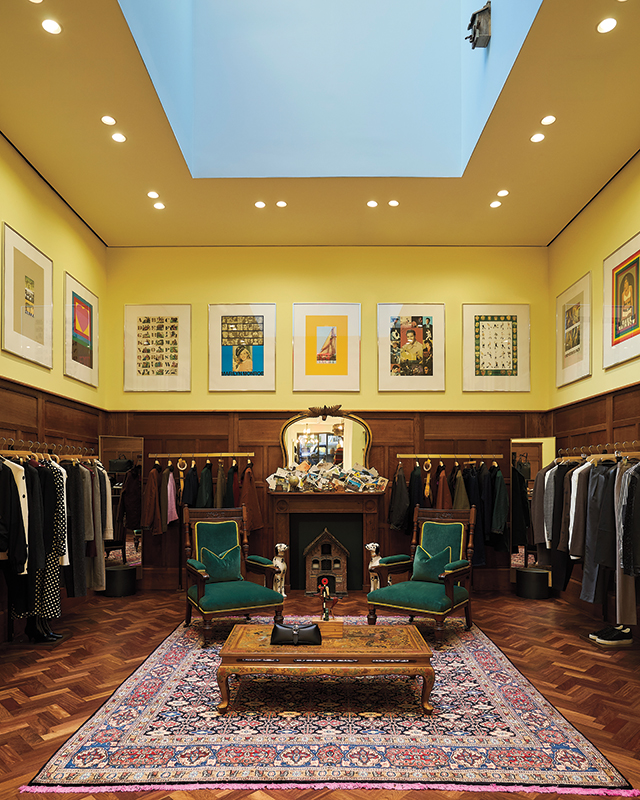
As befits this part of the city, inside is less boho art space and more posh townhouse. “The interior of this new one is based on my house in Holland Park in London, which was built in 1853. I took my shop designers to my home, and we picked out pieces from the odd mix of things I’ve got there.”
‘At first glance the clothes and accessories are pretty classic. But look closer at the details and you’ll see the playfulness’
He runs through examples: a Hans Coray chair from 1938, “which is ‘aluminum’ as they say in the States,” next to a mahogany piece; a light made of spoons; a mirror fashioned from reclaimed dominoes. And the Jet Lag Room: “It’s based on what I have at home; when I’ve come back from a big trip and I don’t want to disturb Pauline, I go to my Jet Lag Room which has Hessian walls, so it feels very calm and warm. There’s one at Madison Avenue now, too.”
He says the store is really worth visiting because it’s full of special, interesting things and ideas. One of his favorite aspects of the place is the facade, where a friend has created a mosaic featuring his logo with a needle and thread and pincushion. “It references my love of tailoring – we do bespoke and made-to-measure here too,” he explains.
I ask him what he thinks he can bring to this famous, upscale shopping street and he says, “I’m very aware that in that strip where we are, there’s so many great clothes shops. But the thing about our shop, without question, will be you’ll get a smile on your face and you’ll think, gosh, that’s interesting. We’ve got beautiful folk art, and we’ve got Peter Blakes on the wall, and so many quirky touches. And the clothes are equally quirky – great quality but you are able to show your character by opening a jacket and getting your pen out of the pocket…” he demonstrates “…and finding that there’s a colorful lining or a little jetting that’s a bit different. Or you’ll lift your arm up and there’ll be something under the cuff, which is slightly different to the rest of your shirt.”
This desire to be different, explains Smith, is what characterizes his fans around the world. “I think the customer has always been same,” he says. “With the exception of about five to 10 percent of what we make, which is a little bit more eccentric – obviously colorful and patterned, which appeals to people in the fashion or movie business, and celebrities – the rest is very wearable. The quality is lovely: the suits are all made in Italy, the fabrics are Italian or British, and at first glance the clothes and accessories are pretty classic. But look closer at the details and you’ll see the playfulness.”
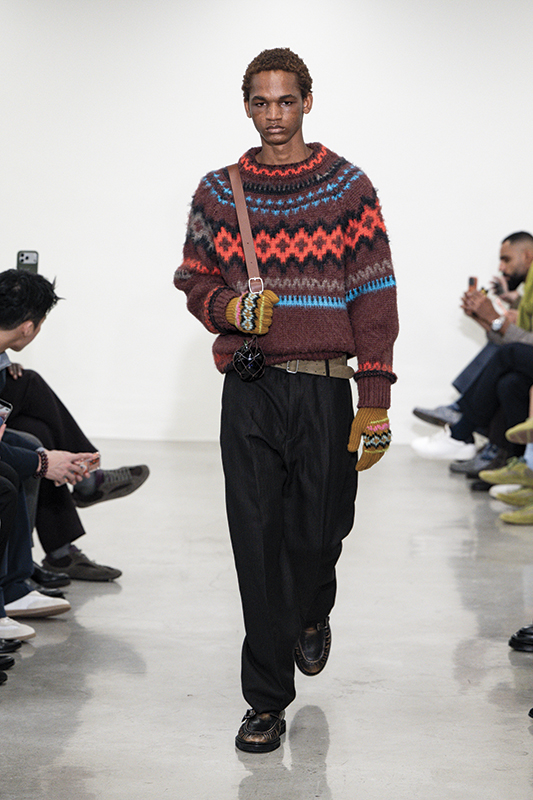
It’s an approach that has won Sir Paul many famous admirers over the years on both sides of the Atlantic. From David Hockney, David Bowie, Gary Oldman, and Cillian Murphy on one side of the pond, to Harrison Ford, John Legend, Robert Downey Jr., and Walton Goggins – who currently appears in ads as the face of the brand – on the other.
Smith talks of how years ago, in Paris, he sold some pieces to filmmakers François Truffaut and Jean-Luc Goddard. “You know that era… they’re buying something that is completely acceptable in a very classical time and a very classical city, as Paris was in the ’80s. But there was always a little bit of color or something on the inside, which they liked. And I think the same is true of Americans today.”
Smith’s aesthetic, which is often described as “classic with a twist,” has had its imitators. But, having turned 80 in July this year, Sir Paul has a claim to being the O.G. With his disarming, restless energy (there is something of John Cleese’s Basil Fawlty about him – in a good way), and his magpie eye that sees inspiration in the most unusual places, like seed packets and displays of fruit (both have appeared as prints), Smith is a master of surprise and delight.
The new store is a testament to that. Like all of Smith’s retail spaces since he opened his Westbourne House shop in 1998 (a Victorian building in Notting Hill that kept the layout of a home, complete with dining room and nursery), Madison Avenue has a unique character. For a quarter of a century, the designer has pioneered the notion that bricks and mortar representations of a brand should feel connected to their locations and not be the interchangeable product of some global luxury cookie cutter.
If Smith’s boutique in SoHo feels like an art gallery, the one in LA references a film studio (its pink exterior is one of the most Instagrammed sites in California), and Smith’s San Francisco outpost, next to his friend designer Jony Ive’s office, resembles a cool, clinical tech lab but with a gallery wall showing some 300 artworks. By contrast, 929 Madison has the flavor of an elegant Upper East Side Anglophile’s abode, seen through the looking glass of a benign Mad Hatter. Mr. Smith’s fans will be happy, and new visitors will be rightly charmed.





Comments