
When Donald Trump said Keir Starmer was “no Winston Churchill,” it is unlikely he was thinking about painting. Not many think of the Great Wartime Leader as an artist. We all know about Churchill’s prodigious ability to write – he wrote at least half a million words, more than Charles Dickens and William Shakespeare put together; but he also painted over 500 canvases. He called them “daubs” – although one suspects there was a touch of mock humility about this because Churchill was proud of his works and is still the only person ever to be elected an Honorary Academician Extraordinary in the history of the prestigious Royal Academy.
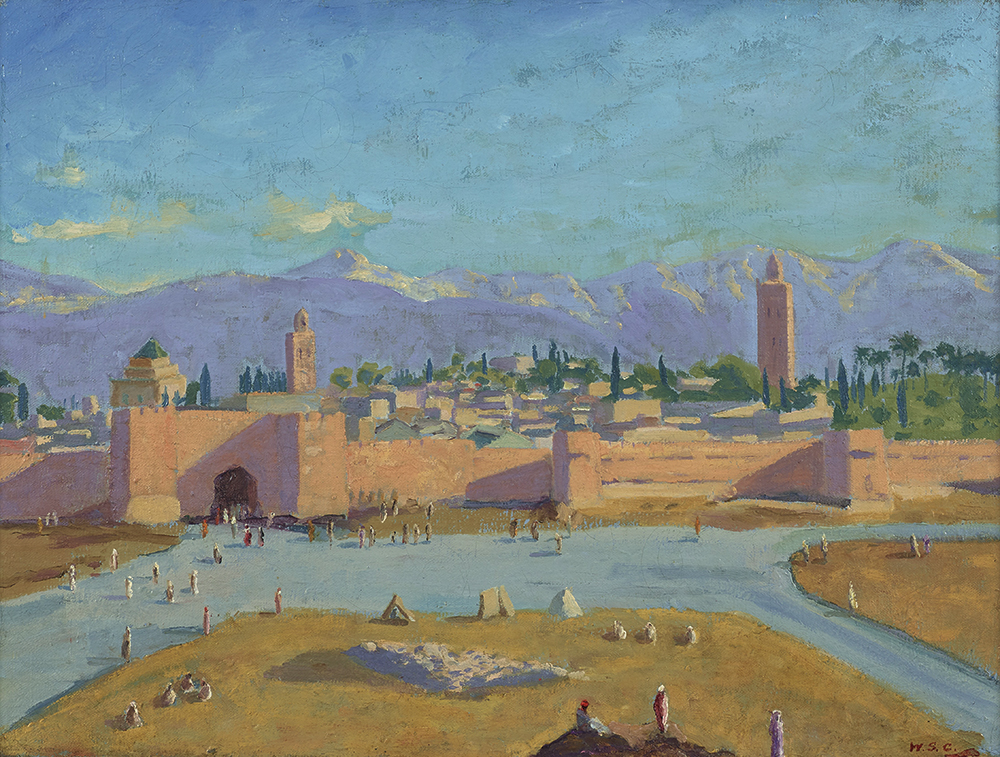
But there’s more affirmation: in 2021, the art market sat up when Christie’s offered Sir Winston Churchill’s “Tower of the Koutoubia Mosque” (1943). His only wartime work, it was a landscape painted in Marrakech after the Casablanca Conference, given as a present to Franklin D. Roosevelt, his ally in every sense. The work had found its way to the collection of Angelina Jolie (Brad Pitt himself had bought the painting in 2011 from a New Orleans antique dealer for what was then considered a punchy $2.95m), and it sold for a record-breaking $11.6 million.
Yet the Tate Collection, the main repository of British art, has just one work by Churchill (not on display) – and that was gifted by Sir Winston himself. And in 2015, when 37 of Churchill’s paintings were accepted in lieu of inheritance tax to the value of £9.4m, institutions didn’t exactly rush – the works that are accessible to the public are almost all at Chartwell, Churchill’s home in Kent, now run by the National Trust. Is it because there are fears about exhibiting work by a historical figure who has been seen as “controversial?” Or it is because Churchill was an untrained artist and curators think his works aren’t very good?
‘Churchill may not have been a great artist – and let’s be clear, he wasn’t – but his work is fascinating’
But the Wallace Collection, which contains magnificent works by artists such as Rembrandt, Titian, Velázquez, and Rubens, is bucking the trend. The gallery, set in the glorious Hertford House in London’s Marylebone, is mounting Winston Churchill: The Painter, the first major survey of Sir Winston’s works since 1959, a show that’s opening at a time when today’s world leaders are not getting great press. Dr. Xavier Bray, the director of the Wallace Collection told me: “It’s something I’ve wanted to do for 20 years. I can’t really predict what kind of public we’re going to get. Whether we’re going to have angry visitors saying why are you doing an exhibition of a painter who was never a professional? Or people who are really interested in the man himself?” My guess is there will be queues. With 57 works spanning Churchill’s career from his earliest works painted during the First World War to a final impressionistic seascape from 1965, the works are arranged both by theme and chronologically. It gives a sense of development in Churchill’s painting, but also a tantalizing insight into what was going on in his mind while he was orchestrating world events.
Churchill was a latecomer to the easel. After the catastrophic Gallipoli campaign of 1915-1916 in which more than 250,000 allied soldiers died, Churchill was made the scapegoat for the disaster in the Dardanelles. He was forced to resign his position as First Lord of the Admiralty, and shortly afterwards left the government into self-imposed exile, taking up a commission as a lieutenant-colonel in the Royal Scots Fusiliers. These were dark days. His family tried everything, including thrusting a paintbrush into his hands. Astonishingly, it worked. Being Churchill, he wrote about it. Looking back on his Damascene moment of art as therapy, he wrote in his 1921 treatise, Painting as a Pastime: “Painting is complete as a distraction. I know of nothing which, without exhausting the body, more entirely absorbs the mind. Whatever the worries of the hour or the threats of the future, once the picture has begun to flow along, there is no room for them in the mental screen.”
And being Churchill, he summoned the very best to help. Sir John Lavery, known for his accomplished portraits for society drawing rooms, was the first to be called up, and seemed only too happy to instruct Winston in the basics of painting, and allowed Churchill to watch him work in his lavish South Kensington studio. As Barry Phipps writes in the exhibition catalogue, “Lavery’s treatment of light and atmosphere left a lasting impression, inspiring Churchill to explore sunlight and shadow more boldly in his landscapes.” Lavery gave Churchill confidence – and was a gateway to other mentors: the equally celebrated artists William Nicholson and Walter Sickert. Nicholson, whom Churchill was particularly close to during the 1930s, the so-called “wilderness years” of Churchill’s career, taught the statesman to be less impulsive; to construct a composition with spatial clarity and to concentrate on tonal shifts. Sickert, whom Churchill got to know in the late 1920s, offered a contrasting approach. With his connections to the French Impressionists, the British modernist encouraged Churchill to be more expressive and intuitive and to paint with a broader brush, literally and figuratively.
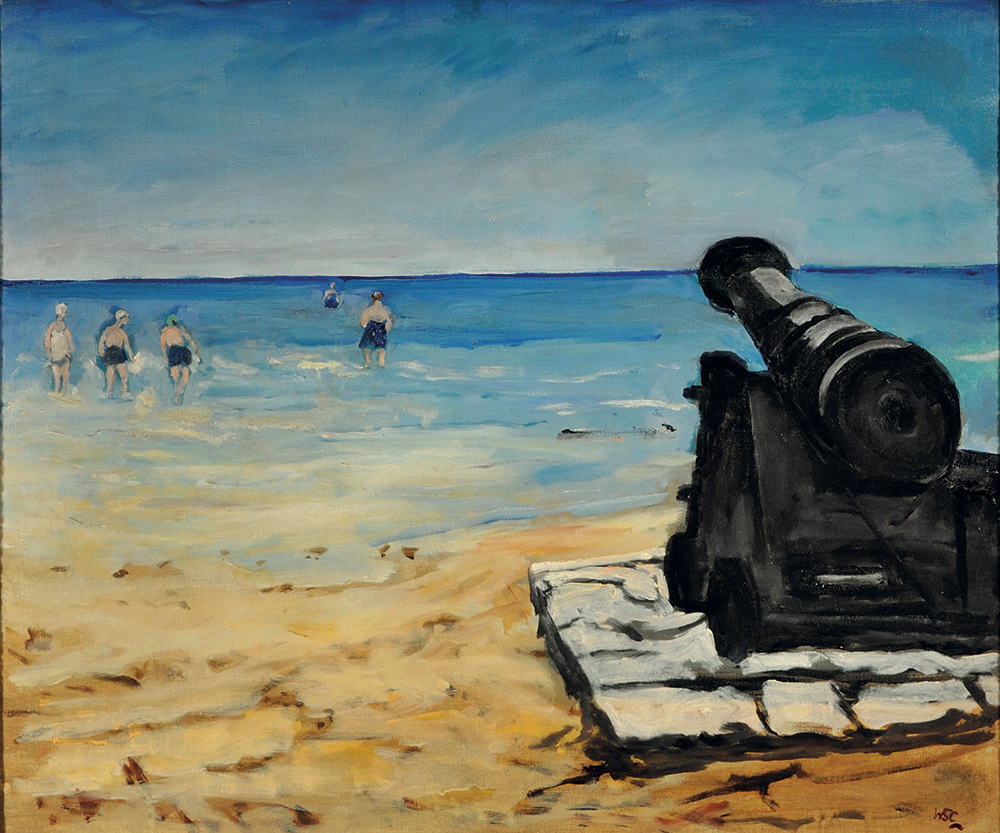
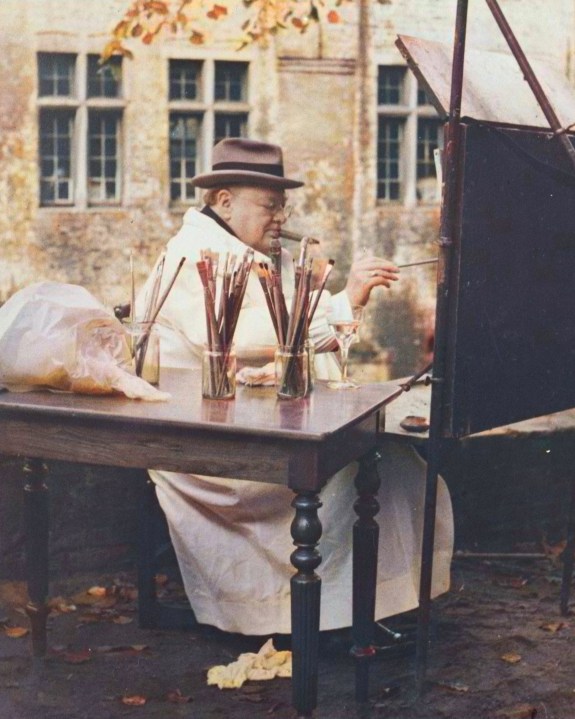
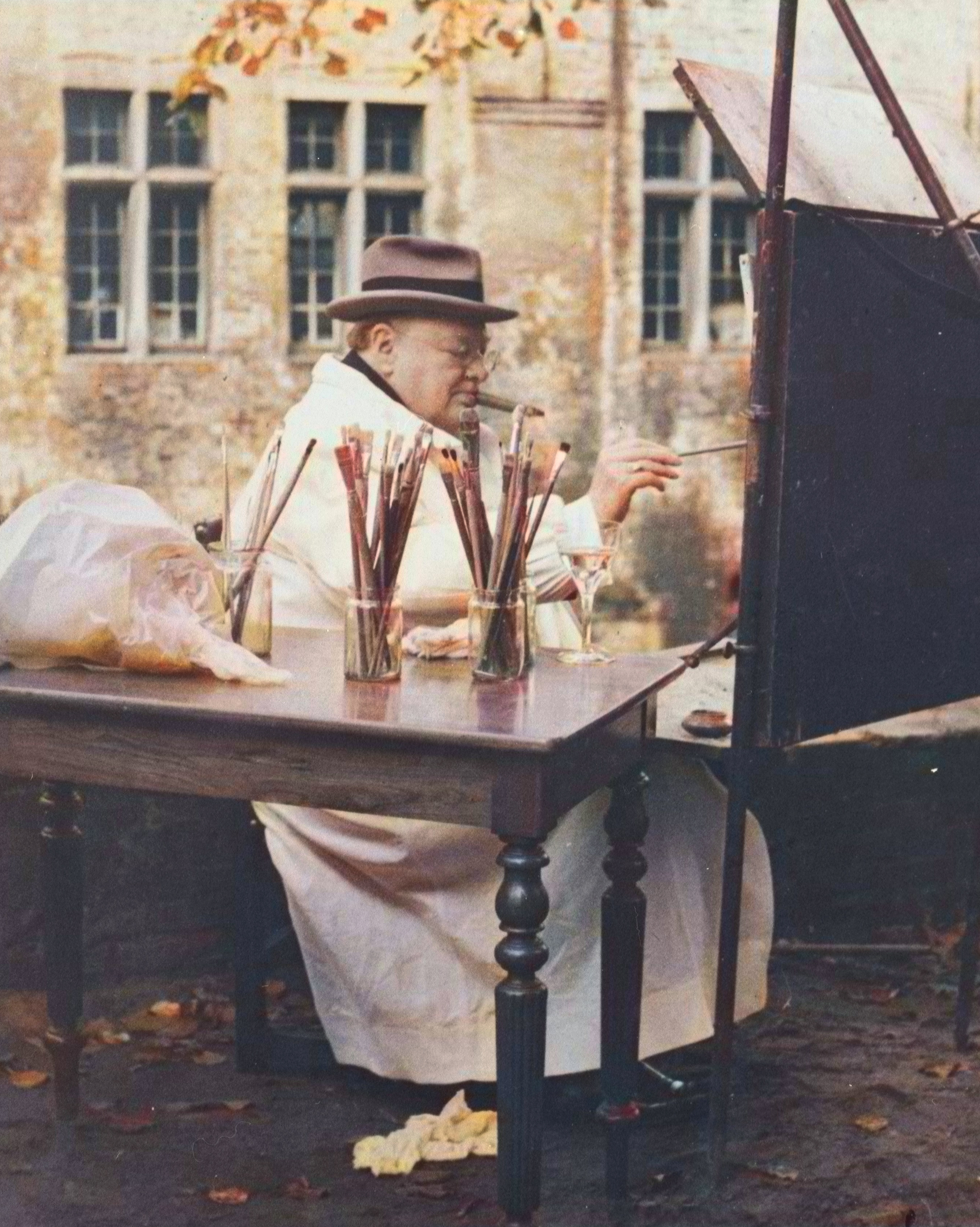
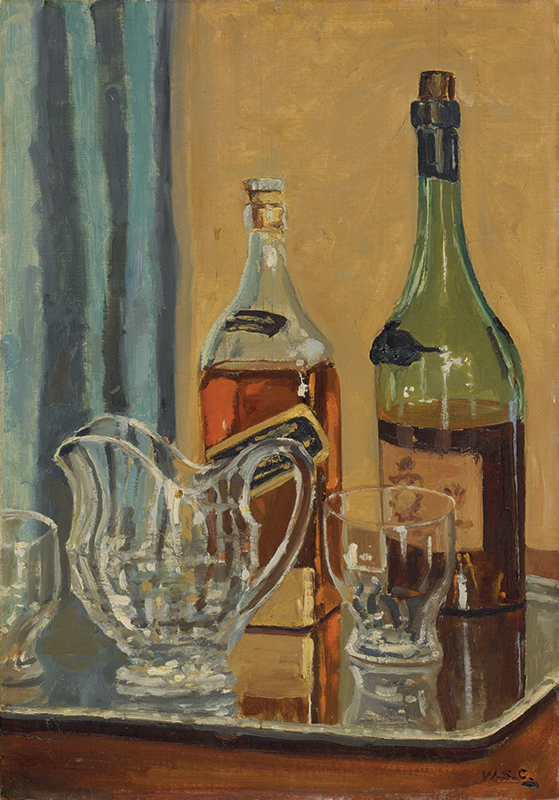
Most of the works are about, and painted in, the grounds of his beloved Chartwell, including “Winter Sunshine: Chartwell” from 1924, which Churchill submitted successfully to the Royal Academy’s Summer Exhibition, under a pseudonym. Chartwell was more than a home: it was a haven. In the 1920s, Churchill’s painting was regarded as a harmless hobby, alongside the champagne drinking, cigar smoking, and afternoon naps. He liked painting en plein air, and generally after lunch. He worked quickly – most canvases took around an hour and a half – and abhorred any interruption. Over the years, he acquired quite a lot of kit: his travel easels, paintbrush, and paint box – embossed with WSC on the lid – which were made to his specifications. He would also travel with a suitcase containing rags, trays of paint tubes, a folding sunshade, a Stetson painting hat, whisky (which he called “mouthwash”), and cigars. A valet or a bodyguard would squeeze out the colors in a proscribed order onto Churchill’s palette. He was not shy in making demands to get the equipment he needed, either. In 1950, a telegram was sent by his staff from Madeira where Churchill was on holiday: “Please send the tempera one of the latest tubes of each given by WillySax [sic] and one canister of white by aeroplane Friday.”
‘Art allowed him to anesthetize his nervous system. He fed the Black Dog paint’
When Churchill went as a house guest, hosts braced themselves for the inevitable gift of a largish canvas, often a view of their house or garden. But the paintings really came into their own as diplomatic gifts. The historian Andrew Roberts estimates that more than 70 were given as presents, including to three US Presidents (Roosevelt, Truman, and Eisenhower). Eisenhower was a particular admirer of Churchill’s painting and in 1958 he spearheaded a world tour together with Joyce Hall, the founder of Hallmark Cards. Lucy Davis, the curator of paintings and co-curator of the exhibition points out, “Churchill had been quite reluctant to have an exhibition of his paintings. He was very modest about them. But there’s a wonderful letter in the catalogue from Eisenhower urging him to do so, saying how much he was loved in America and that this was the moment for his paintings to be seen there. The exhibition traveled to North America – Canada and the USA – and then to Australia and New Zealand and was seen by more than 650,000 people.” Davis discovered in the archives that one work, a sketch of Lake Carezza, which features rapid brushwork and vibrant color only made it into the show because Clementine Churchill asked a bodyguard to hide it under the bed to stop Winston from overworking it.
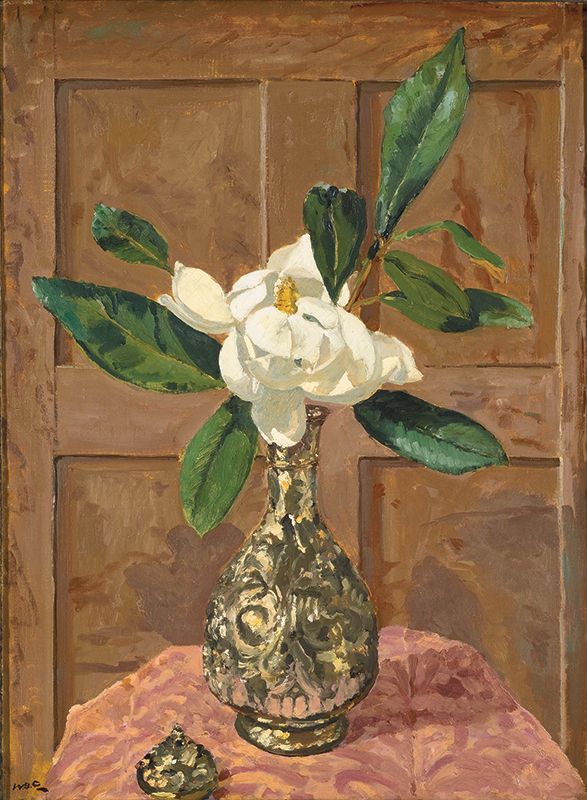
“As an artist, Churchill did have an achilles heel,” says Philip Mould, the gallery owner and Churchill expert who has made a documentary about the statesman’s work. “He had no formal training, and his figures are implausible and arthritic, but having said that, his landscapes show a remarkable fluency. Churchill had a talent for rhythm, mood, narrative, and the subjective response, and when it comes to color, he can occasionally do it really well. But is that the point? Churchill may not have been a great artist – and let’s be clear, he wasn’t – but his work is fascinating on many levels. For a start, it tells us about the great man himself. There’s no doubt that he regarded art as therapy. Churchill was a highly sensitive man – he could blub at almost anything – and art allowed him to anesthetize his nervous system. He fed the Black Dog paint. So no, he wasn’t a great artist, but when he could spend time on a particular work, it usually improved it considerably. He was a brave man and he tackled subjects head-on.”
Xavier Bray agrees. “I think you can see there is an underlying impatience in Churchill’s work, but you can also see he is trying to apply what he has been taught: how to mix color, how to structure a composition, and how to cover up mistakes. I think there’s a sense of his excitement about rippling of water. Some of his speeches have very visual comparisons which only somebody who loves nature would make. Painting must have informed his decision-making, but also his way of expressing himself. I find the works are imbued with Churchill’s enthusiasm and there’s great joy in them. And right now, we need happy shows.”
Winston Churchill: The Painter is at the Wallace Collection, London W1 until November 29; wallacecollection.org




Comments