
The 61st Venice International Art Biennale has just started and continues in “La Serenissima” until November. That much is certain. What happens at this artfest, though, is anyone’s guess. It’s been the rockiest, most highly charged Biennale this century – even before it started.
This year, the main exhibition, which sets the pulse for the Biennale, is In Minor Keys, conceptualized by the inspirational Cameroonian-Swiss curator Koyo Kouoh. Last May, just after delivering her vision for a show featuring 111 artists, including works by Carsten Höller, Alvaro Barrington, and Laurie Anderson, Kouoh died tragically and unexpectedly of cancer. However, she was able to map out the premise for the exhibition which focuses on the small but revealing elements in life. One thing that will be missing this year due to her untimely death is the Lifetime Achievement Award, as the choice is the prerogative of the show’s curator. And as if this wasn’t upheaval enough, there’s more.
But first some background. Since the dawn of the Biennale in 1895, the festival has been arranged along national grounds with each country responsible for filling their own dedicated pavilions that dot the Giardini (the Public Gardens) at the far end of the island. Because these mini embassies were created in the early 20th century, their size and placement reflect the old status quo. The British Pavilion looks down on all from a hill at the end of the main avenue, flanked at a lower level as if in a guard of honor by the pavilions of France and Germany. The structures themselves mirror national characteristics: Russia’s house is massive and looks suitably Slavic; the Scandinavian house is a minimal structure made of glass and wood. You get the picture.
The problem is now not a question of what goes in the pavilions, but if the country should be exhibiting anything at all. In 2024, Russia was a refusenik after the invasion of Ukraine, and its mansion left empty. This year, the Biennale organizers have allowed Russia to participate with a show of 38 artists, but this has resulted in the EU, which gives a substantial €2m subsidy to the event, threatening to withdraw funding from the Biennale as a whole. This is a first.
Just as in the world at large, there is trouble elsewhere. Not surprisingly, Iran is sitting this one out, as is Nigeria, and Israel is “having its pavilion refurbished” – not that this stops the country from exhibiting in another venue.
The problem is now not a question of what goes in the pavilions, but if the country should be exhibiting anything at all
Some countries have brought controversy upon themselves. Take the United States. The selection of the artist for the US Pavilion has traditionally been in the hands of National Endowment for the Arts (NEA), but that responsibility has now been transferred to the newly created American Arts Conservancy, run by former pet-food store owner Jenni Parido. According to The New York Times, when Parido, who has no previous experience in the art world, asked Jeffrey Uslip, a trustee of the American Arts Conservancy, to curate the US Pavilion, “he faced months of rejections when approaching candidates.”
But at last, they found Alma Allen! Born in Utah, but based in Tepoztlán, Mexico, the self-taught Allen creates abstract, organic-looking works from stone, wood, and bronze which, as the Whitney Museum wrote, “at first seem formally simple but which are then remarkably complex and beguiling.” Allen is not as high profile as many of the artists who have occupied the grand classical US Pavilion in recent years, such as Simone Leigh, Mark Bradford, and Jeffrey Gibson, but has exhibited at the Whitney Biennial in 2014. There are 30 works in the show.
Then there’s South Africa. Its pavilion will be empty. Why? The South African culture ministry has canceled artist Gabrielle Goliath’s non-verbal performance work after calling the piece a “highly divisive” tribute to a Palestinian poet. No other artist has been hired. Goliath’s performance will go ahead, but off site at a nearby church, Sant’Antonin. The Australian artist Khaled Sabsabi and curator Michael Dagastino were also dropped because of a film that featured 20-year-old footage of Hezbollah. They were reinstated after a very public outcry.
The British Pavilion features Lubaina Himid, who won the Turner Prize in 2017 and had a major survey show at Tate Modern in 2021, both landmark moments that were considered overdue. Born in Zanzibar but moving to the UK when she was a baby, Himid’s work is about race, identity, and collective cultural memory. Having been trained in theater design, her works are often three-dimensional and visually compelling – those who saw her piece “Naming the Money” (2004) in Entangled Pasts at the Royal Academy will remember how an orchestra of colorful cut-out figures filled one of the huge galleries. Will there be more of the same? Himid told the Guardian in February, “I always paint, so there will be paint. I’m interested in how surrealism meets the everyday, the space between a question and an answer.”
There is always what is known at the World Cup as ‘the surprise package’ – a show that takes the Biennale by storm
Over at the French Pavilion is Yto Barrada, an artist born in Paris but raised in Tangier, and who has “a multidisciplinary approach” often drawing on archives using photographs, writing, and sculptures. These days she has extended her practice into creating a garden – “The Mothership” – in Tangier. She calls this a sanctuary for endangered plants, and one of the byproducts is that she extracts dye from the roots which make her paint. Will we see a garden in the French Pavilion? That would be something.
The German Pavilion has a long history of bracing shows. It was designed in 1938 by Nazi Party member Ernst Haiger, and artists down the years have often focused on commenting on the history and design of the building itself. In 1994, Hans Haacke smashed the floor to pieces. In 2024, Ersan Mondtag created an abandoned home covered in industrial dust with performers wandering around, one naked, seemingly oblivious to the gawping audience. That was then, but this year’s show by Sung Tieu and Henrike Naumann investigates “hostility, violence, and paranoia” in institutional buildings. Do not expect any jokes.
There is always what is known at the World Cup as “the surprise package” – a show that takes the Biennale by storm. New Zealand did this in 2017 with Lisa Reihana’s astonishing panoramic video which featured the story of Captain Cook’s voyages in the form of animated wallpaper. Last Biennale, Egypt fielded the runaway hit with Wael Shawky’s film about an 1882 uprising against the British, using puppets. This year, who knows? That’s part of the challenge. Slovenia sounds interesting. It is hosting the Nonument Collective, an art and research group that focuses on a wooden mosque built by the Austro-Hungarian army during World War One for Bosnian Muslim soldiers. Now dismantled, the artists will evoke the structure through sound and sensory experience. Or will we be surprised by Scotland with two artists, Davide Bugarin and Angel Cohn Castle, who hail from the queer cabaret scene of Edinburgh? Apparently sound, costume, and celebration are involved and that sounds like fun. One pavilion that will be noticed is the Syrian Pavilion. Sara Shamma, who lives in Damascus, has created a 15m-high tower that evokes the tombs destroyed at Palmyra. Within this tower is a series of Shamma’s paintings, figures that hover in an otherworldly sphere. The work is accompanied by a custom-made scent.
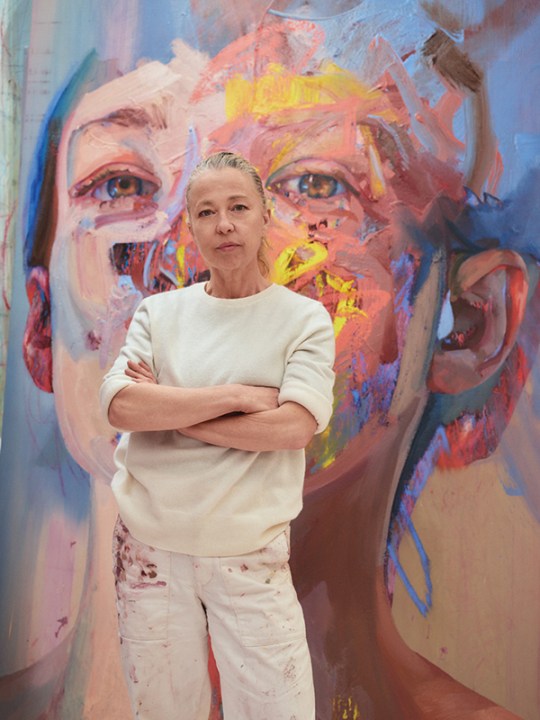
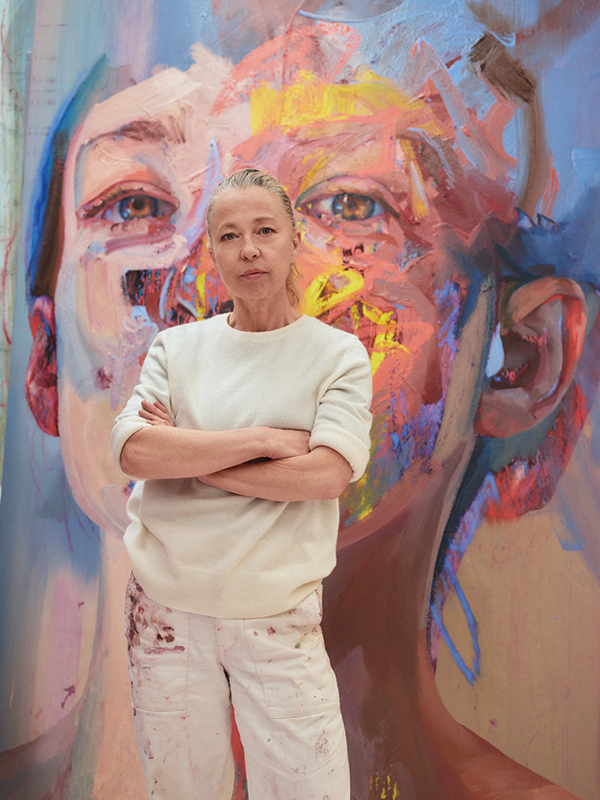
Venice Biennale is also an opportunity for major artists to have defining retrospectives in one of the city’s galleries. And these are the shows to go to if you want to see lots of paintings. British painter Jenny Saville has an exhibition at the Ca’ Pesaro that will run until November and is already attracting rave reviews. With 30 paintings which follow the artist’s career from 1990 to present, Saville’s vast canvases of human bodies with their exquisite rendering of flesh remind one of Willem de Kooning’s maxim: “Flesh is the reason oil paint was invented.”
As a counterpoint, Nairobi-born Michael Armitage has been given Palazzo Grassi for The Promise of Change (until January 10, 2027), an exhibition of more than 150 works. Armitage’s work, made on bark cloth which introduces an element of unpredictability, is immediately approachable. Its subject matter is compelling, the colors vibrant, but the narrative is slippery: he creates his world that might at first glance resemble ours, but which twists and turns in layers to show something more mysterious.
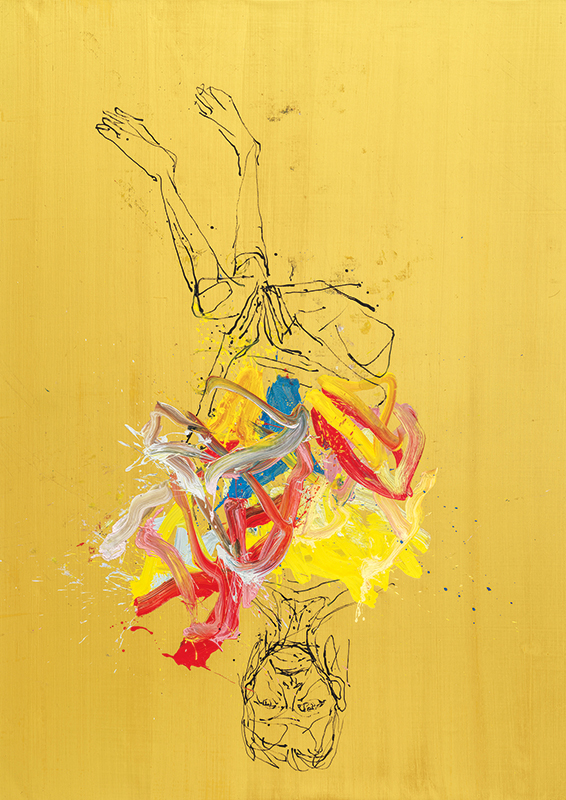
And Biennale time would not be complete without an Old Modern Master – this year, an exhibit of the most recent works by German artist Georg Baselitz, who very sadly passed away just days before the festival’s opening. The pieces (upside down, of course), appropriately painted gold ground and, according to Baselitz, a summation of all the works he has created over the years. The monumental, yet delicate, linear figures – almost a drawing – seem to float in the gold, while some have a patch of thick, gestural brushstrokes over the image. An unmissable coup de grâce.
The challenge, of course, is to avoid “Biennale Shame.” This usually occurs in the departure lounge when flying home. Someone – often in a group – will say, “Obviously the standout hit that altered my perception forever was [insert name of pavilion you didn’t even think of trekking across Venice to see].”
At least there’s YouTube.
The 61st International Art Exhibition of La Biennale di Venezia runs until November 22; labiennale.org




Comments