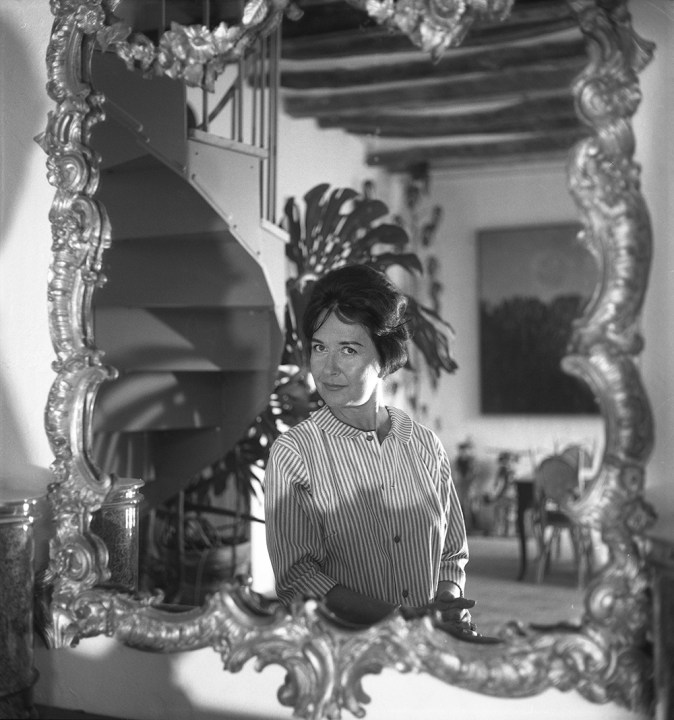
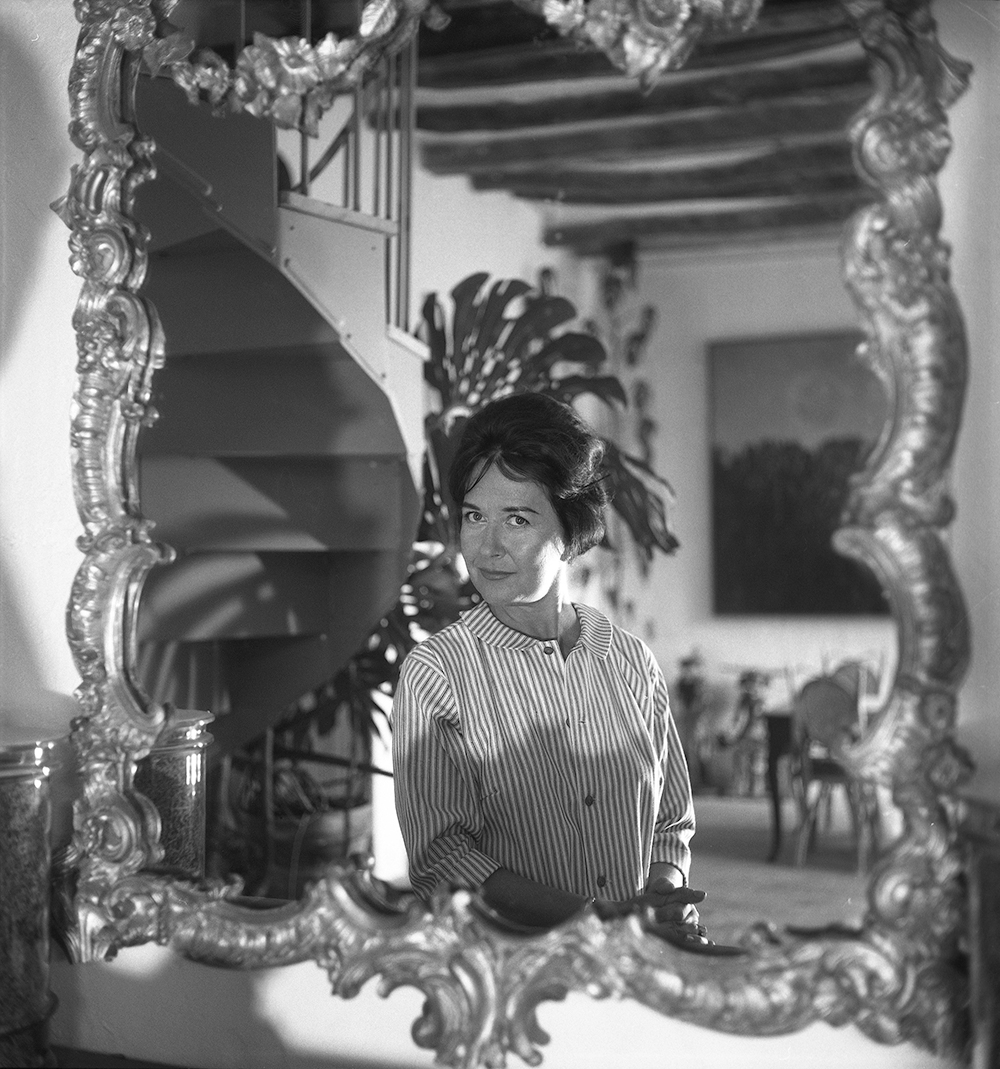
I received this book for review on the same day that Dorothea Tanning was making headlines in the auction world, breaking records with the sale at Christie’s of a tiny but key early work for more than £4 million. Her prices have risen an astonishing sevenfold in the past year, as collectors cotton on to her significance as a Surrealist; and while she may still be trailing on Leonora Carrington’s coat-tails, she looks to be steadily catching up.
Born in America to Swedish parents, Tanning was the very model of a fiercely independent artist, and her works are singular and disquieting like few others. She was largely self-taught as a painter and developed a virtuoso technique. Over seven decades, her restless desire to reframe our perception of the world through the Surrealist gaze led her from painting to sculpture, film and poetry, and from Chicago to New York, Arizona, Paris and beyond.

Her birth, perhaps appropriately, took place during a hurricane in Galesburg, Illinois, in 1910, an otherwise sleepy town in which ‘nothing happens but the wallpaper’, as she put it. Rebellious from an early age, she made it via Chicago to New York in time to catch the wildly successful 1936 MoMA Fantastic Art, Dada, Surrealism show, curated by the champion of modernism Alfred Barr, which showed her, she wrote, ‘the limitless expanse of POSSIBILITY’. The Surrealists were moving on from Paris to capture New York and Tanning was among their willing conquests.
She had to earn her living and found work as a commercial artist, but her Surrealist aspirations crept into her designs for ads and shop windows and by 1942 she was painting dreamscapes around the female nude charged with mystery and eroticism. She was taken up by Julien Levy, New York’s most influential dealer in Surrealism, and then, fatefully, by Peggy Guggenheim, whose husband Max Ernst fell instantly and irrevocably in love with Tanning, provoking much rage and bitchiness. Ernst and Tanning were inseparable, however, both sloughing off their respective spouses and marrying in 1946. It was a true meeting of minds as well as of fervour and talent; each artist gained inspiration from the other, and their practice thrived.
Partly to escape the vengeful Peggy and her circle, the couple made off to Sedona in Arizona, where the parched, red, rocky landscape and their encounter with Hopi Indians were fertile sources for their art. Surrealism had always challenged man-made boundaries and in Arizona the binaries of present and past and man and nature were dissolved. Tanning’s paintings, in particular, responded to a place where the sky was ‘a blue so triumphant it penetrated the darkest spaces of your brain’ and the vast desert offered visions of uncharted terrain.
The couple had many visitors, Lee Miller and Frederick Somner photographing their outpost life in a series of teasing images that capture the harmony of their partnership. Yet Tanning’s work from this period was anything but serene. Her iconography was, as ever, transgressive and ambiguous, drawing deep from the well of the subconscious. Alice Mahon’s discussion of its many meanings are nuanced and sophisticated, offering shrewd interpretations of works that set out to confound, unsettle and disrupt. In doing so she amplifies their poetic charge.
By 1942, Tanning was painting dreamscapes around the female nude charged with mystery and eroticism
A move to Paris followed in the early 1950s, where Tanning found herself inspired by the fabric of the war-torn city, its stained and graffiti-covered walls defying Walter Benjamin’s claim that the unfolding of the modern city could only be captured through film and photography. Her paintings became darker and more inscrutable, and after a move to south-east France with Ernst she turned to sculpture, fashioning fetish-like objects from fabric and wool, their anthropomorphic forms sometimes welded with furniture and walls. It’s tempting here to see parallels with Louise Bourgeois’s cloth sculptures. Tanning’s arresting and often alarming visual vocabulary conjures a raft of associations out of air, by turns playful and menacing.
She was fearlessly and defiantly creative to the end, resolving her concerns with the natural world into a late series of flower paintings that merge botany with landscape, alchemy and the erotic – a culmination of her search for poetic truth. She has certainly earned her place in the pantheon, and deserves this deeply informed monograph by the curator of the major exhibition on Tanning that toured from Madrid to Tate Modern in 2019.
It covers the art-historical terrain and much else with verve, and it is no fault of the author that Tanning remains a somewhat shadowy figure, only emerging into focus in extracts from her writings, which are acute enough to make one long for more. She was plainly remarkable, and both loved and fêted during her long lifetime (she died in 2012, aged 102). It remains tantalising that her unswerving dedication to the mysteries of the unconscious should render her, ultimately, as elusive as a sphinx.





Comments