Sculpture

The message behind the US pavilion at the Venice Biennale

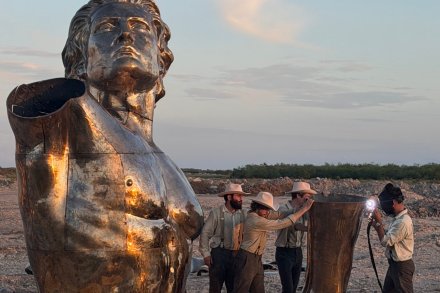
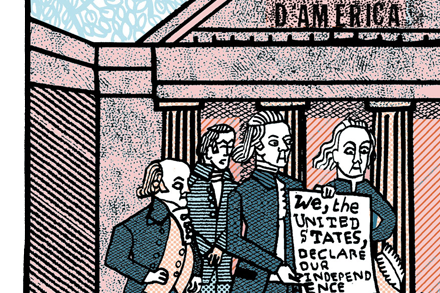
“All art is propaganda,” wrote George Orwell, “but not all propaganda is art.” Upon this subtle distinction rests the success or failure of whatever art we see at the Venice Biennale.  The Most Serene Republic’s exercise in art-world Olympics is propaganda by design. A garden of national pavilions – small buildings in various styles as you might find in a zoological park – presents exhibitions that compete with one another for a “Golden Lion for Best National Participation.” Here, in the murky parkland of the Giardini in the city’s eastern Castello district, nationalist and anti-nationalist passions mix with art-market imbroglio into a sordid spectacle. Just how bad will it be this year? To discover the answer is why we keep coming back.

venice biennale

Adieu, Dinosaur the pigeon

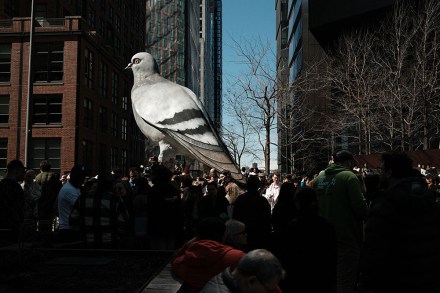
On one of the first warm Saturdays of this year, hundreds of New Yorkers flocked to the popular High Line, the railway-turned-public park that extends over 22 blocks of Manhattan, to bid farewell to a T-Rex-sized pigeon. The pigeon, cast out of aluminum and named “Dinosaur,” had been a resident of its elevated perch since 2024. As so many New Yorkers will tell you, though, part of what’s magical about living in this city is that the experience is often transient. In the words of Baz Luhrmann, you should “leave before it makes you hard.” There’s nothing worse than a hard pigeon and so it was that on that glorious day last month, I joined throngs of people eager to get one last look at the monstrous, departing bird.

Why is the Met making medieval art perverse?

Unwitting historians often reveal just as much – if not more – about their own time and place than the time and place they claim to describe. The curators of Spectrum of Desire: Love, Sex, and Gender in the Middle Ages, a new exhibition at the Met Cloisters, are prime examples. Gathering manuscript illustrations, paintings, sculptures, jewelry and more from the 13th to 16th centuries, the exhibition promises to uncover “the hidden sexuality and sensuality of medieval art.” The intent is “queering the past,” and the objects were chosen to show expressions of “desire” in as many forms as possible – a saucy premise that appeals to contemporary trends. But many of the new interpretations range from the woolly to the laughable.

met kinky

The brilliant, underappreciated work of Germaine Richier

In the spring of 1951, there was a commotion in Assy, a remote part of the Alps where France and Italy are only separated by mountains and valleys. In a town normally famed for its tuberculosis-healing properties and its winter sports, a debate about sacred art was beginning to make itself heard. After nine years of construction, the Église Notre-Dame de Toute Grâce du Plateau d’Assy was finally finished in 1946. A low, squat building, designed by architect Maurice Novarina and fashioned out of sandstone, it looked more like a chalet than a church.

Richier

Greg Lansky: the artist with a scandalous past

St. Paul points out that “all have sinned and fall short of the glory of God.” Despite that inclusive “all,” human nature inclines toward exclusion of the “other,” which is a very difficult thing for many of us to overcome — me included. Enter Greg Lansky, pornographic-film producer. Perhaps no one in recent memory has made a greater profit from the highly lucrative commerce paradoxically known as “adult entertainment” than Parisian-born entrepreneur Lansky. Within the span of about fifteen years, he went from dropping out of school and having few realistic prospects to making fortunes from adult media, partying with celebrities and receiving glowing profiles in magazines such as Forbes, GQ and Rolling Stone.

greg lansky

The human clay

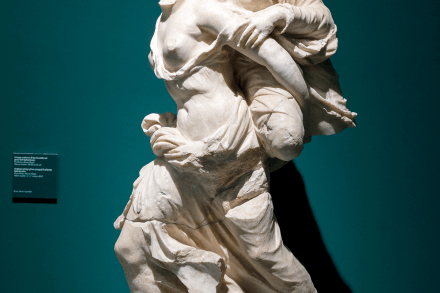
This article is in The Spectator’s March 2020 US edition. Subscribe here.The topics in The Necessity of Sculpture emerged randomly, thrown off by successive exhibition calendars and coming to range in time and place from ancient Mesopotamia to 21st-century Manhattan. As I made the selections, what began to take shape, beyond a conventional anthology, was a synoptic history of the art form. The title is a belated riposte to Ad Reinhardt’s famous dismissal, in around 1960, of sculpture as ‘something you bump into when you back up to look at a painting’.

sculpture

The insufferable wokeness of public art

In the middle of the 20th century, the Central Intelligence Agency executed a commendable troll against the American left. Long rumored to be a joke, documents released in the 1990s revealed that during the Cold War the CIA secretly funded and promoted some of America’s biggest contemporary artists without the knowledge of the artists themselves. It was art as weapon. The US aimed to showcase the intellectual freedom and creative superiority of Western, capitalist societies against the drab, inhibited propagandist art of the Soviet Union by broadcasting this wildly inventive style in vogue at the time. The CIA propped up artists like Jackson Pollock, Robert Motherwell, Willem de Kooning and Mark Rothko.

public art