Peter Hoskin

Last orders in the last chance saloon?

It's the set of headlines which Labour must have dreaded after their recent progress in the polls.  The Times: "The axeman dithereth ... but the taxman cometh".  The Guardian: "Darling soaks the rich ... and the rest of us too".  The Mail: "The Buck Passer's Budget".  And so on and so on.  It doesn't look too good inside the papers either.  The FT rails against a  "lack of clarity on public spending plans", while the Independent says that "rarely has a pre-Budget report promised so much and delivered so little".  The Sun's opposition may not be too surprising, but it's there in bucketfuls: "Britain is staring into the abyss. After yesterday's performance that abyss has got deeper.

Bad news for the country, bad news for Labour

Abandon hope all ye who enter here.  While we mostly knew what to expect from Darling's PBR, it's still surprising just how uninspiring, how thin and how insufficient it is in the flesh.  It's pretty much a bad news budget for anyone you could mention.  Bad news, of course, for the bankers who will be hit by the hazily outlined bonus tax.  Bad news for public sector workers, who are already smarting at the frozen pay rise they'll have to accept in a few years time.  Bad news for anyone who cares about the state of the public finances, which look just as grim, if not worse, as they did back in April, with no significant plan for recovery.

Pre-Budget Report live blog | 9 December 2009

Stay tuned for live coverage of Alistair Darling's statement from 1230. 1231, PH: PMQs is still going on.  Tune into David's live blog of that here. 1233, PH: Here's Darling.  One sentence in and he's already refering to the global crisis and "unprecedented action".  He adds: "The task today is to ensure the recovery and to promote growth."  1234, PH: One minute in, and it's already dividing line heavy.  "The choice is between going for growth or endangering the recovery ... investment ... cuts".  Yada, yada, yada. 1235, PH: Darling is pointing to signs of global recovery - US housing market stabilising etc.  Shame we're still in recession here. 1237, PH: Darling: "I'm confident that the economy will grow by the turn of the year ...

One thing to remember today

As you can probably imagine, plenty of Labour folk are getting excited about the PBR today.  They regard it as a chance for their party to harden their rise in the polls, and hasten the Tories' descent.  But Danny Finkelstein strikes a necessary note of calm over at Comment Central.  As he puts it, a Budget in which the government has to 'fess up to the horrible state of the public finances is hardly going to do much good for them.   To Danny's analysis I'd add one supporting fact: that rarely, if ever, in recent times, has the government received a significant poll bounce on the back of a Budget.  I blogged about this back in April, and Anthony Wells followed it up with an excellent post here.

One year on | 9 December 2009

Coffee House will be live-blogging Alistair Darling's PBR statement from 1230 on.  In the meantime, here's a brief video reminder of George Osborne's PBR response from last year – probably the Shadow Chancellor's finest moment at the Dispatch Box.

Ringfence-a-rama

Just watching Newsnight, and the show's economics editor, Paul Mason, has said we can expect several budgets to be ringfenced from spending cuts in tomorrow's PBR – hospitals, schools and perhaps even the social security budget.  If so, it's another sign of how political the document is set to be.  Ringfenced budgets are the other side of the soak-the-rich coin: sending out the twin message that Labour will batter the "City fat cats," while also "investing" in public services "for the many".  Just a shame that it's all insufficient to the scale of the debt crisis.

Clocking on

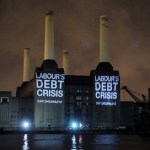
As publicity stunts go, the debt clock the Tories beamed onto Battersea Power Station this evening is quite a decent idea.  Their thinking's pretty clear – get some coverage in tomorrow's papers, and increase the likelihood that the horrendous state of the public finances becomes the story of the PBR – but it's probably no less effective for it.  Anyway, here are some pictures so you can judge for yourself: P.S. Yes, I know it's out of sync with the Coffee House debt counter. We're going to update our numbers on the back of tomorrow's PBR.

Darling contra Brown, Part 573

Ok, so tomorrow's Pre-Budget Report is shaping up to be a horrendously political affair.  But, rest assured, it could have been so much worse.  In what is, by now, a familiar Budget-time story, Alistair Darling is fighting the good fight against some of Brown's most inharmonious fiscal brainwaves.  According to Rachel Sylvester's column today, here are just some of the measures that the Chancellor has resisted: -- A long-term windfall tax on bankers' bonuses (Darling favours a temporary, one-year tax). -- A call to lower the 50p tax threshold from £150,000 to £100,000. -- A reversal of the plan to make it easier for couples to pool their inheritance tax allowances. -- A, ahem, "more optimistic picture of the British economy".

When did the Tories become an “alternative government”?

There are a couple of noteworthy snippets in today's FT interview with George Osborne: the claim that the Tories may not take corporation tax as low as it is in Ireland; the outline of a "five-year road map" on business tax policy, etc.  But, I must admit, it's this passage which jumped out at me:    "[Osborne] says his Tory conference speech in October, which included plans for a public sector pay freeze and an increase in the state retirement age, 'was an important moment' that showed a mental leap to being 'an alternative government, not just an opposition'." These self-bestowed titles – "alternative government," and the like – are silly, really.  The only thing that actually matters is whom the public regards as governing material.

The Lib Dems’ hunt for an issue may lead them to an Afghan pull-out

As Anthony Wells says over at his UK Polling Report, there are plenty of reasons to doubt whether Labour could convert a third of Lib Dem voters over to their cause.  But the article in today's Times on Labour's new strategy will still give Team Clegg pause for thought. The problem for the Lib Dems is that they haven't yet managed to hit on an attention-grabbing issue to make their own – their favourite, perhaps only, election strategy.  The cause of Parliamentary reform could have done the trick, but – beyond Nick Clegg's call to prevent MPs from taking their summer holiday – very few of the Lib Dem proposals have received much coverage.  Likewise, electoral reform, which Labour now seem to be comandeering for their own manifesto.

This week’s PBR looks set to be Brown’s most political Budget yet

Ok, so all Brown Budgets are political – but signs are that this week's PBR could be his most blatantly partisan yet.  I mean, just look at his speech this morning on improving efficiency in the public sector.  Some of its measures are welcome – for instance, pledging to cut the pay of senior servants, and the general idea of using technology more effectively in government.  But, as other folk have pointed out (see Guido and Iain Dale), the measures are insufficient to the scale of the debt crisis, and many are old news.  All in all, the signs are as we expected: Brown is paying only lip service to cuts. Instead, Brown is going to go heavy on soak-the-rich measures; thereby strengthening what Labour see as two dividing lines.

“A Hero for Europe”

This video, which some UKIPers have put together in honour of their former leader Nigel Farage, is comedy gold.  Problem is, I suspect it's unintentionally so...

How will Labour try to soak the rich?

Brace yourselves.  According to today's Daily Express, Alistair Darling is under pressure to introduce a new 70 percent tax rate for high-earners in next week's Pre-Budget Report.  I repeat: s-e-v-e-n-t-y percent. To be honest, I can't see the Chancellor doing it.  Leaping from 50p to 70p would be regarded as far too incendiary, not to mention fiscally insane, even for this government.  But I can still see them introducing a fair handful of soak-the-rich measures, if only to strengthen their reinvigorated attack line against the Tories. In which case, I refer you to Polly Toynbee's column from a few months ago, in which she recommended that the 50p rate start at £100,000 instead of £150,000.

The choice facing the Tories

If you'd like a step-by-step preview of Labour's next election campaign, then do read Alastair Campbell's latest blog post.  All of Brown's attacks from PMQs are in there, and then some: "tax cuts for the rich"; a lack of "policy heavy lifting" on Cameron's part; the Tories "haven't really changed", etc. etc.  The spinmeister has been in closer contact with Downing Street recently, and it shows.  It's all gone a bit bar-brawling. The Tories now face a choice between, broadly speaking, three different responses: i) Ignore Campbell.

Graph of the day

Here's a neat little graph from PoliticsHome, which plots the three main parties' opinion poll ratings alongside their "party morale rating" from the PHI100 tracker.  As PolHome put it, it kind of tells us what we know already: that party morale more or less correlates with poll position.

A PMQs to damage Brown?

A quick tour around the political blogoshpere, and it seems everyone is saying Brown came out on top in today's PMQs.  For what it's worth, I'd agree with them – but only to a point.  On the one hand, Cameron was unusually clumsy, which allowed Brown to land some pretty decent blows.  But, on the other, I suspect some of those blows won't play well on TV later.  And, let's not forget, the entire point of PMQs, from the leaders' perspectives, is to score some coverage on the Ten 'O' Clock News.   It all depends on what the broadcasters pick up on.  If it's Brown's gag that the Tories' IHT policy was "dreamed up on the playing fields of Eton", then it will hardly reflect well on the PM.

Burnham enters the fray

Oh dear.  The Labour leadership speculation is back in full effect, thanks to Paul Waugh's scoop in the Standard.  According to Paul, Andy Burnham is "prepared to throw his hat into the ring" to succeed Gordon Brown, should it all go wrong for Labour in the next election.  Apparently, he's even lined up Tessa Jowell as his campaign manager – although, naturally, the Health Minister is downplaying the claims. One thing's for sure: this story is badly timed for Labour – with their recent progress in the polls – and Brown could well do without another bout of leadership wrangling to undermine his premiership.  But what about Burnham – has he got what he takes to become Labour leader?

The good and/or bad news for the Tories is that there hasn’t been a Brown Bounce

If you're still scratching your head over the latest opinion polls, then I'd recommend you read Anthony Wells' latest post over at UK Polling report.  In it, he outlines four potential reasons for the diminishing gap between the Tories and Labour: Cameron's "reverse" over the Lisbon Treaty; increased economic optimism; Labour performing better; and the absence of positive feeling towards the Tories.  To my mind, it's probably a case of "all of the above," to varying degrees – but, as Anthony concludes, "we can't tell for sure." One further point that's worth making is that the reduced gap between the parties isn't due to a "Brown bounce".

Paranoia rather than camaraderie

Another one for the Brown as Nixon folder, courtesy of Rachel Sylvester's column today: "'It’s about style of government,' says one senior figure due to give evidence [to the Iraq Inquiry]. 'Blair would have a war Cabinet, but a small caucus would meet beforehand. The civil servants were frustrated. Gordon is just as bad. He gives lots of time to Peter Mandelson and Shriti Vadera and ignores the officials. There’s a darker side to the Brown machine — he’s more suspicious. It’s cliquiness driven by paranoia rather than camaraderie, but it has the same result.

The clock is ticking on Iran

When I visited Israel last year, various sources there were convinced – adamant, even – that Iran was within a year or two of creating an atomic bomb.  That may or may not have been the case, but it's still ominous that that hypothetical timeline is nearly up.  We can all too easily forget that, in the background to all the column inches and comment pieces expended on Iran, there are genuine and pressing concerns that the country is on the cusp of becoming a nuclear power. Which is why the two latest news stories from the country are particularly worrying: the capture of a racing yacht by the Iranian navy and Tehran's plan to massively expand its uranium enrichment programme.