Peter Hoskin

Is this Labour’s election slogan?

I wouldn't be surprised if this Gordon Brown snippet gets deployed ad nauseam between now and the next election: "[Brown] described Labour as the party of 'prosperity not austerity'" If so, it's worth noting that it's a phrase that Ed Miliband used in several speeches last year (e.g. here, here and here).  But, whoever its author, it's hard to imagine it working for a governing party which has presided over one of the most spectacular busts in our history.

Clegg keeps them guessing

Yesterday was all Labour, Tories, Labour, Tories.  So, today, enter the Lib Dems.  Nick Clegg has an article in this morning's Times which, to be fair, is actually quite noteworthy.  His main point?  That the Lib Dems are a party in their own right, and will not be engaging in "under-the-counter deals" with the Big Two: "This year’s general election is likely to be the most open and unpredictable in a generation. So you have a right to know where we stand. I can promise voters wondering whether to put an “X” against the Liberal Democrats that there are no backroom deals or under-the-counter “understandings” with either of the other two parties." You can see why Clegg is broadcasting this message.

Tories struggling to find a line on tax

After the platitudes in David Cameron's speech yesterday, comes the bluntness of Ken Clarke in today's Sunday Telegraph.  Interviewed by the paper, the shadow business secretary says that it would be a "folly" to rule out tax rises: "It is something that every Conservative tries to avoid but I didn't avoid it when I was getting us out of recession before. Coming out of a recession when you have such a severe deficit you can't rule out putting up taxes." He's right, of course.  The mammoth size of the deficit, and the lag before many spending reductions take effect, will mean that the Tories shouldn't rule out tax rises.  More than that, in fact: they'll certainly have to introduce them.  As we already know, plans are afoot to increase VAT to at least 20 percent.

Brown’s troubles are returning at just the right time for Cameron & Co.

First she loved him.  Then she hated him.  Then she seemed lukewarm towards him.  And, today, she's gone back to hating him more than ever.  Yes, Polly Toynbee's latest column is another marker stone in her oscillating relationship with Gordon Brown, and it doesn't contain any minced words: "Cancel new year, put back the clocks and forget the fireworks. There is nothing to celebrate in the dismal year ahead. The Labour party is sledging down a black run, eyes tight shut, the only certainty the electoral wall at the bottom of the hill. In five months David Cameron will be prime minister and Gordon Brown will be toast. Remember him? The man who crashed his party. Remember them? The death-wish brigade that let him do it.

Thinking the unthinkable

Woah, hang on there. A Labour and Conservative coalition in the event of a hung Parliament? Crazy talk, surely? But that’s what Martin Kettle devotes his column to in today's Guardian. It’s only unthinkable, he writes, “until you start thinking about it.” Hm. So rather than dismissing the prospect out of hand, I thought I’d register one particular complaint against it. While many of Kettle’s arguments about the fracturing of the party system and the blurring lines between the main parties make sense, the idea that they might coalesce in the aftermath of this year’s election ignores one crucial factor: the Labour leadership.

The year in cuts

As we’re still in that period of the year for looking back as well as forward, I thought I’d share with CoffeeHousers a political timeline I put together. It’s not everything which happened in the political year, mind – but rather the important events in the debate over spending cuts. This debate has, at very least, been in the background to almost every political discussion in 2009, and it will dominate the years ahead – so this kind of exercise probably has some posterity value. But, aside from that, you can also draw a couple of conclusions from the timeline (and I do so below).

Brown kicks off 2010 with dividing lines aplenty

Clear your diary, invite the relatives over, and huddle around a computer: Gordon Brown will be delivering his New Year’s message – via podcast, on the Downing St website – this evening. Just in case you’ve got other things to be doing, this article in the Telegraph gives you a good taste of what to expect. In summary: dividing lines and optimism. There’s plenty on how the Tories are planning for “a decade of austerity and unfairness” – in contrast to our glorious PM, who predicts falling unemployment, more new businesses and prosperity for all. Indeed, the snippets that the Telegraph carries indicate just how eager Brown is to deploy a green shoots strategy.

It’s not just the bankers who will be hanged

Oh, Darling, what hast thou done?  There are few more pertinent, or more damning, examples of what the government’s soak-the-rich policies could mean for the country than the news that JP Morgan is having second thoughts about developing a £1.5 billion European HQ in Canary Wharf.  Of course, the bank may still go ahead with it.  But just imagine if they don’t: the work lost for construction workers and a thousand other contractors; the tax revenues lost for the public finances.  The damage won’t just – or even mostly – be to the financial sector. Thing is, I imagine that Number Ten will be fairly happy with the story.  As the Ephraim Hardcastle column demonstrates today, Brown & Co.

Overlooked books of the decade

As I say in the intro to my selection of the decade's "overlooked" books for The Daily Beast, this kind of list is a tricky little customer.  Not only will you omit some title which really, really oughta be in there – but just what makes a book overlooked in the first place?  Do you include a Martin Amis (as I did) because it feels overlooked in comparison to his other work?  Or is any Amis, by definition, not overlooked?  Anyway, to see how I, erm, wrestled with these problems – and to see which books I picked – just click here.

What will 2010 mean for Iran?

If you're looking ahead to 2010, it's a safe bet that Iran is going to be an even bigger issue than it was this year.  The violence currently rocking the country is an echo of June's presidential election, and a reminder, too, of the continuing internal pressure that the Iranian regime faces.   The question now is whether that will be joined by external pressure of some form.  After provocation after procovation on Tehran's part, it's hard to envision the West keeping its "hand of friendship" outstretched much longer.  But it's also unlikely that  Barack Obama – his eyes on the domestic polls – will want to talk too tough after committing 30,000 more troops to the unpopular Afghan conflict.

Balls’s election strategy is a hostage to Osborne’s pen

Make a note, CoffeeHousers: Labour won’t be fighting a class war against the Tories, after all.  That’s what Ed Balls tells us in this morning’s Times – so it must be true, mustn’t it?  Erm, well, perhaps not.  This is how the Schools Secretary continues: “‘David Cameron’s and George Osborne’s vulnerability is not their schools or their background but that they are prioritising tax cuts for the richest estates ahead of spending on the key public services,’ he said. ‘They have designed an inheritance tax policy which costs billions but which won’t benefit a single lower or middle-income family in Britain but will benefit themselves and a tiny percentage of other individuals.

Willetts takes on the nudgers

The Guardian’s interview with David Willetts is a decent preview of the Tories’ forthcoming green paper on family policy, and is neatly summarised by Jonathan Isaby here. Although I have my doubts about some Tory thinking in this area, there are a few encouraging ideas in there – such as relationship guidance schemes modelled on those provided by the Bristol community family trust.

Those split stories just won’t go away…

A hefty one-two punch in the continuing "Have Gordon and Peter fallen out?" story, this morning.  The Telegraph has quotes suggesting that Mandelson is "upset" and feels "disposed of" by Brown.  And Sue Cameron of the FT details a specific rift between the pair, ending with the observation: "I hear Lord M is not happy, telling friends that he does not have the influence he was promised."  For his part, Mandelson has since dismissed the reports as "complete tosh". Problem is, for Downing Street, the truth of the stories is almost immaterial.  After a relatively stable few months, Brown is once again mired in rumour and speculation concerning his own leadership.  Indeed, the Telegraph reports a potential Miliband challenge on the back of its Mandelson story.

Will this be the game-changer that Brown needs?

So there we have it.  There will be televised election debates between the three main party leaders during the next election campaign, after all.  The first will be on ITV, then there'll be one each on Sky and the BBC.  Talk about good TV for political anoraks. Like Tim Montgomerie and Mike Smithson, I suspect that Gordon Brown and Nick Clegg will be happiest with the news.  Both of them, particularly Brown, need potential game-changing events like this to make some progress in the polls.   As for Cameron, he'd probably be better off not giving his opponents a chance to make inroads into the Tories' poll lead.  But he could hardly have resisted live debates in the current political climate.

Simple but effective?

It's the most straightforward dividing line the Tories could draw: "Tories good, Labour bad".  But it's still striking to see it deployed quite so bluntly as in George Osborne's Telegraph article this morning.  His point is that four more years of Labour will lead us to ruin, whereas a Conservative government would pull us out of the mire.  Here are some snippets: "Down the path of least resistance lie economic decline, higher interest rates, high unemployment, and more social breakdown. This is the path down which a cynical and exhausted Labour Government tempts us. But there is another path that leads to lasting recovery, rising prosperity, social responsibility and a new way of doing things. ... If Labour get in again, that won't happen.

Slightly surprising stat of the day

According to a YouGov poll in tomorrow's People (reported by the paper's political editor, Nigel Nelson, on Twitter): "1% more people would rather have G.Brown than D.Cameron round for Christmas dinner." There's better news elsewhere in the poll for the Tories: the gap between them and Labour is back in double digits.  It's the Tories on 40 percent, Labour on 28, and the Lib Dems on 18.

The dangers with a Tory policy blitz

Sounds like the Tories are going to go policy-heavy in the New Year.  According to this morning's Times, Team Cameron are going to publish a "draft election manifesto" around 4 January, which will – as James revealed in his political column this week – set up a "policy-a-day blitz" throughout the rest of the month.  There will also be a separate policy release "showcasing the party’s commitment to the NHS".  The thinking is that all this will regain some momentum for the party, as well as answering the charge that the Tory operation lacks substance. Question is: will it work?

The case for John Hutton as a New Labour hero

Ok, so identifying the heroes of the New Labour era may not sit well with CoffeeHousers - but I'd still recommend you read through the latest Bagehot column in the Economist, which does just that.  It identifies five figures from the past 12 years who have "done the state and country some serious and lasting service," and whose "virtues [are] not be clouded or cancelled by grave mistakes or misdemeanours".  They are: Lord Adonis, Donald Dewar, Lord Mandelson, Sir William Macpherson and Robin Cook.  James Purnell, Alistair Darling and, strikingly, Bill Clinton finish in the runners-up list. You can debate the merits and demerits of those names all day long, but I'd rather suggest another person for the list: John Hutton.

Festive cheer

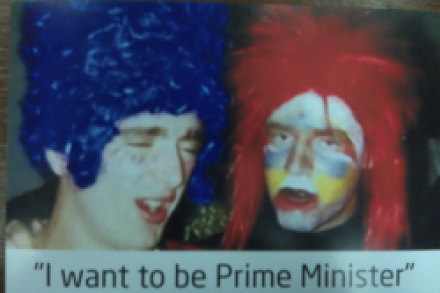
Well, Nick Clegg's reponse to the Labour chief whip's Christmas card made me smile: "Both myself and Nick Brown have good reason to be embarrassed. I posed for pictures in ridiculous fancy dress 20 years ago - and he is an MP for the Labour Party.

And so it rumbles on…

Expenses, expenses, expenses.  This morning's Telegraph splashes with the news that the junior culture minister Sion Simon paid over £40,000 in taxpayers' cash to his sister.  How so?  Well, he rented a London flat from her between 2004 and 2008, and claimed against it as his "second home".  Problem is, the practice of renting a property from a family member at taxpayers' expense was banned in 2006.  Simon has since said he'll pay back the money that he "inadvertently" claimed. Aside from the fact that it's yet another example of, at best, gross error on a politician's part, two other details stand out.