Peter Hoskin

Welfare dominates Osborne’s speech

George Osborne delivered everything we expected, and then some. This was a confident and wide-ranging speech from a Chancellor who has suddenly discovered a central message: what's right about burning £120 million of taxpayers' cash in debt interest payments every day? Wouldn't it be better to get to grips with that waste as soon as possible? And that message percolated down through everything from his attack on Ed Miliband to his case for reforming our public services. "It's like a credit card," Osborne growled, "the longer you leave it, the worse it gets." But if that was the theme of Osborne's symphony, then the motif was certainly welfare.

Osborne takes to the stage, armed with cuts

Rewind the tape to last year's Tory conference, and David Cameron was assuring us that, "It will be a steep climb. But the view from the summit will be worth it." Today, it falls to George Osborne to tell us more about both the arduousness off the ascent and the beauty of that view – although I expect that there will be a heavy empasis on the former. Already, the main passages are spilling into the papers and, as you'd expect, it's mostly cuts and debt. On that front, the main argument seems to be similar to that made by Nick Clegg in Liverpool: that the longer it takes us to pay down our debts, the more money we waste thanks to interest payments and the like. Or as Osborne will put it, "Delay now means pay more later. Everyone knows it's the most basic rule of debt.

OBR Watch

When Sir Alan Budd was head of the Office for Budget Responsibility, there was an insistent argument in opposition circles that the independent body was biased in favour of the coalition. Much of this cented around the OBR's growth predictions. How on Earth, came the question, can growth hit 2.3 percent next year and 2.8 percent the year after? Isn't that a bit optimistic in view of all the warnings about a double dip? Won't the cuts stifle growth? And so on and so on. A few months ago, I produced a graph which showed that, when compared to a range of independent forecasts, the OBR's growth predictions weren't really optimistic at all.

The Coulson story returns (again)

Call it a professional hunch, but I suspect the Tories won't be too pleased that this Guardian story has come out on the first day of their conference. It's about Andy Coulson – and, much like the revelations in the New York Times Magazine last month, features one of his former colleagues alleging that Coulson knew all about the telephonic subterfuge going on at the News of the World. That journalist tells Channel 4's Dispatches that: "Sometimes, they would say: 'We've got a recording' and Andy would say: 'OK, bring it into my office and play it to me' or 'Bring me, email me a transcript of it.'" It's evocative stuff, but – as before – I imagine it's also unprovable. In which case, the Tories will probably just ignore it.

Cameron sets the mood for Birmingham

It's that time of year again: Conservative Party conference. And with it comes wall-to-wall David Cameron. Our PM has a couple of interviews in the newspapers today and, to accompany them, he slotted in an appearance on the Marr show earlier. In all three, he hops neatly across the all same lily pads – spending cuts, IDS's historic benefit reforms and the defence budget – making the points and arguments you might expect. Yet two snippets stand out, and are worth pasting into the scrapbook. First, Cameron's claim on Marr that, "We have got to ask, are there some areas of universal benefits that are no longer affordable?

We need your vote

To celebrate 25 years of The Spectator/Threadneedle Parliamentarian Awards, we invite you to nominate the best MP of the past quarter-century The question hangs in the air: what makes a great parliamentarian? And the answer echoes back: many things. A great parliamentarian may be a swashbuckling orator whose rhetoric never fails to draw blood. He or she may be an energetic campaigner, striving on their constituents’ behalf for a new hospital or school. He may be a crumpled backbencher who upholds the tenets and conventions of their party. He may be a thinker, a gambler, a rebel or a ham. A gilded few might claim with some justification, ‘I am all of the above.

Self-awareness

Will Self loves to go a-wandering; this much we know. For the past few years, he has followed the lead of authors such as Iain Sinclair, and undertaken huge, looping walks around city and country, before writing about the experience afterwards — in his case, in a column for the Independent. This ‘psychogeography’ (for such is it called) is meant to be an exercise more for the mind than for the legs. The dedicated psycho- geographer stomps across ground that is soaked in human interaction, history, myth and potential. His pen seeks out the significance in it all, cosmic or otherwise. And so we arrive at Self’s latest book, Walking to Hollywood — whose title tells you everything and nothing about its contents.

What to make of Warsi’s electoral fraud claim?

Exactly as the headline says, really. Interviewed by Mehdi Hasan in this week's New Statesman, Sayeeda Warsi claims that the Tories "lost" at least three seats in the election because of electoral fraud. The article observes: 'This is the first time a senior minister has made such a blunt and specific allegation about the impact of electoral fraud on the general election result. Can she reveal the names of those seats? 'I think it would be wrong to start identifying them,' she says, but adds: 'It is predominantly within the Asian community. I have to look back and say we didn’t do well in those communities, but was there something over and above that we could have done? Well, actually not, if there is going to be voter fraud.

Cameron road tests his anti-Ed message

After Fern Britton's triumph over Gordon Brown a couple of years ago, we should know that This Morning interviews can have a certain bite to them. But if you needed more convincing, then how about David Cameron's appearance on the show this morning? Lurking behind all the talk of baby Florence and the Obamas, was a sprightly discussion of both defence cuts and the new Labour leader. Cameron was combative on both. Most noteworthy were Cameron's attacks on Ed Miliband. I imagine they will set the template for how the anti-Ed operation is conducted in future. The main aim, it seemed, was to defuse Miliband's talk of an optimistic New Generation – a woefully specious phrase, to be sure, but one that some Tories fear might gain traction.

When Brown beat Blair in an election

With the merry dance of shadow cabinet elections upon us, it's a good time to look back on the last time Labour went through all this. There's a useful list of all the results from the 1992 Parliament here, but here's my summary of some of the more eyecatching outcomes: 1) Gordon Brown, from hero to zero (to Chancellor). In 1992, Gordon Brown came top of the shadow Cabinet rankings. By 1996, he had dropped to 14th. And bear in mind that the number of MPs standing fell from 53 to 26 over the same time. As we all know, though, he still made it to the Chancellorship.   2) Blair less popular than Prescott.

Farewell David Miliband

There we have it, David Miliband has announced that he is standing down from frontline politics. In his statement just now, he fluted all the anticipated notes. "The party needs a fresh start from its new leader," he started, before adding that, "I genuinely fear perpetual, distracting and destructive attempts to find division where none exists, and splits where they don’t exist, all to the detriment of the party." He said he will stay on as an MP, although he wants to do further work in the areas of education, the environment and foreign policy. It puts something of a fullstop under his career at the top of the Labour party, although I'm sure that new paragraphs will be written in future. How will he be judged? With a mixture of respect and mockery, I expect.

Balls spills the beans

File David Miliband's decision not to stand in the shadow Cabinet elections in the folder marked "Worst kept secrets in Westminster". Here's what Ed Balls has just told ITV: "I don't think David Miliband is leaving because of reasons of politics or ideology or policy. I don't think this is a political divide, I think this it's a personal decision. He's decided, and it seems he's decided in the last few days if he has, that for personal reasons he doesn't want to serve with his brother. I understand that because it must have been incredibly difficult to have lost to your brother in that way ... If as a brother you've decided that it's too difficult I think people would understand that. I don't think it's fair to find some big political split or divide here.

Liam Fox does a David Miliband

At least the political fates have a sense of humour. No sooner had David Miliband's frustration screamed into view last night, than the Tories were hit by a story that was similar in several regards: the leaked Liam Fox letter, expressing his anger over spending cuts. Here are a handful of those similarities: 1) Leakage. David Miliband's words for Harriet Harman were meant to be for their ears only, but the TV cameras picked them up. Similarly, Fox's letter was meant to be between him and the PM – but now it's splashed across the front page of the Telegraph. The only difference is that the Fox letter has been put out by someone in Whitehall, a politically interested actor.

David Miliband torpedos his brother’s big speech

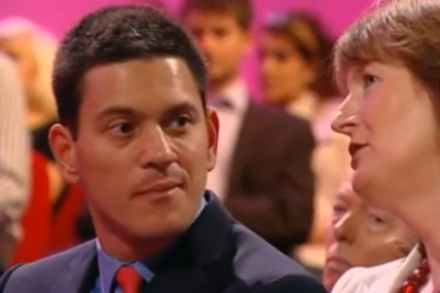
Make no mistake: David Miliband has handled himself with a fair amount of dignity over the past few days. But now some of his frustration has simmered to the surface. ITV news cameras were trained on him earlier, and caught him leaning towards Harriet Harman as she applauded his brother's claim that the Iraq War was "wrong" (see from two minutes into this video). According to the lipreaders, he says to her: "Why are clapping? You voted for it." To which she replies, "I'm clapping because he's leader and I'm supporting him." The elder Miliband does not look impressed. To be honest – and although I didn't support the Iraq War myself – I feel some sympathy for his position here.

Ed Miliband’s speech: neither here nor there

Where are Ed Miliband's editors? If twenty minutes had been lopped off that speech, then it might have been quite a decent little number. As it was, it dwelt too long on the past at the beginning; it hit all of its high notes in the middle; and sagged again during an protracted conclusion. Maybe if David Miliband doesn't stand for the shadow cabinet, he might be persuaded to stick around and at least fine-tune his brother's speeches. As for what we learnt about the MiliE leadership, most of it was presentational. The phrase "new generation" popped up with machine gun regularity, as did words like "optimism" and "change". This was all about setting himself apart from New Labour – but not too much.

Ed Miliband’s speech: live blog

1522, PH: We'll leave it there. More reaction on Coffee House shortly. 1520, PH: And there's the closing summary. He manages to squeeze "new generation" and "optimists" in several times. Then, a standing ovation, natch. 1519, PH: Weird blip as Miliband says that he wants to take on "David ... Cameron". Did he have another rival called "David" in mind? 1518, PH: A bit of life to the speech now, as Miliband takes on the Red Ed label. "Come of it," he swipes, "let's debate the issues that matter to Britain." 1518, FN: A huge sigh of relief in Tory HQ, I suspect, as he says he supports Ken Clarke's plans to cut prison numbers. "I'm not going to say he's soft on crime". Blair, I suspect, certainly would do.
Behind the times

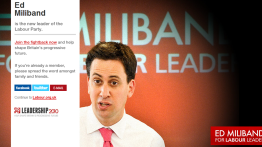
Anyone who isn't interested in political party websites look away now. For both of you remaining, then it's worth adding to Ben Brogan's observation about Labour's site. The photograph of Ed Miliband that greets you upon clicking here isn't the best, he notes (perhaps MiliE should have used this image instead). But there's more: at time of writing, the pages for the leadership election are still available, and Harriet Harman is still logged as the leader of the Labour party. These are only small faults, sure. No doubt it will all be fixed in the next couple of days.

Forcing an apology

Admittedly, this is but an item of marginalia in the notebook of British politics – but I'd appreciate CoffeeHousers' views on it nonetheless. I'm talking about the Tories' efforts to squeeze an apology out of Labour for the state of the public finances. This is something that they've been trying to do since the election, but the strategy has been reheated in the aftermath of Ed Miliband's election. As Sayeeda Warsi put it on Saturday, "what I noticed in his acceptance speech was that there was … no apology for the role that he had played in the current economic mess." Other Tory folk have called for that to be put right. I'm inclined to take a dim view of this.

The IMF delivers a boost for George Osborne

The proclamations of economists and economic bodies shouldn't be taken as the be-all-and-end-all of fiscal policy – for every one claiming that a decision is right, you can find another insisting that it is wrong. But the coalition will still be pleased by the influential International Monetary Fund's latest report, here. It begins: "The UK economy is on the mend. Economic recovery is underway, unemployment has stabilized, and financial sector health has improved. The government’s strong and credible multi-year fiscal deficit reduction plan is essential to ensure debt sustainability. The plan greatly reduces the risk of a costly loss of confidence in public finances and supports a balanced recovery.

The speech that David Miliband would have given on Saturday?

Caveats about positioning after the event, of course, but Andrew Pierce's account of the speech that David Miliband would have given on Saturday is still worth noting down: "You could have heard a pin drop in the conference hall when the new Labour leader delivered his acceptance speech. Far from being triumphalist, he issued a stark and unwelcome warning that shocked the Party: it had to change, or lose the next election. Only minutes after the applause had died down on Gordon Brown’s valedictory address, his successor savaged Brown’s record as Chancellor and Prime Minister. He mocked the claim that Labour had ended the cycle of boom and bust.