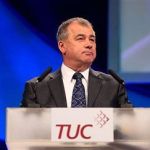
Peter Hoskin

Slapping down the pact

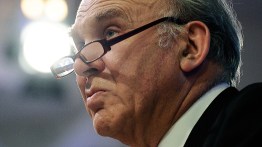
Here's one of the most striking leitmotifs of the Lib Dem conference: how party figures are rushing to slap down talk of an electoral pact between themselves and the Tories. Vince Cable was at it yesterday, writing in the Independent on Sunday that: "Our parties remain totally independent and will compete in future national and local elections." And Nick Clegg is expected to repeat that message, with even less equivocation, in his speech today. To some extent, this isn't surprising. The Lib Dems could hardly go around beating the drum for a pact, some five years before polling day. But the 100 percent certainty of their denials still jars with the "no plans" ambiguity of No.10 on this issue.

The Lib Dems’ Scottish question

If you're looking for a spot of LibCon strife that might actually mean something, then how about Tavish Scott's interview in Scotland on Sunday? Judging by what he says about David Cameron, the leader of the Scottish Lib Dems clearly isn't one for coalition niceties: "I suspect that (David Cameron) doesn't even think about Scotland. It is not even remotely on his radar screen. He has a Scottish Secretary, and that's that." With the Scottish general elections drifting into view, there's little doubt that Scott is dissociating his Lib Dems from a Tory party that is unpopular and – as Alex has frequently noted – inept north of Carlisle. But the question for the Scottish Lib Dems is how far they want to take that process.

The Lib Dems get their lines right

So far, so effective from Nick Clegg and his coalition colleagues. They seem to have three key messages for the party faithful in Liverpool – i) c'mon, let's enjoy being in government, ii) we are achieving something in government, and iii) the cuts are necessary – and they're broadcasting them in bulk. Clegg himself is interviewed in the Observer this morning, stressing how the coalition has "helped release the inner Liberal in a fair number of Conservatives". There's a good serving of Danny Alexander, primed, as he is, to take on the trade union militants. And even Vince Cable is striding the parapets for the LibCon cause, with a piece in the Independent on Sunday defending the coalition's cuts and attacking Labour's "devotees of the Tree Theory of Money" (i.e.

Making history | 18 September 2010

No one who has seen The World at War will ever forget it. Thirty-six years on from its original broadcast, it still stands atop a glittering mound of British documentary television. But the great is about to be made better with a new restoration of the series, available on DVD and Blu-ray. The promotional material informs us that every single frame has been individually tweaked and upgraded – and it shows. Even those who own previous DVD versions should consider stumping up for this set. The genius of The World at War was always in how it allowed the second world war and its participants to speak for themselves. And so it treats us to miles of footage shot during the conflict itself, and lengthy interviews with everyone from Hitler’s secretary to concentration camp survivors.

Balls, McBride and off-the-record briefings

John Rentoul has already pulled the best passage from this preview of a forthcoming radio series on Gordon Brown. But I reckon that the testimony of Spencer Livermore, the former strategy chief in No.10, deserves a spot in the Westminster scrapbook: "Mr Livermore, who was Downing Street's director of political strategy, regrets not warning about the downside of scrapping the election when Team Brown got cold feet as polling in marginal seats suggested only a slim Labour majority. 'I don't think it's possible. Does anyone?' the Prime Minister told his inner circle at the crucial meeting. The mood was 'very, very sombre', according to Mr Livermore.

From the archives: John Paul II’s visit to Britain

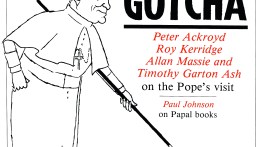
No need to explain why we've disinterred this piece by Peter Ackroyd, on the last papal visit to Britain, from the Spectator archives. And, to the left, the cover image by Garland from that week's issue. As news emerges that five people have been arrested in connection with a terror plot against Benedict XVI, a reminder that papal visits are always replete with global-political significance: The Pope and his princeling, by Peter Ackroyd, The Spectator, 5 June 1982 The pilgrims arrived in Canterbury, carrying their fold-up chairs in plastic Sainsbury bags; strange rumours on the train from London: 'You can't get into town without a permit. They say they've stopped all the cars for three miles … They've taken the door off the cathedral'.

Cable: interim immigration cap is “very damaging to the UK economy”

After stumbling in his crusade for a graduate contribution, Vince Cable seemed to go a bit quiet. But this morning he's roared back into the newspapers with another attack on coalition policy. The target of his anger is, once again, the immigration cap – but he's being far less equivocal about it this time around. The way in which the cap is being implemented this year, he tells the FT, is "very damaging to the UK economy." To force the point home, he says he has a  "file full" of companies who are suffering because of it. And, for good measure, the word "damaging" gets deployed once or twice more.

On the Pope’s visit

The Pope, as I'm sure you know, has touched down in Britain. Here, for CoffeeHousers, is the editorial on his visit from this week's new-look issue of the magazine: Benedict brings hope The arrival of Pope Benedict XVI in Britain has provoked protests that, in the intesity of their anger, far exceed those that greet the state visits of blood-drenched dictators. That is because the Pope is seen to represent — in ascending order of secular distaste — religion, Christianity, the Roman Catholic Church and the conservative wing of Catholicism. Fair enough: Benedict does represent all of these things. He opposes atheism, regarding it as a desperately sad alienation of man from his creator.

Clegg gets forceful over welfare

Enter Nick Clegg with another self-assured article for a national newspaper. A few weeks ago, it was his defence of the coalition's Budget for the FT that caught the eye. Today, it's his case for welfare reform in the Times (£). These may be arguments, about dependency and disincentives, that you've heard before – but here they're packaged in a particularly clear and persuasive way. Just what's needed as the welfare wars, between Labour and the coalition, spill back into newsprint.   Writing about the article, the Times frames it as "Nick Clegg [putting] himself on a collision course with his party" – and you can see why they might think that.

The “progressive coalition” cuts its teeth

Trust Bob Crow to turn down the charm. Explaining why he was boycotting Mervyn King's address to the TUC today, the RMT union boss managed to liken the Governor of the Bank of England to both the "devil" and the "Sheriff of Nottingham". Unsurprising, perhaps – but it's yet another reminder of why, for the Labour leadership contenders, marching in lockstep with the unions may not be such a good idea. To Harriet Harman, a Labour Party bound to Crow & Co. might be a “progressive coalition”. But to the rest of the country, it will probably look slightly left of sane. Only David Miliband, to his credit, seems to have properly grasped this fact – and the fact that he might hope to work alongside people like King one day.

Another difference of opinion on welfare?

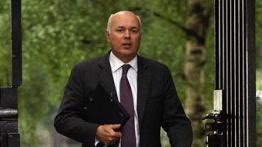
For the briefest of moments, the welfare war seemed to have quietened down. But, this morning, a new front may have flared open. Answering questions from the work and pensions committee, Iain Duncan Smith has struck out against the figures for benefit cuts that emerged at the weekend. The Guardian's Haroon Siddique reports: "During questioning by the work and pensions committee, Duncan Smith was at pains to play down newspaper reports that he and Osborne were at loggerheads with each other. But when asked by committee chair Anne Begg about a variety of figures that had been 'bandied about' including the £11bn savings set out in the June budget and the £4bn, he responded: 'As with regards to figures like 4bn, I simply do not recognise that figure at all.

PMQs live blog | 15 September 2010

Stay tuned for live coverage of today's Cameron vs Harman clash from 1200. 1200: A prompt start. Cameron begins with condolences for the fallen in Afghanistan. Clegg grabs the PM by the elbow as he sits down - making sure there wasn't an embarrassing lap-sitting moment, I think. 1201: Julian Smith asks whether it is "irresponsible" of Labour to back union strikes. Cameron says it is, natch, 1203: A dignified start by Harman. She passes on her congratulations for the Cameron's new baby, and her condolences for the death of his father. Her question is about what progress the government is making on tackling human trafficking. 1204: Cameron quips that Harman is "by far the most popular" Labour leader he's ever faced across the dispatch box.

YouGov has Labour and the Tories at their closest since October 2007

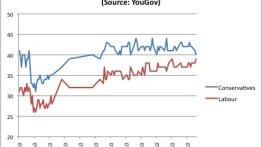
Factor in the usual caveats about polling so soon after a change of government, but the latest Sun/YouGov poll is still pretty eyecatching. It has the Tories on 40 percent, Labour on 39 and the Lib Dems on 12 – the smallest gap between the two main parties since the election-that-never-was in October 2007. Here's a graph of the the two parties' positions since the beginnning of the general election campaign: The Pollmaster General, Anthony Wells, suggests that Labour will overtake the Tories any day now.

Cameron readies his forces

Carry on cutting – and carry on making the case for cuts. That's the message that David Cameron drilled into his ministers during a political session of Cabinet this afternoon. Paul Waugh has a typically precise account of what was said, and the Press Association has a decent round-up, but the key observation is just how forceful Cameron was in making his point. The government, he said, should take on the "vested interests" arguing against cuts – and the Budget was the right action taken at the right time. The PM, you sense, is limbering up for a fight. As Ben Brogan suggests over at the Telegraph, Cameron is right to hold the line. This is not a time for wavering at the chopping block, even if the public have their qualms about the bloodshed to come.

A worrying – but not disastrous – poll for the government

This morning's Times/Populus poll (£) will have supporters of the coalition grimacing into their cornflakes. The headline finding is bad enough, if rather familiar, with Labour closing the gap between themselves and the Tories to only two points. But what follows is worse. According to the poll, around three-quarters of voters reject the government's deficit reduction strategy – preferring, instead, what are loosely the approaches advocated by Labour and the unions. And, what's more, economic pessmism is arrowing upwards. The number of respondents who think "the country as a whole will fare badly," has risen by 13 percentage points since June. The number who think "me and my family will do badly" has gone up by 6 points.

Osborne and Cooper’s knockabout

Far more heat than light generated by this afternoon's urgent question on welfare spending – but a telling spectacle nonetheless. The question had been put forward by a dissenting Lib Dem voice, Bob Russell, and it was up to George Osborne to answer it. He did so with sweeping observations, and attacks on Labour, rather than specifics. And so we never really got into the small print of those £4 billion extra benefit cuts, but Osborne did wonder why Labour have never apologised for "leaving the country with the worst public finances in its history." It was knockabout stuff.   This is not to say that Osborne was ineffective. In party political terms, he had a message – and he pushed it as far as he could.

Harman tries to bind Labour and the unions even closer

Progressive coalition. Those two words haven't been tied together too frequently since Gordon Brown scrambled for survival in the aftermath of the election. But Harriet Harman invoked them in her speech to the TUC today, and she wasn't talking about a union between Labour and the Lib Dems: "We are witnessing an emerging political movement amongst progressives in Britain – beginning to see that the Tory/Lib Dem government has no mandate. They are seeing the difference between what they thought they voted for and what they ended up with. The Labour movement is their vehicle for progressive change.

The coalition faces its most important battle of the next five years

Strolling through central Birmingham yesterday, I came across one of those brewery advertisements from the early part of the last century. "Unspoilt by progress," it boasted – a slogan that popped into my head when I heard the unions' various interventions this morning. As Iain Dale suggests, there is something very 1970s about what Crow, Barber, Serwotka & Co. are saying today. The coalition will need to meet much of the unions' belligerence with some fire of its own. David outlined some ways it can do that earlier. But, to my mind, there is one charge that demands a particularly ferocious counterattack.

Same old problems – and solutions – for Royal Mail

Two years ago, Richard Hooper wrote a report on Royal Mail which recommended part-privatising the service, among other measures. And today, with the official update to that report, we learn that his views have barely changed at all. If anything is different between then and now, it's that the need to modernise Royal Mail has become even more urgent. The number of letters they're sending has plummeted by more than forecast, and their pensions deficit has become even more unsustainable. The rot has quickened – and, yes, it's up to the government to combat it. For their part, the coalition are using Hooper's update to stress just how crucial privatisation is for Royal Mail.