Peter Hoskin

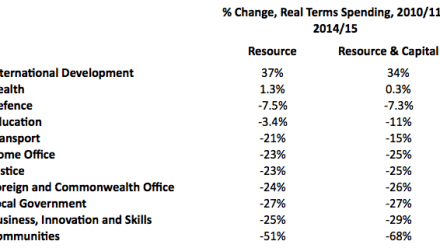
The departmental cuts

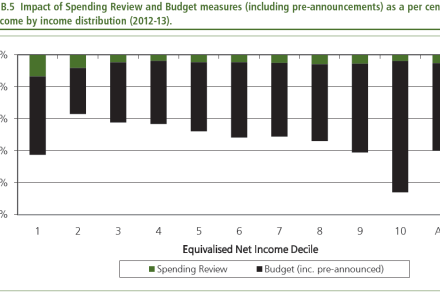
The Spending Review document is available here, but we've collected the cuts facing some of the main departments in the table below. This is not the complete picture of Osborne's announcements today: much of the action takes place in the separate social security budget, but we'll have more on that shortly.

PMQs live blog | 20 October 2010

QUICK VERDICT: More heat than light today, but Cameron easily got the better of Ed Miliband. Now to the Spending Review live blog. 1230: Cameron says that as cuts are made, the government will have to reform the way it does criminal justice. This is a prelude for the deep cuts that the Home Office and Justice department are expected to face in the spending review. 1228: The Lib Dem MP asks whether Cameron believes that better-off graduates should bear more for their university costs. Cameron says that he agrees on principle, and claims that "everyone in the House" wants the "same thing": a fair and well-funded university system. 1226: Cameron says that the spending review will contain answers on social housing - but hints that the results may be better than expected.

How we got here – and where we’re going

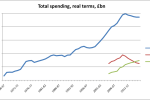
With the Spending Review less than two hours away, I thought CoffeeHousers might like to be armed with a few graphs that set the scene. What follows is by no means the complete picture of the fiscal landscape, but these are certainly some of most prominent landmarks. First up, real terms spending (aka Total Managed Expenditure) from 1966 to 2015: So, yes, all the fuss is about that small dip at the end of the blue line – a dip, as it happens, of about four percent. But don't think that the fuss is entirely unwarranted. What the government is trying to do here is curb a trend of ever-increasing spending that has persisted over decades, and which rocketed during the New Labour years.

The slog starts today

Welcome to Stage Two of the government's life. The first stage was the Budget, which established the size of the fiscal mountain looming over the coalition. The third stage will be the difficult, four-year slog up to the top. But today – the Spending Review – is all about determining the route for that ascent. In just a few hours we will know when, where and why the pain will come. Don't forget to pack sandwiches. Of course, with this roadmap being drawn out in Westminster, we already know some of the details. This morning's papers major on the fact – snapped from Danny Alexander's hands yesterday – that almost 500,000 public sector jobs will be lost over the next four to five years. And then there are the actual departmental settlements.

The coalition’s carrier trouble

We will be presented with the full defence review at around 1430 today – but already its contents are spilling out across the papers. Much of it is unsurprising: a delay for the Trident upgrade, two new aircraft carriers, etc. But some of it is slightly more surprising: for instance, the immediate decommissioning of both our 80-strong fleet of Harriers and the Navy's 25 year-old flagship, the HMS Ark Royal. As Liam Fox admitted on the Today Programme earlier, those last two measures will mean that Britain loses the ability to fly jets from its carriers for up to ten years. Ruling the waves, and even the skies, has been put on hiatus. It's clear that much this defence review has been shaped by compromise.

The coalition outlines its national security concerns

What a curious creature this National Security Strategy is. For some reason, I expected something more than a 39-page document in the same mushy pea colour scheme as the coalition agreement. But that is what we've got – and it doesn't really tell us much. The centrepiece of the document comes on page 27 (reproduced below), with a neat, three-tier guide to the security risks facing this country. At the highest priority level are atrocities such as "chemical, biological, radiological or nuclear attack by terrorists," and "hostile attacks upon UK cyberspace". Further down, there are mentions for "organised crime" and "disruption to oil or gas supplies," among others. But, before we get there, there is – as Nicholas Watt notes – a good deal of waffle.

The return of David Laws

Here's one grace note to this parliamentary term so far: the return of David Laws to public life. Since it was revealed that the former chief secretary to the Treasury has written a book about the formation of the coalition government, he has made more and more regular forays into the outside world. Last week, it was an appearance before the Commons' political and constitutional reform committee. This weekend, he admitted that he still harbours ambitions to be "in the frontline" of politics. And today he's got an article, co-written with the Lib Dem think-tanker Julian Astle, on the pupil premium in the Financial Times. His argument in the FT piece is worth noting down, not least because Laws developed much of the thinking around a pupil premium outside of government.

Alan Johnson’s economic gamble

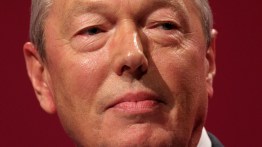
The most shameless line of Alan Johnson's big speech came at the beginning. "Being in opposition does not mean pretending to be in government," he averred, "we will not be producting a shadow spending review." Which would be fair enough, were it not for one simple fact: the Brown government didn't produce a spending review when one was due, last year, either. In which case, Labour's new economic policy is much like their old one. They are sticking by the Alistair Darling plan to halve the deficit over this Parliament, which is encouraging given some of the alternatives. Yet there is still not much detail about how this might actually be achieved. As he has done over the past few days, Johnson riffed on about increasing the taxes on banks.

The presentational battle begins in earnest – as the double-dip warnings wind down

Rule 97 in the Practitioner's Guide to Westminster Politics: if you want to get a message out pronto, then corral a bunch of impressive names into writing a letter to a national newspaper. We saw the tactic used by both Labour and the Tories before the election. And we see it again today, with a letter in the Telegraph, drafted by the Tory peer Lord Wolfson and signed by 35 business leaders, pushing George Osborne to "press ahead with his plans to reduce the deficit". And you know what? He may just do that. In truth, these kinds of letters are hardly a bad thing for the government, however stage-managed they might be. As the week of the spending review kicks in, the headline that people will see is: "Cut now or pay later, say business leaders".

The universities strike back

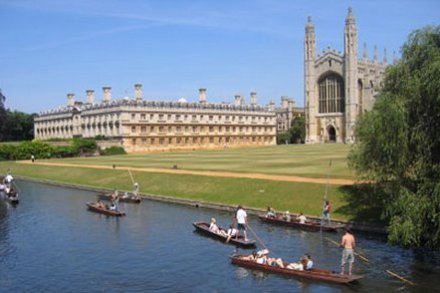
A wander through to p.14 of the Sunday Times delivers one of the most eyecatching political stories (£) of the day. The headline: "Cambridge may go private in fees row". And the content: that officials at Cambridge Uni are dissatisfied with the findings of the Browne review, which they see as too restrictive. Their issue is with the fees that are imposed by the government should a university charge above £6,000 for a year's tuition. This, they claim, prevents them from pulling in the kind of Big Bucks that Ivy League institutions have in their bank accounts - and could lead to British universities falling behind.

The axe hovers over welfare (and welfare cheats)

As we know, education and defence have now had their budgets settled – another two ticks alongside the checklist. But that still leaves the third member of the coalition's trio of sticky settlements unresolved: welfare. The "quad" of David Cameron, George Osborne, Nick Clegg and Danny Alexander will meet today to bash out the final details. Yet some of their key talking points and decisions have already made it into the papers (especially in this article (£) in the Sunday Times). Here's my round-up, along with brief comments: 1) Crackdown on welfare cheats. George Osborne sets the tone with his article in the News of the World (now also behind a paywall). "A welfare cheat," he writes, "is no different from someone who comes up and robs you in the street.

Tales from Afar

If you heard Australian bluesman C.W. Stoneking’s first album, King Hokum, then you will know what to expect from his second: Jungle Blues. If you heard Australian bluesman C.W. Stoneking’s first album, King Hokum, then you will know what to expect from his second: Jungle Blues. If you didn’t, then let me point out that Stoneking is a prize mimic. With a banjo in his hands, and the wail of a Howlin’ Wolf or Robert Johnson in his throat, this 36-year-old (white) man (raised by American parents in an Aboriginal community) sets about recreating every lurch and inflection of 1920s blues and calypso music. The horns swoon, the drums shuffle — and you’d swear you can hear the crackle of old vinyl, dusty between its grooves.

From the archives: Up to our eyes in debt

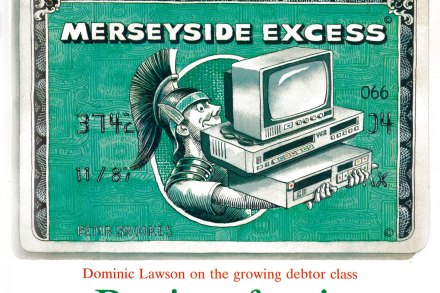
This latest piece from the Spectator archives isn't topical in any specific sense, but it does chart a problem which has spread over recent years until it has seeped into everything from government to football: namely, debt. In it, Dominic Lawson visits a Merseyside housing estate towards the end of the 80s, to find a community which has been force-fed cheap and easy credit, and is preyed upon by debt collectors. As a warning of what was to come, there are few better examples: The debtors of Smack City, by Dominic Lawson, The Spectator, 17 February, 1988 He could not work it out, the Merseyside debt collector. And nor could I, accompanying him on the sort of biting winter evening that his profession relishes (the targets are more likely to be in).

Clegg sweetens the pill with a fairness premium

Only five days to go until the spending review – and after weeks of emphasis on the cuts we're about to see, the government has today unveiled a new spending commitment. It comes courtesy of Nick Clegg: a new "fairness premium" targeted at the least well-off young people. Lib Dem Voice has full details here, but the basic point is that £7 billion will be spent, across 4 years, on programmes for disadvantaged 2 to 20 year-olds. Much of this will go towards the "pupil premium" that we've heard so much about, and which should advance school choice in the most deprived areas. Putting aside his genuine commitment to it, Clegg is facing two ways with this announcement: the public and his own party.

PMQs live blog | 13 October 2010

VERDICT: Well, who would have thought it? In his first PMQs performance, Ed Miliband not only put in a solid showing – but he got the better of David Cameron. I certainly don't agree with the Labour leader's central argument: that it is unfair to restrict child benefit. But he put his point across in measured, reasonable tones – and Cameron seemed flustered by comparison, as he wagged on about the size of the deficit. Make no mistake, the argument and the public's sympathies will unwind themselves over the course of the entire Parliament. They will not be resolved in one session of PMQs. But in presentational terms, MiliE will have the more flattering clips on the news later – which is more than he could have expected going into today.

Counting down to the spending review

Only one week to go, folks, until the main event itself: the Comprehensive Spending Review. And judging by this morning's papers, the Treasury have almost settled on their final acts. Only the welfare, eduction and defence budgets have any significant question marks hanging over them. Those question marks, though, are fading fast. A story in this morning's Times (£) reports that David Cameron has endorsed the building of two aircraft carriers, but has decided to delay the Trident upgrade until after 2015. No, strictly speaking, he's not going back on this. Rather, the idea is that the coalition will keep on working towards a replacement for Trident between now and the next election – but will hold back from signing the very final contracts until five years hence.

Daylight for the 33

As Alex says, the rescue of the Chilean miners has to be the "feel-good story of the year". The first, Florencio Avalos, was winched out of his underground cell at 0310 British time, and a further four have been delivered to the surface since. With 28 more miners to come, this is by no means over – but a much happier end is in sight than many would have believed, 68 days ago.

Bringing Arcadia to Whitehall

Philip Green's business background is writ plain across his review of government waste – right down to its PowerPoint style layout. Many of its recommendations reduce down to a claim made on p.20: "There is no reason why the thinking in the public sector needs to be different from the private sector." And so we read a suggestion that departments halve the number of hotel visits by using video-conferencing. There are passages on how to get the best deals for mobile phone contracts and printer cartridges, too. This isn't to trivialise the report. Far from it. Many of its findings are of the I-can't-believe-government-operates-like-that variety – and Green extrapolates from there to make sensible points about how Whitehall can function better.

The AV rebels change tack

A little snippet from today's Times (£) that is worth noting down: "Tory rebels will this week lift their threat to the date of next year's proposed referendum on voting changes – because they believe May 5 offers the best chance of stopping the alternative vote (AV) system. That date coincides with the council elections in Scotland, Wales and most of England, and was thought likely to boost the 'yes' vote for replacing first-past-the-post general elections. Nick Clegg insists that the Lib Dems will not budge on the date. But a tactical rethink will see many AV sceptics wave it through when the Bill comes to the floor of the Commons this week.