Peter Hoskin

Another item for the coalition’s to-do list: intergenerational unfairnessĀ 

With an uncanny sense of timing, the latest annual British Social Attitudes Survey suggests that the "conflicts of the future may be between today's young and their parents' generation." And the thinking behind this conclusion? Simple: that, in so many ways, young people have never had it so good as the babyboomers did. From tuition fees to house prices, those born after 1975-80 have always tended to fall on the less favourable side of the divide – and that has, in turn, fuelled the sense of injustice that we saw erupt onto the streets last week.

Simmering below the surface…

By way of an addendum to Fraser's post, it's worth reading Melissa Kite's account of internal Tory strife for the Sunday Telegraph (it doesn't seem to be in the paper, but is available online here). The piece records what sounds like a tumultuous week for the Tory whips, as they struggled to keep a group of disgruntled MPs on side. There are plenty of little insights, of which this is just a selection: 1) The 1922 Committee gets angry. "The ceding of a series of major powers to Europe, the increasing of international aid, the decision to have a referendum on voting reform, the redrawing of constituency boundaries – all had been eating away at Tory backbenchers for months. Worse than that, their concerns had been repeatedly brushed aside by Mr Cameron.

Clegg suffers the backlash

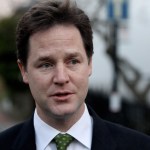
If this morning's papers are anything to go by, Nick Clegg is in freefall. The man who was the Lib Dems' biggest electoral asset is now a magnet for all sorts of political digruntlement. Exhibit A: the Ipsos MORI poll (£) in today's News of the World, where 61 percent of respondents say that they don't trust Clegg, compared to 24 percent in April. He has gone from being "the most trusted politician since Churchill," to one of the least since ... well, ever. It is no small irony that the leader who sailed most capably on the winds of "change" and "new politics" in the TV debates has, whether rightly or wrongly, delivered this Parliament's most stunning example of a broken pledge – and is suffering the fallout from it.

From the archives: The student protests of ’68

No, not Paris, but the University of Essex – where, in early to mid-1968, students rallied angrily against Vietnam and all that. The situation was aggravated when three students – including David Triesman, later Lord Triesman – were summarily suspended from their studies, and The Spectator duly dispatched a correspondent to investigate. The resultant article came in the issue dated 24 May 1968; a few pages on from an editorial headlined "How to deal with the student problem", and alongside coverage of events in France.

The coming battle over Mainstream Conservatism

It's not just the students who are waging a political struggle. In yesterday's Times (£), Tim Montgomerie fired up a debate over the future of the Conservative Party that will no doubt simmer through the rest of this Parliament. For those who can't delve behind the paywall, the argument was broadly this: that a tension is emerging between liberal Conservatism and a more traditional Conservatism. On the side of the Liberal Conservatives are those who want to extend the union with Nick Clegg and his party; a group which may well include the Tory leadership. On the other side are those who want the Tories to go it alone after the next election, with a more traditionally Tory policy platform.

Coalition wins fees vote with a majority of 21

The final tally was 323 in favour of lifting the cap on tuition fees from £3,290 to £9,000 a year, with 302 against. The second vote, on raising the basic cap to £6,000, passed with the same majority. Although we don't know the divisions yet, we can safely say that it's the biggest rebellion of this Parliament so far – the lowest government majority until today was 51. UPDATE 1: 28 Lib Dems voted with the government; 21 against; and 8 either didn't vote or abstained. This is the biggest Lib Dem rebellion since the party was founded.

Putting the Lib Dem rebellion into context

A useful guide from Philip Cowley and Mark Stuart: If 11 Liberal Democrat MPs vote against the whip, it will be the largest Lib Dem rebellion so far this Parlaiment. (The current record is 10, on an amendment to the Parliamentary Voting System and Constituencies Bill in November). If 16 Liberal Democrat MPs vote against the whip, it will be the largest Lib Dem rebellion since the party was founded in 1988-89. If 30 Liberal Democrat MPs vote against the whip (something we doubt very much), it will be the largest rebellion by the Liberal Democrats or any of their predecessor parties since the Maurice Debate of 1918, which saw the Liberal Party split in two. More here.

The Lib Dems walk through the fire

Brace yourselves, CoffeeHousers. Today is the day of the tuition fee vote, along with all the froth and fury that will attend it. The government's motion will most likely pass through the Commons – yes, even without the support of Simon Hughes – but the wider repercussions are, as yet, uncertain. The main question is what the Lib Dems will achieve by walking through the fire, as Nick Clegg puts it. Will they emerge from the other side, a more credible party of government in the public's eyes? Or will they just get burnt to ashes? At the very least, the yellow bird of liberty is stuttering this morning. As Anthony Wells reports, the latest YouGov poll has them at 8 percent – what appears to be their lowest level of support for 20 years.

The Tories keep plugging away at the Big Society

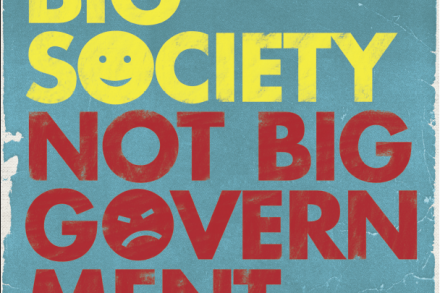
The Big Society never really went away as a theme, but it certainly became a less insistent catchphrase after the general election. The Tories were no doubt stung by the ambiguous response their invitation to government, and felt that the early days of coalition government were not an opportune moment to reheat their central election message. Months went by where the words "big" and "society" barely made any contact at all. That changed with David Cameron's conference speech, of course. And, since then, the Big Society has been back, loud and proud. Only this week, Philip Hammond was talking about a "Big Society approach" to dealing with the snow. Nick Clegg has taken to opening "big society classrooms".

PMQs live blog | 8 December 2010

VERDICT: Tuition fees, tuition fees, tuition fees. Ed Miliband used only one weapon from his armoury today – but it served him unexpectedly well. The Labour leader scraped a contest that, as usual, offered far more heat than light. His attacks were slightly more cutting, his one-liners that little bit more memorable, and it was all the more remarkable given his dreadful performance seven days ago. It wasn't that Cameron performed badly. The PM rightly – and, at times, effectively – pointed out Labour's hypocrisy on this issue. But it all seemed a little flat, as though he was reading from a script that had only just been handed to him. In the end, this was one to cheer the Labour benches, and clear some of the fallout from last week.

The Sun gives Clarke a kicking

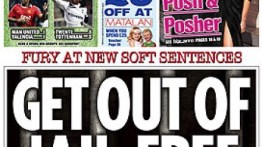
It may not be The Sun wot won or lost the last election, but its readers did swing heavily from Labour to the Tories and, even, to the Lib Dems. Which is why No.10 will not be untroubled by the paper's cover today. "Get out of jail free," it blasts, marking what Tim Montgomerie calls the "beginning [of] a campaign against Ken Clarke's prisons policy." And it doesn't get any kinder inside. Their editorial on the issue ends, "Mr Clarke and Mr Cameron owe Britain an explanation." It captures a strange split in the government's approach to crime. When it comes to catching crooks, the coalition is putting forward policies – such as elected police commissioners – that will go some way to ensuring the public get what they want.

Labour stumble into tomorrow’s tuition fee vote

Oh look, Alan Johnson has performed a hasty Reverse Cable. Only a few days ago, the Shadow Chancellor suggested that he didn't believe a graduate tax – Ed Miliband's chosen policy – could work. Yet, in a wilting Thunderer column (£) for the Times today, he now claims that "there is a very strong case for a graduate tax." From unworkable to strong, in only four days. Sounds like a disclaimer for Ikea flatpack furniture, not a policy position. In a separate article, the Times characterises this as a minor victory for Ed Miliband – and so, in some respects, it is. He has managed to rein his Chancellor on this issue, if not on 50p tax, and the Labour leadership are now backing the same policy, albeit a misguided one.

Some framework for the prisons debate

I thought that CoffeeHousers might appreciate a few graphs to steer them around the prisons debate. It's by no means a complete overview of the issue, but just three of the trends that hover over Ken Clarke's proposals: 1. Rising prison population, falling crime Well, that's striking enough. Expect, as any fule know, correlation doesn't necessarily imply causation – which is to say, the fall in crime could be due to something other than the rise in prisoners. Some put it down to improving economic conditions. Others mention deterrents such as CCTV. But those correlations can barely be hardened into a cause, either. So, all rather inconclusive.

Compromise time for Nick Clegg?

Where are we with the tuition fee rebellion? Nick Clegg has an article in the FT claiming that the coalition's policy is fairness codified, but he is running out of time to persuade his own MPs either way. Barring various unlikelihoods, the crunch vote will be held on Thursday. Before then, a handful of PPSs could well resign their bag-carrying roles. And, judging by today's Sun, a few ministers might even join them (Norman Baker, of course, as well as Steve Webb and Lynne Featherstone). The plan to present a "united front" has already crumbled to naught. What's left for Clegg, ahead of his meeting with MPs later today, is to prevent some of the more toxic fallout from this vote.

Now the Tories have an issue to get stuck into…

While Nick Clegg battles on the tuition fee front, another internal conflict breaks out for the coalition today: prisons. And rather than yellow-on-yellow, this one is strictly blue-on-blue. On one side, you've got Ken Clarke, who is controversially proposing a raft of measures for reducing the prison population. On the other, Tory figures like Michael Howard who insist that prison works – and that there should be more of it. Philip Davies, the Tory MP for Shipley, even told Radio 4 this morning that millions of Conservative voters would be disappointed by the coalition's plans.

The mundanity of espionage

And the most curious political story of the day has to be the one about Mike Hancock's 25-year-old parliamentary researcher, Katia Zatuliveter. If you haven't seen it already, she is facing allegations of spying for the Russians – and looks set to be deported as a result. It's the first time that a Commons employee has been arrested on charges of spying since the Cold War thawed out twenty years ago. There's some lively colour in this tale, but the full picture is, as yet, shaded from view. For his part – as per the video above – Hancock has denied that Zatuilivter is a spy. But the only Cabinet minister to comment on the matter so far, Iain Duncan Smith, has said that the allegations have to be taken seriously.

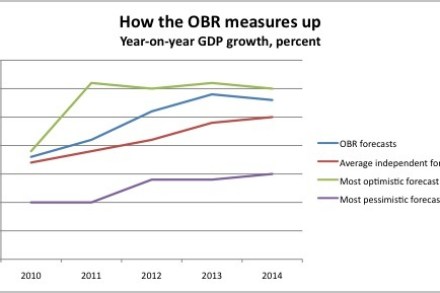
How the OBR measures up

There are only so many Labour interviews a blog can take, so I'll skip over Yvette Cooper in the Guardian (sample: "I did think about standing, and Ed said he thought I should stand and if I wanted to stand he would not stand"). Instead, another catch-up on how the Office for Budget Responsibility's growth forecasts are shaping up against those made by other institutions. Since I last did this, two new documents have been processed into the public domain: the OBR's latest economic and fiscal outlook, of course, as well as the the Treasury's round-up of long-term independent forecasts.

Brown struggles on beyond the crash

Today's Guardian calls it his first interview since leaving office, although I think the Independent beat them to that one back in July. But, in any case, Gordon Brown's chat with Larry Elliot is another staging post on his slow path back to public life. Here's my quick summary: 1) Sniping from the moral high ground. A bit late now, but Brown is making a desperate scramble for the moral high ground. Not for him, he says, scurrilous memoirs that sift through the "arguments" of the past. No, he's got far more important things on his mind than muck-raking and innuendo, like the future of financial regulation across the world. Or has he? It's hard not to see barbs mixed in amongst it all. Take this line from the interview: "I am a full-time MP, not a businessman.

The Lib Dem tuition fee confusion continues

Who knows how, and whether, Vince Cable is going to vote in next Thursday's tuition fee decider? Not even the man himself, it seems. A few days ago he suggested he might abstain for the sake of party unity. Yesterday, he told his local paper that "I have a duty as a minister to vote for my own policy – and that is what will happen." And yet this morning's Guardian has a "party source" saying, "a final decision has not been made. It is still possible Vince could abstain." At least we haven't heard that he might vote against the proposal – although, at this rate, I wouldn't be surprised. To my mind, the most likely outcome – and one mooted in the papers today – is a three-way split.