Peter Hoskin

Clegg strikes an uncertain balance

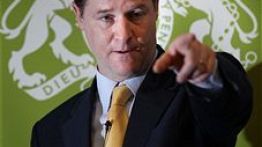
By my count, it's the fourth speech that Nick Clegg has delivered specifically on the subject of deflating the state since last May. And like his last three, today's number was stuffed with words like "liberty" (23 times), "freedom" (19) and "power" (14). Much of the more specific content was familiar, too: like the confident asides about ID cards and a Freedom Bill. What we really wanted to hear, though, was what Clegg would say about control orders. And what he said was … well, not much. Like the PM earlier this week, the Deputy PM suggested that control orders are an imperfect mechanism – and that "they must be replaced".

From the archives: Protesting the price hikes

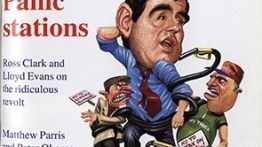
The week began with grim projections about petrol prices, and has been coloured by the twin topics of tax and inflation since. So, a decent opportunity to look back on the fuel protests of 2000, in the latest shot from the Spectator archives. Here's a piece from the time, by Coffee House regular, and Spectator theatre critic, Lloyd Evans:   Do you want a smack in the mouth?, Lloyd Evans, The Spectator, 16 September 2000 As I write this, the gravest crisis in our island story is unfolding before my eyes. The great four-star emergency of September 2000. Where it will lead, no one can tell.

The rise of China and India, by numbers

We're used to seeing growth forecasts for the next few years, but here's an altogether rarer beast: forecasts stretching all the way to 2050. They were released by PricewaterhouseCoopers last night, and I thought CoffeeHousers might appreciate seeing them in graph form. Naturally, slap health warnings aplenty across this – economists barely know what will happen this year, let alone decades hence – but some of the trends are still pretty striking. Here's a round-up: 1. This first graph suggests that – allowing for the relative values of different currencies – China’s GDP will top the US’s around 2020. India's does likewise just before the 2050 endpoint:   2.

Clegg: Read my lips…

This comment from Nick Clegg – speaking to the Evening Standard today – deserves pasting into the political scrapbook: “Let me be absolutely clear once and for all. The Liberal Democrats will fight the next election as we did the last – as an independent political party in every constituency in the country.” Which is considerably less equivocal than David Cameron and George Osborne have managed recently. When the Tory pair were pressed on the matter towards the end of last month, they said only that they "expect" the coalition parties to fight independently of each other come election time. Not that the Clegg quotation rules out electoral chicanery altogether.

IPSA’s olive branch to angry MPs

The foreword to IPSA's latest consultation document is certainly more conciliatory than combative. "The last eight months have been demanding, both for MPs and their staff, and for IPSA," it starts – in subtle reference to the mutual frustrations that have overtaken the expenses operation to date – before asking whether the current system can be made more "fair and workable". And that tone carries across into the main body of the text. Although IPSA insist that nothing has been decided yet, they do at least moot the possibility of raising certain allowances back up again. As James Kirkup writes on his Telegraph blog, this document is, in some respects, IPSA's last chance.

Khan to Miliband: What life experience do you have?

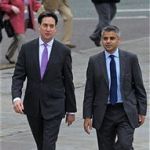
Ok, not quite. But this snippet from GQ's interview with Shadow Justice Secretary Sadiq Khan is almost a description of Ed Miliband's rise to the Labour leadership: "One of my criticisms of a lot of politicians of all parties is that they're career politicians. Since they were 11 years old they dreamed of being an MP, being the Prime Minister, and so they'll do A-Level Politics, Politics degree, get a job with an MP, work for a think tank, become an MP, Prime Minister. And my criticism is what life experiences do you have? The reason most MPs aren't popular is that people can see through that." He makes up for it later, though, saying of Miliband that "I believe in him, I really do, he's a mate.

Will Osborne be vindicated in 2015?

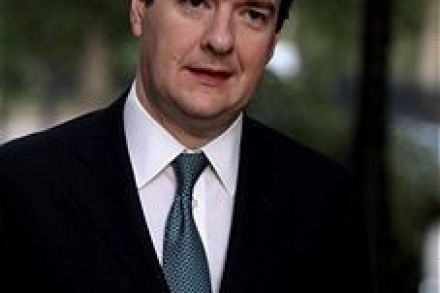
VAT, VAT, VAT – but what's this? The main headline on today's FT doesn't mention the sales tax at all, and the piece below it only does so in passing. Instead, a declaration that "UK austerity measures [are] expected to pay off," based on a survey of economists conducted by the paper. Although those polled have concerns about inflation and the eurozone, only 13 percent say that George Osborne needs a Plan B for dealing with the public finances. As always, we shouldn't place too much stock in this kind of thing. Some economists will back the coalition, others will back Labour; some will be right, others will be wrong. But, today of all days, the coalition will appreciate a presentational leg-up such as this.

Osborne and Johnson battle over the new tax divide

Now here's a thing: a radio appearance by Alan Johnson that actually clarified some details about Labour's economic policy in the Miliband era. Sure, the shadow chancellor spent most of his time on the Today Programme setting about the coalition's VAT hike, with all the usual arguments about jobs and growth. But there was also confirmation that Labour's deficit reduction plan would split 60-40 between tax rises and spending cuts, and that they would raise national insurance levels rather than VAT. It repositions the argument some way beyond the simple Do/Don't divide that was developing around VAT. Now there are two choices for voters to make. Do they prefer a deficit reduction plan which, for the first time, emphasises tax hikes over spending cuts?

Miliband’s first hundred days in five points

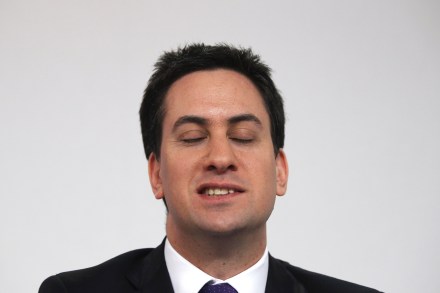
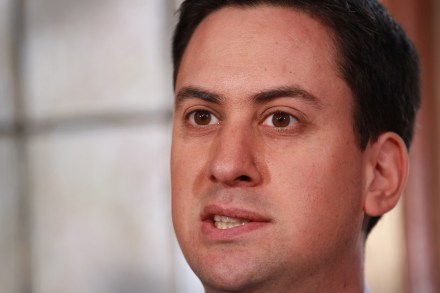
Ok, so Ed Miliband's one hundred day anniversary actually falls on Tuesday – but what's a couple of days between bloggers? Besides, even with two days to go, it's safe to say that his will be a peculiar century. By some scientific measures, Labour are doing alright; sucking up Lib Dem voters to push ahead of the Tories in opinion polls. But that belies what has been an unconvincing start from their new leader. Here's my quick five-point guide to his bitter honeymoon: 1) What's the economy, stupid? One of Miliband's boldest moves to date was his appointment of Alan Johnson as shadow chancellor.

Ed by numbers

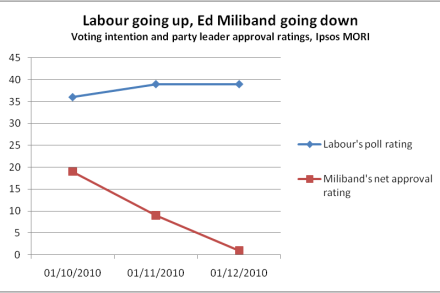
Ed Miliband’s leadership trundles on past the hundred day milestone tomorrow – so more on that, erm, then. But, in the meantime, here’s a quick graph transcribed from Ipsos MORI’s latest research. It depicts what, for want of a proper policy prospectus, is one of the most striking features of the Miliband era so far: that Labour’s support has risen while their leader’s personal ratings have slumped, reaching what today’s Mail describes as the “lowest of any new party leader at the same stage since former Tory leader Iain Duncan Smith,” and lower even than his biggest fan, Neil Kinnock. Here it is:   To be fair, that still puts Miliband ahead of Nick Clegg.

Rising costs: a problem for the public and the coalition in 2011

Ne’er mistake correlation with cause, I know. But, during the Brown premiership, the correlation between petrol prices and poll ratings was still pretty striking. Mike Smithson graphed it early last year, but the basic story was this: the Tories enjoyed their biggest poll lead over Labour when petrol prices were at their highest, and Labour closed the gap to only 1 percent when petrol prices were at their lowest. At the very least, it gives us a hypothesis to work from: prices up, the government suffers; prices down, the government recovers. And it looks as though we’ll be able to test that hypothesis soon enough. Today’s Express reports that – thanks to rising VAT, fuel duty and oil prices – petrol may soon soar to £1.40 a litre.

Bookends: A man less ordinary

The joy – and danger – of these extended conversations with film-makers is that they will skew your critical faculties. The joy – and danger – of these extended conversations with film-makers is that they will skew your critical faculties. So it is with Amy Raphael’s book Danny Boyle (Faber, £14.99). Until sifting through its pages, my opinion of the director’s work was, like many film fans, given to snobbishness: that he squandered the ferocious promise of Shallow Grave (1994) and Trainspotting (1996), sinking to such insipid depths as A Life Less Ordinary (1997) and The Beach (2000), before — even worse — winning Oscars galore for the mawkish Slumdog Millionaire (2008). Now I take a kinder view.

Cameron and Miliband’s New Year message: 2011 will be like 2010 

If you want to know what British politics will sound like in 2011, then just read David Cameron’s and Ed Miliband’s New Year messages one after the other. They share a lot of the same words, but bounce along to different, if familiar, drumbeats. According to Cameron, next year will be “very difficult,” due to the effort of “putting our economy ... on the right path”. According to Miliband, next year will be more difficult than it needs to be, due to “the decision taken to reduce the deficit at what I believe to be an irresponsible pace and scale.” In other words, cuts versus fewer cuts. Just like 2010 all over again.

What are your predictions for 2011?

New Year’s Eve, a time to dwell upon Things to Come – so I thought I’d mine CoffeeHousers for their predictions for 2011. We went through the same process with some friends of The Spectator for the recent Christmas issue, and I’ve pasted their responses below to get you started. And that’s not all: the most amusing prediction, to be chosen next week, will win its author a bottle of Pol Roger. The comment section is, as always, yours. Dame Eileen Atkins I hope we start getting education right. Michael Gove is correct when he says we should go back to an emphasis on five basic subjects: English, maths, geography, history and a foreign language. These should not be purely the province of the naturally academic.

Ed Miliband’s party reforms are purely presentational

Ed Miliband’s proposal to cap party donations at £500 – thereby restraining the huge one-off union payments that sustain Labour – certainly looks radical enough. But, as any fule kno, surface appearances can be deceptive. As Jim Pickard explains in an insightful post over at the FT, the result would be a system that affects the other parties far more than it does Labour and their union support. The trick is crystallised by this passage from the original Independent report: “One reform option would be to treat Labour’s income from union members who pay the political levy as individual donations. This helps to fund the party’s day-to-day spending.

Government by signature

Remember this petition to have Gordon Brown resign as Prime Minister? It secured 72,222 signatures in the end: not quite enough to have it debated in Parliament under the coalition’s new plans, but enough to make you think. I mean, will we see parliamentary debates about whether Dave and Nick should step down at the public’s request? Not going to happen, I’d say. But these latest ideas for involving voters in the legislative process could certainly provoke one or two embarrassments for our political class. Take the obvious example of withdrawing from the EU: that petition could probably attract any number of votes, but is unlikely to be met positively by Parliament. Ditto an entire spectrum of political matters, from MPs’ pay to immigration.

Labour’s first manifesto commitment for 2015

Courtesy of Alan Johnson's interview in the Independent today: "Both [Ed Miliband and Johnson] have accepted that it is 'inconceivable' that the 50p tax rate won't be needed at the time of the next election." Or, in other words, Johnson and Miliband have reached compromise over their divergent positions on the 50p rate.

Going for growth in 2011

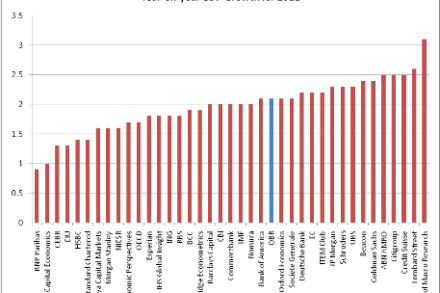
Just as at the turn of 2010, economic growth is going to be big news in 2011. Back then, the question was when we would return to any growth at all. Now, it's more about how fast our recovery can be. So just how fast can it be? If you notice, Labour have fallen very quiet about the possibility of a double dip recession. But they'll still leap clamourously upon any sign that coalition policies are stalling growth and jobs. In this, they might even be joined by those on the right who are sceptical of the coming VAT hike. To put some sort of perspective on proceedings – albeit an incomplete one – I thought CoffeeHousers might appreciate a couple of graphs (see UPDATE below for larger versions).

From the archives: Cricketing over Christmas

How do cricket players get on with touring abroad over Christmas? Mike Atherton, the former England captain, penned an article on the matter for our Christmas issue in 2004. With England currently taking it to the Aussies in Melbourne, I thought it would be a good time to excavate it from the archives:  Some like it hot, Michael Atherton, The Spectator, 18 December 2004 ‘It is no more a place for them than a trench on the Somme’ was the withering verdict of John Woodcock, the Times’s cricket correspondent, on the presence of wives on an England tour three decades ago. Woodcock, it must be said, was and is single, but he is no misogynist.

From the archives: Mark Steyn’s Christmas film selection

To help that Christmas lunch go down, here's a sprinkling of Christmas films selected by the incomparable Mark Steyn in 2004. To see more of his writing for The Spectator click here. Otherwise, just read on...  Christmas Classics, Mark Steyn, The Spectator, 18 December 2004 ’Twas the night before Christmas and all through the house/ Not a creature was stirring, not even a mouse. At which point, Sylvester the cat looks up from his long fruitless vigil outside the mouse hole in the baseboard and sighs with feeling to the narrator, ‘You’re not jutht whithlin’ Dickthie, brother.