Peter Hoskin

Why the government is right to look beyond ASBOs

We shouldn't have believed the hype. For all of Tony Blair's earnest focus on Anti-Social Behaviour Orders, this flagship policy was barely in effect at all. By the latest figures, only 18,670 ASBOs were issued between April 1999 and the start of 2010. According to this Policy Exchange report – the best on the subject that I've come across – that accounts for around 0.009 per cent of all incidences of anti-social behaviour. So let's not pretend that the coalition is upending the criminal justice system by shifting away from ASBOs today. Neither, on the evidence at hand, is it doing away with an effective policy. Here's a graph that I've put together from the latest Home Office statistics.

How much do we spend on the military?

As shocks go, Politician Uses the Correct Statistic is not particularly electric stuff. But I was struck nonetheless by Cameron's claim in his speech earlier that, "we still have the fourth largest military budget in the world." You see, Gordon Brown used to exaggerate this figure by various sneaky methods – and so, by his account, we'd be second in the military spending league table, rather than around fifth. Whereas Cameron had it spot on. Here's what the latest top ten looks like, going off the best measurement that the Stockholm International Peace Research Institute knows (see their explanation here): On the face of it, this would appear to be a strong point against the claim that we underspend on defence. But it doesn't close the case.

A disheartening story

A sad juxtaposition between David Cameron's defence of liberal values and the Times's interview (£) with Paul Maynard, the Tory MP for Blackpool North & Cleveleys. Maynard – who has cerebral palsy – describes his experiences in what ought to be a bastion of British decency: "Mr Maynard knew that people could be unkind, perhaps unconsciously. Nevertheless his worst experience in Parliament came as a shock. A few months later he stood up in the chamber to defend the Government’s decision to cut the Child Trust Fund. Mr Maynard admits that it was a controversial issue but still could not believe what happened. Each time that he lifted his head, his eyes were drawn to MPs across from him.

Cameron signs up to muscular liberalism

"State multiculturalism has failed." Angela Merkel put voice to that sentiment last October. Now it David Cameron's turn to do the same. In a speech in Munich today, the Prime Minister has taken a rhetorical torch to Islamic extremism. "Frankly," he says, "we need a lot less of the passive tolerance of recent years and much more active, muscular liberalism." It is, at the very least, a significant political moment. What Cameron is doing here – as explained by Charles Moore and Paul Goodman – is publicly signing up to a philosophy of the world. It is a philosophy that rejects the idea that extremism should simply be contained. Instead, it says that extremism must be fought – and that means engaging in a battle of ideas.

Clegg stands up for deficit reduction

Cleggologists will mark down the Deputy PM's speech today as a typical effort. There was basically nothing in it that was new – but Clegg still put it across with more punch, and more persuasively, than most of his colleagues could manage. All of the slogans and pre-announced policies added up to something that sounded, fleetingly, like a plan for growth. Although we'll still have to wait for Vince Cable's review to see the outlines of that plan shaded in. Clegg's main point was straightforward enough: that the government has to, and will, go beyond deficit reduction to stoke the embers of the British economy. He then ranged across everything from the national infrastructure to – a theme of this week – endowing the British workforce with skills.

Miliband angles for the youth vote

For those who don't have the inclination to delve behind the paywall, Ed Miliband's interview with the Times can be summarised in four words: think of the children. Yep, the Labour leader is out a-courting the youth vote – and who, really, can blame him? The recent student protests have made Westminster's strategists realise that these people aren't apolitical after all. It was inevitable that someone would try to reach out to them. The problem for Miliband is that he doesn't really have a prospectus to offer. He rattles off three familiar policies – a graduate tax (of uncertain design, and even more uncertain worth), votes at 16, more apprenticeships – but concentrates on simply attacking what the government is doing.

A new golden rule

The last few days have given us enough evidence for a new economic rule: the better the news about the economy, the less we'll see of Ed Balls. As Tim Montgomerie notes over at ConservativeHome, the shadow chancellor was plastered right across the airwaves when last week's growth figures were announced. This week – when the economic omens have been more encouraging – not so much. On Tuesday, as Fraser blogged, we had a record rise in manufacturing activity. Yesterday, there were heartening figures for the construction sector. And, today, the services sector has followed suit, with its strongest showing for eight months. Here's the graph for all three: Sterling has soared on today's news.

The Pope reopens the international aid debate

Spare a dime for a travelling Ponfiff? The Department for International Development can – and then some. According to their latest accounts, they funnelled £1.85 million of cash across to the Foreign Office to help pay for the Pope's visit to Britain last September. The money didn't specifically come out of their ring-fenced aid budget, but it would normally have gone towards DfID operations overseas. "Somewhat surprising," is how one member of the international development select committee has put it. Whatever your take on the Pope's visit, this is still a story which reopens the wider debate about development spending.

Introducing Britain’s skills crisis

Did you know: Britain trails well behind other countries such as the US, Germany and Poland when it comes to educating its workforce? Did you know: the number of young people not in employment, education or training has risen by around 40 per cent over the last decade? Did you know ... oh, you get the idea. All the statistics, and more, are in the booklet on Britain's Skills Crisis that is included in this week's Spectator. For CoffeeHousers who don't buy the magazine (although you should, etc – purchasing options here), you can read the supplement for free via this snazzy, page-turning whatsit. We'll also put one or two of its articles up on Coffee House in due course.

Ten things you need to know about the IFS Green Budget

An exciting day for policy freaks and numbers geeks: the Institute for Fiscal Studies has released its latest Green Budget, an annual survey of the state of the public finances. But if you can't face wading through the complete 329-page document, here's our quick ten-point summary of its main conclusions: 1) IFS forecasts "slightly lower" growth than the OBR. As this comparison shows: 2) But they're more optimistic about borrowing. According to the IFS, borrowing won't be as high as the government expects. The differences between their forecasts and the OBR's are only minimal, but they're there all the same: 3) The tax and spend forecast.

PMQs live blog | 2 February 2011

VERDICT: What a refreshing change that was. After several weeks of Punch 'n' Judy rivalry, the two party leaders finally put down their batons and stumbled upon a new way to do it. Much of the credit must go to Ed Miliband, for asking pacific questions about Egypt and Afghanistan in the first place. But credit, also, to Cameron, for answering them in a straightforward and statesmanlike manner. The rest of the House, for its part, was stunned into silence by this peculiar scene. Some of the blood rushed back into proceedings with the backbench questions, and as Cameron directed attacks at Ed Balls, but this must still go down as the most decourous PMQs in recent memory. Less spice, more meat – not a bad trade-off in this case.  1231: And that's it.

All across the political spectrum

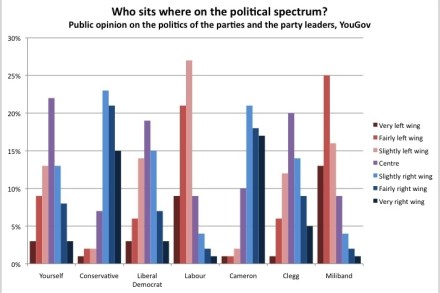
Yesterday's polls may seem like yesterday's news – but it's actually worth returning to YouGov's effort from, erm, yesterday. It contained some distinctive questions, and results, all set around the left-right spectrum. How left wing is the Labour party? How right wing is David Cameron? That sort of thing. Of course, as Anthony Wells has already pointed out, the old labels of "left" and "right" are of decreasing relevance nowadays. But they do still tell us something about popular perceptions of the parties and their leaders.

Osborne’s tax headache

No doubt about it, George Osborne is being pulled in two directions ahead of the Budget. There are those, such as the Lib Dems, who would have him reduce taxes for the least well-off. There are those, such as Boris, who would have him reduce taxes for higher earners. As I suggested yesterday, this debate pivots around two particular measures: raising the personal allowance and cutting the 50p rate. Rachel Sylvester develops the story in a typically insightful column (£) for the Times today. It quotes an "ally of the Chancellor" to the effect that Osborne is minded more to raise the personal allowance than to cut 50p. "Not many Tories want to reverse the 50p top rate," says her source, "We are big fans of raising the threshold and would see that as the priority.

Fox: Iran could have a nuclear weapon by 2012

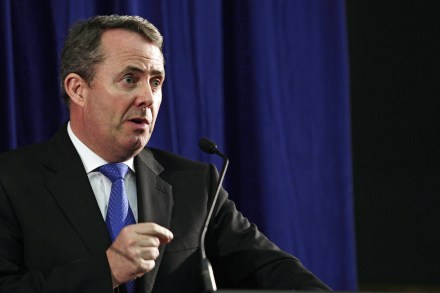
As Cairo smoulders, it's easy to forget about one of the most combustible ingredients in the Middle Eastern cocktail – Iran. Yet the threat still exists, as Tony Blair and Liam Fox have been keen to remind us. James Kirkup reports that the Defence Secretary has warned a Commons committee that Iran could have a nuclear device as soon as next year. Fox isn't the first to make the 2012 claim. The director of the CIA did so last year. And a recent article by the former UN weapons inspector David Albright and Andrea Stricker – which I arrived at via Jeffrey Goldberg – explains just how Iran might pull it off, in spite of recent setbacks: "Technically, Iran could decide to build a nuclear weapon now using the Natanz enrichment plant.

What are Osborne’s options?

One of the most eyecatching political reports of the weekend was squirrelled away on page 16 (£) of the Sunday Times. It's worth clipping out for the scrapbook, even now. In it, Marie Woolf reveals some of the fiscal sweeteners that Osborne might sprinkle into the Budget. There are two particularly noteworthy passages: i) Raising the personal allowance. "The income tax threshold is already set to increase by £1,000 to £7,457 from April 1. However, Osborne is expected to raise it by about a further £500. Details of the additional concession are still being worked on, but it marks a victory for the Liberal Democrats, who have been arguing within government for tax cuts for the poor." ii) Holding off on 50p.

The coalition feels the squeeze

The Institute for Fiscal Studies are out prowling the airwaves again, and they bring happy and unhappy tidings for the coalition. On the happier side, at least presentationally speaking, is their assessment that, "those being hit the very hardest [by tax and benefit changes] are those on [a] higher level of earnings" – just as Cameron and Clegg suggest. But far less marketable is the IFS's claim that 750,000 people will be pulled into the 40 per cent rate of tax as a result of the threshold being reduced from £37,400 to £35,001 this April.   To be fair to the government, they have at least been upfront about this tax change.

Has Maude shut the door in Boris’s face?

Nigel Lawson and Francis Maude are both interviewed in the Telegraph today, and the results are very different in each case. For his part, Lawson is in bombastic form – waxing sceptical on everything from the coalition to the Big Society. Whereas Maude is predictably more reserved and accepting. It's the Maude interview, though, that contains the most politically significant revelation. Namely, this: "Boris Johnson, privately backed by several Cabinet ministers, is leading the charge for tougher union laws. But Maude, a key player in the Coalition’s dealings with the public sector, is reluctant. Tightening Thatcher’s labour laws is a 'last resort' he says.

Ten points about the Ed Balls interview

Ed Balls gets personal in his interview with the Times (£) today, but not in the way you might expect. For most of the piece he dwells on what the paper calls his "hidden vulnerability" – the effort to contain his stammer. And from there on, the politics seems a touch softer than usual. There are surprisingly few overt attacks on his opponents, and those that make the cut are considerably less violent that we're used too. Which isn't to say that the interview lacks politics. No sirree. Here's a ten-point selection of some of the political highlights (so to speak), with my added comments:      1) Doubling back on a double dip.

BOOKENDS: 75 Years of DC Comics: The Art of Modern Myth-Making

Did you know they once burned comic books? And in America, no less. In schoolyards. It was shortly after the end of the second world war, and legislators and parents were all shook up about what these ten-cent publications with their scenes of violence and distress were doing to the minds of their children. So on the concrete they went, in messy piles. A sprinkling of fuel, a lit match, and the fire soon caught hold. Some of the kids even cheered the flames on. Did you know they once burned comic books? And in America, no less. In schoolyards. It was shortly after the end of the second world war, and legislators and parents were all shook up about what these ten-cent publications with their scenes of violence and distress were doing to the minds of their children.

Poll catch-up

Other sites have already covered this week's opinion poll results, among them Labour's largest lead since September 2007 and the public's confusion over the Big Society. But there are a couple of findings that are worth dwelling on as we drift into the weekend: 1) Labour gaining ground in the blame game. Ok, so PoliticalBetting's Mike Smithson mentioned this a few days ago. But, here at Coffee House, we've translated the numbers into the graph below. It shows that, over recent YouGov polls, Labour have been slowly receiving less and less blame for the spending cuts, while the coalition are receiving more: Expected, perhaps – but still noteworthy, not least because of the obvious political implications. 2) Deficit deniers?