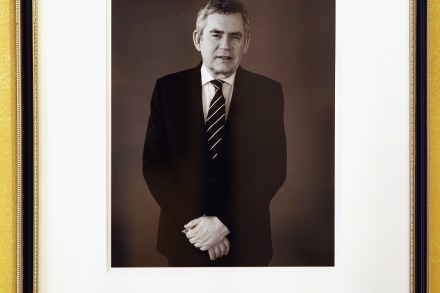
Gordon Brown, back in No.10
Or, rather, he's back in portrait form, as unveiled earlier today: And here it is in full, Prime Ministerial context:.
VERDICT: To paraphrase that famous football cliché, this was a session of two halves. Cameron put in a confident performance against what should have been the trickier set of questions: on the economy. But when it came to Ed Miliband's second topic of choice, the NHS, it all went suddenly awry. The PM's arguments were unusually messy and convoluted, lost in themselves. And he only made matters worse with his Winner-esque exhortation at a Labour frontbencher, "Calm down, dear!" You can argue whether it was sexist of the PM, or not, particularly as it's not clear whom the remark was aimed at (although the smart money's on Angela Eagle). But it was, at least, a moment of frustration that played up to the worst Flashman caricatures of the PM.
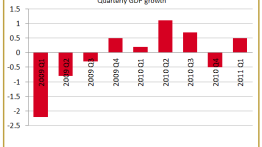
So, we're not back in recession, and growth of 0.5 per cent in the first quarter of this year is in line with what many forecasters were predicting, but... It is hardly indomitable stuff. As Duncan Weldon explained in a useful post yesterday – in which he rightly picked me up on a loosely worded post of my own (since, cheekily, edited) – 0.5 per cent merely compensates for the shrinkage experienced thanks to the snow last year. Across the last two quarters, economic growth has effectively plateaued. It's as we were, Q3 2010. The politics of the situation is fissile, even if we are stuck in the murky area of not-recession-but-not-strong-growth. There will undoubtedly be more pressure on the Coalition, from all sides, to ramp up their efforts for growth.
It may look diminutive in between Easter and the Royal Wedding, but tomorrow is still a big day in the political calendar. It is, after all, the day when we hear the official growth estimate for the first quarter of this year. A negative number, and we shall have experienced two consecutive quarters of shrinkage — which is to say, the country will be back in recession. A positive number, and we shall have avoided that unhappy fate. So what are the forecasters saying? The consensus among bodies such as the NIESR and the CBI is around 0.5 percent, which – as Duncan Weldon explains in a very useful post – is barely enough to compensate for last quarter's snow-induced hit, but is still some sort of growth.
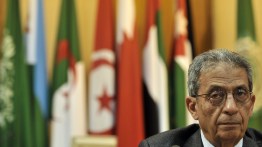
William Hague has chimed in on the situation in Syria, unsurprisingly condemning the horror and bloodshed being perpetrated by al-Assad's regime. But considerably more significant is the statement that has today been released by the Arab League. Although the text doesn't mention al-Assad by name, it clearly has the Syrian autocrat in mind when it calls on "Arab regimes and governments to commit to and speed up reforms, [and to] immediately stop using force against demonstrators and spare their citizens bloodshed." And it goes further, too, in defending the political — and moral — legitimacy of the protests, saying that the unrest blazing across the Middle East heralds "a new Arab era … led by youths seeking a better present and a brighter future.
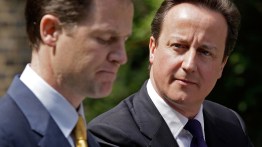
This week, breakage. Next week, super glue. Given the noises emanating from Downing Street, there's little doubt that the Tory and Lib Dem leaderships are going to do a repair job on the coalition once the AV referendum has been decided. As Rachel Sylvester puts it in her column (£) today, "Mr Cameron and Mr Clegg have had several amicable meetings to discuss how to handle the fall-out from the referendum. Both agree that whoever wins should be gracious, and allow the lower to take a bit more of the limelight in the weeks after the vote." They will be looking for quick and easily triggered bonding mechanisms, not least to repel Labour's charge that the coalition is damaged goods. But the question is: what do those bonding mechanisms look like?
By some dark magic, the Ghosts of New Labour have been roused from their political slumber. Over the extended weekend, we had news of Gordon Brown's new job and Alistair Darling's new book. Today, it is Peter Mandelson and Alan Johnson who are haunting the newspapers. Both give interviews – one to the Independent, one to the Guardian – with the same purpose: to rally the vote in favour of AV. Mandelson's is even front page news. "This is our chance to hurt Cameron," reads the headline, underneath a portrait of the man whom Labour learned to un-love after last year's election. Both interviews suggest that Labour are catching up with some of the risks attached to next week's referendum.
Politics has never really settled down since last year's general election — but it still seems especially convulsive at the moment. Only a few weeks ago, Clegg was caught on camera joking about his and Cameron's similarities. Only a few days ago, he was standing up, vigorously, for the coalition. Yet, now, both his rhetoric — and that of his party — has been dipped in acid and wielded against the Tories. And while there is some speculation about how much of the hostility is staged, and about which ministers actually mean it, the basic fact remains: the coalition is no longer a happy band, but increasingly a collection of rivals.
It was, I'm sure CoffeeHousers noticed, the Queen's 85th Birthday yesterday. So here, as a belated commemoration, is an item from the archives that is a even more archival than usual. You see, it's an article that was written on the event of the Queen's 80th Birthday in 2006 — and it looks back at the issue of The Spectator that was published when the Queen was actually born, in 1926. Mary Wakefield, our deputy editor, is the author: The week the Queen was born, Mary Wakefield, The Spectator, 8 April 2006 It was press day at The Spectator when Queen Elizabeth II was born. The printers had set the lines of type for the edition of 24 April 1926, and were waiting for the extra paragraph about the new royal baby. Did their hearts swell with pride when it arrived?
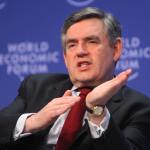
I'm sorry to do this to you, CoffeeHousers, at the start of a bank holiday weekend — but I thought you might have a morbid sort of interest in Gordon Brown's latest role. Turns out that, as expected, our former PM is to join the World Economic Forum in an advisory capacity. He won't be paid for his work, although the Forum will cover his staffing costs. One of his spokespeople has told ITV's Alex Forrest that his task is to "stop the next financial crisis." Which is to say, he'll be saving the world. Again. If nothing else, it's yet another demonstration of Brown's peculiar resilience. Our former PM may be electoral anathema in these parts, but he clearly still holds some allure for the technocrats of Davos, Geneva and Bretton Woods.
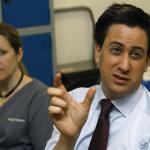
Miliband-o-rama on this Good Friday, with the Labour leader spread all across the papers. The Mirror reports that he is to have an operation to have his adenoids removed this summer, in a rather extreme bid to "improve his voice". The Guardian says that he's to deliver a speech next week — presumably with adenoids still intact — that will engage with the "Blue Labour" thinking of Maurice Glasman. And, if that's not enough, there's a curious interview with Miliband in the Sun. I say "curious," because there aren't too many interviews where a party leader goes through the (less than flattering) nicknames that have been bestowed upon him — and offers comments. On Wallace, from Wallace and Gromit, he says, "I don't see the resemblance, but it is not bad.
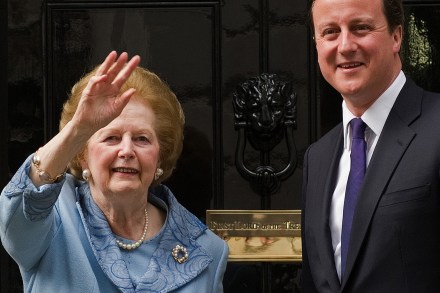
As you've no doubt deduced from the cover image on the left-hand side of this page, the latest Spectator is out today — and it's a soaraway double issue for Easter. By way of peddling it to CoffeeHousers (buy it here, etc.), I thought I'd mention one article among many. It's a celebratory list of some of the country's "most inspiring and influential over-80s," and it includes tributes to them from some rather notable under-80-year-olds. So we have Matt Ridley on David Attenborough, Alex Salmond on Sean Connery, Ian Rankin on P.D James, and plenty more besides. Anyway, there are two entries that CoffeeHousers might care to see in particular, so I've pasted them below: David Cameron on Margaret Thatcher, and Nick Clegg on Shirley Williams.
It's a funny thing, reading the speech on AV that Nick Clegg delivered to the IPPR this morning. It starts off as you might expect: putting some distance between his party and the Tories. Everything is Liberal-this and Liberal-that, while "conservatives" are cited as the opponents of change and choice. But then, from nowhere, comes one of the most brutal attacks on Labour that Clegg has delivered in some time. "For every £8 we are cutting they would cut £7," he quivers. "To deny that reality is to treat the British people like fools." The New Statesman's George Eaton has sifted through the numbers here, but the main point is simply the sheer force of Clegg's words.
It's just a single poll, sure — but Ipsos MORI's latest is still fairly eye-catching stuff. And this is why: it has the Tories level with Labour for the first time since October. Anthony Wells serves up a pinch of salt over at UK Polling Report, saying that this "unusual" result is most likely down to the weightings that are used. But, technicalities aside, any poll that puts the Tories close to Labour, at this stage in the political cycle, is going to be greeted cheerily by Cameron & Co. – and less so by Team Miliband. It's not all bad news for Ed Miliband, though. His personal ratings have improved since last month; a fact which deepens one of the conundrums of his reign.
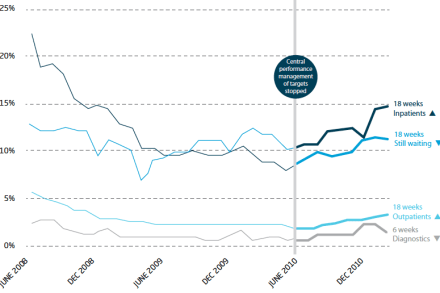
Another story to sour Andrew Lansley's cornflakes this morning: the King's Fund has released a "monitoring report" into the NHS which highlights, among other things, that hospital waiting times are at a 3-year high. The figures they have used are available on the Department of Health website — but unshackled from Excel files, and transcribed into graph form (see above, click for a larger version), they are now, it seems, a discussion point. The Today Programme tried to bait a couple of NHS chieftains on the matter earlier. The worst they could extract from either of them was that, "[waiting times] haven't got massively longer now, but people are worried about the future.
There is no rest for the Prime Minster. After delivering his speech on immigration in Romsey this morning, there was another to deliver, 62 miles away in Woking, this afternoon. This second CamSpeech of the day was billed as a scene-setter for the local elections — and so it proved. Rather than dwelling on a single policy area, the main purpose was to rattle through 101 reasons to vote Tory on 5 May. If there is anything to be taken from the text, it is just how upfront and unapologetic it is. There is little room for nuance, but plenty of room for sweeping, and forceful attacks, on Labour. This passage stood out: "I think we should remember how far we’ve come.
What to do when you've already saved the world? Save it all over again, judging by Gordon Brown's latest reported manoeuvrings. Today's Mail claims that our former PM is "clear favourite" to be succeed Dominique Strauss-Kahn as head of the International Monetary Fund. Although, as the paper says, it's likely that the Coalition would operate against any such appointment. To remind the suits what they might be imposing on themselves, I thought I'd return to this post that we put up on Monday. It asked CoffeeHousers what Brown's biggest mistake in government was. And we received more than enough responses to vote on a Top Ten, as below. We'll keep the vote open until 1700 tomorrow, at which point we'll announce the results. In the meantime, just get clicking and commenting.
I wrote earlier that the immigration debate can bite back — and it's already done just that. Speaking this morning, Vince Cable has labeled the Prime Minister's speech as "very unwise," and at risk of "inflaming extremism." That, lest it need saying, is the same Vince Cable who's a member of Cameron's government. In theoretical terms, what this clarifies is the parameters of the Coalition Agreement. While almost every policy that Cameron highlights in his speech is part of that document, it seems that the Lib Dems don't have to agree with the way he sells them. The point is being made, this morning, that the idea of reducing net migration to its 1980s levels is very much, and very specifically, a Tory ambition.
There is, really, little that is new in David Cameron's speech on immigration today. Besides one or two grace notes, almost all of its policy suggestions appeared in the Coalition Agreement: you know, all the stuff about a cap on immigration and a Border Police Force. Its rhetoric is strikingly similar to Cameron's last big speech on immigration in October 2007. So if he's not saying anything particularly groundbreaking, what is he saying? With the local elections only three weeks away — and on the back of the Lib Dems' newfound assertiveness — it's hard not to see this as an outreach exercise. This is one for core Tory voters, or perhaps those considering voting Ukip or worse. Which isn't to say that Cameron's speech is a Bad Thing.