Peter Hoskin

Yes to AV on the ropes as the final round approaches

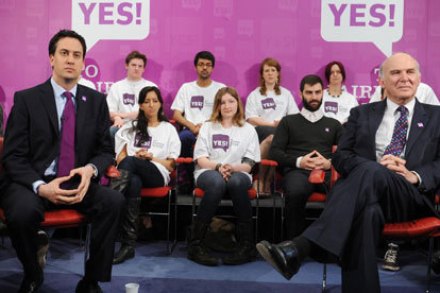
Thanks to this ComRes poll, the question floating around Westminster this morning is: how much?! You see, with only a day to go until the AV referendum, it has the No camp on 66 per cent, and the Yes camp on 34. That puts No a punishing 32 points ahead of its rival. Even allowing for the peculiarities of a bank holiday weekend – as noted by Anthony Wells here – it's still an astonishing gap. It augurs a landslide. Or does it? To my mind, much still rests on turnout and on the voting patterns of Wales, Scotland, etc. Yet there's no denying that Yes are up against it – and in a major way. Their problem, and the problem that they have faced throughout this campaign, is perfectly encapsulated by this morning's newspaper editorials.

Meanwhile, in Libya…

The death of Osama Bin Laden may be a very arresting punctuation mark in the conflict against tyranny — but the conflict continues nevertheless, not least in Libya. The latest news from the country is that the rebels are maintaining their fragile hold on the port town of Misrata, although Western agencies are still struggling to send in aid and relief supplies. "We have seven ICU beds and eleven cases," is how one hospital worker puts it to Channel 4's Alex Thomson. "What is Nato doing? What is the world doing? If any more people come here they will die.

CIA director blasts Pakistan’s intelligence service

"It was decided that any effort to work with the Pakistanis could jeopardise the mission. They might alert the targets." There have been few blunter, nor more high-profile, condemnations of Pakistan's intelligence operation than that made by Leon Panetta, the CIA chief, in interview with Time magazine today. And there are plenty of other noteworthy nuggets in the article as well: among them, Panetta's claim that the US has seized an "impressive amount" of raw intel from Bin Laden's compound. And how about this: "Intelligence reporting suggests that one of bin Laden’s wives who survived the attack has said the family had been living at the compound since 2005, a source tells TIME.

Pakistan responds

The covers of our newspapers are emblazoned with Bin Laden this morning — but it is an article in a US newspaper that really catches the eye. Pakistan's President, Asif Ali Zardari, has written an op-ed for the Washington Post that defends his country's role in the struggle against Al-Qaeda. It's a defence that has four components. 1) Sympathy: "Pakistan … joins the other targets of al-Qaeda in our satisfaction that the source of the greatest evil of the new millennium has been silenced." 2) Credit-sharing: "We in Pakistan take some satisfaction that our early assistance in identifying an al-Qaeda courier ultimately led to this day." 3) Defiance: "Pakistan has paid an enormous price for its stand against terrorism.

What Obama said about Bin Laden and Pakistan before he became President

After the events of today, the video above has fresh resonance. It is from the first presidential debate in 2008, and features Barack Obama defending his previously stated view that "if the United States has Al Qaeda, Bin Laden, top level lieutenants in our sights, and Pakistan is unable or unwilling to act, then we should take them out." Turns out, in this case, he was true to his word.

Osama Bin Laden’s death: the world responds

We have already seen Barack Obama's statement on the death of Osama Bin Laden. Below is more reaction from across the world: David Cameron: “The news that Osama Bin Laden is dead will bring great relief to people across the world. Osama Bin Laden was responsible for the worst terrorist atrocities the world has seen - for 9/11 and for so many attacks, which have cost thousands of lives, many of them British. It is a great success that he has been found and will no longer be able to pursue his campaign of global terror. This is a time to remember all those murdered by Osama Bin Laden, and all those who lost loved ones. It is also a time too to thank all those who work round the clock to keep us safe from terrorism. Their work will continue.

A map that raises questions

Here's a map that I've put together of the area where Bin Laden was discovered and killed. The red point is his suspected residence, the blue and green points are Pakistani military centres.

Osama Bin Laden is dead

The manhunt is over, as is the man. After almost a decade since 11 September 2001, a decade of the Afghan conflict, Osama Bin Laden is dead. The Al Qaeda leader was shot by US forces, not in a dusty cave complex in the mountains, but at a large house north of Islamabad. Announcing the news last night, Barack Obama called it, "the most significant achievement to date in our nation's effort to defeat Al Qaeda." It will surely be remembered as the most significant achievement of his Presidency, too. Let's remember, though, that Bin Laden was not Islamist terror, just as Islamist terror is not Bin Laden. The fundamentalists are a diffuse and diverse poison. Even Al Qaeda itself has many chiefs and many bases of operation, from Afghanistan to Yemen.

Obama contra Trump

You thought Barack Obama had finished with Donald Trump by releasing a copy of his long-form birth certificate? Not nearly. At the White House Correspondents' Dinner last night — video above — the US Pres took every opportunity he could to bait his bouffant-haired baiter. From the tongue-in-cheek music video that kicks of proceedings — "I am a real American," it declares against clips from the Transformers and Karate Kid — to the even more tongue-in-cheek attack on Trump's credentials that follows; this was humour wielded as a weapon. And, yes, Trump was in the audience to witness it all.    Obama also runs through some of the likely Republican Presidential candidates, much as Richard Littlejohn did for The Spectator recently.

Chris Huhne pitches to the left

We're used to AV platform-sharing by now — so it's not the fact that Chris Huhne has written an article for the Observer alongside Labour's John Denhan and the Green's Caroline Lucas that shocks. It's the words he then puts his name to. "Britain consistently votes as a centre-left country and yet the the Conservatives have dominated our politics for two-thirds of the time since 1900," begins the article. "No wonder David Cameron says the current system 'has served us well'," it continues. Although subsequent paragraphs are more conciliatory — claiming, for instance, that Tory voters in the north also suffer thanks to our electoral calculus — this is nonetheless a provocation to rile Huhne's coalition colleagues.

The AV scrap enters its final stage

There are, as James pointed out earlier, only five days to go until the AV referendum  — and that means both campaigns are priming their final appeals for our hearts, minds and votes. So just what will those appeals look like? Today has brought some indication. As Paul Waugh reveals over at PoliticsHome, the Yes campaign is planning to wheel Eddie Izzard — of course! — in front of the microphones. The comedian is going to take part in 16 events across the country this week. And as for the No campaign, ConservativeHome have pictures of their new poster campaign and promotional leaflet. It's the latter that really tugs at the ol' retinas: a shot of Nick Clegg outside No.

Purnell stakes out a new welfare battleground

I said a few days ago that the spirit of James Purnell lingers over the welfare debate in Britain. Well, you can now scratch out "spirit". The real-life, corporeal version of Purnell is giving a speech in Australia today — and, judging by its write-up in the Guardian, it is one that should have some resonance on this side of the planet. This is not just an address by a former Labour MP on where his party should go next — although it is partially that — but also the staking out of new ground on welfare policy. Whether you agree with it or not, it deserves some attention. So what does Purnell say? Much of it is a straight disavowal of New Labour's money-centric approach to welfare and poverty.

An honest plea? Or a cynical gambit?

I was planning on collating today's sunny newspaper covers for Coffee House — but Tim Montgomerie has beaten me to it. So let's, instead, turn our attention away from the Royal Wedding, and on to Libya. A striking thing has happened there this morning: Gaddafi has called for a ceasefire, and for negotiations between his regime and NATO. Although the murderous leader's television address was shot through with the usual defiant rhetoric — "No one can force me to leave my country and no one can tell me not to fight for my country," he bellowed — it also included some concessionary passages. "Let us negotiate," was one of them. "We cannot fight each other," was another. Of course, we should treat this intervention with wholesale quantities of salt.

From the archives: the marriage of Charles and Diana

It is just under thirty years since Prince William's parents, Prince Charles and the late Princess Diana, were themselves married in St Paul's Cathedral. Below are two Spectator articles relating to that wedding. The first is the Spectator editorial from the time, the second an essay by Auberon Waugh on the lessons to be drawn from the occasion. Now that Kate Middleton has become Princess Catherine, you may also want to click here for an article entitled "What Kate should know," by Diana's former private secretary, Patrick Jephson, for The Spectator in 1996. Anyway, back to 1981… The symbol of unity, The Spectator, 1 August 1981 The marriage of the heir to the British throne inevitably leads one to reflect on the on the monarchy and its function today.

From the archives: the Queen’s wedding

Perhaps it's the pageantry of the occasion, but it does feel like one of those days for looking back as well as forward. In which case, we'll have a double dose of Royal Wedding-related archive posts today, of which this is the first. And what a doozy it is, too: The Spectator's editorial on the wedding of the Queen to Prince Philip in 1947. So many of its observations and exultations might equally apply today. "The spirit of egalitarianism is in the air," it notes, "To that even royalty may have in some degree to adapt itself." The adaptation, you feel, is still being written by those gathered in Westminster Abbey this morning. Princess and wife, The Spectator, 21 November 1947 The heiress to the throne is now a wife.

A day when politics is not the story

This, it has to be said, is not much of a day for politics. Although the world's laser-like attention will be focussed on Westminster, it will not be on the operations of our Parliament or its actors, but on Westminster Abbey and the marriage, of course, of Prince William and Kate Middleton. The cameras might pass for a moment over David Cameron, or Ed Miliband, or Nick Clegg. But even their best morning suits will not compete, you fancy, with the collected fascinators and finery on display — let alone with the wedding dress itself. We shall be marking proceedings on Coffee House with video, with archive posts and with our general observations.

The Royal Wedding by numbers

I know, I know, it's deeply unromantic to anticipate tomorrow's Royal Wedding through the prism of opinion polling. But as no one ever said that a political blog has to be romantic — and as there are some quite noteworthy findings among all the data — we thought we'd put together a quick round-up for CoffeeHousers. So here goes: 1) The guest list. There has, I'm sure you've noticed, been quite some hubbub over the fact the Gordon Brown and Tony Blair haven't been invited to the wedding — especially in view of the Syrian ambassador's invitation, since withdrawn. But some new polling from YouGov — highlighted by PoliticsHome — suggests that the public agree with the twin snub for our former PMs.

Righting the wrong of sickness benefits

He may no longer be an MP, but the spirit of James Purnell lingers on. It was, after all, the former Work and Pensions Secretary who introduced the Employment Support Allowance as a replacement for Incapacity Benefit in 2008, with the idea of encouraging people – the right people – away from sickness benefits and into the labour market. And now we have one of the strongest indications yet of just how that process is working. According to figures released by the DWP today, 887,300 of the 1,175,700 claimants who applied for ESA between October 2008 and August 2010 failed to qualify for any assistance – with 458,500 of them declared fit for work straight away, and 428,800 not completing their medical assessment. That's 75 per cent overall.