Peter Hoskin

Universally speaking

As Paul Waugh notes, James Purnell's article for the Times today (£) is striking for its attack on universal benefits. "I have never bought the argument," writes the former welfare secretary, "that universal benefits bind the middle classes in. It feels too much like taxing with one hand to give back with another." Although this is, in truth, a point that he has been making for some time. He said something similar in a speech back in April. The question, really, is how much Purnell's viewpoint will percolate down through Labour circles.

Boris to the fore

Politics has a big, blond hair-do today, with Boris wiff-waffing all across the airwaves. The Mayor of London has already, this morning, called on George Osborne to do more to cut taxes, specifically the 50p rate and national insurance. And he will be leading a series of events, throughout the day, to mark the fact that the Olympic Games are exactly one year away. The Aquatic Centre will be baptised, the medal designs revealed, and general celebration staged across the city. It's difficult not to see all this as part of Boris's re-election bid, and perhaps as a marker for his wider ambitions. Although London's Olympics have not been an unambiguous positive so far, they still give him a bigger and friendlier platform than most politicians will enjoy over the coming year.

Cameron compromises, but Gaddafi might not

What a difference four months of air sorties make. Back in the early days of the Libya intervention, David Cameron was unequivocal when it came to Muammar Gaddafi remaining in the country: there was "no future" for the dictator within its borders, he said. But now, on top of comments by William Hague yesterday, the Prime Minister is thought to be softening his stance. As the Independent says today, he has decided that "the time has come to find a way out of the conflict and back a French proposal to allow Gaddafi to stay in the country as part of a negotiated settlement with rebel forces." So, from no future for Gaddafi to some sort of future, and all while the bombs have been dropping. But France and Britain's change in tack is unlikely to have much effect on the ground.

And the game goes on…

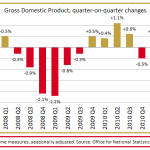
Today's growth figures are a problem for George Osborne. It's basically part of his job description to nurture growth — but, looking at the graph above, he's not having much joy in that. Even allowing for the fact that without one-off shocks such as the Japanese tsunami and the Royal Wedding Q2 growth might have been 0.7 per cent, instead of 0.2 per cent, the Chancellor has some convincing to do. Describing today's figures as "positive news", as he did, was not the best start, especially with inflation soaring ahead of people's spending power. But although those are the facts of life for Osborne, there are reasons for him — and us — to take a step back from this 0.2 percent figure.

The Game of Growth

The release of the Q2 growth figures is still half-an-hour away, but Westminster is already on the boil. Much of the fuss and froth is because it's expected that the economy barely grew at all between April and June, or perhaps even shrank. But some of it is down to this Telegraph story, which suggests not just that "Downing Street aides [have] become increasingly impatient with a lack of growth," but that David Cameron's permanent secretary, Jeremy Heywood, recently held a meeting with Treasury and Business officials, and "read them them Riot Act". So is the longstanding friendship between Dave and George fraying at the edges? Benedict Brogan says not, but adds that things are far from rosy when it comes to their respective teams.

Lansley’s letter pours fuel on Labour’s bonfire

Just when everyone is all afroth about the murky connections between the political class and the media, a letter by Andrew Lansley to Danny Alexander has mysteriously leaked to the Telegraph. It was sent two months ago, and it concerns the government's public sector pension proposals. For five pages, Lansley riffs on about why the reforms may not be such a good idea, particularly when it comes to NHS workers. "We face a real risk, if we push too hard," he says, "of industrial action involving staff groups delivering key public services." He suggests that lower and higher paid staff may just opt-out of the pensions scheme altogether, leaving the Exchequer with "reduced receipts in the short term while still having to pay for past pension promises.

Osborne’s summer of pain starts here

It has mostly been a weekend of terrible and grisly news, especially with the details emerging from Norway about Anders Behring Breivik and his murderous brand of politics. But there was also, behind it all, a slight rebalancing of the British political debate. After weeks of grandmaster-like focus on the phone hacking scandal, our politicians have started talking about the economy again. With the GDP growth figures for the second quarter of this year due out tomorrow, they're all trying to get their spin in early.

See you on Monday

Normally, Coffee House prides itself on being the cafe that never sleeps. But now, after four years — and a particularly furious recent few weeks — we're taking a weekend break to cool our typing fingers and our keyboards. Normal service will, of course, resume on Monday. In the meantime, you can either use this post as an open thread, or head over to the CoffeeHousers' Wall.

Clegg contra the British Establishment

In some ways, Gordon Brown's absurd speech yesterday evening felt like the crest of a wave. It's not that the phone hacking scandal has gone away — far from it. But the initial surge of political activity and spite has abated, having achieved many of its immediate goals: the end of the BSkyB bid, a judge-led inquiry, and so on. Now, our politicians are entering the second phase of this crisis, which will be more about the wider picture and less about News International specifically. There was a hint of this in Nick Clegg's interview with the Today programme earlier, a preview of a speech he is delivering later today. The Lib Dem leader admitted that he sees the phone hacking scandal as an "opportunity" to "clean things up" more generally.

The OBR warns of a fiscal storm

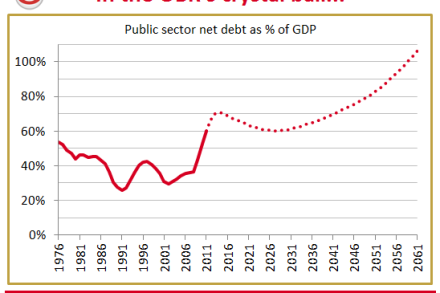
The Office for Budget Responsibility's 126-page Fiscal Sustainability Report really oughtn't make for electrifying reading. But it does. What Robert Chote and his gang of number-crunchers have done is to gaze into our fiscal abyss, and summon up forecasts so that the abyss can gaze back into us. I mean, look at the graph above. On the OBR's account, our country's debt burden could well rise from around 70 per cent of GDP now to over 100 per cent in 50 years time. It is a perturbing trajectory, to say the least. But, before we go any further, we should slap all kinds of health warnings across this. Long-term forecasting is, by its very nature, an uncertain science — and there are plenty of uncertainties in the OBR's work.

PMQs live | 13 July 2011

A change from the Coffee House norm for this last PMQs before the summer recess. Instead of the usual live-blog, we'll be live-tweeting the session, and our tweets will appear in the special window below (you may be familiar with it from Guido's PMQs coverage). Tweets from other political types may also appear. And you can add your own remarks to the live-stream not in the comments section, but in the space below the window. Anyway, it should all be fairly self-explanatory. It might work, it might not. In either case, do let us know what you think.

Parliament prepares to take on Murdoch

Politicians are swarming all over the phone hacking scandal today, in even greater number than during the past week. If it isn't the main topic at PMQs at noon, then it certainly will be immediately afterwards; when David Cameron delivers his statement on an inquiry into the whole mess. And then there's Labour's Opposition Day motion, urging Rupert Murdoch to withdraw his bid for BSkyB. By the end of the day, our parliamentarians will surely have delivered an official reprimand to the News Corp boss and his ambitions. The news that the government will vote in favour of Ed Miliband's motion has sucked some of the vicious factionalism out of today's proceedings. But, never fear, there will still be plenty of political one-upmanship to go around.

The war between Brown and Murdoch heats up

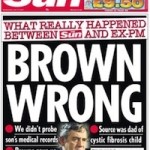
Gordon may have come carrying dynamite, but News International has some explosives of its own. In a pair of statements this afternoon, the Sun and the Sunday Times have set about undermining, or just plain denying, our former Prime Minister's testimony. By the Sun's account, not only did they get the story about his son's medical condition from a "member of the public [who] came to The Sun with this information voluntarily because he wanted to highlight the cause of those afflicted by [cystic fibrosis]," but Brown's colleagues also "provided quotes" to be used in the final article. By the Sunday Times's, their investigation into Brown's property transactions was pursued "in the public interest," and "followed the PCC Code on using subterfuge.

A pain in the wallet

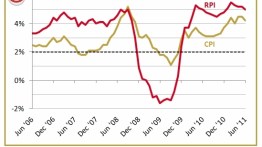
So far as today's inflation figures are concerned, it's April all over again. Just like then, CPI inflation has fallen (in this case, from 4.5 per cent to 4.2 per cent). And just like then, I'd urge against excitement. We are still, don't forget, ballooning above the target level by over 2 percentage points. And forecasters, including the Office for Budget Responsibility, expect us to remain above that level for months, perhaps years, to come: Besides, there are some components of today's inflation figures that are particularly concerning. Take food prices. As we said on the Coffee House Twitter feed, they're inflating at their fastest rate for 2 years. Meat prices alone went up by 2.5 per cent last month, and 8.5 per cent over the past year.

Brown speaks out

We'll try to post the video of Gordon Brown's interview with the Beeb soon. But, for now, here's the transcript of his remarks about News International and his son's medical records: Gordon Brown: [The Sun] told me they had this story about Fraser's medical condition, and that they  were going to run this story. Interviewer: How did that affect you, as a father? GB: In tears. Your son is now going to be broadcast across the media. Sarah and I are incredibly upset about it. We're thinking about his long-term future. We're thinking about our family. But there's nothing that you can do about it. You're in public life, and this story appears. You don't know how it's appeared. I've not questioned how it appeared.

What didn’t make it into today’s reform paper?

"It's like Blair and Brown — but without the acrimony." So sayeth one Cabinet Office source, describing the prolonged build-up to today's public services White Paper to me a couple of months ago. His point was that, although the yellow and blue halves of the Downing Street operation are genuinely chummy with one another, their differences can still put a block on reform. In his story, the Tories are like Blair, striving to go further, faster, stronger. Whereas the Lib Dems can occasionally stand in the way. So what has been blocked from the White Paper? Listening to David Cameron today, you wouldn't guess that anything has been. "Let me assure you of this," he said in his speech this afternoon, "we are as committed to modernising our public services as we have ever been.

Enter Gordon Brown, with dynamite

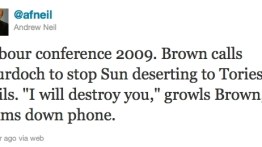
The clunking fist is descending on Rupert Murdoch. After rumours all afternoon about Gordon Brown giving a statement on phone hacking to the Commons, the Guardian has come up with specifics: News International, they allege, used private investigators to target our Prime Minister's phone, his bank account and his family's medical records. You should be able to watch it all go down in the Commons, very soon. As Guido has said, there is more than a hint of cold, cold revenge about this. For all his overtures to the Murdoch press, Brown never wound his way into their affections as Tony Blair did. The Sun's decision to shift over to the Tories, in 2010, sparked Brownite anger at the time. That anger still rankles.

Clegg puts the boot into Murdoch’s BSkyB bid

What Jeremy Hunt's letter this morning started, Nick Clegg has just finished. Thanks to the Deputy Prime Minister, it is now even clearer that the coalition is reluctant for Rupert Murdoch's BSkyB deal to go ahead. "Look how people feel about this, look how the country has reacted with revulsion to the revelations," he exhorted in interview with the Beeb, "so do the decent and sensible thing and reconsider, think again about your bid for BSkyB." The question now is what's meant by that "reconsider" — whether it means the government is pushing for a delay, or for Murdoch to drop the bid altogether. But, either way, it's several degrees firmer than anything they've said previously.

Miliband primes his weapon of choice

There's a lot to sift through in the papers this morning, even apart from history's final edition of the News of the World. I mean, a report that Rebekah Brooks is to face police questioning over the phone hacking scandal; an interview with the assistant commissioner of the Met, who apologises and flusters over the original police investigation; and claims from Paddy Ashdown that he warned No.10 "within days of the election" about the Coulson-shaped trouble that was heading their way. But more politically significant is the news that Ed Miliband could push for a Commons vote, on Wednesday, to block News Corp's takeover of Sky. The Labour leader outlined his plan on Andrew Marr's show just now, saying that, "I don't think [David Cameron] can carry on with business as usual.