Peter Hoskin

More fuel for the media bonfire

I read the news today, oh boy — and it seems that Paul McCartney has waded into the phone hacking row. After claims by his ex-wife, Heather Mills, that her voicemails were accessed by the Daily Mirror, the former Beatle is now set to share his own concerns with the police. Although we cannot yet be sure of the specifics of Sir Paul's case, the whole episode is likely to increase the pressure on Piers Morgan, who was editor of the Mirror when the alleged hacking of Mrs Mills' phone went down.

Fasten your seatbelts…

It has, to paraphrase Margo Channing, already been a bumpy night — and it's only going to get bumpier today. The latest news is how the Asian markets have trembled at what's happening in the West. Japan's main stock index is down 3.7 per cent. Australia's is down 4.2 per cent. Hong Kong's 5.3 per cent. And even oil futures joined in with the collective nosedive, which is continuing as the European exchanges open this morning. All of which adds to the catalogue of horror that was written yesterday. CoffeeHousers will read plenty of grim comparisons in the papers today, not least that yesterday's plunge in the Dow Jones was the worst since 2008.

The IMF manages to please everyone

A bet-hedging sort of report into the UK's economy from the IMF today, which largely supports George Osborne's deficit reduction plan, but will also give some encouragement to his detractors. By way of a summary, here are the parts that might satisfy Osborne himself, as well as Vince Cable, Ed Balls and Mervyn King: The passage that the Chancellor will flash around Westminster comes on the very second page of the IMF document. "Strong fiscal consolidation is under way," it reads, "and remains essential to achieve a more sustainable budgetary position, thus reducing fiscal risks.

Which department could be replaced with a mathematical equation?

I answer the question in an article for the Times (£) today, in response to Francis Maude’s announcement yesterday. But for those CoffeeHousers who can't vault the paywall, here's the relevant passage: "I have been told of an internal report that makes the argument sublimely well. Before last year’s spending review, the Treasury asked a group of outside experts whether plans for a 40 per cent headcount reduction at the Department for Communities and Local Government were too ambitious. Their response? It wasn’t nearly ambitious enough. The staff cut ought to be at least 90 per cent. Responsibilities for fire prevention could be transferred to the Home Office; responsibilities for troubled families to the Education Department; responsibilities for .

The House of Representatives passes the debt deal, as Giffords returns

After all that, the House of Representatives has passed the bill to raise America's debt ceiling, by 269 votes to 161. But, for all the economic significance of last night, it was the vote of one woman that really set proceedings alight. Congresswoman Gabrielle Giffords returned to the floor of the House for the first time since surviving an assassination attempt in January, to vote 'yes': And in less heartening news, Vladimir Putin has described America as a "parasite" on the global economy.

Alexander rallies behind the 50p rate

Danny Alexander is usually the very model of collective responsibility: sober, unfussy and diligent, he sets about the coalition's work without ever causing a scene. Which is what makes his televised comments about the 50p tax rate earlier all the more striking. When pressed on the subject by interviewer Sophie Rayworth, the Chief Secretary to the Treasury was forceful in response. The government doesn't necessarily want to cut the rate, he suggested, and those who thought it would are inhabitants of "cloud cuckoo land". He went on: "We set out in the Coalition agreement, and it's something that we as Liberal Democrats pushed very hard for, that the Government's first priority in tax reductions would be tax cuts for people on low and middle incomes.

Apocalypse averted?

At last, signs that Washington's lawmakers may have scrabbled together a debt deal after all. According to the overnight wires, the White House and Congressional leaders have alighted on a package that would raise the ceiling by $2.4 trillion, so long as the deficit is reduced by at least the same amount over the next ten years. There are more details here, but the key claim is that around $1.2 trillion of immediate spending cuts have already been agreed upon, with a Congressional committee to recommend further deficit reduction measures by the end of November. And although these proposals will still have to pass through the corridors of Congress, leaders from both sides sound increasingly optimistic that it will do just that.

Some context for the death penalty debate

Something quite remarkable has happened over the past couple of the days. It started with the launch of the government's new e-petition site, which promises that any petition which secures 100,000 signatures will be "eligible for debate in the House of Commons". And it continued with Guido Fawkes submitting a petition to reinstate the death penalty for "the murder of children and police officers when killed in the line of duty." Now national newspapers and MPs alike are adding their voice to Guido's campaign. And an issue that has huge public resonance, but which is rarely discussed in Westminster, is suddenly getting an airing. Even if — like me — you don't agree with the death penalty, there is still something encouragingly open and democratic about it all.

Ed Miliband needs David Miliband if he’s to make proper headway

Are the seeping knife wounds healing at last? This morning's Guardian reveals that Ed Miliband has offered his older brother a role as Labour's "unofficial ambassador on university and college campuses", and that David Miliband has accepted. Although party sources tell the paper that "this should not be seen as a sign that [MiliD] is being lined up for an early shadow cabinet return," it surely is a sign that the two brothers are repairing their damaged relationship. From barely speaking to each other to mutually preaching the Labour gospel to a bunch of students. It's progress.   Putting aside the fraternal aspects of the story, it is also an encouraging political development for Ed Miliband.

America’s debt crisis fuels Obama’s political crisis

Momentousness without momentum. That's what we're getting from America at the moment, as this all-crucial debt deal continues to stutter and stall. The main development in Washington yesterday was John Boehner securing enough Republican votes to pass his bill in the House of Representatives — only for it to be summarily tabled by Democrats in the Senate. What will follow over the weekend is yet more frantic negotiation between the Democrats and Republicans in Congress, as each tries to make their various plans more acceptable to the other, while also keeping their own die-hards on side. Meanwhile, the clock keeps on ticking down towards default: three days, 13 hours, 35 minutes...

‘Fessing up to drug use, the Mensch way

Just the thing to liven up a slow news day: a response from the Tory backbencher Louise Mensch to a series of insinuating points put to her by "David Jones Investigative Journalists". The points were all about her time working at the record company EMI in the 90s; about her drug use, night-clubbing habits, that sort of thing. And she has answered them in marvellously unapologetic fashion. You can — and should — read the whole exchange here, although Mensch's response to the question of whether she "took drugs with Nigel Kennedy at Ronnie Scott's in Birmingham, including dancing on a dance floor, whilst drunk, with Mr Kennedy, in front of journalists," is worth pulling out: "Although I do not remember the specific incident, this sounds highly probable.

What happens if the US defaults?

The homepage of the Washington Post has a clock ticking down to America's debt-ceiling deadline: four days, 14 hours, and a fast-declining number of minutes and seconds. It also has details of the events, last night, that upset the prospect of a deal being reached yet again. The Republican Speaker of the House of Representatives, John Boehner, had been frantically trying to corral support for a bill that would raise the ceiling in exchange for $billions of extra spending cuts. He only needed 216 of the House's 240 Republicans to vote with him. But it wasn't to be. The vote was called off, postponed until at least later today, as it became clear that Boehner couldn't immediately persuade those in his party who want further cuts still.

The shifting sands of public opinion on Libya

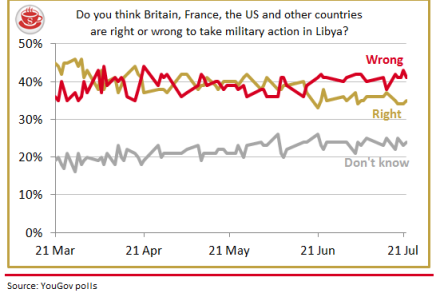
All of the buccaneering rhetoric has been sucked from the Libyan conflict this week, replaced with words of concession, compromise and caution. A few days ago, it was the news that — contrary to what they might previously have said — the government is prepared to let Gaddafi remain in the country after all. Today, William Hague deploys the same line in an interview with the Times (£), in which he also warns that there are "a lot of problems and even convulsions" to come in northern Africa. As it happens, the depressed mood of our foreign-policymakers reflects the tide of public opinion. Here, for CoffeeHousers' benefit, are a couple of graphs that we've made from YouGov's polling questions on Libya.

The romance isn’t dead on Downing Street

Westminster, today, is all a-titter about an anecdote contained within this FT article about Steve Hilton. It is, it must be said, a good 'un: "Mr Hilton’s crusade against employment legislation also saw him suggest that Mr Cameron just ignore European labour regulations on temporary workers, prompting an exasperated exchange with Jeremy Heywood, Downing Street’s permanent secretary. 'Steve asked why the PM had to obey the law,' said one Whitehall insider of a meeting in March to discuss the government’s growth strategy. 'Jeremy had to explain that if David Cameron breaks the law he could be put in prison.

The good news story that Osborne wants you to hear

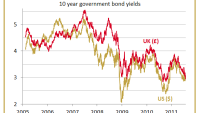
  There was much sly amusement earlier this week when George Osborne, responding to the latest growth figures, described Britain as "a safe haven in the storm". The idea that our high inflation, low growth economy might be a "safe" anything seemed, to many, a grotesque idea. But, in truth, the Chancellor may have had a point — and it's a point that he'll want to make again and again as the recovery stumbles on, and as other indicators fluctuate against him. What the Chancellor was referring to, I'm sure CoffeeHousers know, is the interest rates set by the markets on the UK bonds that fund our borrowing. Broadly speaking, the higher the rates, the less certain our creditors are that the Exchequer can meet its debts.

Alexander’s balancing act

Remember that merry dance between the government and the unions over public sector pensions, a few weeks ago? Expect a minor reprise today, and much more over the summer. The government today announces how much extra public sector workers will have to pay to maintain their pension levels, and already the Telegraph has the numbers. When it comes to the 40,000 best-paid public sectorees — all on considerably over £100,000 — their contributions will rise by around £3,000 a year. And then it's a sliding scale all the way down to the 750,000 least well-paid workers, who will face no increase at all. The unions, who will rejoin the government in talks soon, are unlikely to respond kindly.

The scramble away from cosiness

Aside from Boris's exhortations to George Osborne, one of the most ear-catching lines of the day has been uttered by Jeremy Hunt. "I think the relationships between politicians and the media got too cosy," said the culture secretary on Radio 5 this morning. He's certainly not the first to make the point, but he is one of the most prominent Conservatives to do so. The words, I suspect, were chosen to cool the heat rising from yesterday's lists of meetings between ministers and media organisations. Hunt himself, it was revealed, has met seven times with News Corp types since the general election. Hunt's admission also opens the prospect of a fevered struggle between the Tories and the Lib Dems to appear less cosy with the media establishment.