Peter Hoskin

Lansley stakes his claim on the post-2015 budget

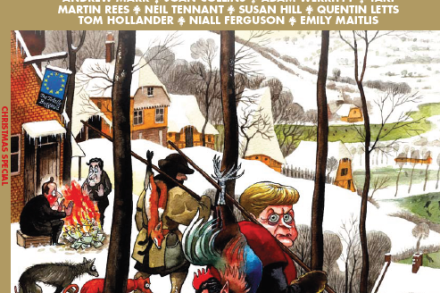
Look slightly to the left, CoffeeHousers, and what you'll see is the cover image to this week's Christmas double issue of The Spectator — a brilliant send-up of Bruegel's ‘The Hunters in the Snow’ by Peter Brookes. You're now able to buy your own copy, but we thought we'd pull out an intriguing little snippet from James Forsyth's interview with Andrew Lansley, by way of a taster. The Health Secretary, it seems, isn't just determined to see health spending rise in real terms in this parliament, but beyond that too: ‘I ask him whether, despite the ramifications of the autumn statement, the NHS budget will still be immune from cuts.

Labour reach out to the Lib Dems (again)

Others have already been there, but it's still worth noting Douglas Alexander's article for the lastest issue of the New Statesman. Much of it, it's true, is a predictable attack on David Cameron's recent activity in Brussels. But slightly more surprising is the fact that, rather than criticising the coalition in toto, Alexander saves his ire for the Tories and reaches out to the Lib Dems. Here's the relevant passage: ‘The roots of what happened on the night of Thursday 8 December lie deep in Cameron's failure to modernise the Tory party. Just because he puts party interest before the national interest, there is no reason others should do the same.

Inflation down, but the squeeze goes on

Has Mervyn King's downwards trend in inflation, promised for over a year now, finally arrived? After all, going by today's figures, inflation has now dropped for two months running. CPI inflation is at 4.8 per cent, and RPI is at 5.2 per cent. What's more, we can expect them to fall even further once the effect the VAT rise is removed in January: But I wouldn't get too excited just yet, CoffeeHousers. Sure, most forecasters have inflation going down from here into the foreseeable future — but, don't forgot, we're still being subjected to pretty high inflation, with CPI over double its target level. And, crucially, even by the OBR's forecasts, inflation is set to outpace wages until at least the end of next year.

Your three-point guide to today’s RBS report

After months of delay, and much hounding by The Spectator's Select Committee Chairman of the Year, Andrew Tyrie, the Financial Services Authority has finally released its report into the wheezing collapse of RBS in 2008. At 452 pages it is a behemoth of a document, and too much for me to have fully digested yet. But a few points stand out at first glance: 1) Don't blame us, blame Gordon. The Tories are making much of the fact that only three politicians are mentioned in the report: Tony Blair, Gordon Brown and, most relevantly, Ed Balls. And they're not mentioned in a particularly flattering context, either. All three are quoted to partially justify the FSA's regulatory approach in the run-up to the RBS debacle.

The new premium on Lib Dem policies

Could it be an accident of timing that the government, in the shape of Sarah Teather, is announcing an expansion of the pupil premium today? Or is it part of a careful response to David Cameron's adventures in Euroland? In any case, the Lib Dem-devised scheme to help the poorest pupils will be extended in 2012-13, so that both the amount given to each pupil and the number of pupils eligible are increased. What's not clear yet is whether this was planned all along, or whether it's because of some previously unforeseen slack in the existing £1.25 billion budget for next year. The pupil premium has, for instance, already been increased for this financial year because fewer children registered for free school meals than expected.

Cameron’s winning the popularity contest over Europe

It's no surprise that David Cameron's actions in Brussels last week appear to be popular with the voting public, but it is significant nonetheless. The Times is carrying a Populus poll today (£) which suggests just how difficult Labour and the Lib Dems will find it to recapture ground over the Continent. 57 per cent of respondents say that ‘David Cameron was right to exercise Britain's veto’, against only 14 per cent who believe he was wrong to do so. And it turns out that 49 per cent of the folk who voted Lib Dem at the last election support the PM too. With one particular exception (which we shall get on to below), most of the poll's other findings will both hearten and embolden the blue half of the coalition.

Spotify Sunday: The new Christmas classics

There are, as they say, only thirteen more shopping days until Christmas. And that, unless you don't much care for seasonality, means only thirteen more days of Christmas music. But what to listen to? There are the old standards, of course: the carols, the hymns, that Slade song. But I thought I'd delve into my collection for a few more recent numbers that you might enjoy. So here's a selection of ten Christmas tracks recorded in the past decade. As always, you can listen to the playlist by following the Spotify link at the bottom of this post. On a Christmas Day — C.W. Stoneking I'm amazed that C.W. Stoneking's music works so well.

The coalition’s latest anxiety attack

It is starting to feel like the build-up to the AV referendum again, if not worse. No longer the casual bonhomie of the coalition's early days, but a great show of mutual distrust and loathing between the Lib Dems and Tories. There was Nick Clegg's interview on the Marr Show earlier, of course, which James has already blogged about. There are rumours that Vince Cable is set to quit. And there is also Paddy Ashdown's caustic article in the Observer, which he has followed by attacking, Major style, the Tory ‘bastards’ on Sky this morning. For their part, many of those ‘bastards’ are looking on at the Lib Dems' pain with glee, eager to make it worse. Some of this is probably choreographed.

Cameron’s ‘No’ leaves Clegg in a tight spot

It's days like this when we should remember that Britain is, officially, the most eurosceptic nation in the EU. Europe may not rank high on the average Brit's list of policy priorities, but many will nonetheless cheer at the idea of us stepping aside from Merkel and Sarkozy's bulldozing plan. Whether the PM swashbuckled or blundered into saying ‘No’, that ‘No’ is unlikely to harm the public's perception of him — and will probably boost it. That's what makes all this particularly difficult for Ed Miliband. Unlike some in his party, the Labour leader is not inclined to out-sceptic Cameron, so that leaves basically one alternative: to claim that the PM has irresponsibly alienated Britain from Brussels, and that our influence will wane as a result.

The Merkozy Plan fails to convince

A day or so ago, the markets were rising in anticipation of what might be achieved at this Brussels summit. But this morning they're mostly either unmoved, or — as in the case of borrowing costs in Italy and Spain — shifting in unpropitious directions. No-one, it seems, has been won over by yet another night of political bargaineering in Brussels. And understandably so. None of the measures mooted this morning are particularly concrete; all have a sogginess about them. More cash will be transferred to the European Financial Stability Facility, but it's still some distance short of the €1 trillion that was, ahem, ‘announced’ at the end of October.

Picketing Parliament

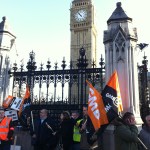
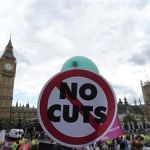
By way of Spectating, I thought I'd take a quick stroll along Westminster's picket lines. And, to be honest, there isn't a huge amount to see, as yet. The groups of around five or six industrial actioneers outside some departments trump the small pile of placards outside the Treasury. There are about thirty to forty people picketing Parliament itself. The photo I shot hastily on my iPhone, above, should give you the sense of it. The striking workers I spoke with, however, were bullish about people turning up later in the day, especially with the march that's happening this afternoon — as well as for the strike's general progress in the rest of London and beyond. An organiser for Met staff reckoned on about 70 per cent turnout from his cohort.

A day of disruption

Another testing day for the government, as we shift from the autumn statement to a national strike. It will certainly be more noticeable than the industrial action in June. Some 2 million public sector workers will be involved. According to the schools minister Nick Gibb, around 75 per cent of state schools will be closed. And on top of that, airport queues will lengthen; non-emergency operations will be cancelled; and today's parliamentary proceedings will go untranscribed. The government's attitude towards the unions — or, rather, union bosses — appears to have been hardening. The brothers will not have liked yesterday's forecast that 710,000 jobs will be shed from the public sector by 2017. And they will not have liked George Osborne's rhetoric either.

Growth has upset Osborne’s plans — and it’s likely to get worse

The real story, as everyone expected, wasn't in the Pre-Budget Report ‘Green Book’ — but in the supplementary document produced by the Office for Budgetary Responsibility. Growth forecasts have taken a dive. And while that is both unsurprising and not all that revealing, it carries grim implications for so much else. I mean, just look at the graphs we produced in our last post: forecasts for debt, unemployment and borrowing are all up. It is not a pretty picture. But despite the dreariness of it all, I suspect that the numbers are far too optimistic.

On the road to break-up?

Before we plunge into the Autumn Statement, we really ought to mention the poison cloud hanging over Brussels today. European finance ministers, including George Osborne, are meeting there later — and it's certainly not going to be good for their collective health. Klaus Regling, the head of the European Financial Stability Facility (EFSF), is expected to tell them that there's basically no chance of them boosting the bailout fund to €1 trillion in the near future, as was promised at the end of last month. Back then, David Cameron urged eurozone leaders to bring a ‘big bazooka’ to the fight. They have barely managed a cap gun. This is far from surprising.

Those gloomy OECD projections in full

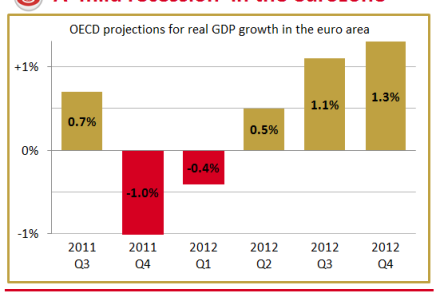
Thanks to the tremors along Westminster's grapevine, we already knew that today's OECD Economic Outlook would make for pretty dreary reading. But now that the report is actually out, we can see the organisation's numbers for ourselves. The headline point appears to be that the eurozone is in, or is facing, ‘mild recession’. Or to put it in graphic form: And the current situation isn't look particularly encouraging for the UK either. The first heading in the section on us reads ‘The economy is weakening sharply’. And a subsequent pair of graphs predicts, first, that we'll experience a mild recession of our own across the next two quarters, and then that unemployment will keep on rising to a peak in 2013.

The trouble with the NHS’s working week

If you like your literature gloomy, then, at first, there may not be much to interest you in the latest Dr Foster Hospital Guide. A double-page diagram, across pages 10 and 11, is mostly about the positive trends of the past ten years: declining mortality rates and waiting times, that sort of thing. The only particularly sour note sounds out from the timeline at the bottom of the spread, which notes the creation of that big, galumphing NHS computer system in 2002, and then its abolition this year for not ‘achieving objectives’.   But keep pressing on, because there is much to be concerned about in the pages that follow — particularly in the second chapter, entitled ‘Reducing mortality at nights and weekends’.

The shape of the Budget battleground

There are still two days and a couple of hours to go until George Osborne's Pre-Budget Report — but, already, we have a good idea of what will be said. The emphasis, beyond just plain ol' jobs and growth, will be on combatting youth unemployment; helping smaller businesses; and relaxing the squeeze on middle-income folk. Most of the measures either announced or suggested so far — from the Youth Contract to the credit easing scheme to the suspension of January's fuel duty rise — fall into one of those compartments. Whether they'll work or not is a different matter entirely.      As for Labour's response, they're already making it — and I doubt anything in the actual Budget document, or the growth review, will change it much.

Cameron cross-questioned

A quick post just to add the Guardian's interview with David Cameron to your Saturday reading list. It takes the unusual approach of fielding questions to the PM from a range of ‘public figures’ — and, although many of those questions reduce down to ‘why aren't you giving more money to X?’, the results are still generally engaging and occasionally insightful. And so we learn, after an enquiry by The Spectator's own Toby Young, that Cameron doesn't keep a diary. And we also have the PM justifiying his stance on Europe to Nigel Farage; skipping over a question about what he may or may not have inhaled during his time at Eton; claiming that ‘not everything [Gordon Brown] did was wrong’; and more besides.