Peter Hoskin

Clark rounds on May

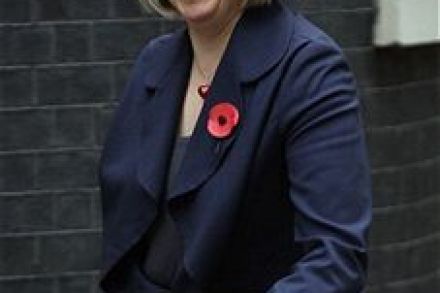
Has anyone used the “Mayday” gag yet? Perhaps it's too cheap and obvious, but it's certainly applicable today. Not only are Theresa May's troubles still splayed across the newspapers — sure to come up in PMQs later — but they have also been aggravated by the man who just quit as head of the UK Border Agency's border force. So far as the bookies are concerned, the Home Secretary is now second-favourite (behind Chris Huhne) to be the Cabinet's next ejectee. As for how the former head of the UK Border Agency's border force, Brodie Clark, has made things difficult for May, I'd suggest you read his resignation statement here. In effect, he accuses May of misleading the Commons about his role in reducing border queues.

Union bosses: Thanks for the concessions, but the strike’s still on

The TUC have just released a statement responding to the tweaked public sector pensions package that I blogged about earlier. It is, in part, fairly conciliatory; saying that the group welcomes "this movement in the government’s position". But it does end with a warning: "unless and until further real progress is made and acceptable offers are made within those negotiations, unions remain firmly committed to continuing their preparations for the planned day of action on November 30.

The pensions battle rages on

An "enhanced offer" is how Treasury types are describing the revised pensions package that will be put before union bosses today — and so it is. As far as we can tell, concessions have been made in three areas: i) the changes to public sector pensions will be spread across seven years, rather than five; ii) the accrual rate, which determines how much of a workers' salary is notionally set aside for their pension each year, will be made more generous; and iii) the "cost ceiling," which sets a cap on long-term taxpayer contributions, will be raised for various schemes. There could be more on offer, too. But all that, sadly, is unlikely to cool the quickening flames of industrial action.

Exclusive: The BBC to apologise for wronging Tyrie

Here's one for newswatchers: a lesser spotted on-air apology from the BBC. During the Conservative Party conference, you may remember, they purported to show footage of Steve Hilton taking Andrew Tyrie into a corner to persuade him of the government's line. But they are about to publicly admit, during the 5pm bulletin on the BBC News Channel, that they misrepresented what actually happened — and they're sorry about it. Peter Oborne detailed the misrepresentation in his column last week; drawing attention to the clarifying blog post that the BBC's James Landale graciously wrote on the matter, two weeks ago.

Uncertainty reigns over Europe

As admirable as George Papandreou's commitment to democracy is, there is still something alarming about his announcement, last night, of a national referendum on Greece's bailout. This is not just a risky political gambit, which could bolster or destroy his government depending on numerous variables, but it has all sorts of gruesome implications for the wider European economy. The Greek people may be entitled to say No to a rescue package that promises little but demands much — but what then? It is that uncertainty that has set the markets trembling this morning. And that's assuming that Papandreou's government even manages to make it to January, the proposed date for a referendum, alive.

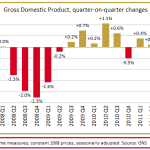
Growth hits 0.5% in Q3 — a nation shrugs

The growth number for the third quarter of this year is out, and it's a little bit better than expected: 0.5 per cent. Many economists were saying that we'd have to hit around 0.4 per cent to recoup the growth lost to the Royal Wedding and Japanese Tsunami in Q2, so we've managed that. But, that aside, this is not the time for party poppers and champagne corks. It may not be Econopocalypse, but it's not Mega Growth either. We are still living in a bleak, borderline stagflationary environment. Besides, I still reckon that we oughtn't get especially worked up about these quarterly figures anyway. For starters, the obsession over micro-percentage points can obscure the fact that many parts of the country are already in effective recession — and have been for decades.

Breaking: Ed Balls has a point

The games have started a day early, folks. The latest quarterly growth figures are set to be released tomorrow morning, but already Ed Balls is waxing insistent about what they have to be: "Simply to stay on track for the Office for Budget Responsibility’s most recent forecast, already downgraded three times, we will need to see growth in the third quarter of 1.3 per cent. And to reach the OECD’s latest and more pessimistic forecast, we will need to see a figure next week of 0.9 per cent." To be fair — and this is not something you'll read often on Coffee House — the Shadow Chancellor has a point, although he's not making it explicitly. When he says that growth needs to hit 1.

The Great Repatriation Question

And the word of the weekend is ‘repatriate’. Not only do we have yet another poll showing that the British public, when asked, would prefer to tug powers back from Brussels, but there's also this eyecatching story in the Daily Telegraph. No.10, we're told, is pushing Whitehall departments to determine just exactly where Europe's influence could be counteracted. There is also a backbench group of Tory MPs providing covering ideas.  So why hasn't this been happening before now, particularly given how frustrated those around David Cameron have become with the constant torrent of EU directives? Part of the answer is that the events of the past week have made all this more urgent. But part of it is that, actually, this work has already been going on in Whitehall.

From the archives: Cut off in Brussels

Let's end the working week how it began: with talk of a European referendum. The talk, in this case, is provided by Daniel Hannan, who wrote an article for us in 2008 about his efforts to promote a referendum on the Lisbon Treaty from within the European Parliament. Here it is, our latest excavation from the Spectator archives: For MEPs, public opinion is merely an inconvenience, Daniel Hannan, The Spectator, 22 November 2008 I’ve just done the most pointless thing an MEP can do: I’ve delivered a speech to the European Parliament. Actually, ‘speech’ is rather a grand word for my little soliloquy which, under the rules, had to be squeezed into 60 seconds.

Daylight scrapping time

Aha, the Spectator's cover story is gathering pace. If you were tuned into The BBC's Daily Politics just now, then you will have enjoyed a preview of the terrific scrap this time-shifting proposal could provoke. They had on both Rebecca Harris MP, who is pushing for us to move to Central European Time (CET), and Peter Hitchens, who revealed in his article for us that the government is minded to back the idea (as well as describing Harris as "one of those homogenised, UHT female Tory MPs"). The pair were, of course, mediated by Andrew Neil. We shall try to secure video of the discussion, if possible.

Osborne’s response to Europe’s gappy deal

Our Submarine Chancellor has bobbed to the surface today, and to perform a fairly important function: explain Britain's position in relation to the sinking eurozone. Here, harvested from his appearances on the Today Programme and in the House, is my five-point guide to what that position is: 1) Yesterday was only a start. Not for Osborne the "new day" hyperbole of the Greek Prime Minister, George Papandreou. No, the Chancellor has been more cautious about the Eurodeal struck last night — and rightly so. Although he did say in the Commons that "The deal put together is much better than was expected yesterday afternoon," he did hasten to add that "much detail remains unresolved.

The government’s European tribulations continue

It has been a fraught and ill-tempered week in Westminster. And — whether it is the rumour that Tory backbencher Andrea Leadsom told George Osborne to "f**k off", or David Cameron's dismissal of Ed Miliband as a "complete mug" — most of it has had Europe at its root.  So it is, too, with the latest news of government strife. Iain Duncan Smith, it's reported, had a ferocious row with the Tory chief whip, Patrick McLoughlin, over the EU referendum . Apparently, he warned that, “If you ever put me in this position again, that’s it”. As it happens, there is more on IDS's disgruntlement in Charles Moore's column for the latest Spectator, out today.

Summit for nothing?

The punchline to yesterday's eurosummit comes in the very first paragraph of the official statement, released in the darkness of morning: "The euro continues to rest on solid fundamentals." Now that you've brushed away the tears from that one, what was it that was actually agreed upon in the end? The main measure is effectively a fiscal target for Greece: its national debt, expected to peak at around 180 per cent of GDP in 2013, will come down to 120 per cent by 2020. And this will be achieved by cutting the value of bonds held by private investors in half, alongside further waves of privitisation and Greek frugality. Brussels will strengthen its "monitoring capacity on the ground," to ensure that Athens abides by these strictures.

Cable’s latest embarrassment

"None of this will stop me talking out against tax avoidance." So says Vince Cable, rather hilariously, in response to being fined £500 for failing to pay £25,000 of VAT on his media work. You've got to hand it to the Business Secretary: it is an ingenious, if convoluted, way to top up the public finances. Although there are questions about whether other people would have got off quite so lightly.    You might say, as Vince's people are this morning, that this is the sort of mistake that can befall anyone — particularly someone so busy as a Cabinet minister. But this isn't just anyone. This is Vince Cable, who has staggered between embarrassment, inconsistency and insubordination ever since the coalition government was formed.

Europe wavers as the crisis deepens

Who'd have thought it? A group of 27 world leaders — each with their own agendas, goals, rivalries and pathologies — finding it difficult to reach agreement with one another? But that unlikely situation is exactly what is happening in Europe right now. Today's summit was, like summits before it, supposed to be the one that finally repaired the disintegrating eurozone. But while the roadmap will have some of its contours filled in before tomorrow — including, perhaps, a €110 billion bailout package for Europe's banks — there will still be too many remaining uncertainties to march ahead. Angela Merkel's confrontations with her German parliamentary colleagues aren't helping the matter.

The coalition bares its tensions over Europe

Here's an irony: last night's EU fandango was the fifth largest vote in favour of the government this year. And yet there is little about the situation that is favourable to the government this morning, as the story moves on from Tory splits to coalition ones.  It started with Michael Gove's appearance on the Today Programme earlier. The Secretary of State for Education put in a much more conciliatory performance than William Hague managed yesterday; praising the "cordiality" of the Tory rebels, and reassuring them that the Tory leadership would like to see specific powers returned from Europe "in this Parliament".

Libya’s revolution, deflated

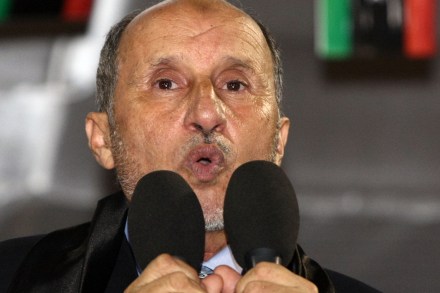
Gaddafi was buried this morning, but Libya's problems remain firmly above ground. The news emerging from the country is mostly grim: a possible massacre by anti-Gaddafi fighters; the hint of complicity on the part of Libya's new leadership; Saif Gaddafi's continuing elusiveness, and so on. Revolution and civil war are never done cleanly, sure. But just because the current situation is unsurprising doesn't make it any less shocking. Unsurprising yet shocking. Much the same could be said of Mustafa Abdul-Jalil's declaration that Islamic Sharia law would be the "main source" of all legislation in Libya from now on. Unsurprising, because Libya is, on the whole, a conservative Muslim country.

Your scorecard for today’s EU referendum vote

I hope you adjusted your calendars accordingly, CoffeeHousers. The parliamentary debate and vote on an EU referendum starts at 1600 today — and what morbid fun it promises to be too. Fresh from being bawled out by Nicolas Sarkozy at the weekend, David Cameron is returning to London to be bawled out by a significant proportion of his own party. And while the Tory leadership is certain to defeat David Nuttall's Eurosceptic motion, it will not avoid being wounded in the process. Most of the wounds have already been self-inflicted.