Peter Hoskin

Clegg tries to reassure his troops

Only a few weeks ago, a statement from Nick Clegg in firm support of the coalition wouldn't have been noteworthy at all. It's just what he, as Deputy Prime Minister, did. But now, after his very public palpitations over Europe, the New Year's message that Clegg has broadcast today is a little more eyecatching than it would otherwise have been. This is no provcation to rile the Tories, but a more or less sober assessment of what the Lib Dems have achieved in government, along with a few lines about how fixing the economy ‘remains the number one priority for our party and the coalition.’ Most strikingly of all, Clegg doesn't include Lords reform in his list of government policies coming next year.

Russia looms significant across 2012

The Christmas weekend was, I'm sure you noticed, rich with political incident. And yet, from continued turbulence in the Middle East to continued turbulence in Chris Huhne's career, few things stood out as much as the protests against Vladimir Putin in Russia. They were, by most reasonable estimates, the largest in that country since the fall of the Soviet Union. And they add to the wave of disgruntlement that has been swelling since even before this month's disputed parliamentary elections. The wave, of course, hasn't broken yet. But few seem sure about how far it will travel and how much change it will wreak.

From the archives: Mr Dickens’ ghost story

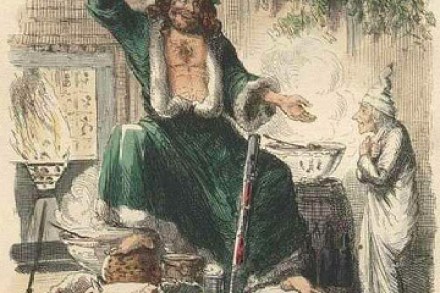
It is the bicentenary of Charles Dickens' birth in February, and Christmas Day today; so a sterling occasion to reproduce The Spectator's original review of A Christmas Carol from the archives. It was written for our issue dated 23 December 1843, and differs from most modern reviews in quoting extremely liberally from the text, to the extent that there is more Dickens than Spectator in what follows. But, on this morning of all mornings, I thought few would complain about that: ‘The object of this seasonable and well-intentioned little book is to promote the social festivities and charities of Christmas, by showing the beneficial influence of these celebrations of the season on the bestowers as well as the recipients of this sort of hospitality.

From the archives: The Christmas truce

Christmas is but a day away, and with it a chance to remember when British and German troops clambered out of the trenches to declare impromptu ceasefires in December 1914. CoffeeHousers are no doubt familiar with the specifics: how the Germans started by singing carols, and finished off (according to some letters from the time) by beating our soldiers 3-2 in a game of football. But I thought you still might care to see how The Spectator wrote it up a week later.

Happy Christmas | 23 December 2011

A brief post to let CoffeeHousers know that the blog will be going a bit quieter over the next few days. We hope you have a very happy and peaceful Christmas. Coffee House won't fall completely silent, though. Tune in over the weekend for the occasional post and selections from The Spectator archives. And there's our ongoing Christmas competition here. We'll be back, proper, early next week.

Tim Loughton versus the adoption bureaucracy

Parliament has decamped for midwinter, but the business of government goes on. Today's announcement, by the children's minister Tim Loughton, is contained within a Times article here. ‘An expert panel,’ it reveals, will be tasked with designing a new system for assessing prospective adoptive parents by March next year. That new system, making it easier for suitable folk to adopt, should then be in place by the end of 2012. In many respects, adoption is perfect Cameroonian territory; being, as it is, at the intersection of social responsibility, family, deregulation, etc, etc. But politics isn't what should concern us here. A lot of unmitigated good can be done in fixing a system that has been strangled and subverted by years of bureaucratic interference.

What do CoffeeHousers want for Christmas?

Quentin Letts certainly wants a lot from good ol’ Father Christmas. In the festive double issue of The Spectator he pens a wish-list that contains no less than 56 items. Here are some of the highlights: A referendum on Britain’s future in Europe... Or, a Linguaphone course to brush up my German. A protest march through Islington by striking taxpayers. An announcement from David Cameron that he is scrapping the Ministerial and Other Pensions and Salaries Act 1991, which granted pay-offs to Cabinet ministers. (The Act was also responsible for setting the Commons Speaker’s indecently generous pension. Double bingo!) Less windbaggery from Speaker Bercow.

Your five point guide to Balls’s highly political interview

It's a strange sort of Christmas present; interviews with Ed Miliband and Ed Balls — but that's what the papers have seen fit to deliver us this morning. There's not much political content in the Miliband one, which is more of an At Home With Ed and Justine sort of deal. But Ed Balls's interview with the Independent is a totally different matter. Here are five points distilled from the shadow chancellor's words: 1) We'd cut, I tell ya. Rarely has Balls sounded as much of a deficit hawk as he does here. Sure, he drops in the usual lines about the Tories going ‘too far, too fast’, and Labour providing an ‘alternative’ — but then he blurs his dividing lines far more than usual.

An early Christmas present for the coalition

It has only taken several months of bitter negotiation and a national strike to get here, but a deal between the unions and the government over public sector pensions could finally be in sight. Danny Alexander has just announced the details in Parliament, but basically it seems that, across a range of schemes, the coalition has offered kinder accrual rates than it did in November. And this more generous proposal has now been accepted in principle, or at least not turned down, by 26 of the 28 relevant unions. Among those who still oppose it outright are the PCS, led by everyone's favourite union malcontent, Mark Serwotka.

Another fine mess at HMRC

Today's report by the Public Accounts Committee hasn't so much been released as detonated onto the Westminster scene. The Exchequer is owed around £25 billion, it suggests, from major companies that have been handled too leniently, or just plain wrongly, by HM Revenue & Customs. And much of the blame is attached to Dave Hartnett, the outgoing civil servant in charge of revenue collection. Interviewed on the Today Programme earlier, the chair of the committee, Margaret Hodge, implied that Hartnett had too ‘cosy’ a relationship with big business.

Clegg sets out his stall for 2012

Under cover of discussing the Open Society and its enemies, Nick Clegg today set out his personal agenda for the next year of this government. Indeed, Clegg's speech to Demos earlier was perhaps the purest distillation of his politics since the big set-piece number he delivered at the Lib Dem conference in 2008. It contained many of the same themes as that earlier speech: ‘social mobility’, ‘civil liberties’, and ‘democracy’. And it added a couple more for good measure: ‘political pluralism’ and ‘internationalism’. The Deputy Prime Minister described these five political impulses as ‘the source of my liberalism’.

The coalition tees up its banking reforms

That was easy. Only a few months after Sir John Vickers released his final recommendations for reforming the banking sector — and after much less intra-coalition struggle than we might have expected — the government is set to announce that it will adopt them ‘in full’. Vince Cable revealed yesterday that he and George Osborne have reached common agreement on the matter. And, for his part, Osborne will appear before MPs today with further details.  As Robert Peston has already explained, ‘in full’, in this case, doesn't quite mean 100 per cent — but it's close. The main proposal to ringfence retail banking off from riskier investment banking will be fully implemented.

‘People, your government has returned to you!’

The playwright who became a protestor who became a president, Vaclav Havel, has died today. There is already much on the blogosphere about this Czech great, and there will be more in tomorrow's papers. But if you only read one thing connected with him, then I'd advise you make it the address he delivered to the Czechoslovakian people on 1 January 1990, which I've copied below. It was only a few days after his election as president, yet triumphalism and celebration is there little. Instead, Havel dwells on the horrors his country endured in the Twentieth Century, and — crucially — how they were permitted to come about.

Cable: Cameron put political gain ahead of national interest

While we're on the subject of LibCon divide, it's worth noting Vince Cable's remarks to Andrew Marr this morning. The headline above is merely a paraphrase, but it's pretty close to what the Business Secretary actually said: ‘It was largely political. Certainly the Prime Minister’s got a sort-of short-term boost from it, but it doesn’t actually deal with the long-term fundamental problems in Europe.’ Seems to me that there have been harsher words deployed this week, but few harsher sentiments. In the spirit of, erm, ‘getting on with my job as I always do’, Cable is going especially far in attacking his coalition partners. Vince, as always, remains One to Watch in 2012 — and mostly for the wrong reasons.

What phase of the coalition are we in now?

It was not so long ago — the run-up to last May's AV referendum, to be exact — that we heard the coalition would be entering a new phase. Gone was the happy synthesis of the Tories and Lib Dems that prevailed after the election, and in its place would be a government that spoke more openly, more angrily about its differences. But even if Phase 2.0 had the appearance of being more fractious, it was actually designed to keep the parties together. The idea was that, by highlighting the essential differences between the two sides, their supporters could more easily be kept on board with the overall project. I mention this, this morning, because it looks as though that strategy is either being ramped-up or taken in a new direction. During Phase 2.

Miliband is trapped in his own foggy argument

With one well-timed jab in PMQs, David Cameron turned much of this week's political debate – in domestic terms, at least – into a debate about Ed Miliband's leadership. And how is Miliband responding? Predictably, for the most part. His celebratory speech in Feltham and Heston this morning reduced down to the claim that the result 'offers a verdict on the Government's failed economic plan'. And his interview in today's FT covers much of the same territory. But the FT interview is also revealing in one particular regard: it demonstrates, once again, how Miliband is caught in a strange, undefinable strategy somewhere between attack and defence. This was, if you remember, a feature of his first speech as Labour leader – and here it crops up again.

A victory for Labour, but not necessarily for Ed Miliband

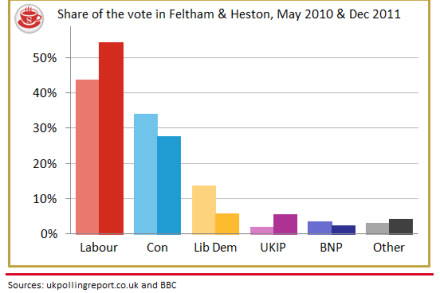
‘This result... is a victory for Labour that shows the progress we are making under Ed Miliband's leadership; a vote of confidence in the way that Labour is changing...’ Or, rather, it isn't. Whatever Labour's winning candidate in Feltham and Heston, Seema Malhotra, says, this byelection result was little more than an unsurprising Labour victory in a Labour area. The opinion polls, as we know, show more comprehensively what people think of the ‘progress’ that Labour is making under Ed Miliband's leadership. And it's far from a vote of confidence. Which isn't to say that Malhotra underperformed in her byelection victory, last night. Not at all. Labour actually increased their share of the vote — from 43.

Nick Clegg’s Christmas recipe

Our Christmas issue is so packed that, sadly, there wasn't enough space to include everything that was originally commissioned. Among the ejectees was a series of Christmas recipes and tips from politicians, writers and friends of The Spectator. In which case, we thought we'd put them up online, where the real estate, just like the goodwill, is endless. You can read Nick Clegg's recipe for Patridge ‘Estofada’ below.

Cameron targets his resources at problem families

The Prime Minister's message today is, basically, that he hasn't forgotten about the riots. In a speech this morning, he's going to announce his biggest new policy in response to them so far: a network of 'troubleshooters' who will work with 120,000 of the country's most unstable families, with the aim, of course, of stabilising them. The idea is that the troubleshooters can help coordinate various services — from police to Job Centres –— to focus on these people. According to the Sun, the families will, in turn, face 'tough penalties' if they don't cooperate. Some of you may be wary of this scheme — and it's easy to see why. I mean, yet more local authority lackeys swarming through the streets?

Miliband’s poll nightmare returns

There has, as we all know, always been a fug of doubt about Ed Miliband's leadership. Even when Labour have been winning by-elections (as they're expected to in Feltham and Heston tomorrow), even when even when they have fluttered ten points above the Tories, the question has always been there: would they be better off without him? After all, in terms of poll numbers, the party has generally exceeded the man. But today that question is wrapped in flashing, coloured lights, with a star on top. It's not just how David Cameron filleted Miliband in PMQs earlier, but more Labour's position in the latest opinion polls. As others have pointed out, every pollster now has the Tories basically level with Labour, or ahead of them.