Culture

Culture

The good, the bad and the ugly in books, exhibitions, cinema, TV, dance, music, podcasts and theatre.

Edinburgh snippets

Theatre

I saw a few car crashes at Edinburgh but I’ll mention only one. Hells Bells (Pleasance, Courtyard) by the excellent Lynne Truss is a peculiar experiment. Truss sets her play in a TV studio and she spends the first 40 minutes explaining the storyline. The show lasts 45 minutes. So when we finally learn what the action is about, the action is about to cease. The nub of the drama concerns a TV show that was cancelled suddenly in 1995. So the play’s conflicts are rooted in the distant past and involve characters who aren’t on stage. The play culminates, weirdly, in a fight involving the destruction of some elaborately ugly hats. It’s hard to avoid the suspicion that this closing scene is Truss’s comment on her own work. Strange, pointless and a bit desperate.

Walk on the wild side

Theatre

A good title works wonders at the Edinburgh Fringe. Oliver Reed: Wild Thing (Gilded Balloon) has a simple and succinct name that promises excitement, drama and celebrity gossip. And it delivers. Mike Davis and Bob Crouch’s exhilarating monologue races through the chief highlights of Oliver Reed’s career. Showmanship ran in his veins. On his father’s side, he was the grandson of Herbert Beerbohm Tree, the founder of Rada. But the connection was illegitimate. Reed’s grandmother had six children with Tree although they never married. Her surname, she claimed, was a facetious comment on the relationship. ‘I’m a frail Reed in the shadow of a mighty Tree.

Touch of evil

Theatre

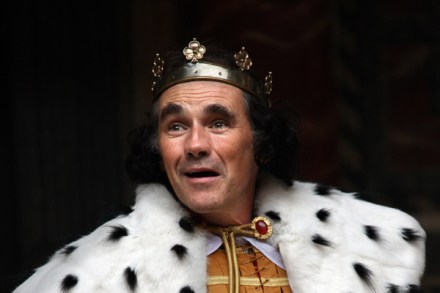
Richard III is seriously bad for your health. Any actor will tell you that the part of the ‘bunch-backed toad’ is so physically punishing that the chap in the title role usually ends up being injected with painkillers by the local quack before each show. Or he finds himself in hospital when he should be on stage. Mark Rylance has heeded these warnings. His Richard — an astonishing feat of creative originality — is very nearly able-bodied. He has no crutches, no twisted limbs, no bandy legs, no hump weighing him down like a medicine ball. He walks with a faint limp. He carries a withered arm discreetly under his doublet. And he has a slight suggestion of a cyst-ette on his shoulder. Otherwise, he’s perfectly formed.

In health and hypocrisy

Theatre

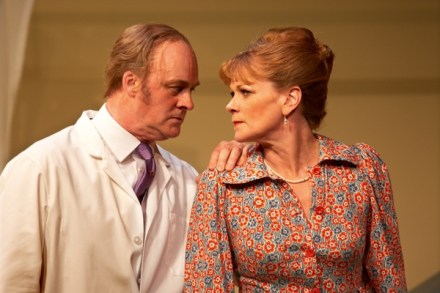
George Bernard Shaw argued passionately that Britain should create a public health service. And he lived long enough (1856–1950) to become one of its earliest victims. This play from 1906 shows the very best and the very worst of his creative abilities. He had a plan: to strip bare the iniquities of private medicine and stick the knife in deep. We open in Harley Street where a gang of slick and prosperous doctors are bantering away, like tipsy clubmen, about their patients. I cured this one. I killed that one. Each quack has his preferred treatment. One thinks all disease is caused by blood poisoning. Another that surgery cures every ailment. A third that cheerful nurses and a decorative sick-bay are an infallible panacea.

Death in Damascus

Theatre

A timely show at the Finborough takes us into the heart of Bashar al-Assad’s terror state. Zoe Lafferty’s verbatim piece gathers evidence from activists and torture victims and flings it straight at us. The result is utterly gruesome and utterly compelling. A fractured, blood-stained snapshot of an ancient monstrosity blundering towards its own funeral. Syria, a Russian sidekick state, still pursues the traditions of Marxist totalitarianism. Every morning, ranks of schoolkids salute their leader. ‘Unity, Freedom, Socialism’ they chant in honour of a regime which traduces all three ideals. The Alawi minority, making up 12 per cent of the population, controls everything. Western music and literature are ruthlessly censored.

Extreme actions

Theatre

OK, I was wrong. I’ve said it a million times but I now realise it’s perfectly feasible. Antique dramas can make sense in a modern location. Nicholas Hytner sets Timon of Athens slap bang in the middle of present-day London. The action begins in a mock-up of the National Gallery’s Sainsbury wing, complete with that dull, forbidding grey hue that some miserable nutcase chose for the walls. Ominously, hanging centre-stage, is El Greco’s swirly pink vision of Christ ejecting the moneylenders from the temple. A launch party is in full swing. Champagne flows. A gang of yuppies, toadies, spivs and freeloaders has gathered to toast the opening of the ‘Timon Wing’. Glamorous sycophants hover around the millionaire philanthropist crying, ‘Timon, Timon!

Double vision

Theatre

Michael Frayn is a schizophrenic. His creative personality bestrides the English Channel. When he’s at home he writes traditional West End farces with amusing titles and plenty of jokes. When he sits at his European desk he comes up with dour, static, talk-heavy historical dramas with boring titles and no jokes at all. Democracy, written in 2003, is a classic Euro-bureau production. Frayn invites us to examine Willy Brandt’s stewardship of West Germany in the early 1970s. Willy is referred to throughout as ‘Villy’ which, for some reason, sounds even more silly than just Willy. Chancellor Villy has a couple of problems. He’s an idealist and he wants the free world to embrace the eastern bloc and to give the misunderstood Soviets a big, warm, sloppy hug.

Disquieting truths

Theatre

Fear is a new drama by Dominic Savage and it’s one of the nastiest plays I’ve ever seen. It’s also one of the most scrappily written. Yet the subject matter and the clunky script make it weirdly captivating. We meet a pair of teenage muggers who hang around posh bits of London scoping out victims and totting up their ‘net worth’. A typical yuppie banker sports about five grand’s worth of portable accessories: Swiss watch, smart phone, designer briefcase, bespoke shoes, wallet full of cash. And these two muggers are expert valuers of lucrative prey. When they strike, they seek more than just upmarket goods. They want revenge as well.

Hippie haven

Theatre

A mad leap into the dark on the South Bank. And I’m all for mad leaps into the dark. A big-name cast has been assembled for a new play by an untested writer at the 900-seater Lyttelton theatre. Cripes. Stephen Beresford is a Rada graduate who knows his way around the dramatic repertoire. And he seems to have approached his first commission from the National in a spirit of dazzling insouciance. ‘Hey, I’ll just nick everything from Chekhov: the plot, the setting, the characters, the relationships and the atmosphere. And no one’ll notice!’ Well, there are smarter ways to go poaching. If you steal from a lesser dramatist, you can improve what you’ve stolen. But if you mug a genius, his genius will embarrass you.

Lukewarm in Narnia

Theatre

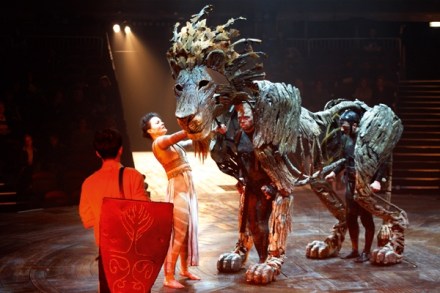
Off to Narnia. Director Rupert Goold has recreated C.S. Lewis’s permafrosted fantasy world in a circus tent moored in Kensington Gardens. And at the height of summer too. An impossible feat. But tons of cash, and many months of preparation, have been sunk into this effort. The show starts with The Wardrobe looming up in the middle of the stage, like a fat slab of mystery, a sort of Tardis perhaps, or the Kaaba at Mecca. Not much like a wardrobe, though. A child steps out and finds herself in a freaky kingdom run by a demented tundra-monger. Here she comes. Sally Dexter, playing the queen in a luminous white bedsheet, cackles sexily and yells commands at her cowering minions. Then she whooshes off in a great surge of whip cracks and dry ice. ‘Was that a bit scary?

Friends, Romans, Africans

Theatre

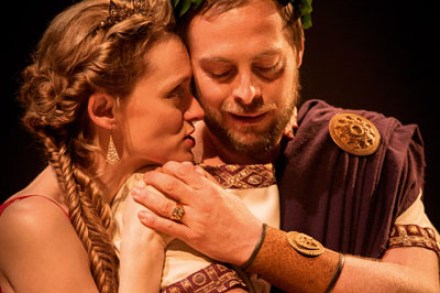
There’s an honourable track record of versions of Shakespeare’s play presenting Julius Caesar as a dictatorial monster of modern times. In 1937 Orson Welles (playing Brutus) cast Caesar as Mussolini and staged many scenes like Nazi rallies. Despite a curmudgeonly critic dismissing the conspirators as looking like ‘a committee from a taxi-driver’s union’, the show was a huge hit and set in motion a train of similar readings. In Miami in 1986 audiences applauded the murderous disposal of Fidel Castro. At the RSC the following year Terry Hands directed a nakedly fascist Caesar, while in London in 1993 Caesar was played by a woman, thus supposedly representing the political assassination of Margaret Thatcher.

Time travelling

Theatre

When should you set Antigone? Apparently not in the time of Antigone. The greatest classics these days seem to be aimed at the stupidest ticket-holders. And these hapless wretches can’t possibly be expected to understand anything outside their immediate experience. Polly Findlay’s version of Sophocles’ tragedy doesn’t even get modernity right. Her slightly out-of-date set design includes antique reel-to-reel tape machines and hefty old photocopiers the size of freezers. She’s taken Thebes and transplanted it to the studio of Crimewatch UK in about 1994. Very odd. The usual justification for these fast-forwardings is that they add relevance.

Problem play

Theatre

It’s all Kenneth Halliwell’s fault. By bashing in Joe Orton’s head with a hammer, he brought the playwright’s career to a premature halt when Orton was still experimenting with brittle and anarchic farces. Had Orton lived beyond 34, he’d have developed his technique and become a richer, truer and more rounded artist. And What the Butler Saw would now be a minor work by a major playwright. Instead it’s a major work by a minor playwright. Uneven in tone, lumpish in detail, unsure of its creative purpose, this is a problem play that doesn’t merit its status as a classic. Orton dashed it off in a few weeks and the script was discovered, after his death, lying in a drawer.

Old-git territory

Theatre

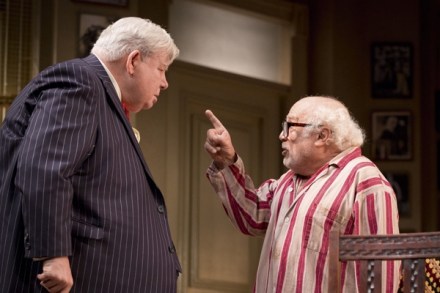
I’m not the biggest fan of Neil Simon, I admit it. In the programme notes for The Sunshine Boys, I discovered that Time magazine once called him ‘the patron saint of laughter’. Good, I thought. When the curtain goes up I’ve got someone to pray to. The show opens with Danny DeVito slumped in a hotel room watching TV in mid-afternoon. He’s a spent vaudeville star whose feud with his comedy partner forced him into retirement 11 years earlier. His nephew, a pushy young agent, wants to revive the famous duo for one last TV special. DeVito insists that he won’t do it. (But he will, of course.

Select all. Delete all

Theatre

If you want to see Scotland’s superiority complex in action, take a look at its literary culture. The works of Hume, Boswell, Walter Scott and Robert Louis Stevenson adorn libraries the world over, and it suits Scotland’s arts lobby to pretend that the age of excellence is still alive. It’s great PR and it justifies the mighty wodges of tax-payer dosh that fund new writing north of the border. But when you seek out the latest Jock geniuses you find someone called David Harrower. Familiar name? Maybe not, but then he’s better known abroad than at home. His most celebrated play Blackbird, written in 2005, told of a child-rape victim who met up with her molester 15 years later and found the stirrings of lurvve still tingling in her loins. Yeah, sure.

Ugly caper

Theatre

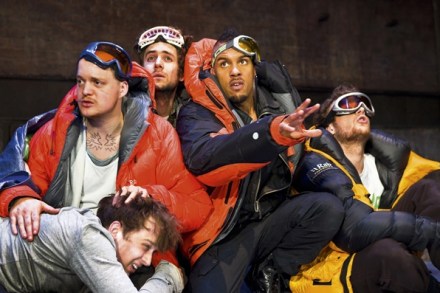
We all know the ‘excellence theory’ of migration. Barriers to entry guarantee that imported cargoes have outstanding qualities. Manfred Karge’s parable of urban despair in the Ruhr comes to the UK with high expectations. It’s been here before. Director Stephen Unwin premièred the play at Edinburgh, 1987. His new revival at the Arcola demonstrates that the ‘false charm theory’ of migration also applies. The foreign and the exotic can mesmerise us more easily than the homegrown. Unwin sets the play in some vague tower-block ghetto. We meet a quartet of jobless alcoholics who become fascinated by Amundsen’s trip to the South Pole. By impersonating Norwegian explorers, the drunken lunks briefly discover some purpose in their sozzled lives.

Water works | 3 May 2012

Theatre

My colleague Lloyd Evans had much fun a couple of weeks ago playing the curmudgeon with the Cultural Olympiad. Alas poor Bard, he quipped, ‘press-ganged’ into the World Shakespeare Festival. And it sounds as though Lloyd will be running for his life, especially from the Bankside-based Globe to Globe project in which all 37 plays will be given in the same number of languages. It is left to the RSC to fly the flag for Shakespeare in his native tongue with a dozen new productions. Risky, you would have thought, to launch its initial contribution of The Comedy of Errors, Twelfth Night and The Tempest as ‘Shakespeare’s Shipwreck Trilogy’.

Small talk

Theatre

What’s going on? Everyone’s doing playlets all of a sudden. I saw five this week. The Donmar is presenting a trio of scripts by Robert Holman entitled Making Noise Quietly. A silly title. ‘A writers’ writer’ — an even sillier cliché — is how the programme notes describe Holman. If they mean ‘a boring writer’ they should say so. His first play shows us two teenage pacifists meeting in the countryside during the closing months of the war. One is openly gay, the other is still hunting for the closet door. They chat. They flirt rather innocently. Then they strip off and sunbathe. That’s all that happens. Plays like this, static and plotless, take enormous risks with the audience’s patience.

Bum deal

Theatre

Wilton’s, the crumbly music hall in London’s East End, has been dressed up as a crumbly Prohibition-era speakeasy. And a good job they’ve done of it, what with the bootlegger types in the foyer, foxtrotters on the upstairs landing, and an Irish giant who ushers us into a side chapel where his friend’s corpse is laid out (is that normal in speakeasies?). The Great Gatsby, adapted by Peter Joucla, is on, too (until 19 May). But this feels like something of a pretext. The speakeasy theme spills into the auditorium and even onstage, in the form of — you’ve been warned — audience participation. To be fair, there is a link with the plot: one of the rumours surrounding Jay Gatsby is that his vast wealth comes from liquor smuggling.

Bible story

Theatre

Be still, at last, you clamouring brainboxes. Those who long for more highbrow drama in the West End can thank God for David Edgar’s Written on the Heart. Commissioned by the RSC, this celebratory play tells the story of the King James Bible, which was first published in 1612. Making scripture accessible to the masses represented a huge moral and cultural upheaval. In 1536 William Tyndale had been executed in Flanders for translating the Bible into English, but just eight decades later the king himself ordered a new vernacular version and showered the translators with rewards. Edgar is no slouch when it comes to taking on lumpish, glutinous topics and he relates the entire story of the English Church during the 16th century.

Written in tears and blood

Theatre

Great title, Long Day’s Journey into Night. The sombre, majestic words are suffused with auguries of doom. ‘A play of old sorrow written in tears and blood,’ was O’Neill’s description of the script, which is inspired by his personal background. We’re in a beautiful seaside mansion where a prosperous New York family, the Tyrones, are living in great splendour. But beneath the gorgeous surface everything’s going to hell. The oldest son is a washed-up actor who can’t keep away from the local knocking-shop. The younger boy, a preppie drifter, keeps coughing TB spores into his hankie. The mother, still grieving for a lost child, is hooked on morphine. And the whisky-soaked dad is a millionaire who can’t bear to switch on a spare light bulb.

The magic of speech

Theatre

Not yet, since you ask. And I doubt if I ever will. My aversion to multiplex cinemas, with their cheerless foyers and their hordes of texting, tweeting cola-hydrated popcorn-gobblers, has deterred me from seeing new movies lately. The King’s Speech eluded me until it arrived, in its original form as a play, in the West End. You know the plot: stammering monarch makes boob-free speech. What’s striking is that the writer David Seidler has managed to hang his entire drama, and by implication the destiny of Britain, on such a footling little crisis. His script is a tad short on analysis.

There will be blood | 7 April 2012

Theatre

John Webster had one amazing skill. He could craft lines that glow in the memory like radioactive gems. ‘A politician is the devil’s quilted anvil; he fashions all sins on him, and the blows are never heard.’ Eliot loved him. Pinter used to stroll around the parks of Hackney shouting his soundbites into the sky. But Webster never discovered how to put his highly wrought lines into the mouths of likable or captivating characters. The Duchess of Malfi is a Jacobean slasher-play, a straight-to-video Tarantino blood-fest, full of cloaked assassins and scheming dukes. We’re in an Italian court where a beautiful noblewoman, played by Eve Best, has fixed her eye on a handsome young bumpkin.

Old meets New

Theatre

It’s back. And I can’t believe I missed it the first time. Live Theatre’s dramatisation of Chris Mullin’s diaries has returned to Soho for a lap of honour. Richly deserved as well. The show moves unobtrusively between Mullin’s many spheres of interest. We see his home life as a father of two and as MP for Sunderland South. And we get an insider’s view of Westminster during the glory days of New Labour when parliament, and the entire country, was infatuated with its tooth-some superstar. Some of Mullin’s recollections have already acquired the status of classics. The late Tony Banks confided to him that no one ever saw Peter Mandelson enter a room. ‘There’s just a chill in the air, and suddenly, he’s there.

Rhythms of the Caribbean

Theatre

There should be a sign on the door. ‘Plotless play in progress.’ Moon on a Rainbow Shawl, by Errol John, won first prize in a 1957 scriptwriting competition organised by Kenneth Tynan and judged by Alec Guinness, Peter Ustinov, Peter Hall and others. The West End promoters thought the script uncommercial and never gave it a decent shot at success. They had a point. Errol John, an apprentice writer, hadn’t learnt how to shape his tale for the theatre and give it that insistent rat-a-tat-tat rhythm of twists and surprises that audiences expect. His languid drama is set in a Trinidad ghetto where a crew of washouts and wanna-bes bicker and copulate their way through a few steamy midsummer days. The grinding poverty seems quaint, and even attractive, to modern eyes.

Knock-off Chekhov

Theatre

Calling all thespians. Roll up, you theatre folk. The Hampstead’s new show is a dramatic love-in you can’t afford to miss. Farewell to the Theatre introduces us to Harley Granville-Barker, one of the greatest playwrights of the early 20th century, as he enjoys a sabbatical in Massachusetts in 1916. Everything is languid, atmospheric and high-minded. Granville-Barker is busy giving lectures and watching American productions of Shakespeare while one of his chums, a literature professor, has had a bust-up with another academic. It’s a pity this off-stage conflict doesn’t test or expose Granville-Barker at all. He just lolls around the garden of a country house making cold, lofty speeches about the theatre and generally being a didactic pest.

Reflections on guilt

Theatre

There can be no doubting the nobility of John Adams’s intentions in writing The Death of Klinghoffer to a text by Alice Goodman, nor ENO’s courage in putting it on, though they do have a captive audience for minimalist and near-minimalist operas. The work is conceived, as all commentaries tirelessly tell us, in the spirit of Bach’s Passions, in which a dramatic narrative thread alternates with arias of reflection and choruses of penance and grief. Yet Bach’s purpose was different in kind from Adams’s.

Only the best

Theatre

Jackie Mason, the New York stand-up, looks very strange. It’s as if somebody shrank Tony Bennett and microwaved him for two hours. Mason is short, dark, troll-like, densely built, with shining bulbous lips and a twinkly expression of diabolical mischief. His hair gathers over his head in a wave of red-brown crinkliness. For his solo show he wears a sharp, grey business suit. He could be Rumpelstiltskin selling real estate. All his jokes are Jewish. And none of them are. He uses ‘the Jew’ as a catch-all tag for a fretful, brow-beaten loser. ‘The Gentile’ is his relaxed, prosperous and self-confident counterpart. The Jew wants to impress people by sporting designer outfits but everyone who talks to him spends all their time reading labels.

Cold at heart

Theatre

‘A masterpiece comparable with the last great plays of Shakespeare’, ‘a veritable turbocharged dynamic of music’, ‘a cliffhanger’, ‘a rollercoaster of a drama’ — which opera deserves these and many more ecstatic epithets? They all occur in the brief programme notes to last week’s concert performance at the Barbican of Mozart’s La Clemenza di Tito, though also quoted there, as an example of outdated hostility to the work, is Charles Rosen’s ‘it’s difficult to convey how unmemorable it is’. Try as I might and have with Clemenza, I am on Rosen’s side.