Culture

Culture

The good, the bad and the ugly in books, exhibitions, cinema, TV, dance, music, podcasts and theatre.

Sheer torture

Theatre

Ever been to a ‘promenade performance’? Barmy, really. The audience is conducted through a makeshift theatre space — often a disused ironworks — where the show is performed in disjointed snatches amid atmospheric clutter. Invariably hopeless as drama, promenade shows can be revealing as social anthropology. They lay bare a secret that lies at the heart of theatrical life: actors loathe play-goers. Without a paying audience, all theatre is simply am-dram. And actors have a morbid fear of slipping into the underclass of voluntary performance. So they covertly resent ticket-buying audiences who alone have the power to convert an unpaid show-off into a self-regarding thesp, with his agent and his Spotlight listing and his drink problem.

Fatal flaw | 14 February 2013

Theatre

A new play about the banking crisis at the Bush. Writer, Clare Duffy, has spent a year or two badgering financiers and economists with questions about ‘the fundamentals’. ‘What is the value of money?’ she asks. ‘What do we want and need money to be?’ Her play has lots of zing and energy, and opens as a TV game show. The audience is divided into teams and individuals are hauled out of their seats and asked to engage in sporting contests with a big stash of 10,000 pound coins that gleam in coppery piles on the stage. Then the show becomes a drama. We’re in 2007. Two bankers, Queenie and Casino, hatch a scheme to short the American housing market. A tiny investment of £5 million will net billions, should the bubble go pop.

English eccentrics

Theatre

Quartermaine’s Terms is a period piece within a period piece. It’s set in that part of the early 1960s which was still effectively the 1950s. St John Quartermaine, a shy bumbler, is the oldest and most useless teacher at a Cambridge language school. All his colleagues are lovable freaks. There’s the Jesus-worshipping spinster shackled to her ailing mum. There’s the caravanning dad who takes calamitous holidays in rain-swept Norfolk. There’s the wannabe novelist ditched by his wife while writing a particularly heartfelt chapter about marital bliss. And there’s the boss, a fogeyish queen, who has no idea the school is heading for the buffers.

Women only

Theatre

A triple thick dose of chicklit at Hampstead. Amelia Bullmore’s good-natured comedy has three girls sharing a student house in 1983. Those were the days. Back then we received ‘grants’ to attend university, i.e., we were paid to look occupied, like job-seekers and politicians. I’m glad to report that Bullmore accurately evokes the culture and language of the time. Just a couple of blunders. We didn’t say ‘PJs’ to mean pyjamas. And ‘what is she like?’, to express affectionate exasperation, didn’t arrive till the 1990s. The girls don’t smoke, nor do they mention Greenham, which is odd, but the play wishes to focus on their emotional and professional development.

Unacceptable faces

Theatre

A play called Rutherford & Son gripped audiences in London 101 years ago. Set on Tyneside, it was the David Hare-style leftie hit of its season. It depicted the unacceptable face of capitalism, a face that belonged to John Rutherford, who rules the family glassworks by fear, hated by his workers and his children alike. It’s still a fresh, brutal-up-north story of a monstrous control freak devoted to work and money and nothing else. The show has a terrific twist at the end and it was an instant hit in London, went to New York and was widely translated. But it became a big news story when the unknown author, K.G. Sowerby, was revealed to be a woman. Women did not write plays back then.

Seeing the light | 24 January 2013

Theatre

Meet Fenton. He’s a psycho. A year or so back he was banged up for murdering a preppy teenage girl in one of America’s less-enlightened southern states. Enter a campaigning congressman, John Daniels, who hopes to teach Fenton to read and write and to help him make something of his ruined life. The opening of Richard Vergette’s play is intriguing enough but a savage twist is on its way. Fenton rejects all the congressman’s overtures. Asked to recite the alphabet, he glares and grunts and spits out monosyllabic expletives. The only expressive medium for which he shows any talent is the flinging of furniture at high speed across the interrogation room.

Curiouser and curiouser | 17 January 2013

Theatre

A tragicomic curiosity at the Finborough written by Hebridean exile Iain Finlay Macleod. The show opens with James, a young Gaelic-speaker, running an internet start-up in London. Business booms. He grows rich and marries his gorgeous university squeeze. The only snag in his life, and it’s quite a serious one, is that he suffers from a constant urge to turn a somersault whenever something remarkable happens. Bust-up with the wife. Somersault! Best mate arrives from college. Somersault! Business goes broke. Somersault! Dad contracts cancer. Somersault! Short of cash and plunged into despair, James is visited by a creepy bailiff who engages him in obliquely amiable conversation while bagging up his collection of LPs.

Decline and fall | 10 January 2013

Theatre

Filmic structures are always tricky on stage. David Mamet, an exception, can get away with writing long chains of scenes that last a couple of minutes each. But the theatre prefers to relax, to snuggle down, to linger slowly over every morsel of a many-layered spread. Encountering a screenplay on stage is like receiving a box of Milk Tray in a restaurant and being told it’s a 32-course meal. David Gooderson’s made-for-TV script concerns an Edwardian sex scandal featuring teenage boys and lauded grandees. Sir Hector MacDonald (aka Fighting Mac) was a crofter’s son who enlisted as an infantryman and reached the rank of major-general during a 20-year career. To rise so high without a private income was pretty rare in Britain’s gentry-loving military.

Wrong, wrong, wrong

Theatre

I wasn’t the only one desperate that Viva Forever! would be a blast. There were hundreds of us eager to leap to our feet and holler through the Spice Girls’ greatest hits as a band of teenage lookalikes led the tribute on stage. Didn’t happen, I’m afraid. The Spice Girls are not in this show. I’ll say that again. The Spice Girls are not in the Spice Girls musical. Jennifer Saunders has penned an arch and scabrous spoof of TV talent contests like Pop Idol and The X Factor. Wrong, wrong, wrong. Even celebrity culture has its epochs and phases, its stratifications and its correct chronology. The Spice Girls date from 1996. Pop Idol didn’t appear till five years later. In slebs-ville, that’s centuries.

Age limit

Theatre

Michael Grandage is homeless. After a near-faultless decade in charge of the Donmar Warehouse, he now reinvents himself as a roving thesp, a buskined vagabond, a theatrical mendicant wandering the byways and the turnpike lanes and ushering his troupe of all-stars into any pen that will accommodate them. It’s a medieval conception. The strolling players. His team of celebrity vagrants has taken a 15-month lease on the Noël Coward theatre where its residency kicks off with Privates on Parade, a 1977 play by Peter Nichols, examining life in an army concert party in Malaya in 1948. In shorthand, it’s the BBC sitcom It Ain’t Half Hot Mum  without the spitting bullies and the pouting misfits. Everything is tremendous fun.

Male bonding

Theatre

Both these plays are about concealed sexuality. Straight, by D.C. Moore, is based on an American indie flick named Humpday. The play has one of the funniest openings you’ll ever see. We’re in a flat occupied by suburban nonentity Lewis and his wife Morgan. Lewis’s old college mucker, Waldorf, has come home after seven years in Mongolia and he cheekily decides to announce his return to western civilisation by inserting his unsheathed tumescence through the letterbox. Lewis doesn’t see it. His wife does and she has to persuade him that she isn’t hallucinating. The gate-crashing phallus symbolises the play’s theme of male eroticism thrusting itself uninvited into soporific domesticity.

Boris unmasked

Theatre

It’s extraordinary how many works have been upstaged by the operas based upon them. Of none is this truer than those of Pushkin, whom the Russians regard as highly as we do Shakespeare or the Germans Goethe. Eugene Onegin and The Queen of Spades are known to most of us primarily from Tchaikovsky’s operas, and Boris Godunov from Mussorgsky. Just how much we’ve been missing is apparent in Michael Boyd’s revelatory staging of the original 1825 Boris Godunov play in Adrian Mitchell’s verse adaptation. It’s a great coup for Sir Michael — the RSC artistic director’s valedictory production appears to be the play’s first professional staging here.

Battle of the sexes | 6 December 2012

Theatre

Tough play, The Taming of the Shrew. Uniquely among Shakespeare’s comedies, it moves audiences to pity and fear. It’s a video-nasty in the garb of a marital farce, an uncomfortable romance whose closing reconciliation scene invariably draws lusty hisses from female play-goers as Kate renounces her autonomy and bows to the will of her brutal husband, Petruchio. Directors prefer to approach this squirm-inducing parade of sexual violence through the comforting distortions of a veil. Single-gender productions are popular. In a Gujurati version, Kate is portrayed as an immigrant and the title had been coyly changed to A Foolish Foreign Woman Comes to Her Senses. Cole Porter goes for the vegetarian option by taking us backstage during a tour of the play.

Comic clockwork

Theatre

Pinero’s comedy The Magistrate is a marvellous confection of shameful secrets and multiplying concealments. Agatha, a beautiful widow of 36, has trimmed five years from her age in order to bag her second husband, Aeneas Posket, an agreeably pompous magistrate. Her subterfuge is imperilled by her 19-year-old son who must pretend to be 14 in order to make the maths work. To please his mother, the young buck behaves like a child at home. But elsewhere he pleases himself. He keeps a private room at the racy Hotel des Princes in town. One evening, he persuades his weakling stepfather to accompany him for a night of drunken antics. The police swoop on the hotel and Posket has to run pell-mell from the officers of the law.

Warring outcasts

Theatre

Are we barmy or what? Our mawkish obsession with the first world war demonstrates that we’re in the grip of a mass delusion: institutional sentimentality. The latest symptom of our death-mania is Nick Dear’s engaging play about the pastoral poet Edward Thomas, who was killed in action in 1917. Thomas began writing verse aged 36 at the suggestion of his American chum Robert Frost. We first meet the pair in a West Country croft in 1914. Frost is a smug, wily and sententious trustafarian who likes the idea of tilling the earth but stops short of actually tilling it himself. Thomas, a suicidal depressive, is incapable of showing warmth to his wife, Helen, and his three squealing nippers.

Vengeance, at a price

Theatre

Where have you been all my life, Orphan of Zhao? Come to think of it, where has any Chinese theatre been? Bang up to the minute, the RSC’s new artistic director, Gregory Doran, launched his regime with the so-called (actually, badly called) ‘Chinese Hamlet’ on the very day that President Hu Jintao, dwarfed by a 20ft hammer and sickle, prepared to hand over control to Xi Jinping. As the Orphan is about successful resistance to the misuse of power, Xi Jinping will need to pay good attention. In truth, the Orphan is a deeply interesting play with a history running back over two millennia.

Issues of Trust

Theatre

An orgy of navel-gazing on the South Bank where a national treasure is satirising the National Trust at the National Theatre. Alan Bennett sets his latest comedy in the drawing room of a crumbling Georgian mansion in South Yorkshire. Greedy speculators are queuing up to seize the house from its plucky owner, Lady Dorothy Stacpoole, a high-born hippie who spent her youth going to parties and modelling. Now aged 80 or 90, she’s ill equipped to outwit the circling vultures. Bennett is good at creating warm, believable women but with Lady Dorothy he simply regurgitates a stale theatrical burp: the beatnik with a bus pass. Writing plots has never been his strong point and he unwisely stuffs his story with fistfuls of loose threads. They poke out all over the place.

Essential Chekhov

Theatre

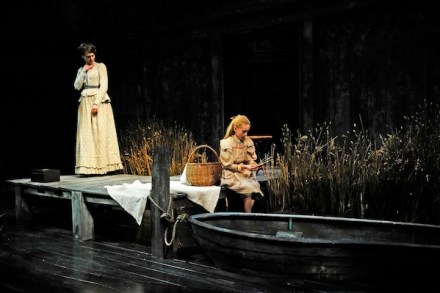
Uncle Vanya comes into the Vaudeville at an artful slouch. Lindsay Posner’s take on Chekhov’s story of bickering Russian sophisticates has an unusual visual style. In Britain we’re used to seeing Chekhov set in some fading Palladian mansion just outside Haslemere or Bath. Designer Christopher Oram has rummaged through the archives and discovered some hideously authentic stylings. He offers us a gloomy Siberian dacha, all cobwebby nooks and stacked timbers painted cowpat brown and carved with ornamental Asiatic doodles. This hulking coffin of a house emphasises the isolation and pinched misery of the play. The starry cast shine with fitful brilliance.

Ryans’ daughter

Theatre

Martina Cole is a rarity among novelists. Her work is set in the ugly, male-dominated world of London’s criminal fraternity and yet nearly all her fans are women. Blonde women, in particular, as I found out when I took my seat in the Theatre Royal Stratford East to see Patrick Prior’s adaptation of her breakthrough novel, Dangerous Lady. In a great sea of peroxide hairdos, my coiffure was the only point of darkness. Cole’s novel starts with a gem of an idea. She takes the brutal mythology of the Kray twins and softens it with a dash of femininity. Her criminal gangsters have a sister. The Ryans are a family of Irish Catholics dominated by a ruthless matriarch, Sarah.

The same old story

Theatre

Hard on the heels of last year’s television adaptation starring David Suchet and Ray Winstone is a new version of Dickens’s Great Expectations, in cinemas later this month. The new version, starring Helena Bonham Carter and Ralph Fiennes, and which closed the 2012 London Film Festival, comes after adaptations which include David Lean’s 1946 classic, the BBC’s 1999 version with Charlotte Rampling, a 1981 take on the yarn, an early 1970s production starring Michael York, one in 2007 with Timothy Spall, another featuring Ray McAnally, and yet another with Gwyneth Paltrow.

Racial tensions

Theatre

Covent Garden, 1833. Edmund Kean, the greatest tragedian of his age, has collapsed while playing the title role in Othello at the Theatre Royal. His son, Charles, is all set to take over and has just prised the lid off a trusty tin of boot polish ready to smear dark grease all over his peachy white cheeks. But, instead, a black American actor, Ira Aldridge, is engaged to play the lead. Kean’s company are aghast by this affront to their man’s talent and authority. But his fiancée, Ellen Tree, who plays Desdemona, is smitten by the charismatic American and tries to embrace his realistic new emotional acting style. This is the starting point for Lolita Chakrabarti’s wonderful new play, Red Velvet, at the Tricycle theatre.

Westminster playground

Theatre

Wow. This is a turn-up. Politicians and actors rarely see eye-to-eye. Thesps regard Westminster as sordid, petty, corrupt and corrupting. Politicians, for their part, like to dismiss the theatre as pretentious, irrelevant and fake. So here’s a play that brings them together. This House, written by James Graham, and directed by Jeremy Herrin, is a triumph on many levels. It takes the most squalid and depressing era in recent political history —1974–1979 — and turns it into a frothy and hilarious melodrama. James Graham’s inspirational idea is to use Labour’s fragile majority as his sole dramatic motor.

Rickety Racine

Theatre

High ambitions at the Donmar. Artistic supremo Josie Rourke has chosen to direct one of Racine’s more impenetrable dramas, Berenice. The play introduces us to the emperor Titus, a besotted weakling, and his lover, Queen Berenice, an ageing sexpot from Palestine. Berenice wants to become Titus’s official squeeze but the xenophobic Romans don’t care for asylum-seeking adventuresses seducing their rulers. So Titus sends Berenice packing. She’s reluctant to go and she hangs around while her ex-lover, Antiochus, hovers in the wings awaiting developments. This is the position at the start of the play and, 90 minutes later, not much has happened although a lot of feelings have been discussed in wordy speeches. Racine writes like a corporate lawyer.

Passage to India

Theatre

I’ve just come back from India. At least that’s how it feels after a double attack of subcontinental drama. Tara Arts, in Wandsworth, has relocated Molière’s The Miser to modern India and commissioned a script from the Glaswegian standup, Hardeep Singh Kohli. He brings the two cultures together with the insouciant aplomb of an experimental chef concocting a lobster and peppercorn fruit sundae. The result may not please hardcore Molière fans, who speak in reverential tones of the master’s subtlety and elegance, his satirical adroitness and his talent for intricate and charming narrative constructions. This is a show that confidently abandons all such sophistication. It aims for low-brow burlesque. And it scores a direct hit.

Weaving an artful web

Theatre

The Charing Cross Theatre has followed the trends of performance art for more than a century. It used to be a music hall. Then it put in a stint as a cinema. Now it’s a small theatre and it specialises in experimental comedies. The Man on her Mind fits the bill nicely. It opens with Nellie, a sexy young book editor, being seduced in her one-bedroom flat by her handsome lover. There’s a knock on the door. The lover hides in the bathroom. In comes Nellie’s horrible sister, Janet, and she — surprise, surprise — needs the bathroom. She goes in and the lover is discovered. But no. The lover isn’t discovered. The lover doesn’t exist. He’s a figment of Nellie’s imagination.

Underpowered Ibsen

Theatre

The tone is the thing. Ibsen is among the heaviest of the heavy-going playwrights and his masterpiece, Hedda Gabler, is an unbearably tense psychological thriller that ends with one of the biggest shocks in the theatrical repertoire. The play takes us into a doomed marriage between Hedda, a brilliant and eccentric depressive, and George Tesman, a dull-as cheesecake university lecturer. Director Anna Mackmin has read the Old Vic audience correctly. They’ve spent all day at the office, raising enough funds to buy tickets, and they’re not interested in a three-hour Nordic brain-bruiser. Instead, they want a frothy, offbeat marital comedy with a few sad bits. And that’s what they get.

Song and strife

Theatre

Without You is a show that requires a bit of prior explanation. However, if you’re a gay jobless thesp living in New York in 1994, and your Mom’s dying of cancer back home in Illinois, and you’ve landed a role in Rent, a new musical about Aids, then you’re already up to speed. You have all the data required. In fact, you’re probably Anthony Rapp, the author of this musical autobiography which has just arrived from Edinburgh. Rapp tells two tales through narrative and song. First we hear about Rent which, you may be aware, is a smash-hit musical based on La bohème and relocated to New York during the HIV epidemic. This house-move intensifies its kitsch morbidity by a factor of about a thousand.

Chance encounter | 6 September 2012

Theatre

If you’re thinking of putting on a West End show, here’s what you need. Half a million quid. That should cover it. Unless it’s a musical, in which case you’ll need five or ten times as much, depending on how munificent/crazy you happen to be. Investors tend to be fretful, superstitious types who rarely make rational decisions about the start date of their theatrical ventures. No producer is willing to send 500 grand’s worth of dramatic wonderment into the skies if his rivals aren’t launching similar attractions in the same week. So the West End calendar is either overcrowded or utterly barren. Every year there are two dead zones. One is the end-of-Edinburgh lull, from which we’re just emerging.

John Bull versus Hiawatha

Theatre

Written soon after Hamlet, Troilus and Cressida is by a long chalk Shakespeare’s most unpleasant play. With a pox-ridden Pandarus and the filthy-minded nihilist Thersites as our guides to one of the least savoury episodes in the Trojan war, Shakespeare probes the cesspit of human nature. It’s an exploration of a farthest frontier from which Shakespeare might never have returned, only to do so magnificently in the works of his final period. To grapple with this play is to increase one’s awestruck understanding of Iago’s dedication to evil and the sagacity of the Fool in Lear. Stratford’s outrageous new co-production is a madcap transatlantic gamble.