Culture

Culture

The good, the bad and the ugly in books, exhibitions, cinema, TV, dance, music, podcasts and theatre.

Nice work

Theatre

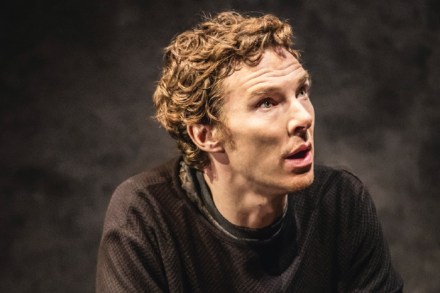
[audioplayer src="http://rss.acast.com/viewfrom22/merkelstragicmistake/media.mp3" title="Kate Maltby and Igor Toronyi-Lalic discuss Benedict Cumberbatch's Hamlet" startat=1642] Listen [/audioplayer]You can’t play the part of Hamlet, only parts of Hamlet. And the bits Benedict Cumberbatch offers us are of the highest calibre. He delivers the soliloquies with a meticulous and absorbing clarity like a lawyer in the robing room mastering a brief before his summing-up. And though he’s a decade too old to play the prince (the grave scene sets his age at about 28), he cavorts about the stage like a ballet dancer delighting in his own athleticism. But he’s also much too nice. The darkest shades of melancholy and the raw emotional ugliness are missing.

Art by committee

Theatre

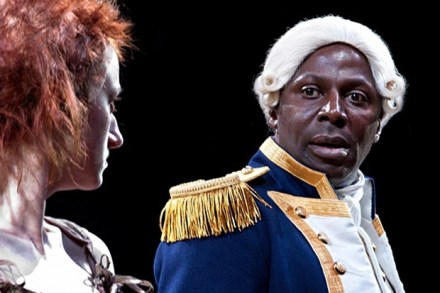
Australia, 1788. A transport ship arrives in Port Jackson (later Sydney harbour) carrying hundreds of convicts and a detachment of English officers under orders to guard the prisoners and to implant the roots of a well-ordered colony. These facts form the basis of Our Country’s Good, which was created in 1988 by Timberlake Wertenbaker in collaboration with Max Stafford-Clark’s Joint Stock company. Stafford-Clark’s method is to prepare a script using committees of actors under the supervision of a writer and the invariable result is a show that prizes the concerns of players over those of play-goers. The director Nadia Fall has revived this script with lavish efficiency. We begin with the ship disgorging its contents on to the Australian shore.

Edinburgh on Thames

Theatre

Showstopper! The Improvised Musical offers a brand new song-and-dance spectacular at every performance. It opens with a brilliantly chaotic piece of comedy. A theatre producer on stage telephones Cameron Mackintosh and pitches him a new musical. Mackintosh answers and the producer invites ideas from the audience. ‘What’s the setting?’ Someone yelled ‘Late-night sauna’ at the performance I saw. The producer, without missing a beat, told Mackintosh that the show would be called, Sweat, Sweat, Sweat. If that was improvised it was world-class. The show develops along the lines suggested by the crowd and a number of hit musicals are parodied. The audience, I suspect, enjoyed this more than me.

Northern lights | 20 August 2015

Theatre

In the clammy shadows of Cowgate I was leafleted by a chubby beauty wearing all-leather fetish gear. ‘Hi! Want to spend an hour with a prostitute for nothing?’ Yes, please. Her show The Coin-Operated Girl (Liquid Room Annexe, until 30 August), part of the free fringe, deals with the seven years she spent servicing sex-starved men in swish London hotels. One of the commonest fantasies was ‘GFE’, which has nothing to do with threesomes or gimp-masks. ‘The Girlfriend Experience’ means sex, kissing, cuddling, chatting, bickering and everything involved in a normal relationship.

Edinburgh round-up

Theatre

Propaganda is said to work best when based upon a grain of truth. Ukip! The Musical assumes that most electors are suspicious of the movement and its leaders. And in Edinburgh that may well be the case. The show portrays Nigel Farage as a bewildered twerp with no charisma and little talent for oratory. His first speech at an Essex shopping centre begins, ‘I am not a pretty nationalist, sorry, a petty nationalist.’ He then falls under the influence of a manipulative racist named Godfrey Bloom. I should point out that ‘Bloom’ in this piece refers to the character in the show, not to the retired politician. Bloom is first seen in a Westminster club, Gay Banana, dressed in a grass-skirt and singing the praises of Bongo-Bongo Land.

Chekhov by numbers

Theatre

Chekhov so dominates 19th-century Russian drama that Turgenev doesn’t get much of a look-in. His best known play, A Month in the Country, was written before Chekhov was born but Patrick Marber’s adaptation, with its new nickname, feels like Chekhov scripted by a Chekhov app. Turgenev’s characters, his atmosphere and his scenarios feel entirely familiar but they lack the tragicomic gestures that give Chekhov his unique appeal. There are no fluffed murders or dodged duelling challenges. No one tries and fails to blow his brains out. We’re on a rural estate where a group of crumbling, damaged sophisticates pootle around falling in love with each other. Every affair is doomed.

Family matters

Theatre

God, what a title. The Gathered Leaves. It sounds like a tremulous weepie about grief and endurance with a closing scene featuring three anvil-faced spinsters staring through the rectory window at an autumn bonfire. It’s not quite like that. The play opens with some clumsy exposition revealing the political chronology. It’s Easter, 1997, and Labour’s shiny-fanged messiah is about to evict the Brixton mule from Downing Street. We meet the Pennington family, a high Tory clan nestling in a frondy corner of the Thames Valley, who are eager to heal an ancient rift. Their estranged daughter and her mixed-race sprog have been skulking in France for the past 17 years. They’re coming back. But when they return to the bosom of the family they get the bazooka.

Has-Bean

Theatre

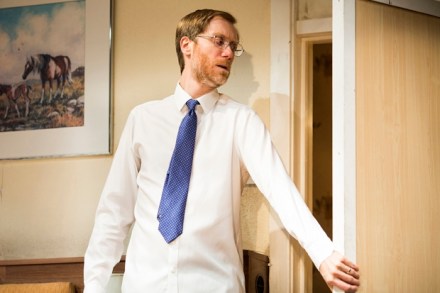
Richard Bean, the country’s most bankable playwright, knocks out a new script every four months. Thanks to the success of One Man, Two Guvnors, he’s not short of houses ready to stage his work. And the hunt for treasure in his back-catalogue continues. The Mentalists, from 2002, stars Stephen Merchant (co-writer of The Office) and Steffan Rhodri as two needy chums pursuing a whimsical dream in a cheap hotel room. Chum One is a hairdresser who makes porn films on the side. Chum Two is a salesman who dreams of founding a rebel colony overseas. Chum One films Chum Two delivering a sermon that will kick-start the revolution. That, ladies and gentlemen, is about it.

Night at the circus

Theatre

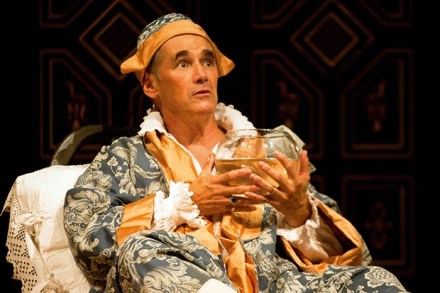
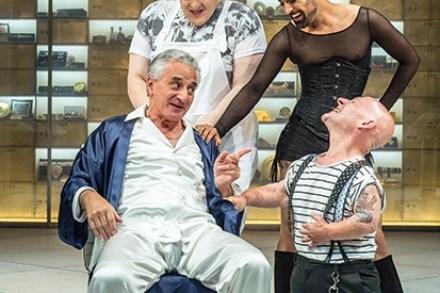
Easy playwright to get on with, Ben Jonson. His world is simple, his tastes endearing. He likes golden-hearted swindlers and unscrupulous servants who outwit their bungling masters. Volpone, the ‘sly fox’ played by Henry Goodman, is a rich Venice merchant without a family who persuades three wealthy rivals that they stand a chance of inheriting his estate. He feigns mortal illness and accepts their tributes, or bribes, from his sickbed while secretly lampooning their folly. This is hardly the most sophisticated hoax but it’s fun to watch the slick, spruce millionaires queuing up to be despoiled of their loot. Trevor Nunn’s up-to-date version skilfully harmonises the Jacobean and the modern.

Home and away | 9 July 2015

Theatre

Refugee crisis in the Mediterranean! Fear not. Anders Lustgarten and his trusty rescue ship are here to save mankind. Lampedusa consists of two monologues, one Italian, one English, which tackle the problem at home and abroad. We meet Stephano, a cartoon fisherman with a Zorba beard and a chunky woollen sweater who lives on Italy’s southernmost salient about 70 miles off the African coast. He follows an improbable path from xenophobia to enlightened altruism. At first he mistrusts the runaways whose corpses choke his native shore. He asks survivors why they don’t ‘speak the language’. ‘We do,’ they reply, in English. ‘This is Europe’s language.

Bid low, break even

Theatre

A new Seagull lands in Regent’s Park. Director Matthew Dunster has lured Chekhov’s classic into a leafy corner of north London to see if it needs an upgrade. The new script, by yuppie-baiting playwright Torben Betts, is casual, slangy and sometimes gauche. Favourite moments have been struck out including the great opening line, ‘Why do you always wear black?’ And Betts decides to make Chekhov’s characters swear. ‘Bollocks’, ‘piss off’. I don’t know Russian but I’m sure Chekhov didn’t need coarse language to portray coarse souls. The outside staging has been jazzed up too. A clunking great mirror hangs over the playing area like a bit of broken satellite.

Savile exposed

Theatre

Ho hum. Bit icky. Not bad. Hardly dazzling. The lukewarm response to An Audience With Jimmy Savile has astonished me. This is the best docudrama I’ve seen on stage. From the early 1970s, Britain swooned before Savile. Marketing pollsters found him the country’s best-loved celeb (bar the Queen Mum). He enforced his influence by winning over several establishments at once, the royals, the Beeb, the NHS, the media, the charity sector, Westminster. Evidence of his criminality existed but it never affected his reputation. He’s the nearest we’ve come to Hitler. The show takes the format of a TV biography which is intercut with scenes from Savile’s early life and testimony from his victims. Alistair McGowan’s ownership of Savile’s persona is astounding.

Own goal

Theatre

For nine years Patrick Marber has grappled with writer’s block (which by some miracle doesn’t affect his screenplay work), but the pipes are now ungummed and wallop! his new bolus of creativity splatters across the Dorfman stage. It’s a wordy three-hander set in the swamp of non-league football. Marber brilliantly captures the grubbiness and despairing optimism of ageing sportsmen who inhabit a golden age that never was. We meet Kidd, a hopeless but garrulous manager, as he tussles with Yates, a lugubrious old kit-man, for a controlling stake in a dazzling young talent, Jordan. The emotional terrain is lifted directly from Pinter and Mamet: male losers fighting over scraps of nothing.

Hard reign

Theatre

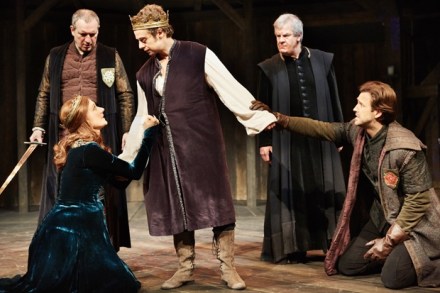
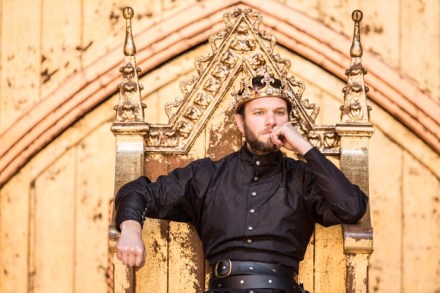
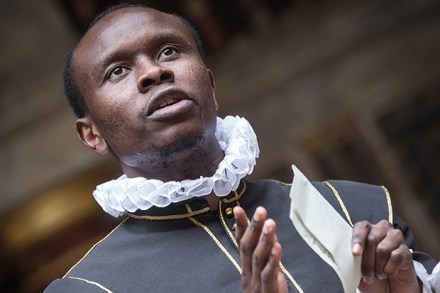
King John arrives at the Globe bent double under the weight of garlands from the London critics. Their jaunt up to Northampton for the première seems to have cast an opiate glaze over their faculties. Plays that are rarely revived earn their hermit status for a reason. They lack social skills or winning graces. They’re hard to get on with. Shakespeare launches his account of the bad king’s ‘troublesome raigne’ by exploring the shadowy crenellations of Plantagenet genealogy. A decent cast performing at full whack to an eager crowd couldn’t keep my brain engaged. After 70 minutes, the folds of my eyes were feeling as heavy as piano lids. Then, a sensation. A scene of extraordinary force and daring.

Close encounters | 4 June 2015

Theatre

In October 2011 anti-capitalist vagrants built an open-air squat outside St Paul’s within shrieking distance of London’s financial heart. The City thrummed all night with the dob-dob-dob of bongo recitals while the rebels held angry debates beneath their plastic canopies and declared the Square Mile knee-deep in ordure. To press the point they used nearby alleys for their ablutions. This half-forgotten protest has become a play in which the central figure, the dean, has to choose between evicting and accommodating his crusty tenants. Conscience informs him that the noisy campers are Christ’s spiritual heirs. But temporal responsibility obliges him to heed his Square Mile parishioners and sweep the ragamuffins from the City’s doorstep.

One foot on the catwalk

Theatre

St James Theatre hosts a new play about Alexander McQueen (real name Lee), whose star flashed briefly across the fashion world before his suicide in 2010. It opens with a mysterious stalker, Dahlia, breaking into McQueen’s Mayfair home and demanding that he make her a dress. ‘I’m calling the police,’ he shrieks but she placates him and they embark on a surreal odyssey to his childhood haunts where they meet his mentors past and present. A pretty clunky start. Who is Dahlia? A dramatic ploy, a figment of McQueen’s imagination or a real person? We don’t know so we don’t care about their relationship. Still less about her flipping dress.

Yank bait

Theatre

Here come the Yanks. As the summer jumbos disgorge their cargoes of wealthy, courteous, culture-hungry Americans, the West End prepares to bag a fortune. Death of a Salesman is just the kind of timeless post-war classic that Americans adore, isn’t it? Not quite. Arthur Miller is mistrusted in his homeland. For starters he was a closet pinko who kept the closet door wide open. He was wooed by Hollywood but spurned every inducement. He married Marilyn Monroe and failed to make her happy. And top of the chargesheet is this play, which proposes that the American dream is a con, a swindle, a diabolical cruelty that hounds mortals to death by engorging their bellies with fantasies of happiness. It’s a superb artefact but relentlessly uncomfortable to sit through.

Four play | 14 May 2015

Theatre

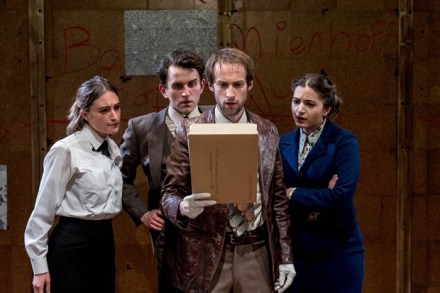
If Julian, Dick, George and Anne had become terrorists they’d have called themselves The Angry Brigade. It’s such a Wendy house name. The quartet of violent outcasts met in a Camden squat in the late Sixties and moved to Stoke Newington where they rented a house to deflect unwanted attention. They began planting bombs around London in the hope of jerking the proles from their consumerist trance and sparking a communist war. They preferred catchy locations for their fireworks: the Albert Hall, a BBC film unit, an MP’s garden. And it took the cops ages to track them down and sling them in jail. James Graham’s new play uses a neat staging device. There are four terrorists and four detectives, and the same actors play both hunters and quarry.

Pinter without the bus routes

Theatre

David Mamet is Pinter without the Pinteresque indulgences, the absurdities and obscurities, the pauses, the Number 38 bus routes. American Buffalo, from the 1970s, is one of Mamet’s early triumphs. Don is a junkshop owner who believes a customer cheated him over a rare nickel so he gets his young pal Bob to steal it back. An older friend, Teach, persuades Don to ditch Bob and let him commit the burglary. That’s it. That’s all that happens in this narrow, gripping thriller, which takes the brutal male culture of the Wild West and imports it to the Chicago slums where three lonely outcasts fight desperately for scraps of cash and friendship. On paper it all sounds grey, miserable and petty. On stage it’s magnificent, multicoloured, vast and tragic.

Losing the plot | 30 April 2015

Theatre

Enter Rufus Norris. The new National Theatre boss is perfectly on-message with this debut effort by Caryl Churchill. Her 1976 play about inequality screams, ‘Vote Ed’ at triple-klaxon volume. Not that anyone in the audience was won over. They’d made up their minds long ago. Which is just as well because the play is hopelessly ineffective on every level. Churchill must be the most over-rated writer the English theatre has produced. She has virtually no dramatic skills. She can knock out humourless preachy rhetoric by the yard but as for the rest of it she hasn’t a clue. She can’t write a plot. She can’t create a human individual or differentiate one character from another with quirks of thought, word or deed.

Stage fright

Theatre

The smash hit Matilda, based on a Roald Dahl story, has spawned a copycat effort, The Twits. Charm, sweetness and mystery aren’t Dahl’s strong points. He specialises in suburban grotesques who commit infantile barbarities. But his prose is sensational. No ‘style’ at all, just the simplicity and clarity of a master copywriter. He’s as good as Orwell. Mr and Mrs Twit are a pair of malignant outcasts who enjoy tormenting innocents. They keep a family of monkeys in a cage and they glue birds to trees and shoot them. You can read the story in about 20 minutes. It probably took Dahl a bit longer than that to write. And Enda Walsh’s essay-crisis adaptation may have delayed him for a day or two.

Death by politics

Theatre

Dead Sheep is a curious dramatic half-breed that examines Geoffrey Howe’s troubled relationship with Margaret Thatcher. Structurally it’s a Mexican bean. It leaps all over the 1980s and it keeps shifting genre from cabaret to tragedy via cheesy political satire. Some actors are impersonators, some are caricaturists, some are neither. James Wilby’s study of Howe avoids his personal mannerisms, the pensive shabbiness, the punctilious, worried eyes, and the soft beguiling purr of his vocal chords. Instead Wilby presents him as a bewildered monk tiptoeing around a lion’s den. Steve Nallon does Mrs Thatcher as a drag-queen which looks pretty odd next to Wilby’s straightforward Howe but Nallon is a master vocalist.

Ayckbourn again

Theatre

Experts are concerned that Alan Ayckbourn’s plays may soon face extinction. Fewer than 80 of these precious beasts still exist in their natural habitat, so theatre-goers will be cheered to know that the National Theatre has created a genetically identical replica and released it into the wild. Rules for Living, fashioned by Sam Holcroft from the Acykbourn blueprint, is a bourgeois natter-fest in which bickering couples meet for a fractious Christmas summit. The characters are a bit nice and a bit nasty. Stephen Mangan plays a failed cricket star married to a soak in a frock. They have an only child who suffers from this year’s must-have mental disorder.

Bad Jews at the Arts Theatre reviewed: strange, raw, obsessive and brilliant

Theatre

Bad Jews has completed its long trek from a smallish out-of-town venue to a full-scale West End berth. Billed as a ‘hilarious’ family comedy it opens on a low-key note in a New York apartment where three cousins have gathered for grandpa’s funeral. Daphna is a puritanical vegan Jewess, training as a rabbi, who wants to move to Israel, marry a soldier and serve in the IDF. She’s insanely jealous of Jonah and Shlomo, whose parents have bought them a flat before either has found a job. Shlomo (who calls himself Liam) is a ‘bad Jew’ obsessed with Japanese culture who intends to marry out.

Blunt and bloody: ENO’s Sweeney Todd reviewed

Theatre

A wicked deception is sprung in the opening moments of this New York-originated concert staging of Stephen Sondheim and Hugh Wheeler’s Sweeney Todd. The English National Opera orchestra, liberated from the pit, is duly assembled on stage at the London Coliseum; flower arrangements and a Steinway grand add to the formality, and right on cue the conductor and cast, suitably attired in evening wear and with scores in hand, take their places behind a line of music stands. The applause dies and Bryn Terfel turns to the conductor, clears his throat and nods. The whirring ostinato introducing ‘The Ballad of Sweeney Todd’ begins — furtively — and Sweeney, of course, has the first word.

Shrapnel at the Arcola works for the slayers, not the slain

Theatre

Quite a hit factory these days, the Hampstead Theatre. The latest candidate for West End glory is Hugh Whitemore’s bio-drama about Stevie Smith. Not an obvious choice. The script, from the 1970s, recreates the atmosphere of Stevie’s life with effortless accuracy. Her vocabulary, her taste in clothes, her habits of thought and expression appear by magic as if drawn from the evidence of intimate friends. Yet Whitemore never met his subject. Zoë Wanamaker plays her as an adorable suburban eccentric, whose razor-sharp intellect peeps out from behind a façade of emerald pinafores and sherry decanters. Stevie (Florence Margaret Smith) was born in Hull in 1902 and lived nearly all her life in Palmers Green.

Radiant Vermin at the Soho Theatre reviewed: a barmy little sketch posing as a revolutionary satire

Theatre

Philip Ridley is best known as the screenwriter of The Krays, in which Gary and Martin Kemp played Ronnie and Reggie as a pair of tanned and lisping choirboys. Ridley loves to bang his own gong. And he’s got enough gongs to raise quite a racket. The Smarties Prize, the W.H. Smith Mind-Boggling Book Award, the George Sadoul prize, the best director award at the Porto Film Festival. His action-packed CV even features trophies he nearly won but didn’t: the London Fringe Best Play Award (nominated); the Carnegie Medal (shortlisted). And no London writer has shown more literary potential than Ridley. He remains the only earthling ever to receive the Evening Standard’s ‘most promising’ award in both film and stage categories. How are those promises shaping up?

The Armour at Langham Hotel reviewed: three new playlets that never get going

Theatre

One of last year’s unexpected treasures was a novelty show by Defibrillator that took three neglected Tennessee Williams plays, all set in hotel rooms, and staged them in suites at a five-star dosshouse in central London. The Langham Hotel, an antique hulk of marble and glass overlooking Broadcasting House, is justly proud of its raffish literary history. Arthur Conan Doyle once met Oscar Wilde there for a chinwag and a cup of tea and by the time the bill arrived they’d conceived a fictional detective named Holmes. The Langham’s management is keen for Defibrillator to repeat last year’s success but how? Search the archive for more plays set in hotels? Dramatise a short story with a hotel location? Commission some brand-new inn-based drama?

Why George Bernard Shaw was an overrated babbler

Theatre

When I was a kid, I was taught by a kindly old Jesuit whose youth had been beguiled by George Bernard Shaw. The provocative ironies of ‘GBS’ were quoted everywhere and he was, for several decades, the world’s leading public intellectual. But as a schoolboy I found it hard to assent to the infatuations of my elders and though I relished Shaw’s aphorisms (‘we learn from history that we learn nothing from history’) I conceived a suspicion that he was smug and overrated. A babbler. Perhaps even a bore. Man and Superman, rarely revived at full length, offers us GBS with all the taps running. Imagine Fry, Brand and Norton rolled into one and given a bushel of coke to snort.