Culture

Culture

The good, the bad and the ugly in books, exhibitions, cinema, TV, dance, music, podcasts and theatre.

Muswell Hill reviewed: a guide on how to sock it to London trendies

Theatre

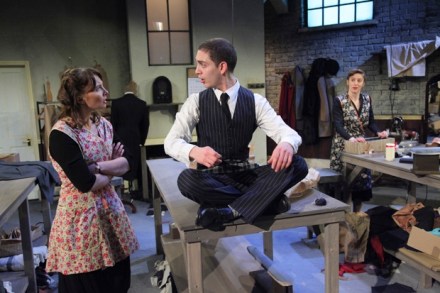
Torben Betts is much admired by his near-namesake Quentin Letts for socking it to London trendies. Letts is one of the few individuals who enjoys the twin blessings of a Critics’ Circle membership card and a functioning brain so his views deserve serious attention. The title of Betts’s 2012 play Muswell Hill shifts its target into the cross hairs with no subtlety whatsoever. Curtain up. Married couple, Jess and Mat, are nervily tidying their yuppie dream home in expectation of supper guests. Jess is a sex-bomb accountant. Mat is a blankly handsome scribbler whose debut novel keeps getting rejected. Then a missile strikes. Mat casually mentions his acquaintanceship with an Australian electrician whom Jess has been secretly entertaining. Tense silence. The doorbell rings.

How to Hold Your Breath, Royal Court, review: yet more state-funded misanthropy

Theatre

‘We hate the system and we want the system to pay us to say we hate the system.’ The oratorio of subsidised theatre rises, in triumphant blast, at the Royal Court whose current empress Vicky Featherstone has chosen to direct an interesting new play by Zinnie Harris. I’d call it a quasi-symbolist extraterrestrial tragicomic chicklit road-movie spoof with Chomsky-esque anti-corporate neo-collectivist socioeconomic textual underpinning but I fear this may lend it a clarity of purpose, and a firmness of character, which it doesn’t quite possess. We start with Dana, a chippy frump on the last lap of her sex life, bedding a UN drudge named Jarron who claims to be ‘a demon, a devil, a god’.

A tatty new theatre offers up a comic gem that’s sure to be snapped up by the BBC

Theatre

New venue. New enticement. In the undercroft of a vast but disregarded Bloomsbury church nestles the Museum of Comedy. The below-stairs space wears the heavy oaken lineaments of Victorian piety but the flagstones have been smothered with prim suburban carpeting, wall-to-wall. There’s a bar in one corner. Yes, a bar in a church. With prices high enough to make you take the pledge. The ecclesiastical shelves are crammed with books, magazines, scripts and photographs that summon up the ghosts of our comedy heroes. A big carved pew, centrally plonked, invites the worshipper to sit and read, let us say, the autobiography of Clive Dunn or the diaries of Kenneth Williams. The sheer incongruity of this arrangement causes palpitations in the brain.

Tom Stoppard’s The Hard Problem review: too clever by half

Theatre

Big event. A new play from Sir Tom. And he tackles one of philosophy’s oldest and crunchiest issues, which varsity thinkers call ‘the hard problem’. How is it that a wrinkled three-pound blancmange sitting at the top of the spinal cord can generate abstract thoughts of almost limitless complexity? In real life Sir Tom is said to have such a flair for philosophical chitchat that he can fire off searching observations about Descartes, mind-body dualism, the nature of immateriality, being and non-being, the ‘cogito’ and so on, until those around him have slithered into a coma. Which is not rude of them.

My Night With Reg at the Apollo Theatre reviewed: a great play that will go under without an interval

Theatre

Gay plays crowd the theatrical canon. There are the necessary enigmas of Noël Coward, like The Vortex or Design For Living, which are slyly aimed at an audience of knowing code-breakers. There are the proud, defiant (and rather tedious) pleas for understanding like La Cage Aux Folles. And the gayest of them all, My Night With Reg, is also the least overtly gay because it dispenses with all homosexual caricatures. There isn’t an interior designer, a flight steward or a hair stylist in sight, let alone a Liberace fetishist, or a Maria Callas wonk. The characters are mainstream yuppies who are exactly like hetero folk, except that they seduce one another with very little encouragement and an enviably high success rate. We’re in the 1980s.

Young Vic’s Bull, review: a new Mike Bartlett play to bore you into catalepsy

Theatre

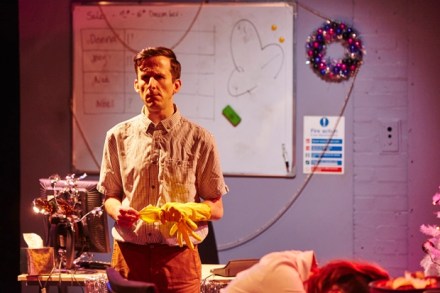
A knockout show at the Young Vic. Literally. The stage has been reconfigured as a boxing ring to make Mike Bartlett’s play, Bull, feel like a sporting fixture. This is a common conceit, even a cliché, but here it’s done superbly. The auditorium floor is squash-club yellow and the stage is surrounded by a casual standing area that creates the ragged informal atmosphere of a training arena. Excellent stuff. The play is a wordy, tricky, shifty, nasty, faithless thing. The characters lie about their backgrounds so it’s hard to know who, or what, to latch on to. More problematically the plot is infertile. Nothing grows or develops. At curtain-fall the position is the same as at curtain-rise. We’re in a workplace.

Old Vic’s Tree: Beckett plus Seinfeld – plus swearing

Theatre

‘Fucking hell. You twat. Fuck off. Fuck. Fuck.’ These dispiriting words are the opening line of Tree, a newish play by the lugubrious comic Daniel Kitson, whose stand-up show once transported me into the heavenly arms of Lethe. His script opens with a chance encounter between two oddball smart Alecs. The outdoor setting, borrowed from Beckett, is a suburban cul-de-sac where a single tree is about to shed its autumn raiment. One man crouches in the branches, another stands below. They exchange confidences, observations, food and witticisms. At the end, one departs. This is a play of quips and anecdotes but no significant action. The tree-dweller is an eco-warrior protesting at the council’s policy of bough amputation and trunk eradication.

Young Vic’s Golem: its status as a cult hit fills me with troubled wonder

Theatre

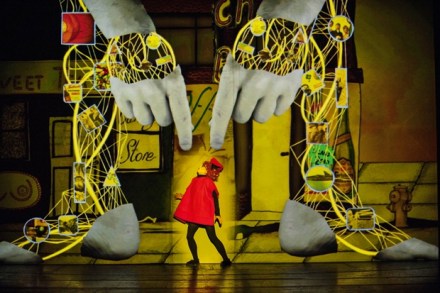
The Young Vic produces shows that please many but rarely me. Its big hit of 2014, A Streetcar Named Desire, won virtually every prize going apart from the one it deserved: the year’s deadliest assault on a much-loved classic. The modernised setting offered us a tactless, shirty Blanche DuBois, played by Gillian Anderson as a stupefied boob-job victim searching for a rich jerk to bankrupt. The Young Vic’s new year programme kicks off with Golem, adapted from Gustav Meyrink’s 1914 novel about a rabbi who fashions an automated slave from some discarded bits of candle wax. The show is created by a posse of euro-troubadours, with the confusing name 1927, who offer a superb blend of animation, satirical sets and puppet-like humans in comedy costumes. Bam!

National Theatre’s 3 Winters: a hideous Balkans ballyhoo

Theatre

A masterpiece at the National. A masterpiece of persuasion and bewitchment. Croatian word-athlete Tena Stivicic has miraculously convinced director Howard Davies that she can write epic historical theatre. And Davies has transmitted his gullibility to Nicholas Hytner, who must have OK’d this blizzard of verbiage rather than converting it into biofuel and sparing us a hideous Balkans ballyhoo. Certainly the play is conceived on a grand scale. Location: a Zagreb mansion. Timeline: 1945 to 2011. Characters: several generations of clever proles plus one dangling aristo. It opens on a note of sourness and corruption. A blonde Marxist stunnah seduces a top commissar who buys her off with the freehold to a townhouse occupied by some rich bloodsuckers. The snooty vermin are kicked out.

Panto season has arrived – and even the kids are turning their nose up at it

Theatre

‘What is a panto?’ I asked my companion at the Hackney Empire’s Saturday matinee. ‘It’s basically a really bad play,’ said Coco, aged five and three quarters. She was there with her older brother and my son to help me appreciate the Christmas frolics. Half an hour in, I feigned confusion over the storyline. ‘People are trying to steal the duck,’ she said. Mother Goose is a parable of wealth and greed set in Hackney-topia where an impoverished family become rich when their champion egg-layer starts to produce bullion instead of breakfast. Menaced by an assortment of harpies and malefactors, they move into a spangly new palace and try to protect their asset from thieving hands.

The recruitment company to go to if you’ve got no arms or legs

Theatre

When to launch? For impresarios, this is the eternal dilemma. Autumn is so crowded with press nights that producers are heard to sigh, ‘The market’s full. There’s no room.’ When the glut abates in late November, the same producers sob, ‘The market’s empty. There’s no point.’ But national rags have to report on something, even a fringey foxhole like the Southwark Playhouse, and a bold investor can exploit this opportunity. Most of the dailies sent their top sniffer dogs to check out Saxon Court by Daniel Andersen, which is set in the feverish, sharp-suited world of Square Mile recruitment.

The National’s latest attempt to cheer us up: three hours of poverty porn

Theatre

Bombay is now called Mumbai by everyone bar its residents, whose historic name (from the Portuguese for ‘beautiful cove’) has been discarded for them by their betters. Near the airport a huge advertising board bearing the slogan ‘Beautiful Forever’ overlooks an alp of discarded junk where homeless paupers crouching in tin shacks toil and slave around the clock to earn a meagre bowl of grey, rat-licked gruel. Welcome to the National’s latest attempt to cheer us all up. The verminous scrapheap teems with cocky adolescents, witty thieves, evil moneylenders and struggling mums.

Norman Mailer’s wife comes out of the shadows

Theatre

‘It’s not as bad as I thought it would be,’ said Norman Mailer to his wife, Norris Church, after reading the first chapters of a novel she wrote in the 1970s. It took her decades to recover from this accolade and the book remained unpublished until 2000. Here’s a two-handed drama she drafted in the 1980s. The setting is a New York strip joint. A social anthropologist finds a girl in a booth and hires her to describe her daily life. He feeds her banknotes through a slot, like a zoo-keeper giving peanuts to a caged marmoset, and she prattles away at him earning a dollar every 60 seconds. She strongly suspects he’s not a scientist but a self-deluding voyeur who disguises his carnal appetites as an intellectual investigation. Happens a lot, she says to him.

Yanks buy stacks of tickets in the West End. Why is Made in Dagenham so rude to them?

Theatre

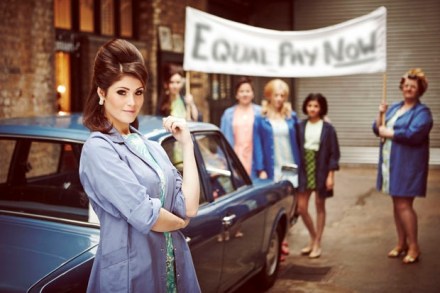
Go slow at Dagenham. The musical based on the film about a pay dispute in the 1960s starts as a sluggish mire of twee simplicities. We’re in Essex. Grumbling Cockney wage slaves inhabit cramped but spick-and-span council flats. Russet-cheeked kiddiwinkies are scolded and cosseted by blousy matriarchs married to emotionally reticent beer guts. The doll’s-house infantilism of Rupert Goold’s production is challenged by designer Bunny Christie whose set is an essay in conceptualism. She uses a vast plastic grid, like an unmade Airfix kit, to suggest the Dagenham car plant. It’s ingenious and intricate but irritating too. Trouble brews at the factory when the executives downgrade the leather workers, who stitch the car seats, to the level of unskilled labour.

An inept dud penetrates the Park Theatre’s dross-filters – and I blame Beckett

Theatre

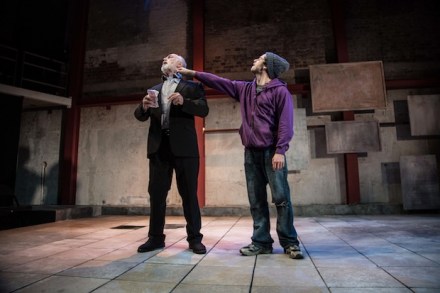
Jonah and Otto is a lost-soul melodrama that keeps its audience guessing. Where are we? The Channel coast somewhere. Indoors or out? Not sure. Near a church maybe? Violence barges in. Jonah, a mouthy scruff, shoves a knife in the face of Otto, a dignified old gent with Big Ears whiskers and a dark, elegant suit. This strange assault is followed by further peculiarities. Rather than calling the cops, Otto seeks a rapprochement with Jonah and they start a rambling, off-beat friendship. Later we discover that Otto, a Cambridge-educated vicar, has an adult daughter who was crippled in childhood by a road accident, and this detail lends credibility to his desire to befriend and redeem his mugger. But the relevant information arrives far too late.

Neville’s Island: a play from the era of Men Behaving Badly – when women were seen as exotic excrescences

Theatre

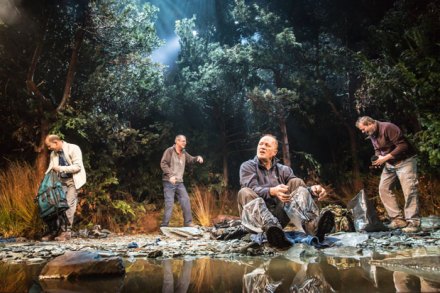
Start with a joke. Neville’s Island. Get it? Laughing yet? Are your ribs splitting into pieces? It’s a cracker, isn’t it? Well it’s a pun, at least, on Devil’s Island. Tim Firth’s play, regarded as a modern classic, premiered 22 years ago in Scarborough: Ayckbourn country, and it shows. Four corporate numbskulls on a team-building exercise get stranded on a remote islet with no hope of rescue. Their Alcatraz is located in the Lake District, which is known to millions as a dead-safe holiday habitat, and this seems to have unsettled Firth so he crams in extra snags to convince us the castaways’ predicament is genuine. Their skiff has capsized. Killer pike throng the lake-waters. Food supplies are limited to a sausage.

Is London’s West End Jewish enough for David Baddiel’s musical The Infidel?

Theatre

David Baddiel has turned his movie, The Infidel, into a musical. The set-up is so contrived and clumsy that it has a sweetness all its own. A golden-hearted London cabbie, named Mahmoud, discovers that he was adopted at birth and that his real parents were Jewish. This strikes him as intriguing rather than alarming, and he starts to investigate Judaism with the sort of disinterested curiosity of a man taking up astronomy after inheriting a telescope and a star-chart from an eccentric uncle. Mahmoud wants an easy life so he keeps his secret from his wife, Saamiyah, and from his son, Rasheed, who plans to marry a girl named Ji-Ji whose father is a ranting Islamic bigot.

Donmar’s Henry IV: Phyllida Lloyd has nothing but contempt for her audience

Theatre

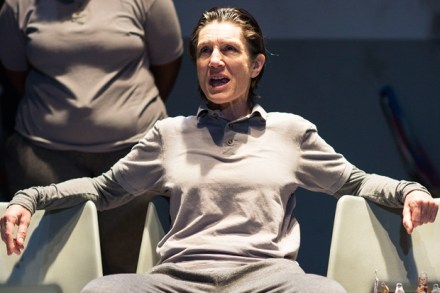
The age of ‘ladies first’ is back. Phyllida Lloyd reserves all the roles for the weaker sex, as I imagine she thinks of them, in this hybrid play assembled from Henry IV (i) and (ii). It’s a twin-layered production that poses as a piece of am-dram mounted in a women’s nick. The Donmar has been refitted, in and out, to resemble a prison. (Quite an expense. And there’s no interval either, so there are no bar profits to subsidise the fancy-dress party.) As we arrive we’re barked at by ushers attired as screws who harry and scold us into our plastic seats. Nothing surprising in this uppity aggression. Contempt for audiences is common among high-end theatre types: anyone ready to spend 30 quid on amusement deserves to be punished.

Were the cast of the Old Vic’s Electra clothed by Oxfam?

Theatre

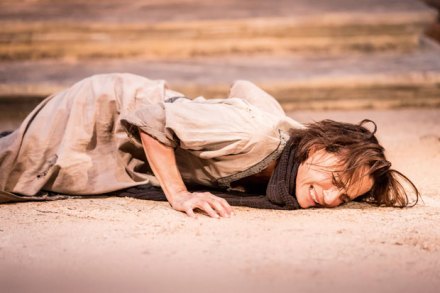
First, a bit of background. Conquering Agamemnon slew his daughter, Iphigenia, in return for a fair wind to Troy. This rather miffed his wife, Clytemnestra, who bashed his head in with an axe when he came swaggering home. Her retribution laid a religious duty on their son, Orestes, to avenge his dad by slaying his mum, which, in its turn, put a bit of a crimp in his social calendar. Sophocles’ play opens during a lull in the butchery. Orestes, now in exile, throws Clytemnestra off her guard by releasing details of his death. The details consist of an urn containing his ashes delivered to the palace.

Will Marti Pellow attract enough tipsy hen parties to Evita to flog all 18,000 seats?

Theatre

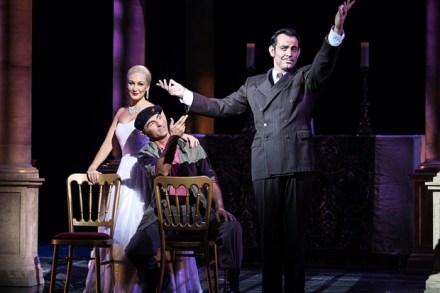
Tim and Andy are back. Their monster hit Evita opens the fully refurbed and re-primped Dominion Theatre, which is built on the scale of an airport terminal and needs a big production to fill it. This is a beautiful version of a show that marks a decline in the Tim and Andy alliance. It hasn’t the naïve and exuberant mischief of Joseph, nor the scope and the sustained dramatic force of Jesus Christ Superstar. Earnestness, and over-reverence for their subjects, are starting to creep in. It spoils the fun to know that the Perons weren’t a pair of sweet-natured do-gooders handing out beefsteaks to the underclass but a couple of egos on stilts running a dictatorship based on fear.

Charles III is made for numbskulls by numbskulls

Theatre

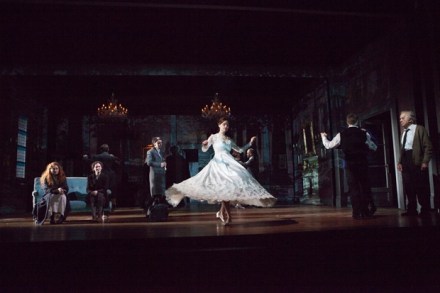
Suppose Charles were to reign as a meddlesome, self-pitying, indecisive plonker. It’s a thought. It’s now a play, too, by Mike Bartlett. In his opening scene he bumps off Lilibet, bungs her in a box and assembles the family at Buck House to discuss ‘what next?’ Bartlett imagines them as stuck-up divs. William’s a self-righteous sourpuss. Kate’s a smug minx. Camilla’s a hectoring gadfly. Harry’s a weepy drunk. Charles is a colossally narcissistic nuisance. They’re too dim to understand the constitution so Camilla has to explain that a new reign commences with the death of the previous monarch and not at the coronation. (This is for the benefit of the audience, who are assumed to have the same poultry-level IQ as the Windsors.

If you have teenage boys who loathe the very idea of theatre, send them to The Play That Goes Wrong

Theatre

It’s taken a while but here it is. The Play That Goes Wrong is like Noises Off, but simpler. Michael Frayn’s cumbersome backstage farce asked us to follow the actors’ personal stories as well as their on-stage foul-ups, and the surfeit of detail proved a bit of a brain-scrambler. This is a badly rehearsed thriller played by useless amateurs on a disintegrating set. Good clean knockabout. Some of the background information is puzzling. The troupe calls itself the Cornley Polytechnic Drama Society even though polytechnics no longer exist. And their decision to put on a creaky 1920s murder mystery seems a little perverse. Aside from the booby-trapped props and collapsing furniture, they haven’t a clue how to bodge their way out of difficulties. This slightly mars the comic effect.

Can the Scots really be as small-minded, mistrustful and chippy as Spoiling suggests?

Theatre

Referendum fever reaches Stratford East. Spoiling, by John McCann, takes us into the corridors of power in Holyrood shortly after a triumphant Yes vote. We meet a foul-mouthed bruiser named Fiona whose strident views and vivid language have propelled her into the public eye during the referendum battle. Her reward is Scotland’s foreign ministry. The most obvious and striking thing about Fiona is her personal ghastliness. A coarse, petulant show-off, over-endowed with self-belief, she has no wit, geniality or political intelligence. Asked how she feels about the birth of Scotland’s liberty, she rasps out her reply like a seagull with tonsilitis. ‘Rebirth!’ Her mistrust of Westminster is deeply engrained.

Bent bureaucrats, ‘fake dykes’ and bad bakers — this week’s theatre

Theatre

Eye of a Needle, by newcomer Chris MacDonald, looks at homosexuality and asylum. Gays from the Third World, who’ve suppressed all evidence of their orientation at home, find they have to leap out of the closet once they reach the UK, and provide documentary proof of their hot-tub marathons and nitrate-fuelled rubdowns. Lots of comic potential there. We open with a boastful Ugandan describing his ten-in-a-bed shenanigans to a shy English civil servant, who transcribes his X-rated testimony with silent professionalism. The message is upbeat: good old Britain helps grateful refugees escape from tyranny and prejudice. Then everything curdles. We meet Natale, a Ugandan lesbian, who treats the application process as an affront to her dignity.

Dolts, Doormats and FGM: theatre to make you physically sick

Theatre

Wow. What an experience. A 1991 movie named Dogfight has spawned a romantic musical. We’re in San Francisco in 1963. Eddie is a swaggering, shaven-headed Marine and Rose is a shy, awkward waitress. Come to a party, he says. She refuses, prevaricates, reconsiders, accepts. They reach the venue; he ignores her. Furtive conversations in corners and a pervasive air of mystery suggest that something is up. The party, or ‘Dogfight’, turns out to be a secret Miss Piggy contest in which a bunch of insecure soldiers award a cash prize to the creep who invites the ugliest escort. When Rose learns she’s been tricked, she asks for an explanation. ‘You were disqualified,’ shrugs Eddie. This grisly set-up occupies the first act.

An innocent graduate of Operation Yewtree, Jim Davidson, dazzles in Edinburgh

Theatre

Let’s start with a nightmare. Wendy Wason, an Edinburgh comedienne, travelled to LA last year accompanied by her husband, who promptly succumbed to a fainting fit. Wason called an ambulance, unaware she was in a hospital car park, and was handed an £8,000 bill to cover the 15-yard trip. By the time her husband had been cured, the invoice had risen fivefold. As comedy Wason’s show (at the Gilded Balloon) is wry, downbeat and hilarious. It also has a Wider Purpose. She believes that US-style healthcare is about to engulf Britain and she wants us to help her save the NHS. Always a dilemma, I find, when stand-ups dabble in politics. Is the comic promoting the cause, or the cause the comic?

The best of the Edinburgh Fringe

Theatre

Rain whimpers from Edinburgh’s skies. The sodden tourists look like aliens in their steamed-up ponchos as they scurry and rustle across the gleaming cobblestones. Performers touting for business chirrup their overtures with desperate gaiety. Thousands of them are here. Tens of thousands. Vanity’s refugees hunkering on the wrong side of fame and hoping to get through the ego-crisis alive. A familiar name forces its way through the anonymous wastes. Julie Burchill: Absolute Cult (Gilded Balloon) is a one-act play by Tim Fountain. We’re at home with the Queen of Spleen as she cracks open a litre of vodka. It’s mid-morning. ‘I’m a hideous parody of myself,’ she tinkles in her soft-core Cider With Rosie accent.

Sorry, Gillian Anderson, but you’ve caught the wrong Streetcar

Theatre

Streetcar. One word is enough to conjure an icon. Tennessee Williams’s finest play, written in the 1940s, is about a fallen woman trying to salvage her reputation before madness overwhelms her. All its horror and tension rely on the Victorian code that required a single woman to appear morally pure or to face ruin in the marriage market. The 1960s destroyed those conventions and this modern-day version feels like a lawsuit being pursued by a stammering counsel interrogating a corpse. The questions are baffling, the answers non-existent. Director Benedict Andrews trusts his own instincts far too much and the author’s not at all. To evoke the lush, exotic heat of Louisiana, he goes for Danish minimalism and clean white surfaces.

Let’s face it, Greek tragedy is often earnest, obscure or boring. Not this Medea

Theatre

Carrie Cracknell’s new version of Medea strikes with overwhelming and rather puzzling force. The royal palace has been done up to resemble a clapped-out Spanish villa that seems to date from about 1983 if the kennel-sized TV set is anything to go by. (Weren’t TVs massive then? And always brown.) The villa’s peeling wallpaper and suppurating marble edifices form a balcony that straddles an eerie little copse, which manages to look both indoors and outdoors at once. These warring effects — villa and forest — do little to elucidate the play’s simple story: jilted Medea avenges herself on love rat Jason by murdering their two sons and bumping off his new sex-bunny.