Culture

Culture

The good, the bad and the ugly in books, exhibitions, cinema, TV, dance, music, podcasts and theatre.

Deluded continent

Theatre

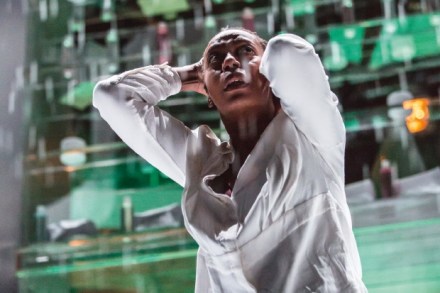
Les Blancs had a troubled birth. In 1965 several unfinished drafts of the play were entrusted by its dying author, Lorraine Hansberry, to her ex-husband, Robert Nemiroff, who mounted a debut production in New York in 1970. Nemiroff has created a fresh version with the help of a ‘dramaturg’ (or ‘colleague’, in English) named Drew Lichtenberg who believes not only that this ramshackle script is a masterpiece but also that Hansberry belongs in the first rank of dramatists alongside Ibsen, Sophocles and Aeschylus. This does not bode well. But the result is surprisingly good. Or good-ish.

Close encounter | 7 April 2016

Theatre

Sunset Boulevard is a tale of fractured glory with Homeric dimensions. The movie presents Hollywood as a never-ending Trojan War that attracts fresh generations of dreamy youths in search of conquest and treasure. The lead characters have retired from battle, wounded. Joe Gillis, like Odysseus, is a vagrant warrior ensnared in the island-mansion of Norma Desmond, who plays the role of broken-queen-turned-sorceress. These fabulous elements are preserved in Andrew Lloyd Webber’s musical version. So is the Norma-Joe affair, with its distasteful emotional template: mother-son, boss-slave, mistress-poodle, crone-toyboy. The lovers are linked by nothing but neediness and failure, and each desires the mirage that the other represents.

Funny boys

Theatre

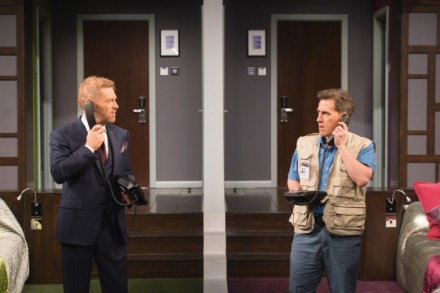
Sir Ken’s excellent West End residency continues with a sugar-rich confection. Sean Foley has adapted and updated an elderly French farce about an assassin who befriends a needy depressive. Hitman Ralph rents a hotel suite overlooking a courtroom where his target is due to make an appearance. The neighbouring room is occupied by a mopey Welshman, Brian, who wants to hang himself from the light socket. Ralph discovers Brian’s plan and realises that Brian’s death will fill the hotel with cops and ruin his assassination attempt. So Ralph must save Brian from suicide. It’s a pretty clunky scenario and the logistics are frankly incredible because the design postulates two adjacent single rooms linked by a communicating door. Hotels aren’t built that way.

Nuclear waste

Theatre

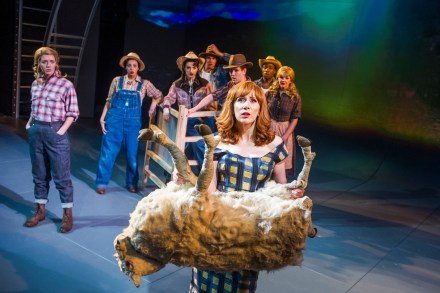
Miss Atomic Bomb celebrates the sub-culture that grew up around nuclear tests in 1950s America. The citizens of Nevada would throw parties and stage barbecues to coincide with the latest nuclear detonation in the desert. This musical has a lot going for it. The melodies are strong, and well sung. The high-kicking chorus lines are easy on the eye and the show has a zippy, innocent spirit. But the storyline gets sidetracked in a mass of contradictory directions. The main theme follows a homesick farm girl who becomes involved with a runaway soldier whose brother runs a Vegas nightclub where a beauty contest is being held that the farm girl hopes to win.

Time out of mind | 17 March 2016

Theatre

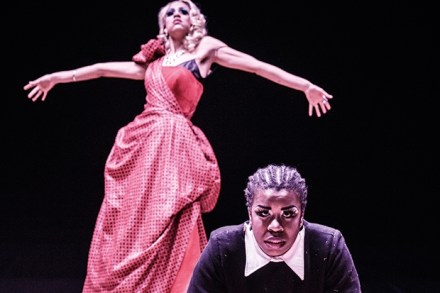
The Maids is a fascinating document. Written in 1947, Jean Genet’s drama portrays a pair of serving girls who enact sexually loaded fantasies while dressed in the clothes of their employer, Madame, whose murder they are secretly plotting. This macabre sketch still resonates because it analyses and presages the key social transition of the 20th century, namely the overthrow of privilege by the underclass. And it boasts extra layers of erotic chic because the sexually inquisitive maids are sisters and because Genet suggested that the girls might be played by men in drag. This delicate, subtle work is as firmly rooted in its historical era as another classic political allegory, Animal Farm, to which it bears some similarities. Jamie Lloyd has based his update on two bold decisions.

Pride and prejudice | 10 March 2016

Theatre

Jonathan Lynn, co-author of Yes Minister, has excavated the history of France during the two world wars and discovered dramatic gold. He presents us with pen portraits of eminent Frenchmen we think we know. Marshal Pétain (Tom Conti) is a humane pragmatist who refuses to risk speculative assaults on the Western Front. He evolved his strategy from a single motto: never attack until victory is certain. That worked fine at Verdun but in 1940 the same doctrine entailed capitulation to the all-conquering Germans. Pétain’s young protégé during the Great War is a surprise and a delight. We imagine Charles de Gaulle as a monumental slab of garlic-scented arrogance with the body of a furniture-shifter and the face of a parrot-fish.

Tragedy trumped by porn

Theatre

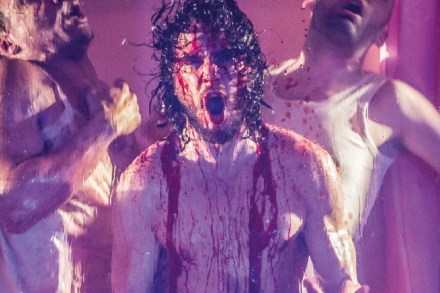
Big fuss about Cleansed at the Dorfman. Talk of nauseous punters rushing for the gangways may have perversely delighted the show’s creators but I’m firmly with the exiteers. This is barely a play and more a thin, vicious pantomime with an Isis-video aesthetic. The minuscule plot follows Grace (Michelle Terry) as she visits a prison hospital to receive news of a tortured relative. She’s immediately roped in as a victim and we’re treated to a sequence of gougings, knifings, electrocutions, rectal penetrations and tongue extractions which are bizarrely interspersed with scenes of lustful romance. Alex Eales’s design stands out.

Kit-car Chekhov

Theatre

Director Robert Icke has this to say of Chekhov’s greatest masterpiece: ‘Let the electricity of now flow into the old thing and make it function.’ He uproots ‘the old thing’ from its natural setting and drops it down in no-man’s land. It all feels modern. Aircraft buzz in the heavy summer air. A thunderstorm sets off a car alarm. English names have displaced their Russian originals. Telegin has turned into Cartwright. The childless but priapic Uncle Vanya has been renamed after a latex prophylactic, Uncle Johnny. Perhaps appropriately. These alterations create huge uncertainties of class, location and era. Who are these Bohemian dropouts swilling vodka in a nameless English shire without even a broadband connection to beguile their titanic boredom?

Kerching, Mr Bing

Theatre

Here’s how to set yourself up for a fall. You stage the world première of your debut play in the West End and you cast yourself in the lead role. Matthew Perry (Chandler Bing from Friends) has invited a critical monstering by brazenly challenging all-comers like this and the result is a terrible let-down. For the reviewers, that is, who have mindlessly attacked this breezy, stylish new dating comedy. It’s not perfect but it succeeds on many levels. It’s pacy, original and easy on the eye. It’s funny throughout (apart from a bizarre scene in a maternity unit, which suggests, rather bafflingly, that no member of the creative team has a clue what happens to a woman during labour).

Master of psychology

Theatre

The Master Builder, if done properly, can be one of those theatrical experiences that make you wonder if the Greeks were a teeny bit overrated. Matthew Warchus’s version is four-fifths there. Ralph Fiennes is well equipped to play Halvard Solness, the cold, brilliant autocrat with a troubled past who falls into the arms of a gorgeous young suitor. But he’s the wrong age for the part. So is his opposite number, Sarah Snook, who seems too mature to suggest Hilde’s skittish frivolity. Fiennes, like all film stars, attends carefully to his looks and although he’s over 50 he could easily play ‘late thirties’. But the aged Halvard needs to be like a grizzled alderman ogling a virgin in the choirstall. The affair should seem repellent and sinful.

Being and nothingness

Theatre

Florian Zeller has been reading Pinter. And Pinter started out in repertory thrillers where suspense was created by delaying revelations until the last minute. He tried an experiment. Suppose you delay the revelations indefinitely. The results were interesting. Pinter’s characters were vague, stark silhouettes lacking background and substance. Audiences found them inscrutably suggestive. Zeller follows suit. He presents us with a bourgeois marriage. The father works. The mother sits at home being stylishly empty-headed. Their grown-up son lives with his girlfriend. No other details are offered. It’s evening. Mother, disported on an all-white sofa, greets her husband and languidly interrogates him about his day’s activities and casts aspersions on his fidelity.

Fine vintage

Theatre

A beautiful crumbling theatre in Notting Hill is under threat. The Coronet, which bills itself as the Print Room, faces the menace of renovation. The lovely rambling building has the tumbledown air of an abandoned Romanian palace. The raised stage sits opposite the dress circle of a former cinema and the auditorium, steeply raked, is bounded by a parapet decorated with plaster reliefs of scarred mermaids and broken-winged angels. A modern design team is bound to strip out all this ramshackle charm. The ragged, gloomy corridors, scented with damp brick dust, will be rationalised into glistening avenues of spotlit perfection.

Pride and prejudice

Theatre

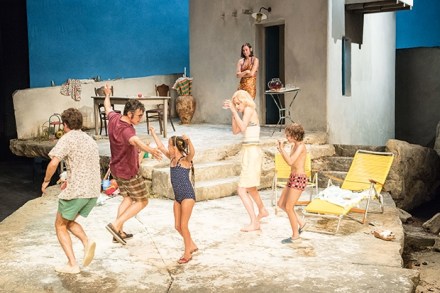
Paul Minx ventures boldly into Tennessee Williams country with The Long Road South. It’s 1965 and the Price family are idling about at home in Indiana. In mid-August the air is heavy with frustrated sexuality. Carol Ann Price (Imogen Stubbs) is a kindly, buxom waster slithering decorously into alcoholic dereliction. Her daughter, Ivy, is a perky little menace who cavorts about the lawn in a skimpy bikini trying to elicit male attention. Jake, the patriarch, is a charmless redneck with anger problems and a secret backlog of unpaid debt. Waiting on these white-trash parasites are two black servants, Andre and Grace, who are smart, industrious, even-tempered and limitlessly patient. Andre is a gifted theologian who pines after his severely disabled daughter.

Gallows humour

Theatre

It begins with a sketch. We’re in a prison in 1963 where Harry Wade, the UK’s second most famous hangman, is overseeing the execution of a killer who protests his innocence. The well-built convict effortlessly shrugs aside two burly but incompetent prison officers. ‘I’m being hanged by nincompoops,’ he laments. One of them helpfully points out that if he’d followed his instructions he’d ‘be dead by now’. Do these arch quips make you quiver with mirth? If so you’ll enjoy Hangmen, a slapstick comedy thriller by Martin McDonagh. The scene shifts to Oldham in 1965. Capital punishment has been abolished and the retired Wade has taken over a pub in his hometown where he enjoys the status of a minor celebrity.

Alice in cyberspace

Theatre

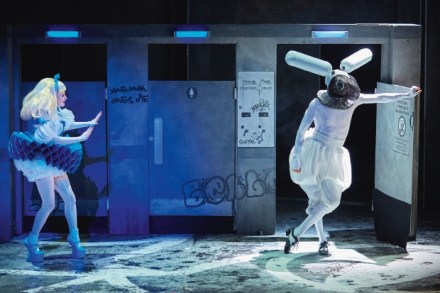
Damon Albarn and Rufus Norris present a musical version of Alice in Wonderland. A challenging enterprise even if they’d stuck to the original but they’ve fast-forwarded everything to the present day. The titular heroine, a trusting and solemn Victorian schoolgirl, has been recast as Aly, a wheedling teenage grump who loathes her mum, her dad, her comp, her teachers and her playmates. ‘I hate being me,’ she announces. And as we learn more about her we’re increasingly struck by the sagacity of this verdict. To escape her distress she downloads a game from www.wonder.land and creates a cyber-self, Alice, who goes on adventures. Hmm. A computer game.

Passion play | 31 December 2015

Theatre

Illness forced Kim Cattrall to withdraw from Linda, the Royal Court’s new show, and Noma Dumezweni scooped up the debris at the last minute. And what debris. All thoughts of kittenish Cattrall evaporated as Dumezweni strode on to the stage, a luscious blend of high-performance hair and trouser-suited luminosity. Linda is in her prime, at 55, a marketing director at a beauty firm, but she faces problems at home. Her balding husband, in midlife crisis, has joined a rock band. Her older daughter, Alice, is in deep trauma after internet trolls mocked an explicit clip of her posted by a jealous ex. Linda told Alice to pull herself together but Alice has withdrawn from life and exists like a waspish nun concealing her nubile physique in a grey onesie.

Tricycle’s Ben Hur is magnificent in its superficiality – a masterpiece of nothing

Theatre

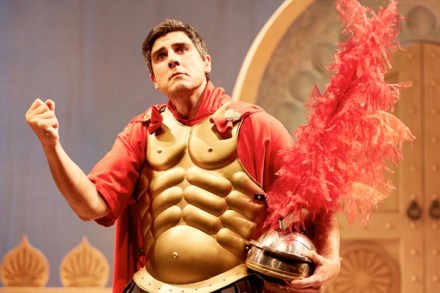
It’s the target that makes the satire as well as the satirist. Is the subject powerful, active, relevant and menacing? Patrick Barlow’s new spoof, Ben Hur, must answer ‘No’ on all four counts. The show takes aim at two principal irritants: vain actors and the Hollywood epics of the 1950s, whose titanic scale was offered as bait to audiences besotted with their cosy new TV sets. Old Hollywood is a spent ogre these days and the foibles of the acting trade are hardly a threat to civilised life, so the show can’t embrace our immediate concerns. But the execution is compellingly assured.

Men behaving badly | 3 December 2015

Theatre

Jamie Lloyd’s production of Pinter’s The Homecoming is a pile of terrific and silly ideas. Mostly terrific. The action takes place on a raised, thrusting stage surrounded by a steel canopy of scarlet rods like a boxing-ring. Ideal for a play about damaged men competing for a female trophy. Soutra Gilmour’s design is a model of sparse elegance. Centre stage, a worn green armchair like a waning tyrant’s throne. Stage right, a veneered sideboard that signals mass-produced chic. We’re in the 1960s so these pieces are from the previous decade. Well spotted, Ms Gilmour. Each scene is punctuated by racy music and strobe-y lights to remind us that this is a heightened, paranormal world. A perfect approach.

Why is there no one at the National Theatre preventing these duds getting staged?

Theatre

Wallace Shawn is a lovely old sausage. A stalwart of American theatre, he’s taken cameo roles in classic movies like Clueless and Manhattan. He’s also a playwright whose new script has received its world première at the National Theatre. Lucky chap. He spent three or four years writing Evening at the Talk House and it reveals a peculiar methodology. A play normally features a central character grappling with a personal dilemma, which leads to suffering, change and self-discovery. Shawn doesn’t bother with any of that, he just lays on a gang of theatre types who spend two hours spouting cascades of circuitous chitchat. The show opens with a speech by a rich and successful American TV producer who tells us how rich and successful he is.

Winter wonderland | 19 November 2015

Theatre

Kenneth Branagh opens his West End tenancy with Shakespeare’s inexplicably popular The Winter’s Tale. We start in Sicily where Leontes and his queen Hermione are entertaining Polixenes, the king of Bohemia. The design is heavily Germanic. Crimson drapes shroud the grey marble columns. A massive fir tree, twinkling with candlelight, is rooted in an ornamental toboggan. Everyone swishes about in thick, elegant Victorian costumes. The sets, by Christopher Oram, aren’t just lovely to look at, their detailed perfection is almost heartbreaking. And Neil Austin’s lighting would have won gasps of admiration from David Lean. The only fault is that it all seems overcontrived. An orchestral score intensifies the emotional colouring but it makes the play feel like a film.

How did this plotless goon-show wind up at the Royal Court?

Theatre

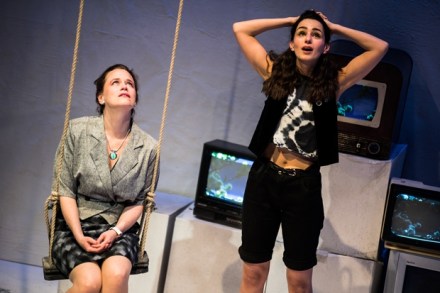
One of the challenges of art is to know the difference between innovation and error. I wonder sometimes if the Royal Court realises such a confusion can arise. Its new production, RoosevElvis, has been hailed as a thesaurus of fascinating novelties but to me it looks like a classic case of ineptitude posing as originality. It opens with two costumed women perched on bar stools speaking into microphones. One is dressed as Teddy Roosevelt in a cowboy hat and a handlebar moustache with a three-foot wingspan. The other is an Elvis impersonatrix wearing a lazy smirk and a black wig that sags forlornly over her ears, which seem to have turned pink with embarrassment. Introductions over, they reveal their true identities.

Glyndebourne caters to the lower-middle classes not past-it toffs

Theatre

What is Glyndebourne? A middle-aged Bullingdon. That’s a common view: a luxury bun fight for past-it toffs who glug champagne, wolf down salmon rolls and pass out decorously on the lawn. But the reality is that it caters to those of my class (lower-middle) who want to boost their pedigree with an eye-catching essay in sophistication. The Sussex opera house was founded in 1934 by John Christie, a passionate and eccentric millionaire who believed the public should suffer for his art. He hated the idea of suburban businessmen ‘catching a show’ for two hours in the West End before falling asleep on the train home. He wanted his audiences to devote an entire day to his productions.

Character assassination

Theatre

Here are three truths about play-writing. A script without an interval will be structurally flawed. A vague, whimsical title means a vague, whimsical drama. And a play about Alzheimer’s will self-destruct for the obvious reason that drama is an examination of character while Alzheimer’s is an effacement of character, so the paint evaporates before it reaches the canvas. A fourth truth is that subsidised theatres know nothing of the first three. So that explains Plaques and Tangles at the Royal Court, which runs for 110 uninterrupted minutes, without the variations of mood generated by an interval, and which examines a case of early-onset dementia. Megan is a married librarian with two kids.

Shakespeare at his freest and most exuberant: The Wars of the Roses reviewed

Theatre

The RSC’s The Wars of the Roses solves a peculiar literary problem. Shakespeare’s earliest history plays are entitled Henry VI parts (I), (II) and (III), which is thought to put people off. If you see one why not see all? If you miss the opener will the sequels confuse you? The solution is to condense the material and to reconfigure it as a single theatrical event. The result is a revelation. Here we have Shakespeare at his freest and most exuberant cramming the stage with every blockbusting trick he can contrive. Sex, battles, conspiracies, sword fights, gorings, cuckoldings, lynchings, beheadings. And there’s a constant stream of jibes aimed at the faithless French. The action opens with the death of Henry V.

The characters are barely stereotypes: The Father at the Wyndham’s reviewed

Theatre

The Father, set in a swish Paris apartment, has a beautifully spare and elegant set. The stage is framed by a slender rectangle of dazzling white dots which impart an air of incalculable and almost intimidating opulence to the show. I felt I was lucky to be there. Here’s the plot. Kenneth Cranham plays a doddery old sausage whose daughter and her husband want to dump him in a nursing home. Will they succeed? That’s the plot. Writer Florian Zeller uses pranks and false starts to create suspense and to illustrate Dad’s scrambled mentality. Different actors play the daughter, the son-in-law and the day-nurse. At first this is gratifyingly weird but repetition makes it seem meagre and banal. Other effects stress the same point.

It may have a meagre script and no plot but Farinelli and the King is still a major work of art

Theatre

Philippe V was a Bourbon prince who secured the throne of Spain using his family connections. Claire van Kampen is a writer who relied on the same method to secure a West End opening for her play about Philippe. It stars Mark van Kampen (aka Mark Rylance) as the charmingly dotty Frenchman. Philippe was a manic depressive who regarded his Spanish subjects as a puzzling inconvenience. He had no interest in governing them and preferred to laze around the countryside, looking at stars, listening to music and indulging his eccentricities. We first meet him in bed trying to hook a fish supper from a goldfish bowl. Courtiers secretly plot to oust him while the queen scours Europe for a singer capable of cheering him up.

Foote fault

Theatre

Samuel Foote (1720–77) was a star of the 18th-century stage who avoided the censors by extemporising his performances. Today we’d call him a stand-up comedian specialising in improv. He served tea to play-goers and claimed that the show was a free accompaniment to the beverages. Dogged by homosexual scandals, he was hounded out of England at least once despite the patronage of George III. A riding accident left him with a compound leg fracture (bone piercing flesh), which required amputation to prevent gangrene. The limb was hacked off in 20 minutes. Foote hobbled back to fame and fortune playing Sir Luke Limp in The Lame Lover. At his burial the preserved limb was reunited with its owner.

The big chill

Theatre

Michael Grandage’s latest show is about an old snap. Geneticists regard the X-ray of the hydrated ‘B’ form of DNA as one of the loveliest images ever captured. To laymen it looks like some woodlice drowning in yesterday’s porridge. The pic was taken in 1951 by the British biochemist Dr Rosalind Franklin but she failed to realise its significance. When James Watson passed through her lab he took one glimpse and instantly twigged that it revealed the helical structure of DNA. With his pal Francis Crick he built the famous double-helix model which bagged them the Nobel Prize. Dr Franklin (played by Nicole Kidman) won nothing. We know all this in advance, of course, so the play lacks any suspense.

Double tragedy | 17 September 2015

Theatre

To examine an ancient text requires an understanding of the ancient imagination. The Oresteia is set in a primitive world where people believed that every animal, tree, stone, river, mountain, star, cloud and clap of thunder was inspired by a spirit controlled by the gods. Heaven signalled its wishes through dreams, oracles or chance events which were interpreted by prophets. What we understand by ‘faith’, i.e. a volitional fealty to a particular religious code, didn’t exist. There was no free will either. Mortals chose between one divine instruction or another. The genius of Aeschylus was to commit his characters to a cycle of moral conflicts where every act of obedience was also an act of betrayal.