Culture

Culture

The good, the bad and the ugly in books, exhibitions, cinema, TV, dance, music, podcasts and theatre.

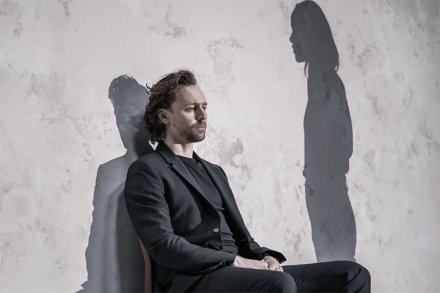
Flimsy and pretentious sketches: Caryl Churchill’s Glass. Kill. Bluebeard. Imp. reviewed

Theatre

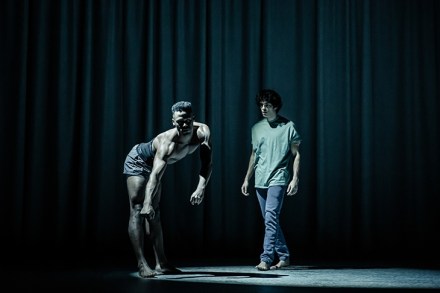
Caryl Churchill is back at the Royal Court with a weird collection of sketches. The first is set on a mantelpiece where a clock, a vase, a statuette and a plastic dog discuss their lives. These ornaments morph into human teenagers. One is a lad who wants to die after being raped by his father. His girlfriend tries to comfort him but she’s harassed by two nasty bullies. These four youngsters have perhaps created alter egos as household ornaments in order to block out their nightmarish lives. Somewhat opaque. In sketch two, a young chap seated on a cloud summarises the storyline of Aeschylus’s Oresteia in a glib and knowing manner. He treats every act of violence as an amusing in-joke. This monologue will mean little to those unfamiliar with the original.
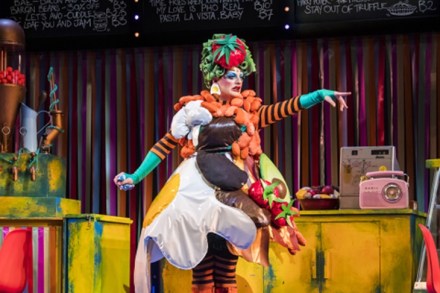

One for pauper-gawpers: Faith, Hope and Charity at the National reviewed

Theatre

Tony Hawks’s musical, Midlife Cowboy, has transferred from Edinburgh to the Pleasance, Islington. At press night, the comedy elite showed up (Andy Hamilton, Angus Deayton, Caroline Quentin, Alistair McGowan) to see Hawks playing a songwriter, Stuart, whose marriage is on the rocks. To revive his love life, Stuart puts his wife in charge of the country-and-western club they jointly own, and the story follows the travails of their in-house band as they seek glory in a local talent contest. The cast, led by Hawks, are skilful musicians with oodles of charm but the narrative is short of high stakes and surprises. The script might be punchier. Sample gag: Stuart reacts to a proposal he mistrusts. ‘I’m like a native American. I have reservations.

Is it time to give up on the Ibsen adaptations?

Theatre

Pub quiz question: what do John Osborne, Brian Friel and Patrick Marber have in common? The answer is they’ve all written their own versions of Hedda Gabler. Although none of them, it should be noted, to any particular critical acclaim. Is it time to give up on the Hedda adaptations altogether and just stick to the original? Or maybe opt for a different tack: why not let a woman have a go? Step forward, Cordelia Lynn, a 30-year-old playwright with three London productions under her belt. Having updated Chekhov’s Three Sisters for the Almeida this spring, she now turns her attention to Ibsen.

How refreshing to see a show about prejudice that barely mentions white people

Theatre

Lynette Linton opens her stewardship of the Bush with a drama about racial and sexual bigotry. Four British women decide to start a girl band but only one of them, Yomi, happens to be straight. The script mixes confessional monologues with bitchy interactions over kitchen suppers. Beth, whose parents are West Indian, once dreamed of living in suburban bliss with ‘a little concrete garage for my car’. She named her imaginary children ‘Pauline, Graham and Amanda’. But when she embraced black culture she threw out her Dostoevsky novels and her Dire Straits albums and invested in jazz-funk records and the works of Toni Morrison instead. Anyone with a lifelong allergy to Dostoevsky or Dire Straits will applaud this wise decision.

Funny, short and cheap to stage, Hansard is an excellent bet for a transfer

Theatre

Hansard is the debut play by actor Simon Woods, who enjoys a deep knowledge of his subject. The characters are a middle-aged couple, the Heskeths, who occupy ‘a country house in Oxfordshire. Georgian. Good bones. Not large’. The year is 1988 and Robin is a busy Tory MP whose wife Diana has realised that she loathes the Conservative party and all its doings. ‘They talk a good game,’ she says, ‘but they’re unbelievably dangerous.’ As a lifelong leftie, she has even started begging strangers to vote against her husband, whose policies ‘inflict damage on the most vulnerable in society’. She also suspects him of philandering and has taken to appearing unannounced at his London flat. Robin shares his wife’s talent for invective.

A decorative pageant that would appeal to civic grandees: The Secret River reviewed

Theatre

The Secret River opens in a fertile corner of New South Wales in the early 1800s. William, a cockney pauper transported to Australia for theft, receives a pardon from the governor and decides to plant a crop on 100 acres of Aboriginal land. His doting wife, Sal, begs him to take her and their young sons back to her beloved London. They make a deal. William must succeed as a farmer within five years or pay for their passage home. He clashes with a tribe of spear-waving Aboriginals who make it clear that they want him off their ancestral turf. Neither side speaks the other’s language. ‘This is mine now. You lot can have the rest,’ says William, pointing vaguely at Australia.

Watching Stephen Fry was like being in the presence of a god

Theatre

Stephen Fry lies prone on an empty stage. A red ball rolls in from the wings and bashes him in the face. He stands up and introduces himself as Odysseus, stranded on an island-kingdom as he makes his way home after the Trojan War. The ball had escaped from the hands of a clumsy maidservant who was playing on the beach with a local princess. Now Fry, as Odysseus, begs her help and asks for a petticoat to cover his nakedness. This tale comes from Homer’s Odyssey, Book Six, but Fry doesn’t quote the reference he merely plunges on with the story. Odysseus shows up at the palace of the local warlord, King Alcinous, and tries to explain how he came to be wearing the princess’s undergarments.

Tony Slattery is still a miraculously gifted comedian

Theatre

Some of the marketing efforts by amateur impresarios up in Edinburgh are extraordinary. I was handed a leaflet for a poetry show called Don’t Bother. I didn’t. Tony Slattery appears in Slattery Will Get You Nowhere (a good pun that advertises the content), in which the ageing comic takes the audience back to the 1990s. In those days he was a handsome, clever, charismatic wag who suffered from an excess of self-regard. Now he’s a grizzled, ramshackle presence, jowly and ill-shaven, like a forgetful pensioner on his way to the day centre. He starts his show with a lot of banter about wine but he doesn’t drink on stage. Alongside him sits a friendly interviewer who guides him through the rougher bridleways of his anecdotes.

Best of the Fringe

Theatre

Clive Anderson’s show about Macbeth, ‘the greatest drama ever written’, offers us an hour of polished comedy loosely themed around the Scottish play. Shakespeare’s material is still topical, he says, ‘a clever Scot with a rampantly ambitious wife, like Michael Gove and Sarah Vine’. He prefers Macbeth to Hamlet which is ‘about some bloke who can’t make up his mind, like a three-and-a-half-hour interview with Jeremy Corbyn’. The act’s centrepiece is Anderson’s memory of his infamous encounter with the Bee Gees who stormed out of his TV chat show in 1996. He’d been encouraged to mock pop stars by Sting who enjoyed being teased about his stage name. ‘Sting is a minor skin-wound,’ Anderson told him.

Classics of the future

Theatre

Games for Lovers feels like a smart, sexy TV comedy. Martha is still in love with her old flame Logan whose new girlfriend has a huge libido which he can’t hope to satisfy. When Martha starts flat-hunting she answers an advert coincidentally posted by Logan’s best friend, Darren. Thus, perhaps too neatly, the two warring couples are set up for a massive falling out. Darren (played brilliantly by Billy Postlethwaite, with shades of Kevin Kline) is the beating heart of this story. He’s a former nerd who works as a City analyst and uses tricks learned from the internet to bed women. But all his techniques backfire and he becomes the victim of his botched seductions.

Animal magic | 25 July 2019

Theatre

Equus is a psychological thriller from 1973 which opens with a revolting discovery. An unbalanced stable-lad, Alan, spends his evenings taking the horses out for an illicit gallop. Meanwhile, he’s busy seducing a hot young cowgirl at the farm but his awakening sexuality confuses him. The girl’s erotic nature brings out his closeted gay side and he tries to purge his homosexuality by stabbing six stallions in the eyes. A mopy shrink (Zubin Varla) takes on Alan’s case but finds himself investigating his own troubled psyche instead. Some of the details in Peter Shaffer’s play have dated badly. Alan’s parents are caricatures of nauseating suburban inanity.

Hare-brained | 18 July 2019

Theatre

The National Theatre’s boss, Rufus Norris, has confessed that he ‘took his eye off the ball’ when it came to female writers and he plans to strike an equal balance between the sexes in future. Good news for male scribblers who’ll know that they’ve been selected on merit but rather demoralising for females who’ll suspect that they’re just making up the numbers. Sir David Hare, who has written or adapted 25 shows for the National, could easily solve the NT’s sexual identity crisis by announcing that he’s a woman. His latest is a modern version of Ibsen’s barmy but enjoyable fable Peer Gynt, which mixes folklore, fantasy, social comment and tragicomedy.

Split decisions

Theatre

Europe. Big word. Big theme. It was used by David Greig as the title of his 1994 play about frontiers in the age of mass migration. The setting is a railway station in eastern Europe and it opens like a kids’ TV show with each character entering and doing something ‘typical’. Everyone is either good or bad. The stationmaster is a bullying xenophobe. His deputy, Adele, is a meek, well-meaning housewife unhappily married to a dim, angry factory worker whose unemployed mates are as stupid as he is, apart from one who wants to go travelling and another who makes stacks of evil cash out of smuggling. Two migrants arrive, father and daughter. The father is a sublimely intelligent amateur philosopher with a fluffy grey beard and a habit of speaking in epigrams.

Mixed messages | 4 July 2019

Theatre

Present Laughter introduces us to a chic, louche and highly successful theatrical globetrotter, Garry Essendine, whose riotous social life is centred on his swish London apartment. This is Noël Coward’s version of Noël Coward. In the script, from 1942, Coward alleges that his alter ego is being chased by three women. The in crowd would have laughed at the reference to Coward’s secret orientation but this version rather earnestly converts one of the females into a rugged Spanish male. What for? Few scripts from the wartime era remain in the theatrical canon and one of the pleasures of seeing a vintage play is to examine the habits and conventions of a half-forgotten age.

Sex pests and patriarchs

Theatre

Bitter Wheat, David Mamet’s latest play, features a loathsome Hollywood hotshot, Barney Fein, who offers to turn an actress into a superstar provided she lets him rape her. The show’s gruesome storyline has flashes of bitter comedy. Fein boasts that the Writers Guild of America would ‘drink a beaker of my mucus’ if he forced them to. Although this is the ultimate #MeToo play it can’t prevent itself from taking a masculine point of view. Fein’s assistant, Sondra (Doon Mackichan), conveniently vanishes at the right moment and leaves the starlet at the monster’s mercy. But was Sondra complicit? We aren’t told. And we learn nothing about her attitude to her boss.

Bad science

Theatre

Kill Climate Deniers is a provocative satire by Australian theatre-activist David Finnigan. The title sounds misanthropic and faintly deranged but the show is a comedy delivered with oodles of verve and fun. Finnigan is a skilful writer of dialogue, a gifted farceur and, at times, an astute analyst of power and its corrupting tendencies. Like most Aussies, he’s incapable of pomposity and his show takes a pop at every player in this game: the politicians, the shock jocks, the sainted Greens and the media. A TV journalist has the surname ‘Ile’ — an anagram of ‘lie’. Finnigan reminds us that the bulk of eco-warriors are white middle-class malcontents whose priority is not to save planet Earth but to get themselves noticed.

A whole lotta shakin’ goin’ on

Theatre

Sometimes it’s hard to describe a play without appearing to defame the writer, the performer and the theatre responsible for the production. Here’s what I saw. A semi-naked woman lurks in a corner, with her back to the audience, shaking. Rap music pounds. The woman shakes and shakes. Then she shakes a bit more. And a bit more. As her weird spasms enter their 17th uninterrupted minute, the spectators glance anxiously at their watches. Finally the woman’s twitching ceases. Speaking in a New York accent, she recites a conversation between an inquisitive child and an older girl. The theme is explicit sex chat.

Poetic and profound

Theatre

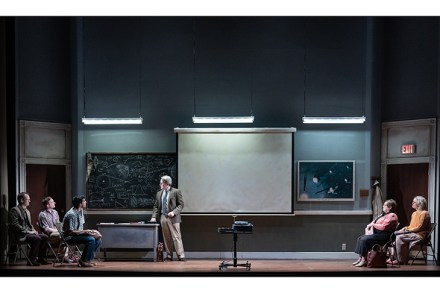
Kenneth Lonergan, who wrote the movie Manchester by the Sea, shapes his work from loss, disillusionment, small-mindedness, hesitation and superficiality, all the forgettable detritus of life. The Starry Messenger is about Mark, a disappointed astronomer aged 52, who gives public lectures at a city planetarium. He loves his subject even though it let him down and every week he tackles the daft questions of his pupils with superhuman patience. The same two pests always raise their hands. One is a burly misanthrope who disbelieves all experts, the other is a high-flying oddball who craves attention. Mark starts a slow-burn affair with Angela, a single mum who needs a role model for her nine-year old son: an expert on the stars and inter-planetary travel is just the ticket.

The spying game | 30 May 2019

Theatre

Arts Council England takes money from almost all of us and spends it on culture for almost none of us. Among its clique of favoured writers is Ella Hickson whose work has twice been staged at the subsidised Almeida. Her first effort was a historical sketch show about oil-drilling, the second looked at the problem of elderly gropers who commission scripts from vulnerable tragediennes We have the NT to thank for her latest, Anna, a title that’s unlikely to set the pulse of theatreland racing. Viewers take their seats and are asked to don headpieces. The stage is shielded from the auditorium by a soundproof membrane of glass that stays in place during the action. Listening to the dialogue through headphones makes us feel like secret policemen monitoring a bugged apartment.

Blond ambition | 23 May 2019

Theatre

The opening of Jonathan Maitland’s new play about Boris purports to be based on real events. Just before the referendum, the Tory maverick invited some chums over to help him decide whether to opt for Leave or Remain. Mrs Johnson was present along with Michael and Sarah Gove and the Evening Standard’s owner, Evgeny Lebedev. For a bit of fun, the writer adds spectral appearances from three ex-prime ministers, Blair, Thatcher and Churchill. This is amusing at first but it slows the play down because the fantasy figures can’t affect the real-life action. There are dazzling performances here. Tim Wallers plays Evgeny as a name-dropping simpleton with naked ankles and an ultra-camp gait. Wonderful.

Labour pains | 16 May 2019

Theatre

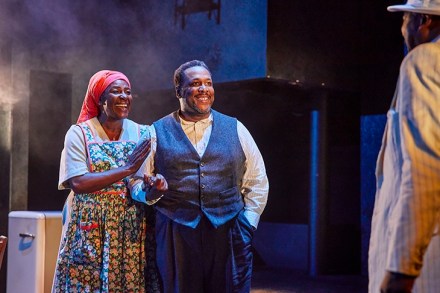
Colour-blind casting is a denial of history. The Young Vic’s all-black version of Death of a Salesman asks us to believe that an ordinary African-American chap living in Brooklyn in 1928 might have owned a Chevrolet, and that a black businessman in the 1940s would consider asking a friend for ten grand to purchase a ranch in Texas. Younger viewers may assume that US society has been racially integrated for nearly a century. Is that the right message? Willy Loman, the duffer at the play’s core, is one of American drama’s least attractive heroes. A preachy, devious, boastful, fawning, angry, narcissistic misery guts, he’s professionally incompetent and morally bankrupt.

Hilarity with heart

Theatre

Small Island, based on Andrea Levy’s novel about Jamaican migrants in Britain, feels like the world’s longest book review. We meet Hortense, a priggish school teacher, and her cool, handsome boyfriend who survive on a pittance in the Caribbean. Then we skip back to Hortense’s childhood in a house dominated by a bullying preacher who forbids conversations at mealtime. Then we cross the Atlantic to Lincolnshire and meet a chirpy blonde, Queenie, whose auntie runs a sweetie shop. Does Queenie want a job selling sweeties? Yes, says Queenie to her auntie. All this takes ages, and it feels like a deadly earnest sociology lecture. Then a stiff young bank clerk enters the shop and asks Queenie if she’d like to go for a walk. And the show takes off.

One of the great whodunnits

Theatre

It starts on a beautiful summer’s morning in the suburbs of America. A prosperous middle-aged dad is chatting with his neighbours in the garden of his comfortable home, but by nightfall his family has been destroyed. This is one of the most momentous convulsions in all drama. Arthur Miller’s masterful plotting, which he never again surpassed, is a match for the best. By the best I mean Oedipus. Jeremy Herrin’s production emphasises the lush fertility of America in the late 1940s. Trees in full leaf overlook the timber house that is perhaps a little too small for its millionaire owner. Joe Keller is a pioneering industrialist who served a brief jail term for supplying faulty components to the air force during the war. More than 20 pilots died.

Keeping it real | 25 April 2019

Theatre

It starts at a secretarial college. The stage is occupied by a dignified elderly lady who recalls her pleasure at learning shorthand in the 1920s. She lived in Germany and she took a job at a firm headed by a man named Goldberg. He was Jewish. These unremarkable disclosures are spoken by Brunhilde Pomsel, a woman of high intellect and modest ambitions, who was born in 1911 and died two years ago, aged 106. Her life story was turned into a documentary film, which Christopher Hampton has adapted for the stage. Pomsel’s words are spoken by Dame Maggie Smith. What makes her fascinating is that she worked for Josef Goebbels and spent the entire war in the propaganda ministry in Berlin. Her acceptance of Nazism is gradual and semi-conscious.

Sweet nothings

Theatre

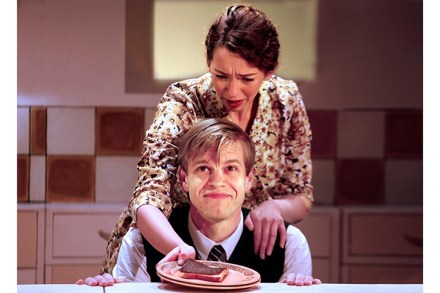
Nigel Slater is popular because he’s an exceptionally meek cook. Not for him the sprawling restaurant empire or the transatlantic TV career to excite envy and loathing. He writes about his trade in simple vivid prose and his bestselling memoir, Toast, has become a play. Young Nigel enters as a 1960s schoolboy, with shorts and a side parting, living in a posh suburb of Wolverhampton. Dad is a kindly but remote presence, an alien in his own home. Mum is a braindead kitchen-limpet who encourages Nigel’s first culinary experiments. The family are adventurous. They try spaghetti bolognese. Dad takes charge at the dinner table and loads each plate with a heap of yellow string topped by garnish the colour of lava spewed from a volcano. Nigel pronounces the dish quite good.

Rising to the top

Theatre

Caryl Churchill’s best-known play, Top Girls, owes a large debt to 1970s TV comedy. It opens with a Pythonesque dinner party in which noted female figures from myth and history get drunk while swapping gags and stories. We meet a Victorian explorer, an emperor’s concubine, a 16th-century Flemish battle-axe and a long-suffering Italian peasant girl. The scene has no internal logic or dramatic direction and, just like a Python routine, it’s besotted with its own inventiveness and it relies on erudite banter and verbal shocks to sustain our interest.

Bad blood | 4 April 2019

Theatre

The Phlebotomist by Ella Road explores the future of genetics. Suppose a simple blood test were able to tell us how long we will live and what disease will kill us. If the tests were compulsory and the results publicly available, a new hierarchy based on life expectancy would emerge. Citizens facing chronic illness or early death would struggle to find jobs and spouses. The scientists who administer the tests would come under pressure to falsify the results. And alpha citizens with high-grade DNA would be murdered, and their blood harvested to create fake genetic identities. This gruesome, ingenious and all-too-believable scenario is presented through a squeaky-clean romance between two young lovebirds.

Toxic waste

Theatre

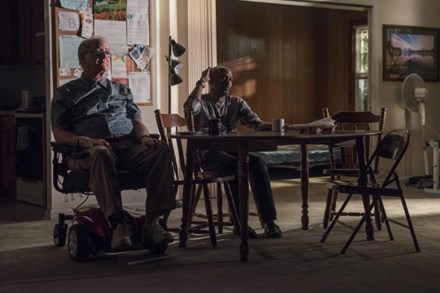
Bruce Norris is a firefighter among dramatists. He runs towards danger while others sprint in the other direction. His Pulitzer-winning hit Clybourne Park studied ethnic bigotry among American yuppies and it culminated in a gruesomely funny scene in which smug liberals exchange racist jokes in public. The play was morally complex, dramatically satisfying and an absolute hoot to watch. His new show, Downstate, co-commissioned by the NT and Steppenwolf Theatre in Chicago, takes on a far crunchier topic than racism. Child sex abuse. We’re in a residential home occupied by a quartet of tagged offenders monitored by a sharp-tongued probation officer. We meet the molesters. Fred was once a music teacher who thought it was OK to seduce the boys perched on his piano stool.

Great expectations | 21 March 2019

Theatre

No menace, no Venice. This new production of Pinter’s Betrayal is set on a bare stage with scant regard for the play’s physical requirements. The script specifies a handful of furnished locations: a pub, a study, a flat, a hotel bedroom, a living room. But instead we get an off-white void where three youngish actors prowl in circles, ogling each other. This is Pinter’s finest work, a tense romantic tragedy with flashes of comic fireworks, and it differs from the rest of his output by revealing its themes directly to the audience, by delivering an intelligible plot full of suspense and surprises, by focusing relentlessly on the human duel at its core, and by never relapsing into obscurities or screeds of reminiscence spoken by dotty vagabonds.