Culture

Culture

The good, the bad and the ugly in books, exhibitions, cinema, TV, dance, music, podcasts and theatre.

Contains the loveliest new song I’ve heard in decades: Bob Dylan’s new album reviewed

Pop

Grade: A ‘Rough’ in terms of the mostly spoken vocals, but only ‘rowdy’ if you’re approaching your 80th birthday, which of course Dylan is. This is a sometimes playful and often self-deprecating Nobel Laureate at work, the lyrics (like the vocals) carrying a whiff of late Leonard Cohen, the arrangements of some of the slower, if not funereal, songs a nod to Tom Waits. In ‘I Contain Multitudes’, the grizzled old boomer has given us his best song since ‘Idiot Wind’; like many on here, the delicate melody is implied by the chord changes rather than explicitly stated.

In defence of Prince’s late style

Pop

In 1992 Prince released a single called ‘My Name Is Prince’. On first hearing it seemed appropriately regal. Cocky, even. Only in hindsight did it appear somewhat needy, a litany not of what Prince was going to do, but of the things he had already done. On it, he pulled rank on his status — ‘I’ve seen the top and it’s just a dream / Big cars and women and fancy clothes’ — called out young rappers for their potty mouths, and declared himself ‘fresh and funky for the 90s’. Context is everything. By 1992, Prince was still funky – but fresh? He had been, indisputably, pop’s premier agitator throughout the previous decade; as David Bowie was to the 1970s, so Prince was to the 1980s.

After weeks of silence, Royal Opera reopened with a whimper

Music

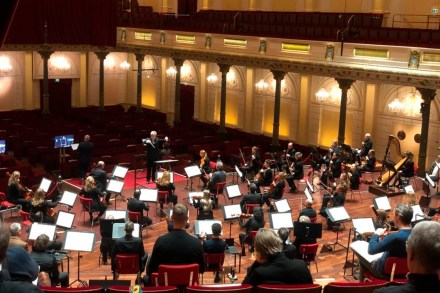
It was the fourth time, or maybe the fifth, that I found myself reaching for the tissues that I began to feel suspicious. Somewhere between the poignant gaiety of A.E. Housman’s ‘…lads that will never be old’, Shakespeare’s tender valediction ‘Fear no more the heat o’ the sun’ and Strauss’s ‘Morgen!’, with its rapturous vision of a never-reached tomorrow, emotion turned to manipulation. You can’t engineer catharsis (though you can score it to music), and this attempt felt like something a visit to the Royal Opera House has rarely felt like before — cheap. It wasn’t that there was anything wrong with the performances at this first in a series of live-streamed concerts.

The Madness of George III is much easier to like than King Lear

Theatre

The longest interval in theatre history continues. Last week the National Theatre livestreamed a 2018 version of The Madness of George III produced by Nottingham Playhouse with Mark Gatiss in the title role. The script, written by Alan Bennett as a response to King Lear, is much easier to like than the original. An engaging family comedy, with a sad bit in the middle, it benefits from a wonderfully happy ending. The good king is cured, the bad doctors are vanquished, order is restored. A real crowd-pleaser. Bennett’s research gives it the feeling of a documentary drama as he examines the difficulties faced by monarchs who wielded real political power. Family feuds spilled over into public affairs, and if the king happened to run an empire the consequences could be global.

In defence of the Southbank Centre

In last week's Spectator magazine, Norman Lebrecht accused the Southbank Centre of being a ‘subsidy guzzler in need of privatisation’. Mr Lebrecht has, as he admits, spent the past 30 years complaining about it. Nothing, it seems, will shift his view. I admit I'm biased, as the Southbank Centre's director of music. Yet I do think it is right to argue that the Southbank is a rare example in London of a true civic space: a social and artistic hub; a place where people can spend time without having to spend money; where they can work, meet up, sing in choirs, dance, discover fledgeling bands, visit the National Poetry Library, let their children play in a fountain designed by artists.

The musical event of the year: Wigmore Hall BBC Radio 3 Special Broadcasts reviewed

Classical

Remember when 2020 was going to be Beethoven year? There were going to be cycles and festivals, recordings and reappraisals; and if you weren’t actively promoting old Ludwig Van there was money to be made whinging about overkill. So was Stephen Hough’s decision to end his Wigmore Hall recital last Monday with Schumann’s Fantasie in C — a work conceived at least partly in homage to Beethoven, which opens with a fragmented musical landscape that Schumann at one point called ‘Ruins’ — a conscious reflection of the musical world’s changed circumstances? Or would that be reading too much into a situation in which a once-routine lunchtime concert suddenly feels like the musical event of the year?

The power of cheap music: pop podcast round-up

More from Arts

Noël Coward was so right that his words have become a cliché: it is indeed extraordinary how potent cheap music can be. Its potency, however, is not innate. Amanda Prynne, from Coward’s Private Lives, would not have been especially struck by ‘Some day I’ll Find You’ had it been playing on a wireless in a shop; its impact came from hearing it as she again encountered her ex-husband. For cheap music to be potent, context is everything. Without a wider meaning, a cheap little pop song is just notes and chords. With meaning, the most throwaway frippery can become an object of fascination. That’s often true of the best known of songs.

Skates on the edge of parody: The 1975’s Notes on a Conditional Form reviewed

Pop

Grade: B+ Just what you wanted. An opening track that matches banal piano noodling to an address by Greta Thunberg. Followed by a hugely unconvincing stab at tuneless industrial metal on a song called ‘People’, in which the aforementioned — me and you, not them, of course — are cautioned to ‘WAKE UP!!’ Leafy Wilmslow’s middle-class skag-head prophet, Matty Healy, is back, then, with a series of injunctions for us all, spread over interminable length and always skating on the very edge of parody. The 1975 are probably Britain’s biggest ‘rock’ band — those quote marks are needed — and this vast slab of pretentious, gullible, vacuous commendations to us all went straight in at number one.

The best recordings of Ravel’s L’enfant et les sortilèges

Opera

‘I don’t want to do my work. I want to go for a walk. I want to eat all the cakes… to shout at everybody!’ Which of us hasn’t felt like this at some point during the past ten weeks? The small child at the centre of Ravel’s L’enfant et les sortilèges speaks for us all as he rages against the restrictions of his suddenly enclosed and joyless world. Shut in the schoolroom until he finishes his homework, the little boy lashes out, spilling ink on the carpet, smashing the crockery, snapping the pendulum off the clock, tearing the wallpaper and terrorising the cat. But just as his tantrum is exhausted he finds that the tables have turned as the furniture, objects and animals that surround him come to life and scold him for his behaviour.

Meet Dion, one of the last living links to the earliest days of rock ’n’ roll

Pop

Only two of the Beatles’ pop contemporaries are depicted on the cover of Sgt. Pepper’s Lonely Hearts Club Band. One is Bob Dylan. The other is Dion DiMucci. In a pleasing third-act twist, Dylan contributes the liner notes to Dion’s new album Blues With Friends — an act of deference that the recipient is still processing. ‘I asked him, I didn’t know if he had the time, but he sent me back those paragraphs and said that I knew how to write a song.’ He whistles. ‘That’s from a Nobel Prize winner. I thought, I’ll take it, I’ll take it!’ So he should. Dion — like Kylie, a single moniker suffices — is one of the last living links to the early days of street-corner rock ’n’ roll.

Top of my must-watch mustn’t-watch: Cats revisited

Film

At the outset of lockdown I gave you my list of top mustn’t-watch films — that is, the ones that aren’t worth the bother — with the rider that when Cats is released digitally it will, however, likely be a must-watch mustn’t-watch. ‘I absolutely must watch this mustn’t-watch,’ you may even have said to yourself, after reading some of the wonderfully terrible reviews. (The Daily Telegraph gave it zero stars. Variety said it was one of those ‘once-in-a-blue-moon embarrassments’.) And it is as hoped.

I’m still not wholly convinced by Kirill Petrenko: Berlin Phil’s Digital Concert Hall reviewed

Classical

At the start of Elgar’s Second Symphony the full orchestra hovers, poised. It pulls back; and then, like a dam breaking, the music surges forward in wave upon wave of golden sound. ‘Rarely, rarely, comest thou, Spirit of Delight!’ writes Elgar, quoting Shelley, at the top of the score, and you won’t hear that spirit captured more exuberantly than in a performance from May 2009 by the Berlin Philharmonic under its future music director Kirill Petrenko. The violins gleam, the horns swell and every player is audibly leaning into the music. Under Petrenko, Elgar’s leaping compound rhythms almost seem to dance.

Drunk singers, Ravel on film and prime Viennese operetta: the addictive joys of classical YouTube

Music

The full addictive potential of classical YouTube needs to be experienced to be understood. And let’s be honest, there are only so many lockdown videos the human spirit can take. Which is why, on a sunny spring afternoon, in the prime of life and health, I find myself watching the late John Cage stroking bits of wire with a feather. The haircuts suggest that we’re in the early 1980s, and a Ron Burgundy type is floating across the screen in a little box. ‘It’s been said that listening to John Cage’s music is like chewing sand,’ he explains, unhelpfully. It seems that we’ve also been watching a live performance by the German artist Joseph Beuys. And that we’re now going over to a firework display at the Pompidou Centre.

The best recordings of the greatest symphony

Music

I am daunted. Bruckner’s Eighth Symphony is a work that I regard with love, awe and even anxiety. I always wonder whether I’ll be able to cope with such large and deep demands on me and, if I hear a performance or recording that doesn’t disappoint me, be able to articulate why I find it so powerful, one of the supreme masterpieces of Western music, the greatest of symphonies. With musical works that one has the strongest kinship with, there is, as everyone finds, an urgent need to locate the qualities that make it so penetrating an experience, combined with misery at the gap between how one responds and what one feels able to say.

Joyous and very, very funny: Beastie Boys Story reviewed

Pop

The music of the Beastie Boys was entirely an expression of their personalities, a chance to delightedly splurge out on to record everything that amused them. And early on, in their teens-get-drunk debut album, Licensed To Ill, that resulted in obnoxiousness. But mostly they were kinetic and colourful, which is why the new Apple TV+ film about them works so well. The format suits the story. Beastie Boys Story simply documents a stage show where winningly they talk the audience through their personal history. It’s much like Netflix’s Springsteen on Broadway. But since the third Beastie, Adam Yauch, died in 2012, the band no longer perform, so where Springsteen punctuated his memories with songs, the Beasties do it with film clips.

Releasing a charity single is a performance – but don’t mock attention-seeking superstars, pity them

You can’t move for them. At least, you wouldn’t be able to if you could leave your house. NHS charity singles as far as the eye can see – from Queen, from the collection of second division 90s musicians billed as the Indie Allstars, from the rather bigger names gathered together by Radio 1 to record Foo Fighters’ 'Times Like These'. From unknowns – The Singing Dentist, The Ideas. And from the charity hero du jour, Captain Tom Moore, accompanied by star of stage, screen and the Christmas CD market, Michael Ball. Then there are the charity gigs that have been announced, to raise money for the NHS, or to give NHS staff a free night out – gigs by Liam Gallagher, Manic Street Preachers, Rick Astley, Paul Heaton and Jacqui Abbott.

No one understood the ennui of lockdown better than Louis XIV and his courtiers

Opera

A few years ago I interviewed an eminent baroque conductor. Prickly and professorial, tired after a day of rehearsals, he batted question after question away until we landed on the subject of French baroque opera. No longer disinterested, now he was furious. He’d recently had a conversation with a major UK opera house, who had decided never again to stage anything by Lully, Rameau or Charpentier. Why? ‘It doesn’t sell.’ Since then we’ve had precisely one professional production of this repertoire in this country. It’s not the first time that English audiences have been suspicious of foreign imports. Back in the 18th century, when the cultural invasion came from Italy, feelings on this subject ran high.

Beautiful voice, pretentious album: Fiona Apple’s Fetch the Bolt Cutters reviewed

Pop

Grade: C+ Where did they all come from, the quirky yet meaningful rock chicks who don’t have a decent song between them yet put out albums by the bucketload? Back in the day it was just Joni Mitchell, who had four good songs, Laura Nyro who had two and Dory Previn who had one. Now there are thousands of these creatures, flaunting their intemperance without showing much brilliance. And all slavered over by the (still male) music press. Years of oppression, of being disregarded, they would argue. But disregarded for very good reasons, in almost all cases. Yeah, Carole King is ten times the songwriter James Taylor ever was. I will give you that. We got that wrong. But that doesn’t mean we have to be tormented for eternity by the likes of Laura flipping Marling, does it?

Why we love requiems

Arts feature

At some point during the 20th century death disappeared. The dying were discreetly removed from our communities and homes, taken to hospitals with short memories and wipe-clean walls. Mourning blacks faded before vanishing altogether; the elaborate funeral monuments of the 19th century shrugged off curlicues and cherubs and arranged themselves into unobtrusive, apologetic sobriety. Coffins — gauchely literal — gave way to the more tasteful euphemism of the ash-filled urn. Only concert halls bucked the trend. Suppressed from everyday life and language, death found a different outlet. How many choral societies or symphony choruses today go a year without performing a requiem mass? How often do Classic FM or Radio 3 go a day without playing music from one?

It costs a lot of money to look this cheap: Metropolitan Opera’s At-Home Gala reviewed

Opera

Desperate times call for desperate measures. With the world’s opera houses currently dark, the New York Metropolitan Opera tackled the crisis the way it knows best — by assembling the most glamorous possible list of vocal megastars and presenting them at astronomical expense. But dollars can’t get around social distancing, and in lockdown even the greatest voice is only as good as the mic on a smartphone. Cue four hours of free-to-view party pieces from 43 of the world’s greatest singers, broadcast live from their homes without orchestra, without editing and without excuses.

Livestream-hopping is just as irritating as being at a real festival

Pop

The ghost of Samuel Beckett oversaw the Hip Hop Loves NY livestream last Thursday night. Time and time again its host, the veteran hip-hop TV presenter Ralph McDaniels — known to all his guests, unnervingly, as ‘Uncle Ralph’ — tried to connect to some Golden Age legend. Time and time again, his attempts at a straightforward interview went wrong. We saw Uncle Ralph, on one half of the screen, ask a question about Covid-19, nod along to the answer, then say, ‘Thank you, doctor.’ But we didn’t have a doctor on screen, or on our audio. We had Ice T. ‘I ain’t no doctor,’ Ice-T said. Cut to Nas. But Nas was inaudible, and his picture was breaking up. ‘I see Chuck D!’ He did, but we didn’t.

Michael Tanner remembers the greatest musical experience of his life

Music

No surprise: the greatest musical experience of my life was Parsifal at Bayreuth in 1962. I thought at the time that I would never again be so moved by a performance of anything. I have kept an open mind ever since, and still it takes me no time or effort to answer the question. Obviously I can’t discuss here why I regard Parsifal as a supreme work, but even if I thought that Wagner had written greater ones, or that some other master composer had — in fact, I do think there are several works by four composers that are as great as Parsifal, though at that altitude rankings and comparisons become absurd — what I experienced in Bayreuth that year was unique and unpredictable.

Felt longer than the lockdown itself: BBC1’s One World – Together At Home reviewed

Pop

You have to admire the spirit of the organisers of last weekend’s One World: Together at Home concert. To put on an event that seemed to last longer than lockdown itself is the sort of can-do attitude we love to see. The main event — the really star-studded portion that was shown live on Saturday night on the big three US networks, and then adapted for the UK and shown on BBC1 on Sunday — began only after six whole hours of preamble from slightly lesser turns. Six hours. That’s an awful lot of watching people sit with an acoustic guitar in front of their webcam. Or sometimes not even sit with an acoustic guitar — Jessie J appeared to be doing karaoke with her own CDs and singing over the top of them.

The musical benefits of not playing live

Music

Glenn Gould considered audiences ‘a force of evil’. ‘Not in their individual segments but en masse, I detest audiences.’ He retired from public performance on 10 April 1964, at the age of 31, having given fewer than 200 public recitals. The Canadian classical pianist had longstanding philosophical objections to the ritual of performing live. He found applause automatic and insincere, and often asked spectators not to bother. He even wrote a (partly) tongue-in-cheek manifesto, the Gould Plan for the Abolition of Applause and Demonstrations of All Kinds, in which he called for clapping to be banned. Gould believed that the most useful and honest response to music came following a period of solitary reflection, rather than as instantaneous public display.

The marvel of Mozart’s letters

Classical

It’s 1771, you’re in Milan, and your 14-year-old genius son has just premièred his new opera. How do you reward him? What would be a fun family excursion in an era before multiplexes or theme parks? Leopold Mozart knew just the ticket. ‘I saw four rascals hanged here on the Piazza del Duomo,’ wrote young Wolfgang back to his sister Maria Anna (‘Nannerl’), excitedly. ‘They hang them just as they do in Lyons.’ He was already something of a connoisseur of public executions. The Mozarts had spent four weeks in Lyons in 1766 and as the music historian Stanley Sadie points out, Leopold had clearly taken his son (ten) and daughter (15) along to a hanging ‘for a jolly treat one free afternoon’.

The best recordings of my favourite Passion

Music

In the autumn of 1632, a man called Kaspar Schisler returned home to the small Bavarian town of Oberammergau. He didn’t walk through the gates in daylight, but waited until night, sneaking in past the tower guards. A few days later he was dead from the plague that was swelling and blistering its way across Europe — a plague which, until that point, strict quarantine had kept out. Within a year it had killed a quarter of the town. The remaining residents gathered together and made a vow: if they were spared, they would stage a play of the life and death of Jesus, and would continue to do so every ten years in perpetuity.

Haunting and beautiful: Revolutionary Army of the Infant Jesus’s Songs of Yearning reviewed

The Listener

Grade: A It has taken 33 years — during which time this decidedly strange Liverpool collective have put out only three albums and done virtually no interviews — for the Revolutionary Army of the Infant Jesus to become sort of au courant. Which is perhaps why they have suddenly, in a wholly unforeseen bout of activity, put out two in the same week. The other is the limited edition Nocturnes. Given our current predicament, the simple iron church bell that tolls here and there on this album should be resonant enough. But musical fashion has swung around a little to this band, too.

The joy of Haydn’s string quartets – here are the best recordings

Classical

As Joseph Haydn was getting out of bed on the morning of 10 May 1809, a cannonball landed in his back garden. Napoleon’s armies were closing on Vienna, and Haydn’s suburban home was in the line of fire. His valet recorded that the bedroom door blew open and every window in the house rattled. Shaking violently, the 77-year-old composer’s first thought was for his household, which at that point comprised six servants and a talking parrot who addressed him as ‘Papa’. ‘Children, don’t be afraid, for where Haydn is, nothing can happen to you,’ he shouted. This was nothing particularly new. Over a long life Haydn survived smallpox, saw his house burn down (twice) and narrowly escaped castration at the hands of an overenthusiastic choirmaster.

Taylor Swift is fascinating – but you really wouldn’t want to be her

Pop

There had been some question about whether Taylor Swift’s Netflix special would actually appear. Last year it seemed that the ownership of her old songs by her previous record label would scupper it. But no, Ms Swift is not to be resisted, and lo, Miss Americana is available right now on Netflix, one of its two big music documentaries for the spring. Many older men seem to have a visceral distaste for Ms Swift. If you share that distaste, then I’m sorry, it’s your loss, because she’s a fascinating figure (who has also made three truly terrific albums in Fearless, Red and 1989), and Miss Americana is well worth watching.