Culture

Culture

The good, the bad and the ugly in books, exhibitions, cinema, TV, dance, music, podcasts and theatre.

Dirty ditties

Claudine Van Hensbergen, an Oxford Don, has disinterred some early Georgian smut from a 1714 edition of The Works of the Earls of Rochester and Roscommon. The poems, found in a sub-section titled 'The Cabinet of Love', were added by the publisher, Edmund Curll, and are definitely not by John Wilmot, although I imagine he would have cackled along to the bawdy rhymes. Van Hensbergen told the Times (£): “To my surprise, The Cabinet turned out to be a collection of pornographic verse about dildos.

The critic is dead, long live the critic

If the Observer was hoping to reignite the debate on the future of cultural criticism they couldn’t have found a soggier squib than American academic Neal Gabler’s unenlightening essay. Professional criticism, thinks Gabler, is dead. According to him, reviewers, or “cultural commissars”, used to be able to control what we “ordinary folk” read, watched and listened to “through a process close to cultural brainwashing”. Now we ignore them, consulting blogs and Twitter instead. Gabler sees this as a revolution against cultural elitism. Several things annoy me about his doomladen, US-centric prognosis: 1.

Discovering poetry – bloody men and Wendy Cope

Wendy Cope is a household name, a force in light but cutting verse to match Betjeman and Larkin. So it’s somewhat surprising that she has produced so little since in a career spanning 30 years. Anyway, I wish she’d write more because few things give such simple and sustained pleasure as her rueful stanzas: Bloody Christmas, here again, Let us raise a loving cup, Peace on earth, goodwill to men, And make them do the washing up.                   Or curt two-liners: 1. Don't see him. Don't phone or write a letter. 2. The easy way: get to know him better. Her poetry has an understated wit and barely worn insight, skipping to gentle rhymes.

The trials and tribulations of being anonymous

Being anonymous doesn’t immunize you from criticism, as the nameless author of O: A Presidential Novel has discovered recently. Numerous high profile reviewers have been sharpening their critical cutlery and tucking in.   Simon Schama, usually the model of bouncy good humour, was brought to a savage, Swiftian boil by 'this turkey' in the Financial Times over the weekend. And his guess at the reason for anonymity is amusing, if not a little cruel: ‘…if you’d committed something as dull as this you’d want to make sure no one found out either.’ A definite thumbs-down.   Justin Webb, in the Times, is a touch kinder.

The genius of Raymond Chandler

'I needed a drink, I needed a lot of life insurance, I needed a vacation, I needed a home in the country. What I had was a coat, a hat and a gun.' Philip Marlowe had it lucky: I haven’t even got a hat. This month, Radio Four will air four plays of Raymond Chandler’s novels. Adapted by script writers Stephen Wyatt and Robin Brooks and starring Toby Stephens as Chandler’s infamous detective, the Classic Chandler season begins at 2:30 this Saturday with The Big Sleep. Make it your business to listen. Somewhere between the fish course and the appreciation of Islamophobia, dinner party guests discuss how Chandler revolutionised the detective novel. I disagree.

So much for the audacity of hope

Those who expected a novel loosely based on Barack Obama’s re-election to be a puff piece should look away now. O - A Presidential Novel is a refreshingly cynical look inside the Obama White House by an anonymous someone who claims to have seen the President live and work at close hand. Like Primary Colours with Clinton, the novel never attempts to disguise who “O” might be. And, like the West Wing, it is an irreverent and witty take on an ideal Washington world, following the ups and downs of compelling characters from across the spectrum. From lobbyists, hungry journalists to rich donors, O takes a peek at every level behind the scenes from 2011 to Election Day 2012. But there is more.

Book of the Month: The Slap

It is shaming to stare into the mirror after a late night. Your hair is snarled and your lips are puckered. Your nose glows red. Blotches cover your skin, which is underlain by a lurid translucence. Your eyes are dull, their whites are pallid; and the bags which envelop them are puffed-up. You can’t abide yourself and that is to say nothing of the metaphysical trauma of realising how you live. Christos Tsiolkas’ The Slap is the mirror into which modern society gazes, and be repulsed by what it sees. It begins with a character smacking an errant child at a barbeque and, via the inner lives of eight protagonists, reaches the grander and more repugnant aspects of the contemporary world and multiculturalism.

Compulsory political reading

What I find so depressing about this book is that so few politicians and journalists have bothered to read it. A couple of days ago I popped in to the Commons for dinner. As I still had Boles’s book in my pocket, every time I bumped into ministers and senior journalists I asked if they had read it. Not one had. This is as remarkable as it is worrying. There are too many people who moan that they don’t know what the Coalition stands for or how it ticks. For those who really want to know – for those, of all parties, who really care about this country and her peoples – this book should be compulsory reading. The glory of Which Way’s Up? is that there is something in it for everyone.

BOOKENDS: 75 Years of DC Comics: The Art of Modern Myth-Making

More from Books

Did you know they once burned comic books? And in America, no less. In schoolyards. It was shortly after the end of the second world war, and legislators and parents were all shook up about what these ten-cent publications with their scenes of violence and distress were doing to the minds of their children. So on the concrete they went, in messy piles. A sprinkling of fuel, a lit match, and the fire soon caught hold. Some of the kids even cheered the flames on. Did you know they once burned comic books? And in America, no less. In schoolyards. It was shortly after the end of the second world war, and legislators and parents were all shook up about what these ten-cent publications with their scenes of violence and distress were doing to the minds of their children.

The Romanovs afloat

More from Books

‘I have to do everything myself, I who have all my life been so spoilt.’ So lamented the Dowager Empress Marie Feodorovna, mother of Tsar Nicholas II, in the diary she kept aboard HMS Marlborough, the British warship carrying her and 16 other Romanovs, in April 1919, from Yalta into perpetual exile. ‘I have to do everything myself, I who have all my life been so spoilt.’ So lamented the Dowager Empress Marie Feodorovna, mother of Tsar Nicholas II, in the diary she kept aboard HMS Marlborough, the British warship carrying her and 16 other Romanovs, in April 1919, from Yalta into perpetual exile.

Odd characters

More from Books

Cedilla picks up where Adam Mars-Jones’s previous novel Pilcrow (2008) left off. Cedilla picks up where Adam Mars-Jones’s previous novel Pilcrow (2008) left off. That book described the early life of John Cromer, a boy whose joints are fused by arthritis. Most of it saw him bed-bound, whether at home in Bucks, at hospital, or boarding at a school for the disabled, where, sizing up the bulges in his classmates’ trousers, he wowed his dormitory with an unrivalled ability to talk filth after dark. The new book gets out more.

Beasts in battle

More from Books

‘Never such innocence again’ wrote Philip Larkin of an unquestioning British people on the eve of the first world war, and much has been made, not unreasonably, of the trusting frame of mind in which young men of that time accepted the arguments for war in 1914. ‘Never such innocence again’ wrote Philip Larkin of an unquestioning British people on the eve of the first world war, and much has been made, not unreasonably, of the trusting frame of mind in which young men of that time accepted the arguments for war in 1914.

Palace intrigue

More from Books

Plunging into the second volume of Alastair Campbell’s diaries is like opening a Samuel Richardson novel. Plunging into the second volume of Alastair Campbell’s diaries is like opening a Samuel Richardson novel. The tone is breathless and excitable and the dramatic world of backstabbing, tittle-tattle and palace intrigue is instantly captivating. Historians will scour the book for valuable new information. Practitioners of media management will regard it as a classic. Downing Street rivalries dominate from the start. The impression that ‘the TB-GB riftology’ developed after 1997 is inaccurate.

The real deal

More from Books

‘“We weren’t phoney,” Stephen said. “Our whole point was to live an authentic life, to challenge the bourgeois conventions of our parents’ generation. We wanted to make it real.”’ Such is the lifelong aspiration of Stephen Newman, the baby boomer hero of Linda Grant’s new novel. ‘“We weren’t phoney,” Stephen said. “Our whole point was to live an authentic life, to challenge the bourgeois conventions of our parents’ generation. We wanted to make it real.”’ Such is the lifelong aspiration of Stephen Newman, the baby boomer hero of Linda Grant’s new novel. As ambitions go, it’s fairly modest.

Bookends: 75 Years of DC Comics

Peter Hoskin wrote the Bookends column for the latest issue of the Spectator. Here it is for readers of the blog: Did you know they once burned comic books? And in America, no less. In schoolyards. It was shortly after the end of the second world war, and legislators and parents were all shook up about what these ten-cent publications with their scenes of violence and distress were doing to the minds of their children. So on the concrete they went, in messy piles. A sprinkling of fuel, a lit match, and the fire soon caught hold. Some of the kids even cheered the flames on.

Laying the ghost to rest

'But perhaps there was an answer, using a kind of extreme logic. My direction as a writer changed after Mary's death, and many readers thought that I became far darker. But I like to think I was much more radical, in a desperate attempt to prove that black was white, that two and two made five in the moral arithmetic of the 1960s. I was trying to construct an imaginative logic that made sense of Mary's death and would prove that the assassination of President Kennedy and he countless deaths of the Second World War had been worthwhile or even meaningful in some as yet undiscovered way. Then, perhaps, the ghosts inside my head, the old beggar under his quilt of snow, the strangled Chinese at the railway station, Kennedy and my young wife, could be laid to rest.' J. G.

KJV 2.0

The annual BibleTech Conference - where bible study enters the cyber cafe - is to be held in Seattle this March.  In between consultations about the latest Bible apps, one wonders how much attention will be paid to the 400th anniversary of the Authorised Version of the Bible. Steadily, Anglicans have put aside the King James Bible in favour of modern translations: many prefer to use the New Revised Standard Version which, according to its supporters, combines the poeticism of the AV with the familiarity of contemporary language.  More recently, in 2002, former Presbyterian pastor Eugene Peterson brought out The Message; and Rob Lacey’s Word on the Street came out the year after.

Much ado about Israel

Ian McEwan is in hot water with some of his lesser known fellows. A group of self-styled ‘pro-Palestinian authors’ wrote to the Guardian on Monday, and expressed their regret that McEwan will accept the biennial Jerusalem Prize. They averred that the prize, which is awarded to those who explore the theme of individual freedom in society, ‘is a cruel joke and a propaganda tool for the Israeli state.’ Some politically strident people have been cracking that cruel joke: Jorge Luis Borge, Bertrand Russell, Simone de Beauvoir, Isaiah Berlin, Susan Sontag, Eugene Ionesco, Arthur Miller, V S. Naipaul and J M. Coetzee. However, as you may have noticed, these tools of perfidious Israel’s cynicism are all dab-hands with a pen and a sheet of paper.

Of art, beauty and life

If you are new to Ruskin, this volume from Penguin’s ‘Great Ideas’ series is the perfect place to begin. It contains two self-contained essays, ‘The Nature of Gothic’ (from The Stones of Venice) and ‘The Work of Iron’ (a lecture he delivered at Tunbridge Wells in 1858). The two essays are short enough to be both read over in a couple of hours or so, but they cut right to the heart of Ruskin’s concerns. What do examples of good art have in common, and why should those specific qualities make them better than bad art? What is the connection between beauty and morality, and how should a well-ordered society bring them together? What does it mean to know something?

Walcott wins

At last, Derek Walcott has won the T S. Eliot Prize for poetry. Walcott’s latest collection, White Egrets, was described by chairman of the judges, Anne Stevenson, as a “moving, risk-taking and technically flawless book by a great poet; in the best traditions of the Eliot Prize.” Walcott overcame some renowned competition – including his fellow Nobel Laureate Seamus Heaney and Simon Armitage – to secure Britain’s most prestigious poetry award. The panel of judges is comprised of poets and academics, bestowing professional recognition on the winner, who also collects a handy cheque for £15,000.

Coming to a screen near you

Some intriguing literary whispers did the rounds yesterday. Both the Telegraph and the Observer carried the story of Anne Robinson's imminent leap from quiz-master to literary chat-shown host. And today confirmation of such an unlikely move was confirmed by the BBC: My Life In Books, a new daily show hosted by the queen of mean is set to hit our screens with confirmed guests like the Duchess of Devonshire, P.D. James, Giles Coren and Sir Trevor McDonald.

Across the literary pages | 24 January 2011

The New York Times’ Janet Maslin reviews Frank Brady’s review of Chess playing wild child Bobby Fischer. ‘It’s no exaggeration to call Bobby Fischer both one of the most admired and one of the most reviled figures in American history. The admiration is prompted by his precocious rise to the pinnacle of the chess-playing world and his galvanizing 1972 cold-war-era triumph over Boris Spassky, the Soviet champion. The vilification stems from the monstrousness he exhibited in later years. On Sept. 11, 2001, he told a radio interviewer, “Yes, well, this is all wonderful news,” and, “It’s time to finish off the U.S. once and for all.” Thanks to the Internet, those comments will live forever.

Dark art

More from Books

Shadow Catchers is an effective title, with its magical and occult associations, and a nice echo of body snatchers into the bargain. Shadow Catchers is an effective title, with its magical and occult associations, and a nice echo of body snatchers into the bargain. The exhibition (sponsored by Barclays Wealth) it labels is less impressive: a group of five individuals who might be photographers or might be artists showing us their experiments with light-sensitive materials. Wandering round the more than usually subfusc exhibition space, I wondered whether this was not more properly a display for the Science or Natural History Museums.

Under Eastern eyes

More from Books

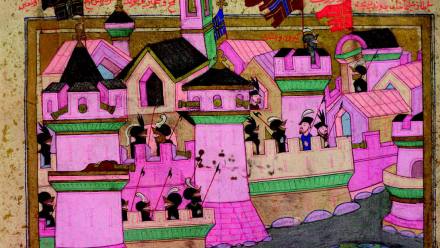
The Ottoman Empire inspired great travel books as well as great architects. Travellers like George Sandys, Richard Pococke or the Chevalier d’Arvieux in the 17th and 18th centuries were curious, erudite and less arrogant than their 19th-century successors. The Ottoman Empire inspired great travel books as well as great architects. Travellers like George Sandys, Richard Pococke or the Chevalier d’Arvieux in the 17th and 18th centuries were curious, erudite and less arrogant than their 19th-century successors. Like cameras, they recorded monuments, encounters, manners and customs. They can make the reader feel that he or she is there, in Smyrna or Beirut, at that time. Ottoman travel writers on Europe, however, are far fewer.

Living dolls

More from Books

Born in Japan, growing up in America in the Sixties, Yoko Kawaguchi was perplexed by the persistence of what she felt to be an anachronistic image of Japanese culture: the geisha. ‘That mincing, simpering personification of female subservience to the male infuriated me,’ she writes in the introduction to Butterfly’s Sisters. Her book explores the Western portrayal of Japanese women with emphasis on the geisha, from the mid-19th century to the present day, comparing perception with reality, misunderstandings compounded by prejudice. She details the geisha’s appearance from head to toe (tortoiseshell hairpin to wooden-soled geta), and the life, from the market in virginity to retirement and/or violent death, encompassing history, myth, literature and art.

The sweet smell of danger

More from Books

If this novel is ever published with a scratch-and-sniff cover — which incidentally, I think it might be successful enough to warrant — this is what it would smell of: cheap petrol, lust, the ripe, acidic scent of decaying corpse, cat litter, $2,000 suits, Cristal champagne, decaying encyclopaedia, corruption, fumes from the power plant, betrayal, sausage. If this novel is ever published with a scratch-and-sniff cover — which incidentally, I think it might be successful enough to warrant — this is what it would smell of: cheap petrol, lust, the ripe, acidic scent of decaying corpse, cat litter, $2,000 suits, Cristal champagne, decaying encyclopaedia, corruption, fumes from the power plant, betrayal, sausage.

Pig in the middle

More from Books

Writing an autobiographical account of middle age is a brave undertaking, necessitating a great deal of self-scrutiny at a time of life when most of us would sooner look the other way and hope for the best. Jane Shilling took up riding relatively late (she even joined a hunt, as described in her book The Fox in the Cupboard), so she has physical daring. The Stranger in the Mirror shows that she also has emotional and intellectual courage. Unsurprisingly, the news is not good. God and gardening are the traditional refuges of the menopausal, but neither seems to hold much interest for Shilling. Romantic entanglements seem unlikely and her teenaged son is advancing towards independence: solitude looms. Career prospects diminish. Looks aren’t what they used to be. Regrets prosper.