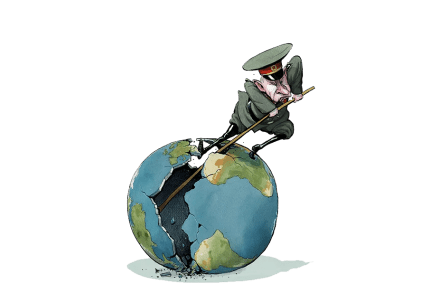
Vladimir putin

Is Putin in pain?

Is Vladimir Putin in pain? Until now, there has been plenty of chatter about the wellbeing of his minister of defence, Sergei Shoigu. Before the war, this veteran political survivor from the Yeltsin era was famous for being photographed on manly Siberian expeditions with his new patron, the bare-chested saviour of ‘All the Russias’. Putin and Shoigu camped out together in the taiga, with moody fireside photos and a spot of fishing – ‘Brokeback Mountain 2’, jested Russian bloggers. Though in reality, the two looked a more like Jack Lemmon and Walter Matthau in a dreary remake: Frumpy Old Men. More than evidence of enduring affection, the staged video sequences

The age-old story of strongmen

The only good news, after the massacres in Ukraine, is that so many ugly behemoth super-yachts have been seized and will not be polluting the seas this summer. There is no more horrible sight than an oligarch’s super-yacht on the horizon, and that is before it disgorges its passengers, which is a horror show in itself. Arab boats, with their hookers on board, are even worse. The other good news is that Elon Musk has become the largest shareholder in Twitter, and in a Trojan War replication has challenged Putin to a duel. Oh, what a wonderful world this would be if those who started wars would duke it out

The view from Ukraine: world war three has already started

I saw the first Russian bombs land from my balcony in Chernivtsi. They hit a military depot 50 miles away but the vibrations were so strong it felt like it happened right by us. I’d attended an intelligence briefing from Volodymyr Zelensky’s office hours before to be updated on the situation: I’m the governor of Chernivtsi, the capital of the Oblast region. The President’s office was keeping us abreast of plans for an invasion that many Ukrainians thought would never happen. Even now, it’s hard to take in. The horrific images from Bucha have finally alerted the world to Putin’s true tactics. We are living through daily air raids, rocket

Viktor Orbán is no friend of the West

Viktor Orbán‘s victory speech in Budapest on Sunday night took a curious turn. Speaking after a fourth landslide win, he opined: This victory is one to remember because we had the biggest [opponents] to overpower. The left at home, the international left, the bureaucrats in Brussels… the Soros empire… and even the Ukrainian President. Orbán skipped over the challenge to regional stability caused by the Russian invasion of neighbouring Ukraine. Having refused military aid to Kyiv, and having exchanged barbs with President Volodymyr Zelensky, he reassured ethnic Hungarians in West Ukraine: ‘Don’t be afraid, the motherland is with you’. Orbán’s party is raising the prospect of secession of Ukrainian lands,

The rouble’s astonishing recovery

The tank columns are stalled; one or two towns captured from the Ukrainians have been retaken. Russia’s war effort has been going nowhere fast for the past fortnight – unless you count the constant pounding and destruction of apartment blocks a form of progress. But then is the economic war being waged against Russia making any greater progress? True, Muscovites can no longer get a Big Mac, and western-made luxury goods have disappeared from the shelves. Yet look at the dollar’s march against the rouble and it is starting to look like a convoy of Russian armoured vehicles. For the first few days, the rouble sank inexorably as sanctions kicked in.

Francis Fukuyama on Ukraine, liberalism and identity politics

This week, Sam Leith spoke to Francis Fukuyama – the author of ‘The End of History and the Last Man’ and the newly released ‘Liberalism and its Discontents’ on the latest episode of The Book Club. You can watch their conversation below, listen to it here or read this transcript. The conversation has been edited for length and clarity.   Sam Leith: Liberal is a word that means something very different in Tennessee than it does in Muswell Hill. What exactly are the parameters of what you call classical liberalism? Francis Fukuyama: It does have a very different meaning in the United States than it does in Europe. My definition of it is closer

Putin and the Muslim world

Several thousand Muslim Chechen fighters are reportedly massing on the edge of Kiev. Syrian volunteers, filmed this week holding assault rifles and chanting pro-Moscow slogans, are en route to the Ukrainian frontlines. Is Vladimir Putin running out of Christians for his war machine? The number of Russian battlefield casualties has certainly been high. Up to 7,000 Russian infantry have been killed since the invasion began, according to US estimates. That would put Russian casualties at more than the entire American losses in 20 years of fighting in Afghanistan and Iraq. As many as 14,000 Russians may have been injured. Military experts say that once a battle group has exceeded about a

What happens if Russia defaults?

Well down the list of things to worry about as the ghastly Ukrainian tragedy unfolds is the high probability that the Russian government will stop paying its international debts. But this risk should certainly be somewhere on that list – as the fallout from past defaults has shown. We have been here several times before. Moscow also defaulted on its debt in 1998, exacerbating a sell-off across all emerging markets. It led to the collapse of a huge US hedge fund, Long-Term Capital Management, which had to be bailed out to prevent a worldwide meltdown. This came too late to save many other investors from large losses. Ten years later, apparently

Don’t make war in Ukraine about Putin’s mental health

There was a time when supposedly serious commentators on world affairs used to at least feign historical knowledge. They might quote Bismarck or Castlereagh. Now, international relations punditry, like almost everything else, has succumbed to the language of pop psychology. Vladimir Putin is ‘gaslighting’ the Russian people, we are told, motivated by his ‘hypermasculinity’. His invasion of Ukraine is, according to one commentator on Radio 4 this morning, ‘unforgivable abuse’. I thought abuse meant kicking a dog or being cruel to a partner. Now it means starting a war. It’s almost as though we’re unable to think of Putin as anything other than a nasty contestant on reality TV. Take

What’s behind Russia’s new Z symbol?

National symbols are usually proudly emblazoned for all to see. That’s the point of them. One, though, seems rather to have crept up on us in recent weeks, being flashed almost like a secret tattoo and then quickly covered up again. It is the letter ‘Z’ that Russians have started using to denote national solidarity and support for their country in the war in Ukraine. The Z came to international notice when a Russian gymnast, Ivan Kuliak, displayed it prominently on his strip two weeks ago while standing next to a Ukrainian competitor at a tournament in Qatar. He now faces a disciplinary inquiry as under the rules such symbols must not

The joy of wigs

I thought, or anyway hoped, that once I’d finished the chemotherapy I would spring back to vitality. Seven weeks on and I’m still creeping about like a two-toed sloth. Now and then I study my face and head in the bathroom mirror for signs of rejuvenation. The narrow skull now boasts a light covering of baby fuzz. Sprouting from my upper lip are some widely spaced bristles. But no sign yet of any eyebrows. From their pouchy sockets the eyes look back at me uncertainly. Listening to In Our Time a few weeks ago, I heard Melvyn Bragg read aloud Thomas Hardy’s poem ‘I Look into My Glass’. The three

Putin is bored

At the beginning of this year, Vladimir Putin was sitting comfortably in the Kremlin: his legacy so far a steady leader who had saved his people from the helter-skelter of robber capitalism in the 1990s and given them a modicum of stability and pride. He must have known that if he waged war on a country of 45 million brother Slavs, he risked losing it all. Liberty and life are now less certain. So why did he do it? Having spent four years in Moscow and more than two decades of Russia-watching, I have never believed that Putin was a chess grandmaster. While his apologists in the West lauded his

Russia’s war on Ukraine: the lessons so far

The sheer complexity – and horror – of Russia’s war on Ukraine makes it difficult to distil the essential points. To take only one example, the battlefront north of Kiev, where the Russian convoy is stalled, is significantly different from that along the Black Sea, where Russian forces from Crimea have made substantial progress. A third front, in the east, is consolidating in Russia’s favour, though the fight was much harder and longer than Moscow expected. Amid this complexity, it is important to summarise what we know so far: 1. Vladimir Putin’s decision to invade Ukraine appears to be the most catastrophic strategic mistake since the end of the Cold War and

How close is Russia to collapse?

Russia is now as closed off to the world as the Soviet Union was before Mikhail Gorbachev made his first tentative steps towards glasnost more than 40 years ago. Pretty much all the progress that post-Soviet Russia had made towards becoming a ‘normal’ country has been reversed within the space of two weeks. Vladimir Putin’s presumed legacy – of stability, predictability and hugely improved living standards for the vast majority of Russians – is vanishing before their eyes. In recent days, Netflix and TikTok have joined what had already become a mass western boycott of Russia. American Express followed Barclaycard and Mastercard in leaving the Russian market. Western supermarkets, including Sainsbury’s, are pulling out;

Do Russians support Putin’s war?

Everyone is calling the conflict in Ukraine Putin’s war and insisting that it has nothing to do with the Russians themselves. The nightmare would end – they tell us – if only Vladimir Putin were to disappear in a coup. They used to say the same thing not only about Adolf Hitler but also Benito Mussolini. Yet both the Fuhrer and the Duce would have been as powerless as the speakers at Hyde Park Corner if they had not enjoyed the willing consent of a critical mass of Germans and Italians. Meanwhile devout Catholics like my Italian wife recite Psalm 109 – the one used to curse the outstandingly evil

The downfall of Russia’s oligarchs

The normal justification for sanctioning oligarchs is that doing so will cost them money, causing them to put pressure on Vladimir Putin so he stops killing Ukrainians. But this rests on the untested assumption that they are able to put pressure on him, and that is where the plan is currently falling down. Oligarchs are not what they used to be. Our idea of the Russian oligarch was born in the 1990s, when a tiny group of men emerged from the wreckage of the Soviet economy, using their nous to seize anything with real value. While the Russian government was left with all the costly bits of the communist state

No-fly zones won’t work, but what about aid to Ukraine?

Vladimir Putin’s forces are encircling the cities of Kharkiv, Kherson and Mariupol, and a 40 mile-long convoy of Russian armoured vehicles is north of Kiev on the seventh day of fighting in Ukraine. The coming days are likely to see greater barbarity from the Russian President after he failed to get his way in the first few days of the invasion. Those days are also likely to stretch into weeks as Putin lays siege to these cities until they are his. The debate about what the West should be doing to needs to widen out So far the political debate in the West has been dominated by a noisy argument about

Boris rules out a no-fly zone over Ukraine

What can the UK do to ensure that Vladimir Putin fails in Ukraine? The Prime Minister has just given a press conference in Poland with his counterpart Mateusz Morawiecki where he repeated his assertion that ‘Putin will fail’ and that the West ‘will succeed in protecting and preserving a sovereign, independent and democratic Ukraine’. The Russian president, he said, had underestimated the resolve of Ukraine and its allies. He also warned that things were likely to get much worse, saying:  Johnson was confronted by a campaigner who accused him of being afraid ‘It is clear that Vladimir Putin is prepared to use barbaric and indiscriminate tactics against innocent civilians to

Liz Truss is having a good war

Liz Truss gave a striking statement in the Commons this afternoon on the action the government was taking to respond to the Russian invasion of Ukraine. It contrasted to the approach taken by some of her colleagues, because it contained a number of admissions about the impact of this action. For the first time, the Foreign Secretary stated that Britain would ‘have to undergo some economic hardship as a result of our sanctions’. This has been implicit over the past few days, but Truss was the first to say it clearly. She added that ‘our hardships are nothing compared to those endured by the people of Ukraine’, and also warned

‘Staying Switzerland’ on Ukraine is impossible

The striking thing about the financial sanctions on Russia is not their severity, but just how many countries are joining in the effort. Switzerland has today announced that it will adopt the EU sanctions on Russia, particularly significant because it has been the biggest recipient of private transfers by Russians in recent years. The fact that such a traditionally neutral country is imposing sanctions will deepen the wedge between Putin and the rest of the ruling elite. Meanwhile in Asia, Japan, South Korea and Singapore have signed on to the economic measures on Russia. Their willingness to do this is as much about Taiwan as Ukraine; they know that China is