Unemployment

How the coalition plans to recover

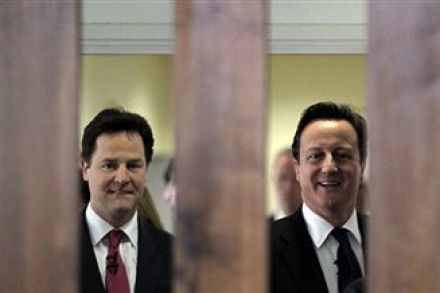
This morning’s battle of the political odd couples shows the dangerous direction in which the AV referendum is going for the coalition. The Yes campaign are becoming ever closer to making explicit the argument that a yes vote is the best way to keep the Tories out. For their part, the No side are continuing to hammer the compromises of coalition and the unfairness of the party in third place determining the result. In other words, no more Lib Dems in government. These campaign strategies mean that the result of the referendum will be seen as a decisive rejection of one side or other of the coalition.

At last, Grayling takes on the Ancien Regime

To disguise the radical nature of reform, one need only make it boring. And here Chris Grayling has succeeded spectacularly. Today he has announced further details on the ‘Work Programme’ and the ‘Benefit Migration’, which sound like the type of well-intentioned but doomed reforms that ministers tried over the Labour years. The welfare state has incubated the very ‘giant evils’ it was designed to eradicate. There are, scandalously, 2.6 million on incapacity benefit right now – a category which ensures they don’t count in unemployment figures. Brown didn’t care much, but Grayling is taking this head-on.

David Cameron’s dreams and nightmares are written into today’s employment figures

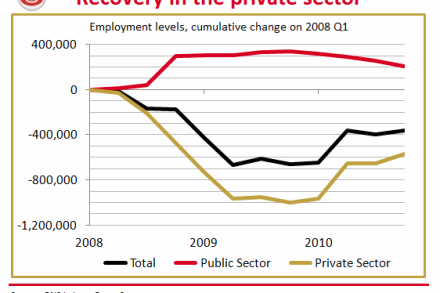
It is almost a cliche to describe jobs figures as a "mixed picture" — and yet that's exactly what today's are. Beneath the headline finding that the number of unemployed people has risen above 2.5 million, are numbers that will fuel not only David Cameron's happiest dreams, but also his most paranoid nightmares. Let's start with the nicer stuff first. The graph above shows the cumulative change in employment levels since the recession started to take hold in 2008. What it shows is something that often goes ignored: that is was the private sector, not the public sector, that took the greatest hit from the crunch.

Curing youth unemployment

Youth unemployment in the UK has hit another record. More 16 to 24-year olds are out of work than ever. The unemployment rate in this group is now a shocking 20.5 percent, which amounts to nearly a million young people out of work. Of those, 600,000 have never had a job since leaving school or college. All unemployment is bad news, but youth unemployment is particularly bad news. We want young people who leave education to get a job, learn the skills and disciplines of work and build up the experience that will help them be upwardly mobile. That benefits them, obviously, and it benefits the whole community too. But instead of young people getting into the work stream, too many are getting into the welfare stream.

The Tories’ secret weapon

Too much time at the barbers. That’s the opposition’s problem. Ed Miliband showed up at PMQS today after a long morning lounging in the chair having his hair coiffed and burnished. His darkly gleaming scalp now looks like the kind of thing toffs scrape their boots on after a morning’s shooting. And that’s precisely what the Prime Minister proceeded to do with him today. With no time for a strategy meeting beforehand Ed had just grabbed a list questions from the last PMQs-but-three.   He began by having a go at Cameron on youth unemployment. But we know how Cameron deals with that one. Been a problem for decades, old boy. Miliband then challenged him on the economy. And we know Cameron’s answer to that one too.

Unemployment rises

It was the snow wot done it. The new unemployment figures have been published and the headline figures are that unemployment increased by 44,000 to 2.49 million between December 2010 and January 2011; the claimant count also went up by 2,400 to reach 1.46 million. It’s disappointing news, especially as figures from Germany are markedly different. Miliband may exploit the news at PMQs. But there are reasons to be positive. The government’s mouthpiece on these issues, Chris Grayling, who is less attack dog more beast of burden these days, argued that Q4’s negative growth figures will have had some effect on employment (and it’s likely to continue to do so into this month and the next, if the economy did indeed contract in the last quarter).

China eclipses the Japanese economic miracle

Official figures suggest that China has replaced Japan as the world’s second largest economy, after an estimated 10 percent growth rate left China with an economy worth close to $5.8trillion at the end of quarter four 2010. Japanese growth hovered around the 3 percent mark in 2010 with a total GDP value of $5.47 trillion. Analysts have told the BBC that it is ‘realistic’ that China will overhaul the US’ economy in about a decade, which, as Pete has demonstrated, does not look too outrageous a suggestion.  All of this puts me in mind of the European Union. The CIA World Factbook records that the EU leads the globe in GDP (purchasing power parity): with an estimated value of $14,890,000,000,000, against the US’ $14,720,000,000,000.

Hardly vintage stuff from Ed and Dave

Neither Ed Miliband nor David Cameron had a good PMQs. Cameron let his irritation at questions about the appointment of his campaign photographer to a civil service post show. It was also a bit rich for him to criticise a Labour MP for asking a question scripted by the whips when Tory MPs ask patsy questions with monotonous regularity, I counted at least four in this session alone. But the regular shouts of ‘cheese, cheese’ from the Labour benches were clearly riling the Prime Minister. But it wasn’t a good session for Ed Miliband either. His delivery was rather halting and he stumbled on his words far more than he usually does. His jokes didn’t quite come off either.

Housing benefit reform is a Good Thing

Dressed with his effortless prose, Matthew Parris has a point (£) that proves why he is the leading commentator of the last two decades. Housing benefit reform is his subject and he urges his readers reject the legends that have accrued around the issue - not Boris, not Polly Toynbee, not shrill councils, not rapacious landlords and definitely not the government. No one, he says, has the numbers but there are several certainties: ‘The outcomes may not prove nearly as brutal as this week’s predictions. What (as I asked above) can we know? We know that comparisons with Paris are ludicrous. All of our big cities are speckled with very large-scale “social” housing of a type that is suited only to the income groups for which it was constructed.

More to Osborne’s plan than gambling

Paul Mason's review of the cuts for Newsnight last night (from 10:20 into the video here) was one of the most powerful critiques of Osborne from the left. His package majored on Osborne's decision to cut a further £11 billion from welfare and pensions, to soften the departmental cuts. Adopting a rather funereal tone, Mason declared that, "if you are poor, your life is about to change". He produced a decile graph, showing the poorest are hit second hardest. It foreshadowed this morning's Guardian cover: "Axe falls on the poor". Danny Alexander was fed to Paxo: "You said you would not balance your budget on the backs of the poor - when did you change your mind?" (Alexander performed very well - stunningly, even, given what he was doing only six months ago).

Cameron’s warm-up act for Boy George

Cameron was a mere warm-up man at PMQs today. With Osborne’s statement due at 12.30 the session felt like a friendly knock-up rather than the main fixture. Ed Miliband rose to thunderous cheers from his backbenches and he tried to capitalise on their support by opening up an ancient Tory wound – heartless attitudes to unemployment. Spotting Cameron chinwagging with Osborne instead of listening, Miliband chided the PM for not paying attention. ‘Well, it’s a novel concept,’ said Dave smoothly ‘but in this government the prime minister and the chancellor speak to each other.’   Ed’s problem was that the OBR has predicted rising employment for the next three years. Bad news for the opposition leader.

Exclusive: 1.5 million jobs to be created during the ‘cuts’

Almost every newspaper today leads on the chilling figure of 500,000 jobs to go. This was taken from a briefing paper held by Danny Alexander – a “gaffe” says The Guardian. Indeed: it was top secret - to anyone without internet access. “The OBR’s Budget forecast was for a reduction in public sector workforce numbers to 490,000 by 2014/15”. Read the offending sentence. This was not private advice, but posted online (here) and this is what it said…   But hang on. The same forecasts predict that the number of jobs in the economy will rise – by 1.08 million over the same timeframe. So by the same forecasts, the economy will create three times as many jobs than the public sector is shedding.

What you need to know ahead of the spending review: deprived areas

This is the next of our posts with Reform looking ahead to the Spending Review. Earlier posts were on health, education, the first hundred days, welfare, the Civil Service, international experiences (New Zealand, Canada, Ireland), Hon Ruth Richardson’s recent speech, selling the case for cuts to the public and how to deliver retrenchment.  (And the next subject, defence expenditure, can be found here) The debate over spending cuts was taken out of Westminster to the ex-mining constituency of Cannock Chase, Staffordshire on Friday. For “Can Cannock Cope? Showcasing local champions and public sector reform in Cannock Chase”, Reform assembled heads of local public services and business leaders in front of an audience of 100 Cannock residents.

What do you need to know ahead of the Spending Review – Welfare

This is the fourth of our posts with Reform looking ahead to the Spending Review. The first three posts were on health, education, and the first hundred days. What is the budget? The welfare budget must be at the heart of the debate on how to restore the public finances. The Government spends more on welfare than anything else. In 2009 the bill for social protection was around £199 billion. This has almost doubled in real terms over the last 20 years from £104 billion in 1989. Social protection now represents 32.5 percent of all government expenditure or 14.2 per cent of GDP. Some welfare spending varies with economic conditions, with increasing unemployment, for example, leading to greater expenditure on assistance to support people back into work.

The government’s transparent approach to worklessness

Sometimes hope lies in the details. Take this morning's press release from the DWP, for instance. On the surface, it is a response to today's encouraging employment figures. But what it really is is a new way of approaching the problem of worklessness in this country. And all because of its headline: "Figures reveal five million on out of work benefits as Grayling pledges to make work pay." This is, as far as I can remember, the first time that the total out-of-work claimant count has reached the summit of an official release. The last government always knew what the figure was, of course, but never drew much attention to it. Instead, we heard Brown mumbling on about "3 million new jobs," while wilfully ignoring the millions who had been overtaken by globalisation.

In the service of others

David Cameron’s Big Society re-launch continues after his American interlude. Today, he will introduce the national citizens’ service for 16 year olds, which was famously backed by Michael Caine during the election campaign. There is no military element to this national service; the aim is to unite different communities, ages and classes. As a leader in the Times puts it: ‘The bold aim is to turn a summer of potential drift and disaffection into one of purpose for youths from different backgrounds, working together to help people worse off than themselves, under the wing of various charities and social enterprises; and thereby, perhaps, to lay the ground for a less dislocated society in the future.

Meeting the cost of welfare reform

As far back as last September, Iain Martin wrote that Iain Duncan Smith’s plans to reform the welfare system were going to run into trouble over cost: 'But there is no way these proposals, as drafted, will be implemented by a Conservative government, for one simple reason: they carry an estimated up-front increased cost of £3.6bn. A Treasury and Tory Chancellor desperate to find massive savings quickly will never nod that through even if advocates of these proposals promise vast “long-term” savings. Officials will simply say: how many times have we heard such talk before?' It would be a real tragedy if the political will built up to take serious action on this issue was wasted out of a failure to make the sums add up.

Perverse though it sounds, prisons can be a haven for opportunity

So much of the welfare debate is lost in jargon and the numbingly large and depressing numbers. John Bird, founder of The Big Issue, has just been on The Daily Politics and he condensed the specious waffle into plain but evocative sound bites. ‘You don’t have a broken society without a broken system. The usual suspects come in and advise Blair, Brown and now Cameron that what you need is money for the poor. The poor don’t need more money; the poor need more opportunity.’ Bird admitted that prison made him upwardly mobile. He left it being able to read, write and paint, and was given the confidence to pursue his entrepreneurial instinct.

Osborne must make the workings of the OBR even more transparent

Forget the hubbub about Gove's schools list, the most damaging story for the government this week could well be on the cover of today's FT.  Alex Barker does a great job of summarising it here. But the central point is that the Office for Budget Responsibility changed its forecasting methods just before the Budget, with the effect of reducing how many public sector jobs would be lost due to the government's measures. This isn't damning on its own: statisticians constantly tweak their forecasting methods. But when you consider that the OBR's new methods incorporated policies which haven't even been announced yet (including one which pre-empts the findings of John Hutton's pensions commission), then it starts to look more dubious.

The plan’s afoot

In the midst of this ongoing row about employment numbers, it is worth noting that the OBR figures released today show that there’ll be 610 thousand fewer public sector jobs at the end of parliament than there are now. But the overall number of jobs in the economy will increase by 1.34 million. This means there’ll be 1.95 million more private sector workers at the time of the next election. As I wrote in the magazine last week, one of the aims of the Budget was to shift employment from the public sector to the private sector. The OBR’s numbers show that the Budget should do this. There are, at least, two reasons why Osborne wants to do this.