Unemployment

Labour miss out the details

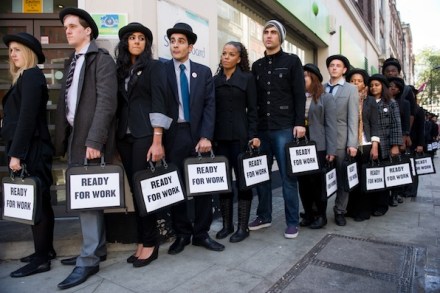
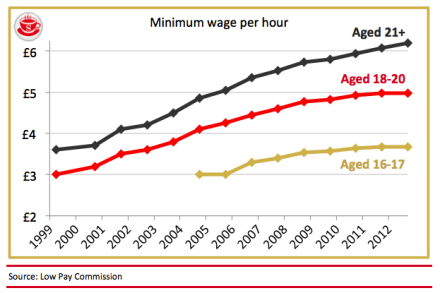
Labour's launch of its new youth jobs policy has been rather overshadowed by Harriet Harman's inability to explain the costing behind the policy on the Daily Politics earlier: not a good look for a party trying to show that it is fiscally credible. But more interesting than the number behind the policy is how it marks an attempt by Labour to toughen up its position on welfare. Those young workers who have been out of work for a year will have to take one of these minimum wage jobs or have their benefits docked.


 On the Labour front, the interview with Ed Miliband in the Times today is also worthy of comment.

Unemployment’s high, but at least it’s stopped rising

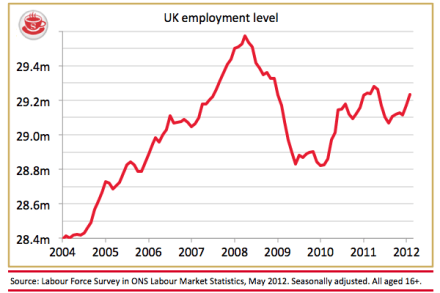
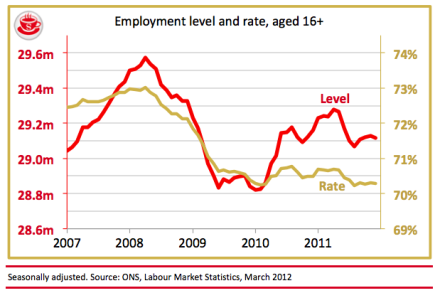
So, new jobs figures out today. Which do you want first: the bad news, or the kind-of-alright news? The bad news is that employment’s showing no signs of growth: the total number in work has been stuck at 29.1 million since it fell there in the summer. It’s a touch better than the trough of 28.8 million we hit at the end of 2009, but still half a million below where we were when the recession hit. And we’re showing no signs of getting there any time soon: And the not-so-bad news? Unemployment’s slightly down on last month, which was slightly down on the month before. It’s not a big drop — well within the margin of error — and the number of unemployed still stands at 2.7 million, so this doesn’t exactly count as good news.

Graduates struggling to get graduate jobs

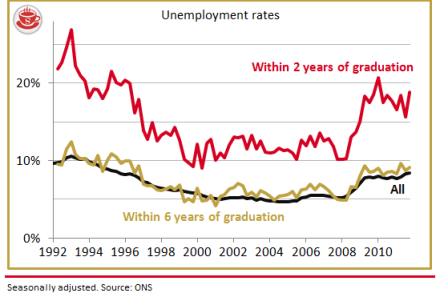
Today’s ONS release will make pretty grim reading for students and recent graduates. It shows that the unemployment rate among recent graduates — those who graduated in the last six years — stands at 9.1 per cent, higher than the overall unemployment rate of 8.4 per cent. It’s even worse for those who graduated in the last two years — the unemployment rate among them is 18.9 per cent, up from 10 per cent before the recession. But there’s an even more worrying trend among those recent graduates who do find employment. In 2001, three-quarters of them were in ‘higher skill’ jobs — those requiring more than GCSEs. Now, less than two-thirds of them are: So what does this mean?

Raise the tax threshhold and let youth prevail

Youth unemployment is approaching crisis levels in Britain. For almost two decades, Britain’s more flexible labour market had favourable effects on youth employment. But the re-regulation of the British economy has narrowed the difference between our jobs market, and that of the continent. Meanwhile the British poverty trap has been strengthened by a dysfunctional welfare state: British workers can in some circumstances keep as little as 5p in every extra pound they earn if they find work. Who would break their back for less than 50p an hour? We’re paying people not to bother, so little wonder that most of the employment rise — in the last government, and under this one — is accounted for by a rise in foreign-born workers.

Transcript: Grayling on work experience

On the Today Programme this morning, Employment Minister Chris Grayling defended the government's Work Experience programme in light of the recent controversies around it. Here's a full transcript of the interview: Evan Davis: Well how can work experience get such a bad name? A string of high profile companies have pulled out of one government scheme providing work experience for young people. The latest, retailer Poundland, has announced it is suspending its participation in the scheme although it’s not quite clear which scheme it is, because there are several government schemes for getting people, long-term unemployed or young, into work. Let’s see if we can clarify what is going on with the Employment Minister, Chris Grayling. Good morning to you.

How can employment and unemployment go up at the same time?

The employment level has risen since the election, according to today’s figures — albeit only slightly, from 29.0m to 29.1m. But unemployment’s up too: from 2.46m to 2.67m. So how come we’ve seen both more jobs and lengthening dole queues? Well, that’s because the ‘economically active’ population (people who are in work or ‘have been actively seeking work and are available to start work if a job is offered’) has grown faster than employment has. There are now 31.8m people in the UK who fit that description, an increase of 320,000 since the coalition came to power. But with only a 110,000 rise in employment, that means the number of folk unemployed has risen by 210,000.

The Tories are extending their lead on the economy

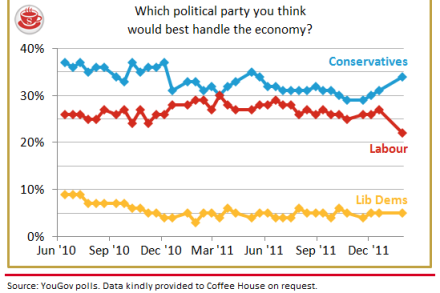
It looks like Dave’s still made of Teflon. Even after the economy shrank by 0.2 per cent and the unemployment rate rose to its highest point since 1995, the public still think his party is better at handling the economy than Labour. And the Tories’ lead on what is by far the most important issue to voters hasn’t just survived all this bad economic news — it’s actually grown. Before Christmas, 31 per cent said the Tories would best handle the economy, against 27 per cent for Labour.

The bias towards migrant workers

Why are you never served by a Londoner in a London branch of Pret A Manger? I asked this in the Telegraph recently, and yesterday’s Evening Standard had a great piece tracking down four who applied, and were rejected without an interview. Some suspect there is a bias in favour of immigrants: if your name doesn’t sound exotic, game over. I doubt that a company like Pret, whose most valued ingredient is the famous enthusiasm of its staff, can afford to discriminate in any way. But the wider point is a very serious one: that British employers have come to prefer immigrants, believing that they work harder. And that a bias for foreign workers is adding to the problems facing Britain’s young unemployed.   In general, I do think this is an issue.

Why the government shouldn’t be confident that employment’s rising

No two ways about it: today’s employment figures are difficult for the coalition. The unemployment figure’s up for the seventh month in a row, and now stands at 2.68 million — the highest since 1994. And the unemployment rate — up to 8.4 per cent — is at its highest since 1995. It doesn't look like getting better anytime soon, either: unemployment's predicted to carry on rising at least until the end of the year, possibly matching the three million peak of the early ‘90s. In its defence, the government claims that employment is rising too. Today's figure of 29.1 million in employment is about 150,000 higher than it was at the general election. That may seem odd — how come unemployment's up when more people are employed?

The lesson from today’s PMQs? Unemployment makes Cameron uncomfortable

What’s the point of Ed Miliband? Does the Opposition leader have any purpose in life other than to provide ritual entertainment for the Tory wrecking crew at PMQs? Having spent the New Year listening to lethal attacks from his dearest supporters, Mr Miliband has now seen his leadership shrivel to a pair of policy statements which rival each other in desperation and barminess. The first, outlined by Liam Byrne this morning, is a fantasy tax on banking, ‘to create 100,000 jobs’. The second is Labour’s new position on the government’s austerity programme. This would baffle the dippiest and trippiest resident of Alice in Wonderland. We hate the cuts. We back the cuts. We oppose the cuts. We endorse the cuts. We accept the cuts.

Cameron endures his monthly unemployment grilling

Downing Street is painfully aware that one PMQs in four is going to be about unemployment. Today, with the monthly figures having come out this morning, Miliband led on the subject. The Cameron-Miliband exchanges were not particularly enlightening. Miliband said ‘it really is back to the 1980s’ and Cameron mocked Miliband for being ‘so incompetent, he can’t even do a U-turn properly’. In the backbench questions, Cameron wasn’t put under much pressure. The news of the session came when he said in response to a question from Andrew Rosindell that the National Security Council had devoted a whole session to the Falklands yesterday.

Cutting immigration won’t help youth unemployment

Reading the papers today, you could be forgiven for thinking that MigrationWatch’s new report was a smoking gun against immigration. Here we have a study that links immigration to unemployment, in the face of nearly all previous research that has found no such link. However, looking at the MigrationWatch piece itself, it quickly becomes clear how implausible these claims are. The MigrationWatch report centres on a comparison of rising youth unemployment and rising immigration from the ‘A8’ countries – the Eastern European states that joined the EU in 2004. The correlation between the two is remarkably weak. During the initial rise in immigration between 2004 and the end of 2008, there is no significant rise in unemployment at all.

The Autumn Statement: What you need to know

We've been posting some of these charts on Twitter, but here they are, collected, for CoffeeHousers. You can expect more as we mine deeper into the OBR's supplementary document. Do shout out, also, if you spot anything yourself. 1. Weaker growth — except for a very optimistic figure for 2015 2. Higher debt — both in real terms and as percentage of GDP   3. Osborne borrowing more than he'd hoped 4. More persistent — and deeper — ILO unemployment 5.

A Clegg-up for young workers?

There was a time when Nick Clegg was the most agile and persistent defender of the coalition's deficit reduction programme. But now — although he's still got it in him — he is more often wheeled out to announce some spending wheeze or other. A couple of weeks ago, it was the next instalment of the government's regional growth fund. Today, it's a £1 billion scheme, spread out over three years, to encourage companies to take on young people. This latest scheme is one of those that looks very neat on paper. Put aside questions about how it will be funded, and what we have is a plan whereby £2,275 will be paid to companies for each young recruit they bring on. It means that, in effect, the state will cover half of the youth minimum wage for a six-month period.

Ed looks more dead than deadly

If Roman Abramovich owned the Labour party, Ed Miliband would be toast by now. The floundering opposition leader gave the sort of inept, predictable and ill-organised performance at PMQs that would get a manager sacked in the Premiership. It scarcely helps that Mr Miliband seems to prepare for these sessions like a deluded psychic. He and his team of prophets at Labour HQ clearly believe they can foretell what the prime minster will say and how best to smash his answers to pieces. Referring to the rise in unemployment, Mr Miliband began by attacking the PM for scrapping the Future Jobs Fund in March. He boasted, rather weirdly, that ‘under Labour, youth unemployment never reached 1 million.

200,000 extra working pensioners

Despite – or perhaps because of – the recession, pensioner employment has increased dramtically over the past few years. In his Telegraph column today, Fraser remarks on this important but largely ignored trend in Britain's workforce. 'A million jobs have been lost since the Great Recession began', he says, 'but the number of pension-aged people in work has increased by 200,000.' Here's that phenomenom in graph form: Why has this happened? Fraser puts his finger on one important factor: 'Crucially, they pay less tax. A pensioner manning the tills in Tesco will take home 12 per cent more than a working-age colleague on the same salary.

Miliband’s ‘responsible capitalism’ requires deregulation

Despite yesterday’s gloomy unemployment figures there is, it turns out, good news for the government buried in current labour patterns: the total number of hours worked in the last three months has risen by three million. The bad news is that employers are currently filling this demand by getting current employees to work longer hours (average weekly hours over this time period rose by 0.3 to 31.5), rather than taking on new workers. Presumably this is because it is so much cheaper, and less risky, to do so.   This should come as an encouragement to the government, as they search for ways to bring about growth.

Unemployment rate highest in 15 years

Today's unemployment figures do not make for cheery reading. Youth unemployment is up to over a million and unemployment overall has reached 2.62 million, meaning that the unemployment rate is the highest it has been for 15 years. Laura Kuenssberg tweets one particularly striking statistic: 'Number of UK Nationals in work fell 280k compared to this time last year, number of non-UK Nationals in work increased 147k over same time' This suggests that it's a touch too simple just to say that there are no jobs out there. It also means that we really should think about why non-UK nationals are proving so much more adept at finding work than their British counterparts.

If Clegg wants to reduce youth unemployment, then he’s going to have to look at regulation

Nick Clegg’s interview in The Times today presages a major Lib Dem effort to try and promote policies to reduce youth unemployment. With figures out on Wednesday expected to show youth unemployment going over a million, the Lib Dem leader is keen to show that the government is acting. But as The Times reports, the quad—Cameron, Osborne, Clegg and Alexander—are divided on what to do about the matter. The Tories are keen to do Beecroft for young people, removing some of the employment protections that make firms so reluctant to hire new staff. But given how the Lib Dems have set themselves so firmly against the Beecroft review and its principal idea of replacing unfair dismissal with severance pay based on length of service, they won’t accept this.

Labour aren’t capitalising on the government’s woes

Ipsos MORI's latest monthly political monitor is just out, and it doesn't bring much good news for either the government or the opposition. 63 per cent of respondents are dissatisfied with the government and 54 dissatisfied with David Cameron — both the highest proportions since the election. On the public's number one issue — the economy — just 36 per cent say the government's done a good job. And even wose, a whopping 77 per cent say they've done a bad job of keeping unemployment down — hardly surprising considering unemployment has risen by 100,000 since the election. But while all this presents a great opportunity for Labour, other numbers show how bad a job they're doing at taking advantage of it.