Unemployment

Brown’s children

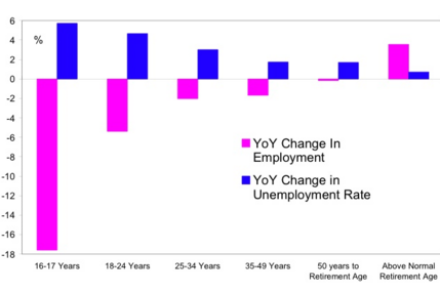
Why is this recession so cruel to the young? The unemployment figures - now up to 2.44 million - are bad enough. It's the largest single quarterly drop since data began in 1971. But look deeper and there's a striking disparity amongst the age groups. The under-18s – school leavers – are hit the most, with their employment numbers down 17% year-on-year. The 18-24 year olds are next worst hit. But there is actually a rise in pension-aged people returning to work. The bottom line: unemployment amongst the under-25s is a third higher than when Labour came to power. CoffeeHousers may remember how full of pious anger Gordon Brown was during the last recession, saying that youth unemployment was a particular outrage, and he called them "Major's children".

The human cost of deprivation 

The news that in one Northern city, 15 percent of Neets, those young people not in education, employment or training, are dead within ten years in immensely depressing. It is a reminder of the horrendous toll that drugs and social breakdown take on our society. The director general of schools, who revealed this, stresses that these numbers shouldn’t be taken to be typical of the country as a whole. But seeing as we don’t have numbers for the rest of the country, this was a local study, it is impossible to know how serious the situation is nationally.   One can talk in policy terms about possible solutions to this problem.

Is this the Most Stupid Headline Ever?

This morning's Telegraph excelled itself in the idiocy stakes. The headline on the story about the government's Future Jobs Fund announcement was dripping with the kind of sneering philistine right-wing pomposity we will probably have to live with for the next half-decade. "£1bn scheme to create 'soft jobs" screamed the "hamper" story across the top of the front page. This scheme was first announced in the Budget, but the first tranche of 47,000 jobs, mainly created in local authorities was announced by Peter Mandelson and Yvette Cooper today. Examples of "soft jobs" given by the Telegraph included "dance assistants, tourism ambasadors and solar panel engineers".

Revive the Enterprise Allowance Scheme

Some will see it as final proof that I have made the journey from left to right, but I have to say I don't see it that way. In tomorrow's Telegraph I have written a column calling for the revival of the Thatcher-era Enterprise Allowance Scheme. This initiative gave a £40 per week payment to people who wanted to get off the dole and set themselves up in business. Alumni include Alan McGee, who set up Creation Records on the EAS, Julian Dunkerton of the Superdry fashion label and visual artists Jane and Louise Wilson. New Deal of the Mind was commissioned by the Arts Council to examine the government's response to the recesssion.

Britain: the Coming Crisis

Do we really have any idea of how serious this is about to become? As I sat watching BBC 2's recesion drama Freefall tonight I realsied that we are beginning to get an inkling. This was a quick-hit drama intended as an immediate response to the recession and it was very rough at the edges, but it showed how quickly the culture has grasped that this getting very grim indeed. It was a conventional enough story of an aspirational family wanting to move to a new private housing estate, but it sent a chill through these bones. There was a fascinating set of statistics in Nick Cohen's Observer column this weekend, which should send a chill through everyone's bones.

How New Labour Policy Making Works

The best New Labour policies have always been designed for sale to liberals and reactionaries at the same time. When I was on The Observer I always made a point of asking for the Mail on Sunday half of the story whenever I was pitched a Sunday trail for a policy launch during the week ahead. Of course this briefing of journalists in advance of a government launch will no longer happen in the new era of parliamentary propriety (until the next time). But its worth applying this to the latest Gordon Brown policy document: Building Britain's Future. Some of this policy fits the model perfectly.

Another Way Out of this Mess

One of the reasons I haven't been blogging as often as I should is that I've been writing a report for the Arts Council about self-employment in the creative industries. I've been convinced for some time that the government should be re-creating some version of the 1980s Enterprise Allowance Scheme to encourage entreprenership. The original scheme paid people £40 a week to set up their own businesses. This was slightly more than the dole at the time and this acted as an incentive for people to come off benefits. This was seen at the time as a way of fixing the unemployment figures, but it also launched a number of successful careers, including that of Alan McGee, the founder of Creation Records .

Is Anyone Thinking Strategically?

The MPs' expenses scandal has been a devastating distracttion. It has been an essential process. But it is a distraction all the same. How many times have commentators now said the country is now facing a political crisis to match the economic crisis? This is not the whole story. The economic situation means that people's anger about the venal behaviour of their MPs is intensified to the point of  fury. But the MPs' scandal is just a sideshow to the main problem, which is a serious political vacuum at the top of British politics. No one is now listening to Gordon Brown any more. His position has become absurd.

What Would a Budget for Innovation, Enterprise and Aspiration Look Like?

The papers make pretty depressing reading this morning, whether you are Alistair Darling, a Spactator reader facing the prospect of a 50p top tax rate or a member of the mythological "hardworking" family. Growth at its lowest rate since the war, stratospheric debt, unemployment over two million: the end of the first decade of the 21st century is turning into a living nightmare. And I don't buy the prediction that this will be over by the end of the year.  I agree with those who say that the government which takes us out of recession will harness the hard work, enterprise and aspiration of the nation. But I really don't the 50p tax "bombshell" is the real issue here. The micro-entrepreneurs and innovators that we need so dearly at the moment are not people earning the top salaries.

The Wisdom of Clay Shirky

I've long been an acolyte of US new media guru Clay Shirky. His book Here Comes Everybody is essential reading for anyone interested in the future of the media and the future of... well, let's just say the future. One of my students (thanks Alex) has just alerted me to these thoughts, entitled, Newspapers and Thinking the Unthinkable, on the future of the industry I have worked in for most of my professional life. It's a long piece (so much for the web encouraging bite-sized chunks of information) and some of it is very technical.

Suzanne Moore on New Deal of the Mind

I know I said I wouldn't do this, but I have to plug one more article on the New Deal of the Mind. Suzanne Moore make a great contribution to the debate in Downing Street on Tuesday by warning that the initiative must not become just another opportunity for the arts lobby to hand out the begging bowl. Suzanne's Mail on Sunday column this weekend captures the spirit of the summit meeting and the philosophy of the enterprise: "It is an urgent situation and amazingly everyone there realised it and started putting some money on the table. Trevor Phillips committed up to a million then and there. Jenny Abramsky of the Heritage Lottery Fund and Jude Kelly, who is also responsible for some of the Olympics money, agreed to look at projects they could fund.

New Deal of the Mind at 11 Downing Street

I don't think it's quite right for me to keep promoting New Deal of the Mind here on my Spectator blog. That should happen elsewhere and will. But just in case readers are interested, the launch meeting at Number 11 Downing Street was a fascinating affair. Cabinet Ministers Andy Burnham and James Purnell pledged their support as did opposition culture spokesman Ed Vaizey. It's probably best to let others who were there speak about this so check out Lynne Featherstone's report of the event. Lynne has been a great supporter of the initiative, designed to harness the innovative potential of the creative industries during the downturn.

Is the Left Waking From Its Slumber?

A rather impassioned piece on unemployment from Polly Toynbee in yesterday's Guardian made me realise that there are a number of people on the liberal-left in Britain thinking very hard about the implications of the global recession. "Has the horror of it all struck Westminster with full force?," asks Polly? I think they are beginning to, but the problem is that they are stuck in the politics of the late-1990s census, which had us all triangulating like mad. All the clamour for an apology from the Prime Minister stems from a desire for him to atone for all our sins. It was difficult not to embrace the market when the market seemed so cuddly. What we mistook for comforting girth turned out to be the flabby product of over-indulgence. But this is not the time for self-flagellation.