Ukraine

Russia slogs through the Donbas

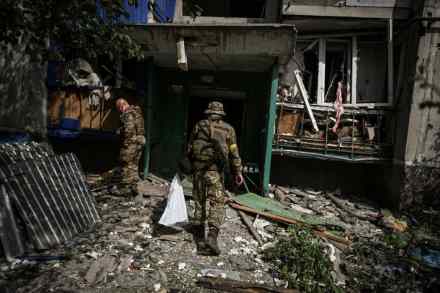
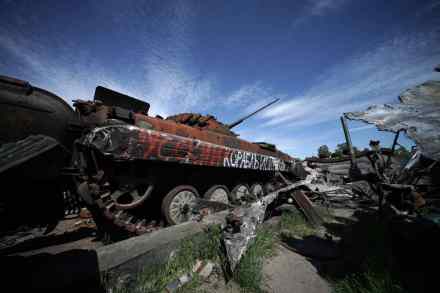
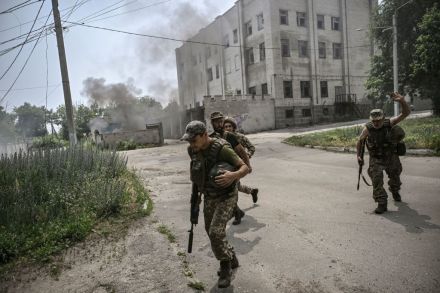
A brutal artillery battle: that’s what the latest phase of Russia’s war on Ukraine has become. Vladimir Putin failed in his original goal of seizing the entire country swiftly, beginning with the capital of Kyiv, and installing a puppet government. When Ukrainian resistance prevented that, Putin shifted to a smaller, more achievable objective: establishing complete control over two eastern provinces, Luhansk and Donetsk, which border Russia and are jointly known as the Donbas region. That’s where the war is being fought now, with an uncertain outcome. Victory will depend on who wins the artillery battle. Russia has more blunt firepower; Ukraine has more precise, longer-range weapons — or at least it will have them when more NATO supplies reach the frontlines.
artillery

Biden of Arabia

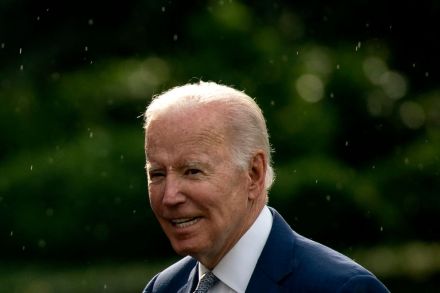
When news broke that President Biden was planning a trip to Saudi Arabia to visit the crown prince Mohammed bin Salman (known as MbS), members of his party were horrified. Representative Adam Schiff, the chairman of the House Intelligence Committee, was especially disturbed and recommended the White House cancel it outright. "I wouldn't go. I wouldn't shake his hand,” Schiff told CBS on June 5. "This is someone who butchered an American resident, cut him up into pieces in the most terrible and pre-meditated way.” That resident was Jamal Khashoggi, a former Saudi royal family insider who used his perch as a columnist at the Washington Post to raise awareness about the crown prince’s ruthless ways.

arabia

What if the Ukraine war is never won?

From our UK edition

In late March, roughly a month into Russia’s invasion of Ukraine, an unnamed Nato official told NBC News that the conflict was turning into a meat grinder for both sides. ‘If we’re not in a stalemate, we are rapidly approaching one,’ the Nato official said at the time. ‘The reality is that neither side has a superiority over the other.’ Sure enough, a month and a half later, the Pentagon’s top intelligence official testified to the Senate Armed Services Committee that ‘stalemate’ is exactly what is occurring.

‘Famine is part of Russia’s strategy’: Zelensky’s economic adviser on Putin’s tactics

From our UK edition

Alexander Rodnyansky has a desk waiting for him back at Cambridge, where he’s currently on sabbatical from his role as a junior economics professor. But he won’t be returning for some time. He’s working from Kyiv, prioritising his other job: as economic adviser to Volodymyr Zelensky. Rodnyansky was in Ukraine when the war broke out and he could easily have returned to the UK. ‘That wasn’t really much of a thought,’ he says. ‘I’m sixth-generation Kyiv. I was just going to stay.’ He became a full-time presidential adviser two years ago, hired to help reform Ukraine’s financial institutions, including the privatisation of state-owned commercial banks. ‘About 55 per cent of our banks are government-owned,’ he says.

Portrait of the week: Jubilee celebrations, energy bill discounts and a trade deal with Indiana

From our UK edition

Home The Jubilee for the Queen’s 70 years on the throne was marked by two days of public holiday, 16,000 street parties, a service at St Paul’s, Trooping the Colour, late pub opening, beacons, bells, and anxiety about the Queen’s health. After Rishi Sunak, the Chancellor of the Exchequer, announced in parliament that he had added £15 billion of public money to the £9 billion allocated in the spring statement to relieving energy bills, the nation questioned what it meant for their pockets and for Conservative politics. The government would get some of the money for the plan from a windfall tax, or ‘energy profits levy’, of 25 per cent on the profits of oil and gas producers, expected to yield £5 billion this year.

‘Putin may be prepared to go to the limits’: Antony Beevor and Serhii Plokhy in conversation

From our UK edition

The military historian Antony Beevor joins Serhii Plokhy, professor of Ukrainian history at Harvard, on Spectator TV this week to talk about the war in Ukraine. This is an edited transcript of their discussion. Putin’s plan ANTONY BEEVOR: I’m alarmed by the latest developments. The encirclement or imminent encirclement of Severodonetsk could cut off a large number of Ukrainian troops, leaving them in an impossible position. It’s a move that suggests Russia’s real attempt at the moment is to seize Severodonetsk and the area around it, and to cut off Ukraine from the Black Sea entirely. This is deeply worrying because it means that Putin could then say, right, we will negotiate on this basis – and Ukraine will be totally vulnerable.

Germany is failing Ukraine

From our UK edition

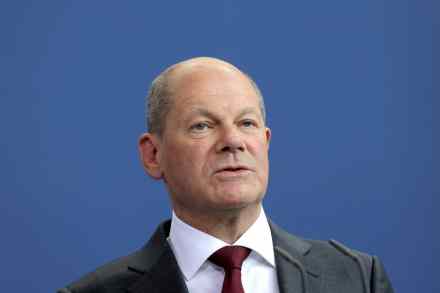
‘A giant step for German and European security,’ is how Chancellor Olaf Scholz described his government’s €100 billion cash injection for the country's depleted military. But while Germany’s newfound commitment to its own defence is welcome, its commitment to Ukraine’s is still questionable at best.   Over the weekend, the German newspaper Die Welt reported that it had seen documents showing that Berlin had reduced military support for Ukraine to ‘a minimum’. According to inside sources, only two German weapon deliveries have reached Ukraine since the end of March. Both contained light equipment such as mines, hand grenades and spare parts for machine guns.

How Russia wins

From our UK edition

It is still too early to predict the outcome of the war in Ukraine. Russia has certainly solidified its position in the east and is making small military gains. What's become clear over the last few days is that Russia may, after all, be able to achieve at least some of its military goals. Here is an interesting, albeit disturbing, political scenario by Sabine Fischer, a senior fellow at a German foreign policy tank. She notes that the mood in Moscow itself has shifted. It is the Kremlin’s political calculation that the western nations will not sustain their massive financial and military support for Ukraine.

The West is watching the war in Ukraine like it’s sport

From our UK edition

Every time I hear a politician speak of Munich, I suspect that something is amiss. Last week, President Zelensky accused former US Secretary of State Henry Kissinger of living in the ‘deep past’, and demanding that ‘a part of Ukraine be given to Russia’. ‘It seems that Mr. Kissinger has 1938 on the calendar instead of 2022’, Zelensky said. He wasn’t alone: figures from the Dutch Prime Minister Mark Rutte to the former chess champion Garry Kasparov put themselves on the record timidly or violently disagreeing with Kissinger. I wasn’t at Davos, but I learned of Kissinger’s revelations through Twitter.

The age of American unexceptionalism

Our administration would have us believe that Joe Biden is the leader of the free world. But he isn’t — and our relative inaction on Ukraine should firmly put to rest the idea of “American exceptionalism.” While Ukrainians were heartened by British prime minister Boris Johnson’s April trip to Kyiv, our commander-in-chief has adopted a different strategy for this active war zone: send in the women. Security concerns are ostensibly to blame for Biden being MIA, but sending in three of the country’s most important ladies — Speaker of the House Nancy Pelosi to Kyiv, First Lady Jill Biden and Vice President Kamala Harris to neighboring countries in Eastern Europe — seems an odd way to demonstrate that the administration is worried about security.

unexceptionalism

Are sanctions making Russia richer?

From our UK edition

Before the invasion of Ukraine, it was by no means certain that there would be a united response from the West. The sanctions imposed on Russia after Vladimir Putin’s annexation of Crimea in 2014 were fairly limited, especially from the European Union. Germany pressed on with the Nord Stream 2 gas pipeline to Russia. But now, America, Europe and much of Asia have been united in applying severe sanctions against Russian banks, companies and oligarchs. Three months on, it’s time to ask: are the sanctions working? The answer from the Bank of Russia’s balance of payment data for January to April isn’t reassuring. It showed that the sanctions are emphatically not working, at least not in the way that they were intended.

Inside Taiwan’s plan to thwart Beijing

From our UK edition

Taipei   Nowhere is watching Russia’s faltering attempt to crush its democratic neighbour more closely than Taiwan. The Ukraine war is seen in Taipei as a demonstration of how determined resistance and the ability to rally a global alliance of supporters can frustrate a much larger and heavily armed rival. Taiwan has spent the past few years planning how it would cope if China attacked. It is developing a doctrine of defence warfare right out of the Ukrainian playbook. China was carrying out military exercises off the east coast of the island last week when I met Joseph Wu, Taiwan’s foreign minister. ‘They keep circling in that area,’ Wu says. ‘Nonstop for two weeks, and it is very threatening.

Could Putin be toppled? An interview with Richard Dearlove

From our UK edition

‘One of the things about being in Moscow as the guest of the Russian government,’ says Richard Dearlove, the former head of MI6, ‘is this real attempt to make you feel like an outsider.’ It comes, he says, ‘from a fundamental Russian suspicion of foreigners’: ‘The Kremlin is designed to intimidate you. It’s designed to make you feel as if you are at the centre of a great empire.’ Dearlove joined the Secret Intelligence Service in 1966, and though spies are always a little cagey about their past, it seems he served as an intelligence officer behind the Iron Curtain. After a stint as head of station in Washington, in 1999 he was appointed chief of MI6 by Robin Cook. It was then that he first met the man who is now Russian president.

‘China is all-out against us’: an interview with Lithuania’s foreign minister

From our UK edition

On the 16th floor of a tower block in Vilnius, Lithuania, is an office with a nameplate so incendiary that it has started a trade war. The ‘Taiwanese Representative Office’ violates a rule that China imposes upon its trade partners: never allow Taiwan to open official offices. Call it ‘Taipei’, or anything, just not ‘Taiwan’. Lithuania recently decided that an important principle is at stake: should small countries be bullied by big ones? It thought not – and has allowed Taiwan to use its own name at what is regarded as a de facto embassy. This was Vilnius going out on a limb, saying it was time to defend democracies and support freedom, and it is now looking to build an alliance of like-minded countries. This has made Beijing very angry.

Ukraine and a short history of dogs in war

From our UK edition

In his own inimitable way, Ukrainian president Volodymyr Zelensky has unleashed his dogs of war on Vladimir Putin and once again he’s pulled off a propaganda coup. The Russian President has in the past not been averse to using animals to his advantage; he posed topless on horseback, making the pulse race of every red-blooded Russian woman, and in 2007 he famously brought his pet labrador, Konni, to a meeting with Angela Merkel, fully aware that the then German chancellor had a fear of dogs. Zelensky is more a Jack Russell guy and earlier this month he decorated one of Ukraine’s bravest of the breed – Patron, which means ‘ammo’ in Ukrainian.

Inside Russia’s military collapse in Ukraine

From our UK edition

The Russian military has performed far worse in Ukraine than anyone could ever have predicted. After failing to take Kyiv, Russian troops have now been forced to focus on the Donbas region. Despite this greater concentration of forces, they are still struggling to make any major gains beyond the final capture of Mariupol, which had been under siege since the first days of the invasion without resupply or relief. For Vladimir Putin this represents a grand humiliation. But for the West, Russia’s struggling campaign offers an unrivalled opportunity to understand Russia’s capacity to pose a future military threat.

Zelensky is the star of the Cannes Festival

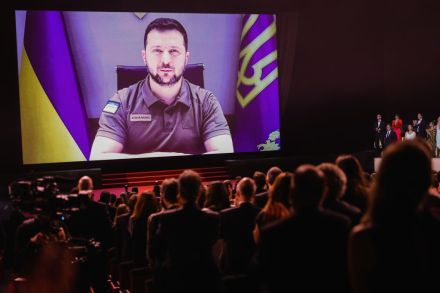
The Cannes Film Festival remains the most glamorous and famous gathering of the movie industry in the world. High-profile, black-tie premieres attended by some of the best-known actors jostle alongside the more disreputable commercial market. Films on sale this year include My Neighbor Adolf, about the unlikely friendship that is struck up between a Holocaust survivor and a mysterious man who may or may not be Adolf Hitler. But back in the main festival, everything is going entirely to plan. Apparently. There has not been a “normal” Cannes Film Festival since 2019. The 2020 edition was canceled, and the 2021 event took place in reduced and rather glum circumstances in July. But now Cannes is back, back, back, bébé!

What we learnt from Eurovision

From our UK edition

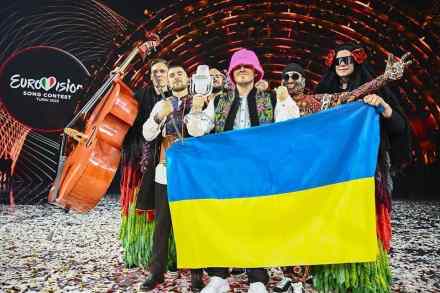
Twice during the Eurovision Song Contest our television lost the signal and the set went blank – once, mercifully, during the performance of a hirsute, gurning, cod-operatic bellend from that patently European country Azerbaijan. ‘Putin’, my wife and I both reckoned, seeing as Russian hacker groups favourably disposed towards their country’s leader had promised that they would do what they could to disrupt the broadcast and indeed the voting. If this really is the third world war, then I suppose it is a suitably banal and modernist take on universal annihilation – this yearly celebration of joyous gayness and very bad music suddenly part of the same war as the bloodshed, carnage and misery of Mariupol.

Portrait of the week: Inflation’s 40-year high, Tory MP’s rape arrest and monkeypox in Britain

From our UK edition

Home The annual rate of inflation, impelled by energy costs, rose to 9 per cent, its highest since 1982. Unemployment fell to 1.2 million, 3.7 per cent, its lowest since 1974 and below the number of vacancies of 1.3 million. Britain said it wanted to do something about the Northern Ireland Protocol, but the EU said it couldn’t. The Democratic Unionist party said it would not take part in the power-sharing executive of Northern Ireland unless Britain did. Liz Truss, the Foreign Secretary, told the Commons that a new law would adjust Northern Ireland’s trading status. Maros Sefcovic, vice-president of the European Commission, said the EU would ‘respond with all measures at its disposal’.