Ukraine

Russia isn’t just losing influence in Ukraine

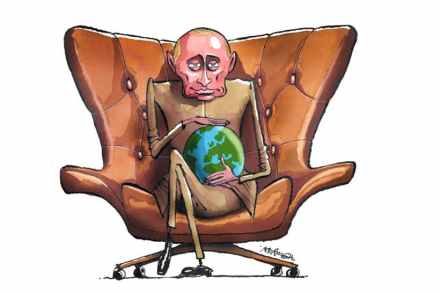
If Vladimir Putin’s goal is to reestablish Russian influence, his ambitions are on track for another major setback. Far less high-profile than the war in Ukraine, a slow and quiet revolution has been brewing south of Russia’s borders in Central Asia and the Caucasus. These nations, members of the former Soviet Union, have traditionally been in Russia’s sphere of influence. That, however, is now changing. At the start of the year, it looked like Russia was ascendant. Putin had over 150,000 troops waiting to invade Ukraine, and was receiving a steady stream of Western visitors pleading with him to step back. When Kazakhstan was engulfed in popular protests, Putin stepped in and deployed about 2,500 Russian troops after an appeal by the Kazakh president to help quell the unrest.

Exhilarating, frightening and hilarious: Made in Leeds – Three Short Ballets reviewed

From our UK edition

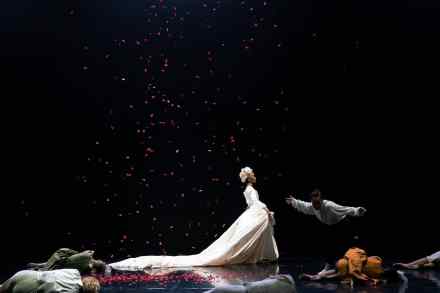
Good, better, best was the satisfying trajectory of Northern Ballet’s terrific programme of three original short works, which moves south to the Linbury Studio at the Royal Opera House at the beginning of November. The company has a new director in the amiable Federico Bonelli, formerly a principal with the Royal Ballet, and he has several problems to address, not least the shortage of richly characterful dancers among the senior ranks. But this triple bill should boost everyone’s morale, and the audience at the Leeds Playhouse was enthralled. First up was Wailers, Mthuthuzeli November’s elegiac return to the world of his childhood in a parched South African township.

What’s behind Putin’s no-show?

From our UK edition

Has Vladimir Putin carried out a cynical stunt, or ducked out of a seismic decision? That’s the debate among Kremlinologists tonight, as the Russian President failed to show up for a planned 8 p.m. address to the Russian people. Faced with catastrophic losses of territory in north-east Ukraine, a weaker Putin has been considering his options. One that has been suggested is fully mobilising the population to fight, and introducing martial law, which the State Duma (parliament) proposed today. Men aged between 18 and 65 would be banned from leaving the country. Today also saw the announcement of referendums on Russian annexation for the Luhansk and Donetsk regions of Ukraine, as my colleague Lisa Haseldine reported.

More mad than Vlad: Russia’s ultra-nationalist threat

From our UK edition

‘Russia without Putin!’ was the cry of Muscovites who turned out to protest against Vladimir Putin’s return to the presidency for a third term in December 2011. Crowds 100,000 strong chanted their opposition on Moscow’s Academician Sakharov Prospect – as symbolically named a venue as you could wish for – as riot police stood calmly by. There was anger in the crowd. But there was hope, too, not least because the massive protest was officially sanctioned. One after another, prominent opposition politicians such as Ilya Yashin, Boris Nemtsov and Alexei Navalny denounced Putin from a stage provided by the city authorities. Today the memory of those protests seems to belong to a different age of Russia. Yashin and Navalny are in jail.

How Russia is forcibly relocating Ukrainian civilians

With the stunning, rapid advance of its military against the Russians, Ukraine has shot back into the headlines. The focus is, understandably, on the battlefield, but the happenings behind the lines deserve attention too. Since the first weeks of the war, information has trickled in about Russia’s massive, criminal attempts to relocate Ukrainian civilians. While much of the situation in the Russian-occupied regions of Ukraine remains murky, what is known provides a rough outline. Russia’s attempt at social control in Ukraine consists of two key elements: filtration and forced relocation.

Vladimir’s no good, very bad week

The Ukraine war’s first seven months have been a long slog, with high costs in both men and material. Then, over the last week of combat, that suddenly changed. While casualties undoubtedly remained high on both sides, the Ukrainian army’s surprise counteroffensive in the northeast shattered Russia’s defensive lines and culminated in the most humiliating Russian tactical defeat since its forces were pushed out of Kyiv in April. While Russian President Vladimir Putin was celebrating the opening of a new Ferris wheel in Moscow, his troops 534 miles to the south were dropping their weapons and retreating.

russia realities
kharkiv

Ukraine’s incredible success turns the tables on Russia

Ukraine’s swift counter-offensive has captured more territory in four days than Russia’s huge army did in six months. The victories go beyond the 3,000 kilometers of liberated land. The Ukrainians have managed to break and scatter the enemy army across city after city in Kharkiv (in the country’s northeast) and are now moving swiftly into Luhansk (in the north Donbas region). Russian commanders have abandoned major cities and supply hubs, forfeited their hard-won control of vital rail lines and highways, and fled eastward for their lives. Their soldiers have dropped their guns and abandoned vast stores of heavy weaponry, from tanks to anti-aircraft batteries. It has been a complete rout. How did Ukraine accomplish this swift and unexpected victory?

I’ve become a war addict

From our UK edition

It is an almost unquestioned orthodoxy that war is hell, and that every needless death in a needless war diminishes our common stock of humanity. It’s curious, though, how we're able to hold that conviction alongside a positively visceral excitement at watching the Ukrainian counter-offensive carve its way through the Kharkiv Oblast. Some 3,000 square kilometres have been recaptured: Ukrainian troops are moving through their own land at such a clip that they’ve made more progress in three days than the massed might of the Russian invaders have since April. I’ve been eating it up. Haven’t you? The images of abandoned armour, the fuel dumps, the sullen faces of Russian commanders rounded up as prisoners of war.

The missing Biden foreign policy

What is Joe Biden's foreign policy? It's a trick question, because he has no actual policy, no plan, no careful set of chess moves a step ahead of his adversary. America suffers for it. Biden's foreign policy initially began and ended in Afghanistan with the disastrous withdrawal that left refugees strewn across the globe. There were years, then months, then weeks, then days to plan the NEO — the noncombatant evacuation order — and plenty of planning books for one sitting on desks in places like Seoul.

Ukraine turns the tables on Russia

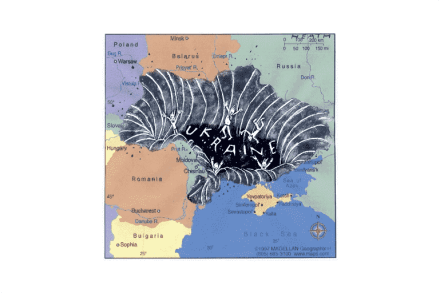
Russia’s brutal war on Ukraine has moved into a new phase, a very encouraging one for Ukraine and its western allies. In Phase 1, Russia tried — and failed — to seize the capital city of Kyiv with a blitzkrieg assault. The idea was to decapitate the Zelensky government quickly and install a puppet regime, subservient to Moscow. After that failed, Russia focused on taking the Donbas region of eastern Ukraine and forming a “land bridge” to Crimea, which Russia seized in 2014. Russia has had some success in this Phase 2 of the war, at very high cost, but movement along that front has now stalled.

Why the Baltics fear Russia

From our UK edition

In the historic heart of Riga, Latvia’s lively capital, there is a building that reveals why the Baltic States remain so wary of the Russian Bear. From the street, it doesn’t look like much – just another apartment block on a busy boulevard full of shops and cafes. Only the discreet sign outside gives the game away: ‘During the Soviet occupation the KGB imprisoned, tortured, killed and morally humiliated its victims in this building.’ Most passers-by barely give it a second glance. They know this story all too well. The KGB vacated this apartment block in 1991 when Latvia regained her independence, but over 30 years later the memories remain raw. As we step inside my Latvian guide, Edgars, tells me his father was summoned here twice for interrogation.

What young Ukrainians will learn from reading Joseph Roth

From our UK edition

As Russia’s assault on Ukraine continues, Volodymyr Zelensky’s ministry of education has just announced changes to the national curriculum that include removing almost all the Russian authors on the foreign literature syllabus. In last week’s Spectator, Svitlana Morenets revealed the new names: we see Robert Burns, whose inclusion may be a nod to Britain’s support during the conflict. Then there is Joseph Roth, a master of German prose, whose writing about interwar Europe speaks to Ukraine’s modern upheavals. Roth was born in 1894 in Brody, a town that now stands in western Ukraine but then lay in what was known as Galicia, the eastern Austro--Hungarian crownland.

What did Nasa achieve last time it visited the Moon?

From our UK edition

Of mice and Moon What did Nasa achieve last time it visited the Moon? Apollo 17, in December 1972, involved putting two astronauts, Eugene Cernan and Harrison Schmitt, there for 75 hours. They used a lunar roving vehicle to collect 254lb of rock and dust samples from areas up to 4.7 miles from the landing site. Among them was some orange dust believed to have originated in a volcanic eruption 3.5bn years ago. Experiments were also conducted into the flow of heat from the centre of the Moon to the surface, into minor changes in gravitational force, and the effect of cosmic rays on mice. At the end, Cernan said that he thought humans would return ‘not too long into the future’. North Sea hopes Can the North Sea avert the energy crisis?

From Moscow to Kyiv and back again

During the best of times, I left New York for gonzo journalism in Moscow; and during the worst of times, I fled a jingoistic wartime Moscow for the post-Covid euphoria of a resurgent New York City. My life in a sense has come full circle: I left New York for Russia in my freewheeling, bohemian twenties in search of future adventure and returned in my fifties when the rose-tinted dreams of the future that fueled Russia’s hedonistic capital were snuffed out in a murderous rage. That rage of a crumbling empire also engulfed lovely Ukraine in flames, battering its gorgeous capital Kyiv, where I had spent a blissful decade. With two of the three cities that I had called home caught up in a fratricidal zero-sum war, New York is once again King of the Hill.

Moscow

Ukraine stuns Russia with a counter-offensive in Kherson region

From our UK edition

The southern city of Kherson, which fell to Russian forces in the first few days of the war, is one of the places Ukraine would need to liberate if Putin’s army is to be repelled. But what realistic chance is there? Many argued that the Russian occupation is a one-way process: that having taken Crimea, Putin would extend his reach northwards and westwards – with the only question being how long Ukraine could hold off an offensive from its far-bigger enemy.  But that conversation is changing, and fast. This morning, the Ukrainian army broke through the first line of the Russian defence in Kherson region – a move that was only recently seen to be beyond the capability of Ukrainian troops.

Why Crimea could be key to Ukraine winning the war

From our UK edition

Over the six months since Russia invaded Ukraine, the ambitions of President Zelensky and his compatriots have only grown. From an early readiness to engage in talks – first in Belarus and then in Istanbul – Kyiv has progressed to an insistence that Ukraine can win, and from there to a definition of victory that includes not just a return to the status quo before the war, but the restoration of Ukraine’s post-independence borders, and now also the recovery of Crimea. Zelensky himself has often seemed slower than some in his entourage to expand the mission. But he has been adding his voice to those calling for the recovery of Crimea for a few weeks now, with Independence Day prompting these ringing words: ‘Crimea is Ukraine. And we will return it.

Are sanctions against Russia actually working?

Six months ago this week, the United States and its European allies enacted one of the most comprehensive, stringent sanctions regimes against a major economy in history. Russia’s unprovoked invasion of Ukraine on February 24 not only shocked the West’s sensibilities, but pushed Washington and Brussels to take actions that would have been unthinkable only a few weeks prior. As far as the West is concerned, Vladimir Putin’s Russia is nothing less than a dangerous pariah state — and its aggression against a neighboring country meant it had to be treated as one.

What’s on Ukraine’s new school syllabus

From our UK edition

For the first time since Russia’s invasion, schools in Ukraine are starting to re-open. For many parents, including my own, this presents a dilemma. Is it safe for pupils to return? My brother is seven and has spent the past year doing ‘remote learning’, which is hard enough in countries at peace, let alone those fighting an invasion. A return to school would be good for his education, but then again, might there be the danger of Russian air strikes? Parents at my brother’s school have been asked to vote on whether they would prefer pupils to continue with online learning, or return, with all the risks involved. It’s estimated that at least 3,000 of Ukraine’s 12,800 schools will reopen their doors.

Portrait of the week: Drought in Europe, property crisis in China and barristers and binmen strike

From our UK edition

Home Inflation would reach 18.6 per cent by January and the energy price cap £5,816 in April, according to a forecast by Citi, the investment bank. An annual National Grid exercise simulating a gas supply emergency has been extended from two days to four in September. Workers at Felixstowe, Suffolk, Britain’s biggest container port, handling 48 per cent of traffic, went on strike for eight days. Strikes by Scottish dustmen spread from Edinburgh. Barristers belonging to the Criminal Bar Association voted to go on an indefinite strike in England and Wales after their demand for a 25 per cent increase in pay for legal aid work was denied. A man was charged with the murder of Rico Burton (a cousin of the boxer Tyson Fury), who was stabbed to death in Altrincham at 3 a.m.

The stalemate in Ukraine won’t last forever

From our UK edition

Addressing the vexed question of who is winning the war in Ukraine, six months on, is a task to challenge military strategists, geopolitical analysts – and semanticists, because so much depends on what ‘winning’ means. On one level, after all, one could suggest everyone is losing. That said, we cannot escape the fact that both Moscow and the West had essentially written Ukraine off at the start of the war. The conventional wisdom was that it would take perhaps a fortnight for Vladimir Putin’s much-vaunted war machine, the product of two decades of heightened military spending, to defeat its Ukrainian counterpart.  Instead, the Ukrainians proved determined and disciplined in the defence, and imaginative and impassioned in the attack.