Uk politics

How long until the plug is pulled?<br />

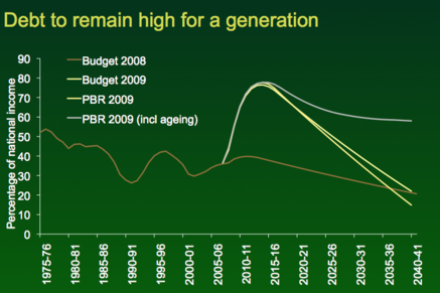
Moody’s AAA sovereign monitor was published today, and whilst the UK’s AAA status remains ‘resilient’ the situation is far from rosy. The report states: ‘The UK economy entered the crisis in a vulnerable position, owing to the (overly) large size of its banking sector and the high level of household indebtedness. Both continue to weigh on economic performance. Net bank lending to the UK business sector has continued to contract through Q3 2009, and repairs to household balance sheets (i.e. the rising savings ratio) may weigh on demand for some time to come. The depth of the crisis has been mirrored by the ongoing deterioration of public finances (with gross debt/GDP having risen from 44% at the end of 2007 to an estimated 69% at the end of 2009).

Luck shines on the brave

Nevermind the bankers, the UK Border Agency should have been awarded £295,000 in performance bonuses. Phil Woolas’s defence that “brave” border workers deserved remuneration beyond their basic salaries is imaginative, though unremittingly egregious. The agency is plainly maladroit. Keith Vaz’s Home Affairs Select Committee has found: 'There is still a huge backlog of unresolved cases and UKBA simply must get through them faster than they have promised.

A significant endorsement for Osborne and Hammond

Bernard Gray, a member of the Tories’ Public Service Productivity Advisory Committee, explains why he has joined forces with the Tories. He writes in today’s Times: ‘From my experience of working in and with the Ministry of Defence over the past decade I know how strong such vested interests are and how much commitment is required to overcome resistance to change. It will take acts of extraordinary political will to take on these entrenched interests. The Shadow Treasury team, George Osborne and Philip Hammond, have persuaded me that they are have the determination, drive and belief in change to tackle this issue at this critical time. That’s why I’ve been persuaded to help them.

Ever the optimist

It seems absurd to describe our dour and jowly Prime Minister as an eternal optimist, but he is. Rachel Sylvester’s column contains this delicious snippet of gossip: ‘When Mr Darling said that Britain was facing the worst recession for 60 years, Mr Brown telephoned him to tell him the downturn would be over in six months.’ Prudent foresight, there's nothing like it.

Darling contra Brown, Part 573

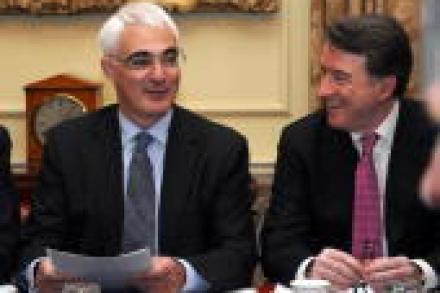
Ok, so tomorrow's Pre-Budget Report is shaping up to be a horrendously political affair.  But, rest assured, it could have been so much worse.  In what is, by now, a familiar Budget-time story, Alistair Darling is fighting the good fight against some of Brown's most inharmonious fiscal brainwaves.  According to Rachel Sylvester's column today, here are just some of the measures that the Chancellor has resisted: -- A long-term windfall tax on bankers' bonuses (Darling favours a temporary, one-year tax). -- A call to lower the 50p tax threshold from £150,000 to £100,000. -- A reversal of the plan to make it easier for couples to pool their inheritance tax allowances. -- A, ahem, "more optimistic picture of the British economy".

When did the Tories become an “alternative government”?

There are a couple of noteworthy snippets in today's FT interview with George Osborne: the claim that the Tories may not take corporation tax as low as it is in Ireland; the outline of a "five-year road map" on business tax policy, etc.  But, I must admit, it's this passage which jumped out at me:    "[Osborne] says his Tory conference speech in October, which included plans for a public sector pay freeze and an increase in the state retirement age, 'was an important moment' that showed a mental leap to being 'an alternative government, not just an opposition'." These self-bestowed titles – "alternative government," and the like – are silly, really.  The only thing that actually matters is whom the public regards as governing material.

The Lib Dems’ hunt for an issue may lead them to an Afghan pull-out

As Anthony Wells says over at his UK Polling Report, there are plenty of reasons to doubt whether Labour could convert a third of Lib Dem voters over to their cause.  But the article in today's Times on Labour's new strategy will still give Team Clegg pause for thought. The problem for the Lib Dems is that they haven't yet managed to hit on an attention-grabbing issue to make their own – their favourite, perhaps only, election strategy.  The cause of Parliamentary reform could have done the trick, but – beyond Nick Clegg's call to prevent MPs from taking their summer holiday – very few of the Lib Dem proposals have received much coverage.  Likewise, electoral reform, which Labour now seem to be comandeering for their own manifesto.

This week’s PBR looks set to be Brown’s most political Budget yet

Ok, so all Brown Budgets are political – but signs are that this week's PBR could be his most blatantly partisan yet.  I mean, just look at his speech this morning on improving efficiency in the public sector.  Some of its measures are welcome – for instance, pledging to cut the pay of senior servants, and the general idea of using technology more effectively in government.  But, as other folk have pointed out (see Guido and Iain Dale), the measures are insufficient to the scale of the debt crisis, and many are old news.  All in all, the signs are as we expected: Brown is paying only lip service to cuts. Instead, Brown is going to go heavy on soak-the-rich measures; thereby strengthening what Labour see as two dividing lines.

The politics of distraction

If everyone concentrates on the actual numbers in the PBR then it will be a disaster for Labour. So, instead Labour will try and distract us all with small but eye-catching measures — a new rate of inheritance tax for estates worth more than £5 million, that kind of thing. The aim will be to move the debate from the grim reality of the country’s fiscal situation to Labour’s dividing lines. There will be a lot of pressure on Cameron and Osborne to denounce Labour’s soak the rich measures. But the most important thing for them to do is to get the debate back to the state of the public finances and that is inevitably going to involve side-stepping the arguments that Brown wants to pick.

Cameron and Ashcroft should come clean

David Cameron’s ‘nothing to do with me guv’ response to the Ashcroft tax question on yesterday’s Politics Show has not put the issue to bed. In fact, his obfuscation has the reverse effect. The Independent runs an article today describing how little is known about individuals and authorities. ‘The House of Lords Appointments Commission says that it does not know whether Lord Ashcroft is UK resident. The Cabinet Office and HM Customs and Revenue have declined to answer questions about his status, on grounds of privacy.

A tax Blitz that reveals Labour’s mistakes in full

The rumour mill is pulling 24/7 shifts. In recent days, newspapers and newswires have turned into gossip columns devoted exclusively to Alistair Darling’s Pre-Budget Report. If the rumours are true, which is a huge assumption, Darling will not offer the taxpayer a pre-election lolly-pop besides deferring the Age of Austerity until 2011, by which time he will probably be out of office. If Labour’s 1992 manifesto was a tax bombshell, then by all accounts this PBR will be like Dresden. Everyone, both rich and poor, is in the firing line, and there is no space here to analyse every alleged proposal.   Darling looks likely to prolong the VAT cut until at least February, but Smith and Williamson expect VAT to rise to 20 percent in 2011.

Brown waits to strike

Things are shaping up nicely for Gordon Brown ahead of the Pre-Budget Report next week. The Tories were 17 points ahead on ICM in October – now it’s 11. Cameron would have a narrow majority on this basis but, given the margin of error, we’re back into hung parliament territory. And this has a self-reinforcing effect on the Tories. A shrinking opinion poll means they tend to get paralysed, avoid arguments, play it safe, wait for Labour to screw up again. As I say in my News of the World column today, the voters who are looking for leadership then don’t really see it. This, of course, softens the Tory vote further. So the stage is set for Labour to get away with murder next week.

Recognising the best

On Thursday night Michael Gove announced that a Conservative government would pay off the student loans of those with good science degrees from quality universities. The move, paid for by cutting out a level of bureaucracy in teacher development, would help address the shortage of science and maths specialist in state schools. It was a smart piece of policy that even Ed Balls didn’t attack. But the Telegraph reports carping amongst various unions that the scheme does not go far enough. The NUT says that, “It is a real mistake to think that they can designate small number of universities as being better than the others.” This quote sums up so much of what is wrong with the British edcucational establisment.

The correct decision but a tactical blunder

The Telegraph reports that Alistair Darling will allow married couples to continue to pool their inheritance tax allowances. Downing Street has pressed the Treasury to abolish pooled allowances in order to demarcate between Labour, the party that promotes fairness, and the Tories, the party that entrenches privilege.   For all the recent polls and bravado, the near-bankrupt Labour party is still fighting an intensive rearguard. If it is avoid annihilation, the party has to hold on in Scotland, Wales and urban Northern England. Darling’s pledge illustrates that there is more than one way to fight a defensive battle.

Saving the world | 5 December 2009

The further revelations about the astonishing costs of the bank bailouts so far indicate just how much taxpayers’ money is now being used to plug the holes in the banking system.  A key cause of the bank crisis is explained by the above IMF graph, charting the decline of some of the trillions of AAA structured credit assets created during the boom.  AAA means “extremely strong capacity to meet financial commitments”, but now over 80% of the US AAA Collateralised Debt Obligations (CDOs) created between 2005 and 2007 are rated BB or lower, somewhere between junk bonds and default (and in some cases almost entirely worthless). In terms of getting things totally wrong this is hard to beat.

What happens when you try to debate climate change…

Sky News invited me around for what I expected would be a civil debate on climate change at 2:30pm today - but for people like Bob Ward, there’s no such thing. He is policy director at the Grantham Research Institute on Climate Change at the LSE. The debate proceeded along the bizarre path that these types so frequently tread. I was asked about what the climategate emails mean: I said it shows people putting spin first and science second. And raised the prospect of data manipulation. Hope replied by saying, “it's remarkable about how the so-called sceptics have been using this as a propaganda tool to promote political end...

Bernanke trashes Brown’s tripartite system

Gordon Brown’s much heralded tripartite regulatory system failed the first time it was faced with a financial crisis, proof that taking away regulatory powers from the Bank of England was a massive mistake. Now, Ben Bernanke — who is trying to secure a second term as Fed Chairman and keep the Fed’s regulatory powers intact — is citing the Brown model as what not to do, telling the Senate banking committee: "[O]ver the past few years the government of Britain removed from the Bank of England most of its supervisory authorities.

Balls: ‘I have resisted moving’

Ed Balls has given an interview to The Times Educational Supplement which contains a comically audacious attempt to rewrite history. When asked about whether he really wants to be in his current job, Balls tells the interviewer, “I have resisted moving”. Now, I suspect this will come as a bit of a shock to Alistair Darling who fought off an effort by Balls to take his job.