PMQs live blog | 7 March 2012
PMQs 7 March.
PMQs 7 March.
In a speech tonight, George Osborne calls on businesses to respond en masse to the government’s consultation on whether to exempt small businesses from unfair dismissal claims. The Chancellor will say: ‘And now we’re beginning a call for evidence on the case for a new compensated no-fault dismissal for our smallest businesses. Plenty of trade unions and others will be submitting their evidence for why we shouldn’t do this. If you think we should, and it will increase employment, then don’t wait for someone else to send in the evidence. Send it in yourself.’ The fact that Osborne is personally throwing his weight behind the Beecroft agenda is striking.
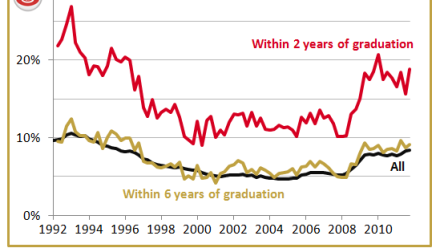
Today’s ONS release will make pretty grim reading for students and recent graduates. It shows that the unemployment rate among recent graduates — those who graduated in the last six years — stands at 9.1 per cent, higher than the overall unemployment rate of 8.4 per cent. It’s even worse for those who graduated in the last two years — the unemployment rate among them is 18.9 per cent, up from 10 per cent before the recession. But there’s an even more worrying trend among those recent graduates who do find employment. In 2001, three-quarters of them were in ‘higher skill’ jobs — those requiring more than GCSEs. Now, less than two-thirds of them are: So what does this mean?
If you think things couldn’t get worse than Ed Miliband’s Five Live interview, read his speech on patriotism. It seeks to build on his ‘predators’ speech, which suggested a Manichean divide between bad companies and good companies. Labour MPs of Mr Miliband’s political heritage always place manufacturers in the latter camp. He hails the success of many of them. ‘You know better than I that this success has been achieved against the odds.’ I suspect they know better than he the effect that a 25 per cent devaluation has on exports. ‘Economic protectionism is what governments reach for when they don’t believe firms can compete. And we will never return to those days,’ he says – before doing just that.
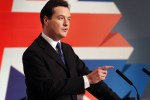
Why should someone on the minimum wage subsidise the childcare arrangements of someone on £100,000? So runs the argument for abolishing child benefit for higher-rate taxpayers. You can see why George Osborne went for this: in theory, we are talking about the best-paid 14 per cent. If he was going to cap benefits, he had to be seen to hurt the rich too. The 50 per cent tax was not enough; axing child benefit would be just the tool he needed to say ‘we’re all in this together’. The problem is that the 40p tax band is set far too low in Britain, and now takes in policemen and teachers. People who can not really be described as rich, especially if one earner is supporting a family and paying off a mortgage.
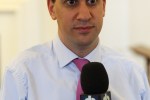
Who let Ed Miliband out again? You’d have thought that Labour HQ would have learnt from the #AskEdM debacle but apparently not. Ed popped up on Radio 5 Live today following his Made in Britain speech to answer questions from voters. It’s hard to work out whether the callers were CCHQ staffers in disguise or ordinary members of the public, thanks to the extreme vitriol thrown at Ed. He had little of interest to say on the EU (he wouldn't have signed the treaty), child benefit (he can't promise to reverse the cuts) and Labour’s attitude towards business (he's pro-, apparently). Instead, the callers took the opportunity to attack him personally. As Dot Commons reports: 'They ranged from the biting...
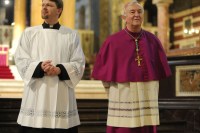
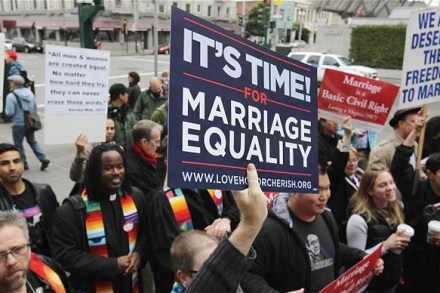
Last night, we posted Douglas Murray's conservative argument in favour of same-sex marriage. Here's the opposite view: Consultations are, for the prudent, an exercise you only engage in when you’re quite sure of the outcome. I’m not sure, then, that Vincent Nichols, the Archbishop of Westminster, is entirely wise to go all out in galvanising the Catholic community into action against the Government’s plans to legalise gay marriage. As the Daily Telegraph reports today, he is issuing a letter to be read out in churches on Sunday to urge congregations to participate in the Coalition’s consultation exercise on the proposal — against.
With some right-wing voices — including Catholic Cardinal Keith O'Brien, Tory MP Peter Bone and the Daily Telegraph — speaking out against same-sex marriage, here’s a piece Douglas Murray wrote for The Spectator in October arguing that conservatives should instead be welcoming it: In America a new generation of Republicans is challenging the traditional consensus of their party on gay marriage. They — as well as some of the GOP old guard like Dick Cheney — are coming out in favour. In Britain the subject is also back on the agenda with the coalition government, at the insistence of the Prime Minister apparently, planning a ‘public consultation’ on the matter.
There’s a huge amount of confusion surrounding the proposals for a ‘mansion tax’ and, more generally, taxation at the top end of the housing market. Old and novel arguments are rolled out by its proponents: that it is easier to tax wealth that can’t be taken offshore, or that the current level of taxation on high value property (generally perceived to be low) isn’t fair on first time buyers struggling to raise a deposit at the other end of the market. In reality, there are three main reasons why a mansion tax is unwarranted and potentially counter-productive, which I discuss in more detail in a Centre for Policy Studies report released today. 1. It would unfairly penalise the income poor, equity rich.
It might mean little to people outside Westminster, but the decision of Mark Pritchard not to stand for re-election to his job as Secretary of the 1922 Committee is a significant moment. It suggests that the Cameroons might be making some progress in their attempt to gain control of the internal structures of the parliamentary party. Pritchard has been a thorn in Number 10’s side ever since he started warning against the ‘Purple Plotters’ who wanted to merge the two coalition parties back in January of last year. Since then, his positions on circus animals, his role in the rebellion of the 81 and his general willingness to speak out against the government have driven Cameroons into a rage.
This afternoon’s Lords debate on the government’s Legal Aid Bill promises to be a heated affair. The Independent’s interview with Baroness Scotland – Labour peer and former Attorney General — gives a taste, beneath the headline ‘Women and children could die because of legal aid cuts’. But even before we get into an emotional debate about domestic violence and hitting ‘the poorest and weakest’ — important though it is — there’s one potential flaw that could undermine the whole point of the proposal: it might not actually save us any money. Take benefit claimants, for example, who will now longer be entitled to legal aid when challenging decisions about their benefits.
Nick Clegg has confirmed this morning that the coalition is looking at how to tweak its policy of removing child benefit from families in which someone pays the higher rate of income tax. As I wrote in the Mail on Sunday, there are three options being explored. The first is designed to address the fact that, a family where one parent works and earns £45,000 while the other stays at home raising the children would lose their child benefit while the one next door where both parents are on £40,000 would keep theirs. This change would see families with one higher rate taxpayer lose only half of their child benefit. But, I understand, that this is not the preferred tweak at the moment.
Try telling George Osborne that ‘tax doesn't have to be taxing’ — I'm sure he'd laugh at the sentiment. The story this morning is that he has a grand, gritty choice to make ahead of the Budget: to tax income or to tax wealth. The Lib Dems have apparently agreed to relent on the 50p rate, but only if they get a mansion tax on properties worth over £2 million in return. The thinking is that, in the current political environment, the government must always be seen to be hitting the well-off in some way. So, will Osborne accept the offer? He and other Tories will certainly be tempted to do so.
Can you trust someone like Alex Salmond to save Scotland from future crashes? The First Minister appeared on BBC1’s Sunday Politics earlier, where he was challenged about how he sees it. And it seems he may just be a graduate of the Gordon Brown school of Scottish financial mismanagement. In a Times debate on Friday, SNP deputy leader Nicola Sturgeon said they’d use sterling — whether the Bank of England liked it or not — and would not need the Bank to be a lender of last resort because Scotland would be so sensible it wouldn’t need it. An interesting suggestion, given that the 1707 Union between Scotland and England is the result of a bailout.


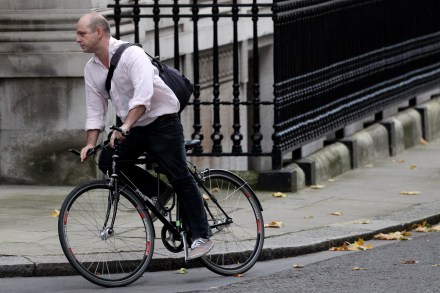
It is a sign of the influence that Steve Hilton has on the Cameron project that there have been more column inches devoted to his departure from Downing Street than there would be to most Cabinet resignations. But even after he heads to California in May, Hilton will still be part of the Cameron brains trust. He is already scheduled to work on the Prime Minister’s conference speech. Hilton has, I understand, been mulling the idea of taking a sabbatical since last summer. His decision to go ahead and take next year off seems to have been motivated by a variety of factors. But those closest to him stress that family reasons genuinely were key. This is not to say that Hilton is not frustrated.
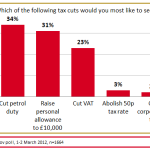
YouGov’s new poll for the Sunday Times includes one set of numbers that will be of particular interest to George Osborne at the moment. It asks the public: ‘If the government has money available to cut taxes in the budget later this month which of the following tax cuts would you most like to see?’ Here are the results: With the news this week that fuel prices are at an all-time high and expected to rise further, it’s hardly surprising that the public support a cut in the taxes on it. The AA, among others, has already called on the Chancellor to abandon the 3p rise in line with inflation currently planned for August. Last week, Osborne didn’t sound terribly likely to bow to their demands, but as Pete said on Tuesday, he might surprise us still.
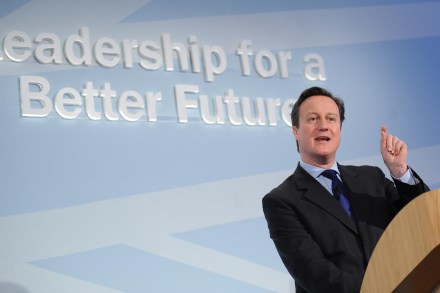
David Cameron’s speech today is another reminder of how concerned the Tories are about losing their traditional advantage among female voters. The message that the Tories are cutting so that the country is passed on in a better state to the next generation is a direct response to the fact that the party’s polling has found mothers to be deeply concerned that their children will not have as good a quality of life as they have had. At the away day for Tory MPs last week, Andrew Cooper — the PM’s chief political strategist — said that talking about deficit reduction in these terms was crucial to winning over female swing voters.
Do you remember the great parliamentary battle over privatisation of police services? Me neither, which is why Theresa May, the Home Secretary, is proving a better minister than Andrew Lansley, the Health Secretary. The drive for savings in the police budget is leading two constabularies, West Midlands and Surrey, to outsource certain services. The Guardian has got hold of the tender documents and splashed with the story today. Yvette Cooper is angry — but, crucially, there’s nothing she can do. Theresa May doesn’t need legislation to enact this reform; it’s not even being done under orders of the Home Office. This is two police forces who would rather save money by outsourcing back office functions than cut at the frontline.

‘Revealed: hidden government plans to privatise the police’, proclaims the Guardian headline this morning. The story is that, in an attempt to protect frontline services in the face of a 20 per cent cut in government funding: ‘West Midlands and Surrey have invited bids from G4S and other major security companies on behalf of all forces across England and Wales to take over the delivery of a wide range of services previously carried out by the police. The contract is the largest on police privatisation so far, with a potential value of £1.5bn over seven years, rising to a possible £3.5bn depending on how many other forces get involved.
Perhaps, the greatest testament to Steve Hilton’s influence in Downing Street is that everyone chuckles when you ask if anyone will replace him. His role in Number 10 as the senior adviser was one he had carved out for himself so that he could work on what he wanted to. It is deliberately designed not to fit on any ‘org chart’, the kind of document that the post-bureaucratic Hilton has little patience for. Hilton was for years caricatured as being not really right-wing. But, in reality, the opposite is true — he was, in some ways, the most right-wing man in Downing Street. Few matched him on subjects like 50p tax and labour market regulation. The Lib Dems were right when they called him ‘Thatcher in a t-shirt’.