Uk politics

Which tax cuts do the public want?

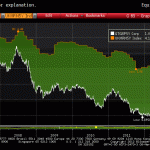
YouGov’s new poll for the Sunday Times includes one set of numbers that will be of particular interest to George Osborne at the moment. It asks the public: ‘If the government has money available to cut taxes in the budget later this month which of the following tax cuts would you most like to see?’ Here are the results: With the news this week that fuel prices are at an all-time high and expected to rise further, it’s hardly surprising that the public support a cut in the taxes on it. The AA, among others, has already called on the Chancellor to abandon the 3p rise in line with inflation

Cameron’s pitch to women voters

David Cameron’s speech today is another reminder of how concerned the Tories are about losing their traditional advantage among female voters. The message that the Tories are cutting so that the country is passed on in a better state to the next generation is a direct response to the fact that the party’s polling has found mothers to be deeply concerned that their children will not have as good a quality of life as they have had. At the away day for Tory MPs last week, Andrew Cooper — the PM’s chief political strategist — said that talking about deficit reduction in these terms was crucial to winning over female

May’s quiet revolution

Do you remember the great parliamentary battle over privatisation of police services? Me neither, which is why Theresa May, the Home Secretary, is proving a better minister than Andrew Lansley, the Health Secretary. The drive for savings in the police budget is leading two constabularies, West Midlands and Surrey, to outsource certain services. The Guardian has got hold of the tender documents and splashed with the story today. Yvette Cooper is angry — but, crucially, there’s nothing she can do. Theresa May doesn’t need legislation to enact this reform; it’s not even being done under orders of the Home Office. This is two police forces who would rather save money

Private policing is nothing new

‘Revealed: hidden government plans to privatise the police’, proclaims the Guardian headline this morning. The story is that, in an attempt to protect frontline services in the face of a 20 per cent cut in government funding: ‘West Midlands and Surrey have invited bids from G4S and other major security companies on behalf of all forces across England and Wales to take over the delivery of a wide range of services previously carried out by the police. The contract is the largest on police privatisation so far, with a potential value of £1.5bn over seven years, rising to a possible £3.5bn depending on how many other forces get involved.’ This

After Hilton

Perhaps, the greatest testament to Steve Hilton’s influence in Downing Street is that everyone chuckles when you ask if anyone will replace him. His role in Number 10 as the senior adviser was one he had carved out for himself so that he could work on what he wanted to. It is deliberately designed not to fit on any ‘org chart’, the kind of document that the post-bureaucratic Hilton has little patience for. Hilton was for years caricatured as being not really right-wing. But, in reality, the opposite is true — he was, in some ways, the most right-wing man in Downing Street. Few matched him on subjects like 50p

Steve Hilton to leave Downing St

The Prime Minister’s strategy chief is heading to California to teach for a one year sabbatical, we learn. But who takes a one-year sabbatical in the middle of what’s supposed to be a five-year fight to save Britain? He did this before in Opposition, and came back. But this time, I doubt he’ll be back. He’s joining Stanford University as a visiting scholar, presumably to spend more time with his wife Rachel Whetstone who is communications chief for Google. Hilton’s friends say that, in his head, he never quite came back from California — his aversion to shoes (and sometimes manners) has led to much mockery. But overall, he is

Devo disunity

The trouble with the Unionist cause is that it’s so disunited. Douglas Alexander’s speech in Scotland today may appear to bring Labour in line with the Tories and Lib Dems by hinting at greater powers for Scotland in future, but the truth is that it’s just another piece of string in an increasingly tangled mess. And so we have Alexander saying that ‘we must be open minded on how we can improve devolution’s powers, including fiscal powers,’ while, we’re told, he’s also ‘cautious… about fiscal measures that undermine the stability of the block grant system used to fund the three devolved governments in Edinburgh, Cardiff and Belfast.’ We have the

The time for Osborne to shed Brown’s 50p rate is now

Will George Osborne have a better chance to abolish the 50p tax than this month’s Budget? It would be unpopular, so it’s the kind of move he’d be unlikely to make before an election. The Lib Dems have something they want to trade: permission to raise the tax threshold towards £10,000. And two recent reports, by the CEBR (pdf) and IFS (pdf), have reinforced that this tax is losing money. At the heart of the 50p tax is a deeper question: is Osborne a transformative Chancellor who will change the terms of debate? Or is he doomed to operate within parameters set by Gordon Brown? I look at this in

Europe is being strangled by the Franco-German alliance

David Cameron’s complaints at last night’s EU meeting about the lack of a growth agenda have, in part, been addressed by the new draft conclusions. Cameron — who was supported by the Dutch, Italians and Spanish — seems to have secured promises on the completion of the single market, deregulation and the services directive in the summit’s draft conclusions. This isn’t going to turn around the European economy. But it is a step in the right direction and a small, but possibly significant, victory for the PM.   I understand from sources in Brussels that there has been frustration with the extent to which the conclusions presented last night simply

Imagine if Cameron hadn’t vetoed…

When David Cameron headed to Brussels last December, it was far from certain that he would veto the proposed treaty. It was only when Nicolas Sarkozy proved totally uninterested in accommodating Britain’s demands that the Prime Minister decided that he could not sign up to it. In a way, Sarkozy did Cameron a favour. Imagine if Britain had got the safeguards the Prime Minister wanted and had signed up to the treaty. How would he then have reacted this week, when the Irish announced that they were going to hold a referendum on it? The pressure from the Tory benches to let the British people vote on it would have

So how much do you really like The Smiths, Dave?

David Cameron’s love of The Smiths has been tested numerous times, in the press, in person and at PMQs. But today, there’s new dimension to the saga. Johnny Marr, the group’s former guitarist, has announced he will delight fans and reform the band – but only if the Prime Minister steps down: ‘We won’t be reforming this week. Maybe if the government stepped down. If this government stepped down, I’ll reform the band. How’s that? That’s a fair trade, isn’t it? I think the country would be better off, don’t you? I’ll do it if the coalition steps down.’ As a dedicated fan, it’s certainly a tough call for Dave

Join The Spectator’s debate on immigration

‘Immigration: enough is enough.’ That’s the motion for The Spectator’s next debate, and also a major concern for many disgruntled voters. The Tories are currently miles off course for achieving their aspiration of reducing net migration from the ‘hundreds of thousands’ to the ‘tens of thousands’ in this Parliament. Should they do more to meet it, so that the UK’s economic and cultural fabric isn’t frayed irreparably? Or should we be glad that that they’re not, because immigration is a crucial ingredient for growth? These will be the questions at hand for our panellists, who are Dominic Raab, Frank Field and Kiran Bali speaking for the motion, and David Aaronovitch,

The conflict over 50p has escalated once again

Just like fuel duty, George Osborne can’t shake off the fury and discontent over the 50p tax rate. This morning, in a letter to the Telegraph, 537 bosses of small-to-medium-size businesses have called on the Chancellor to drop the rate. ‘The tax, which is in effect a 58p tax after national insurance is taken into account,’ they note, ‘puts wealth creators like us in a very awkward position.’   Usually, it’s easy to be both sceptical and dismissive of these mass-signed letters. They tend to be party political constructs, such that another group of ‘experts’ will soon reply to profess the opposite. But this one is different, and could help

Grayling bows to the inevitable

The changes announced to the work experience programme today have been designed to reassure the companies involved. Those on the scheme will now only face any benefits sanction if they commit the equivalent of gross misconduct. Once some big corporations started getting cold feet about the scheme some tweaks to it were inevitable. As Matt d’Ancona wrote on Sunday, corporate Britain has proved remarkably spineless in the face of attacks from a bunch of hard-line left-wingers. But the tweaks announced today by Chris Grayling — whose robustness on the issue has impressed Tory high command — maintain the purpose of the scheme. Offering those who are unemployed structure and a

What James Murdoch’s move tells us

When Rupert Murdoch visited the Sun newsroom recently, eyebrows were raised by the fact that he was accompanied not by James Murdoch but Lachlan Murdoch. James Murdoch, who has never had his father’s emotional commitment to the newspaper side of the business, has now stepped down as executive chairman of News International, though he remains as deputy COO of News Corporation.   James Murdoch has not come out well of the various investigations into hacking. He has appeared to have been oddly uninterested in developments at the company. His performances in front of parliamentary select committees have left several questions unanswered. James Murdoch, though, will now have left News International

These NHS bouts are becoming more insipid by the week

Health reforms again dominated PMQs today. That’s four weeks in a row. And the great debate, like a great sauce, has now been reduced to infinitesimal differences of flavouring. David Cameron repeated his claim that 8200 GP practices are implementing his policies. But, corrected Ed Miliband, that’s not because they love the reforms. It’s because they love their patients. He quoted a Tower Hamlets health commissioner who berated the PM for confusing reluctant acquiescence with whole-hearted endorsement. Fair enough. But this nicety won’t resonate beyond the tips of either men’s brogues. The rest of the bout was a repeat of last week’s effortful stalemate. Mr Miliband had a list of

Miliband can count on the NHS in PMQs, but not much else

Today’s main PMQs drama came after the session itself had ended. Julie Hilling, a Labour MP who Cameron had said was ‘sponsored’ by the union whose leader threatened to disrupt the Olympics last night, said in a point of order that she was not ‘sponsored’ by Unite. The Labour benches were in full flow, jeering at Cameron as he was leaving the chamber. Cameron then returned to the despatch box and pointed out that she had declared a donation from Unite to her constituency Labour party in the register of members’ interests. I suspect that this row about the meaning of the word sponsorship will rumble on. Labour hate the