Uk politics

How Cabinet responded to Boris Johnson’s prorogation plan

When news broke on Wednesday morning that Boris Johnson was planning to prorogue Parliament for five weeks ahead of a new Queen's Speech, a conference call was hastily scheduled with his Cabinet. By the time it happened, every minister on the call was aware of what the Prime Minister was seeking to propose. The Prime Minister used the call to stress that the decision to suspend Parliament was not about denying MPs the chance to have their say. However, he did say that  if Brussels thinks MPs cannot frustrate Brexit, there is a better chance of an eventual deal. The general mood of the Cabinet towards Johnson was one of support – ministers previously opposed to both no deal and prorogation found words of praise for the Prime Minister.

Boris Johnson’s Brexit strategy gives MPs a simple choice

Talking to various figures in Government today, it is clear that Boris Johnson's team want the choice for MPs to be between their Brexit strategy and making Jeremy Corbyn prime minister. They believe that ultimately there aren’t enough MPs prepared to make Corbyn prime minister; meaning that they’ll get to carry out their Brexit strategy. The decision to prorogue Parliament is designed, in large part, to limit the amount of time available to the opposition to find a legislative way to force the Government to seek an extension. At the same time, it also sends a message about how hard forcing Boris Johnson to request an extension will be.

Will the no-deal opponents finally get their act together?

So what now for the opponents of no deal? Boris Johnson has dramatically called their bluff, and as Mr Steerpike reports, not all of them are taking this particularly well. Both proponents and opponents of Britain leaving without a deal are engaged in a political wrestling match, with all the theatrics that entails. Both are working out which parliamentary mechanisms will suit them best. Both are also accusing the other of blocking democracy, pretending not to notice the similarities in their tactics. Neither will admit that the other side has a right to do what it has chosen to, instead preferring to call it a 'constitutional outrage'. The problem for those trying to stop no-deal is that their team isn't working as well as Boris Johnson's.

Does Tony Blair think free speech isn’t for everyone?

Not content with agitating against democracy with his relentless Remainer shenanigans, now Tony Blair appears to be aiming his fire at freedom of speech. Seriously, is there no civilisational liberal value this man doesn’t want to take down? A new report for Blair’s think-tank, the Tony Blair Institute for Global Change, says hard-right groups should be subjected to censorship even if they are not involved in any kind of violent activity. The report says the government should draw up a list of ‘designated hate groups’ — you mean a blacklist? — and these designated groups should be prevented from appearing in media outlets or engaging with public institutions.

Johnson confirms he will prorogue parliament

Downing Street has just confirmed that the Prime Minister will be asking the Queen to prorogue parliament ahead of a new Queen’s Speech on 14 October. In a letter sent to MPs this morning, Boris Johnson claims that this is a move designed to put a fresh domestic programme before Parliament, writing: 'I therefore intend to bring forward a new bold and ambitious domestic legislative agenda for the renewal of our country after Brexit. There will be a significant Brexit legislative programme to get through but that should be no excuse for a lack of ambition!' The focus in the letter and in briefings from No.10 is on domestic policy, with Johnson explicitly criticising the lack of action from Theresa May.

Europe’s politicians should be terrified of a no-deal Brexit

Jeremy Corbyn has vowed to use 'all tactics available' to block a no-deal Brexit. The Labour leader is meeting MPs today to try work out how to do just that. But with no deal back in the headlines, are we having the wrong discussion about what it would mean for Britain to leave the EU without an agreement? Most of the focus around a no-deal Brexit has been on the economic pain that will be suffered by various parties, but particularly the UK. Little thought has been given, however, to the political pain. To politicians seeking re-election (for either themselves or their party), small issues can become greatly magnified. Whenever a steel plant or a car factory faces closure, the government comes under pressure to meet with the owners to find a rescue plan.

Is the Chancellor’s cancelled speech another sign an early election is looming?

Sajid Javid has this afternoon cancelled a speech he was due to give tomorrow, and brought forward the one-year spending review to early September. It was due to take place later in the autumn. A statement from the Treasury said 'the forthcoming Spending Round will instead be brought forward in early September and will cover the themes and priorities he was due to outline'. This isn't a surprise for any of those in government who had been working on the spending review. Secretaries of State have been returning to Whitehall today, ready for meetings with the Treasury this week about their spending envelopes.

Gordon Brown has done enough damage in Scotland

Gordon Brown has broken his silence again. The former prime minister told the Edinburgh International Book Festival that the Scottish Parliament had ‘failed to deliver a fairer and more prosperous Scotland’ and had instead become a ‘battering ram for constitutional warfare’. What’s that, Lassie? Timmy’s trapped down the well? And creating a Scottish parliament to run almost all of Scotland’s affairs separately from the rest of the UK helped rather than hurt the campaign for independence? Jeepers. The battering ram that Brown laments exists only because the party and government in which he played a somewhat senior role insisted on fashioning it.

Jeremy Corbyn capitulates in cross-party Brexit talks

Jeremy Corbyn's cross-party talks to stop a no-deal Brexit have broken up, with opposition leaders and MPs releasing a statement saying they 'agreed on the urgency to act together to find practical ways to prevent no deal, including the possibility of passing legislation and a vote of no confidence'. The Labour leader opened the meeting by saying he would prioritise legislation, rather than a vote of no confidence, which will be kept as a last resort. Calling a vote of no confidence in the first few days of Parliament sitting next week might have been a dramatic way of Corbyn trying to show that he was serious about stopping a no-deal exit and that he does really want a general election, but it is also very unlikely to have succeeded.

For better or worse, Boris Johnson is different

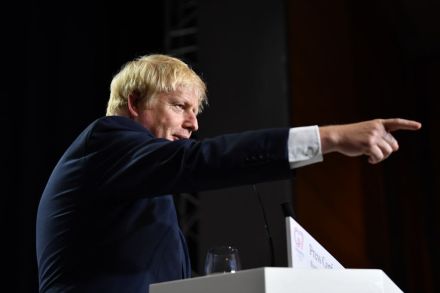
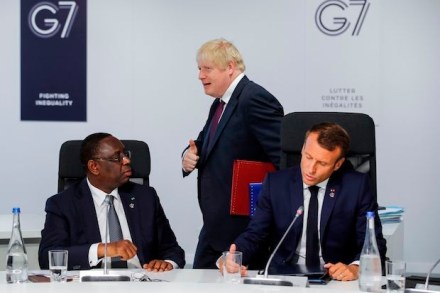
I’ve learned only one thing at the G7 summit of big rich countries here in Biarritz: Boris Johnson absolutely loves being Prime Minister. There’s little of the conspicuous sense of duty that weighed on the shoulders of Theresa May, Gordon Brown and Sir John Major. Nor is there that unnerving claim to embody the spirit of a nation that Tony Blair and Margaret Thatcher perhaps made too often and believed too much. There’s a touch of David Cameron’s Old Etonian entitlement, the idea that it would be odd if he weren’t PM. But mostly Johnson simply seems to be having fun – whether by pointing a joshing finger at the imperious president of France or telling an incredulous President of the EU that they agree on absolutely everything.

Boris Johnson has not made Nigel Farage go away

Nigel Farage: whatever happened to him? You remember, the chap in the coat who used to go on about Europe and all that. Time was, you couldn’t turn on the TV without seeing him. These days, not so much. Farage’s relative quiet in political circles says quite a lot about how easy a ride Boris Johnson is getting in his early days as PM. It is implicitly assumed by many commentators and editors that the advent of a Boris Johnson Government packed with ultra-committed Brexiters, directed by the Vote Leave team and seemingly hell-bent on No Deal will, in due course, render Farage and his Brexit Party irrelevant.

How the Tory party could come back to life

We are living through the most dramatic period in British peacetime history since the agitations leading up to the Great Reform Bill – and, irrespective of Brexit, there is more to come. The UK is about to experience a revolution in government. This will take one of three forms. There could be a chassis revolution, as in 'The world's in a terrible state of chassis.' If the Government were forced into an early election, with the Brexit party on one flank and the Liberals on the other, Parliament would be hung beyond hope of stability. It is reasonable to describe the prospect of such chaos without foreseeable end as revolutionary. There could also be a more orthodox revolution, if Jeremy Corbyn gained power.

Stop thinking Merkel will save us, Dominic Cummings warns

Is Boris Johnson more likely to get a Brexit deal after his meetings with Angela Merkel and Emmanuel Macron? The Prime Minister today tried to dampen hopes, saying that while the 'mood music' had been 'very good' during his meetings with the two leaders this week, it was still going to be hard to persuade the EU to give way. Speaking during a visit to Devon, Johnson said: 'This is not going to be a cinch, this is not going to be easy. We will have to work very hard to get this thing done.' Much of the week has been spent trying to work out what various comments and bits of body language really mean. Was Johnson celebrating successful talks or just having a stretch when he arrived back in Downing Street after his meetings?

Macron’s no-deal Brexit gamble could backfire

The ‘Non’ was not quite as frosty as it might have been. When Boris Johnson met up with France’s president Emmanuel Macron there were at least some pictures of the two men talking amicably. Even so, while Germany’s chancellor Angela Merkel and some of the EU’s other leaders have at least left the door a tiny bit open to renegotiating the UK’s departure from the EU, Macron made it clear it was almost completely shut. In fact, Macron is making almost as big a bet as Johnson. His calculation is that a no-deal Brexit will work to France’s advantage. Yet he may well have mis-calculated – and it could easily drive his own economy into recession.

Alastair Campbell’s remain rally fails to draw the crowds

How come the crowd was so small? A free show at the Edinburgh festival featuring two local MPs, three stand-up comedians – and Alastair Campbell – should have been a massive draw. Barely a few hundred attended the open-air People’s Vote rally at the Meadows yesterday. ‘You’ll forgive us. We’re comedians. Our language may get a bit flowery,’ announced the compere, Fred Macaulay, as an elderly woman wove through the crowd attaching ‘Bollocks To Brexit’ stickers to babies in pushchairs. ‘I’ve got one thing in common with Boris Johnson,’ announced Macaulay, ‘I haven’t a clue what’s going on.

The good, bad and ugly of Boris Johnson’s Brexit letter to the EU

Boris Johnson has written to European Council president Donald Tusk, setting out key aspects of his government’s approach to Brexit. The four-page letter has a number of positive points but also some worrying ones. The good bits: The letter condemns the Irish backstop as undemocratic and inconsistent with both UK sovereignty and the Good Friday Agreement. It also rightly notes that the backstop would lock the UK into a customs union with the EU indefinitely with no means of escape. The letter also states that the UK government cannot continue to endorse the commitment its predecessor made in the Joint Report of December 2017 to ‘full alignment’ with wide areas of the single market and customs union.

Boris Johnson and Angela Merkel’s optimistic press conference

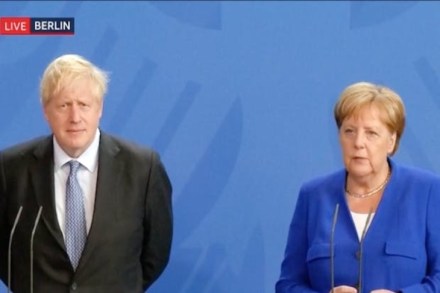
When Theresa May held press conferences with European leaders over Brexit, they were often a painful affair – with her counterpart quick to suggest little progress had been made. This afternoon Boris Johnson opted for an optimistic approach in his first outing on the world stage. The Prime Minister met with Angela Merkel this afternoon in Berlin for talks ahead of the G7 summit this weekend. In the press conference, Johnson joked that the pair had many things to discuss including the 'small matter of Brexit'. With figures in Brussels – including EU council leader Donald Tusk – rejecting the demand in Johnson's letter to ditch the backstop from the Withdrawal Agreement, an undeterred Johnson used the press conference to make the same point.

France says no deal now the most likely Brexit outcome. But why now?

Why would French government officials brief that they think it most likely Britain will leave the European Union without a deal? Boris Johnson hasn't even made it as far as his meeting with French President Emmanuel Macron, and is only just being welcomed by German Chancellor Angela Merkel. So why brief that out now, before the leaders have even spoken? The comments appear to be part of the briefing war between European leaders and the British government, with neither side wanting to take the blame for any fallout from a no-deal Brexit.