Steven Fielding

Steven Fielding is Emeritus Professor of Political History at the University of Nottingham. He is currently writing a history of the Labour party since 1976 for Polity Press.

Where is Keir Starmer’s joy?

From our UK edition

‘Thank you for bringing back the joy’. So effused Tim Walz to Kamala Harris whose new-found position as Democratic nominee for the US presidency has turned the race for the White House upside down. You might expect Walz, Harris’s pick for vice president, to say nice things to his boss. But in terms of crowd numbers, their enthusiasm and the polls, Harris – the dancing, laughing, Happy Warrior – really has made a striking impact on the American public, much to Donald Trump’s consternation. Starmer finds it hard to communicate anything more uplifting than stolid competence The contrast to when Joe Biden was the Democrats’ presumptive candidate is remarkable. Of course, there were concerns about Biden’s age.

Looking to the past won’t help the Tories navigate their future

From our UK edition

These are going to be dark days of introspection for Conservatives. And, as they try to make sense of the 2024 election, some will look to the party’s past to put it into historical perspective. There is, however, no precedent for how awful the result was for the party in terms of vote share and seats won: it really was that bad. Yet, as a comfort amongst the wreckage, but also an inspiration for future effort, some party members will likely alight upon earlier examples of how the Conservatives recovered from cataclysmic defeat. Of those modern instances – 1906, 1945 and 1997 – 1945 is by far the most appealing.

Does the fate of Foot’s Labour show what could happen to the Tories?

From our UK edition

The party is floundering. Its leaders are at odds with their activists about what are their core beliefs. It is in danger of being relegated to third place in the popular vote by an organisation whose prominent figures are former members. And many commentators wonder whether the party has any kind of future. No, this is not a description of Rishi Sunak’s Conservative party in the 2024 campaign but of Michael Foot’s Labour party as it faced disbelieving voters in 1983. Opinion polls since Nigel Farage’s restoration as leader of Reform have provoked feverish speculation about what might happen after the polls close on 4 July.

Has Starmer really changed the Labour party permanently?

From our UK edition

In his first speech of this election campaign, Keir Starmer made what is likely to become an extremely familiar claim. Focusing on the concerns of those who abandoned Jeremy Corbyn’s Labour for Boris Johnson’s Conservatives in 2019 he argued that voters could trust him with the economy as well as Britain’s borders and security ‘because I have changed this party permanently’.  As leader, Starmer has certainly sought to distance himself from the policies and personnel and even imagery of the Corbyn leadership. He talks about his patriotism, surrounds himself with Union Jacks, has rowed back from commitments to nationalise various industries and has become much more friendly with business while expunging the party of the taint of anti-Semitism.

How Starmer wants to reverse Thatcher’s legacy

From our UK edition

Members of Labour’s frontbench have recently fallen over themselves to acclaim Margaret Thatcher. Hot on the heels of Rachel Reeves feting the Iron Lady’s determination to reverse Britain’s decline, David Lammy lauded the woman who defeated his party three times as a ‘visionary leader’. But like Mark Antony’s attitude to Julius Caesar, Reeves and Lammy come to bury Thatcher rather than to praise her. This appropriation of a Conservative icon like Thatcher is highly mischievous Labour's shadow ministers invoke the 'Iron Lady' because they know a certain kind of voter, one Labour needs to help it win power, still goes all of a quiver at the mere mention of her name.

Starmer doesn’t need to be loved to win the next election

From our UK edition

Conservatives are currently reassuring themselves that a general election defeat is not inevitable because, as Nadine Dorries put it recently, ‘There is no love for Keir Starmer on the doorstep’. This line has been heard many times since the by-election defeats in Wellingborough and Kingswood last week. In the aftermath of those by-elections, the Conservatives pointed to the low voter turnouts and argued that Labour wasn’t adding any more votes to their 2019 totals. Some even said that so modest was Labour’s majority, that had Reform not stood in Kingswood, the Conservative candidate would have retained the seat. There are even more crumbs of comfort for the Tories to glean from a new survey of 2019 Conservative voters published by Deltapoll yesterday.

What can Keir Starmer learn from Ramsay MacDonald’s failures?

From our UK edition

A century ago today, the first ever Labour government was formed. Yet even many Labour members will probably be ignorant of the anniversary. To be fair, most historians of the party (this one included) have overlooked the government in favour of the superficially more consequential post-war administrations, especially that of 1945. After all, the 1924 government lasted just nine months and its legislative successes were few. Formed after the inconclusive December 1923 general election left the Conservatives unable to command a Commons majority, as his was the second largest party and enjoying qualified Liberal support, Labour leader Ramsay MacDonald stepped in.

Why Starmer praised Thatcher

From our UK edition

In an event that almost forms part of Britain’s unwritten constitution, if not quite as regular an occurrence as Big Ben’s bongs, a Labour leader has praised Margaret Thatcher. Keir Starmer has now expressed his admiration for the woman who helped keep his party out of office for eighteen years. That this made the news only shows how limited the time horizons of most political journalists are. For every Labour leader since Tony Blair has at one point or another done the exact same thing. The only notable exception is Jeremy Corbyn, who is no longer a member of the parliamentary Labour party.

Why Keir Starmer should be wary of Blair

From our UK edition

During his successful 2020 leadership campaign Keir Starmer claimed he was his own man, saying, ‘I can think for myself, I don’t need to hug Jeremy Corbyn, I don’t need to hug Tony Blair or anybody else to make a decision.’ Having kicked Corbyn out of the parliamentary Labour party, Starmer is unlikely to seek or indeed receive many hugs from his immediate predecessor. Starmer has, however, increasingly and pretty blatantly sought to evoke comparisons between himself and Blair, the last Labour leader to win a general election. Recently Starmer even shared a platform with Blair at the latter’s Foundation for Global Change’s ‘Future of Britain’ conference, dubbed ‘Blairstock’ by wits.

Can Labour’s ‘no money’ note still work magic for the Tories?

From our UK edition

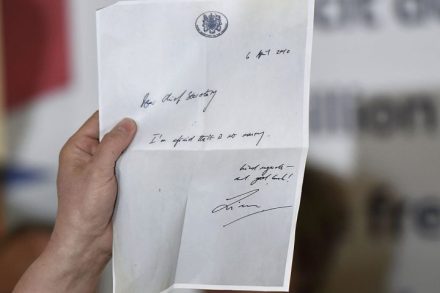
It’s back! The scrap of paper left in 2010 by Labour’s outgoing chief secretary to the Treasury Liam Byrne for his successor, that half-jokily, semi-sympathetically stated ‘I’m afraid there is no money’ is once more in the news. When the recipient of the note, Liberal Democrat David Laws, made its contents public it was widely taken to confirm the incoming coalition government’s claim that Labour had irresponsibly left the country’s finances in a mess. It was concrete, and apparently irrefutable, evidence of the need for the swingeing austerity later imposed by Chancellor George Osborne. The note also helped Osborne deflect responsibility for austerity onto Labour.

Labour aren’t the first to fight dirty with attack ads

From our UK edition

If you believe Britain’s commentariat, Labour’s new series of political ads, which make a variety of claims about Rishi Sunak, have polluted the nation’s politics. A consensus has emerged among them that they mark a 'new low' in political debate, are undoubtedly 'immoral' and could possibly encourage Q-Anon-like conspiracy theories. Even Labour front benchers Yvette Cooper and Lucy Powell seemed to want to distance themselves from the ads. It is certainly true that the first of these ads was especially contentious. Asking if the reader thought adults convicted of assaulting children should go to prison, it claimed, juxtaposed next to a smiling Sunak, that the Prime Minister did not.

Why Starmer’s lack of vision might not matter

From our UK edition

Tradition dictates married couples receive gifts made of leather on the third anniversary of their union. Labour leader Keir Starmer – whose party enjoys a sustained 15-20 per cent poll lead over the Conservatives – has marked his third anniversary in office this week by receiving an old-fashioned leathering in the press. 'His party remains a mystery to voters', according to the Guardian, which chose his anniversary to issue one of its regular ex-cathedras criticising Starmer for his dullness, lack of ambition and the absence of the ‘vision thing’. The paper was not alone: the Times revealed that nearly half of voters were not sure what Starmer stood for, while the Evening Standard published findings that showed he was only level-pegging with Rishi Sunak.

What does Starmer really stand for?

From our UK edition

Keir Starmer is no longer a leader under pressure – at least for now. When he set out his ‘Five Missions for a Better Britain’ yesterday during a speech in Manchester he did so from the vantage point of a huge Labour lead in the opinion polls and an election victory seemingly in the bag. A few days ago, he consigned his troublesome predecessor Jeremy Corbyn to history by confirming he would not be allowed to stand at the next election. Starmer dominates his party like no Labour leader since Tony Blair in his pomp. But when Blair became prime minister, everybody thought they were clear what Blairism was about. However less than eighteen months from a general election there are still big questions about what Starmerism represents.

Is 2023 the year Starmer throws caution to the wind?

From our UK edition

With Labour twenty points ahead of the Conservatives and leading in most policy areas – including, crucially, the ability to best manage the economy – the next election seems to be Keir Starmer’s to lose. Divided and distraught Conservative MPs appear to have accepted their fate. Indeed, some supporters of Boris Johnson and Liz Truss relish the prospect of opposition so they can properly settle accounts with their enemies. Yet Rishi Sunak still has a slim hope of retaining power, should the economy start to right itself by 2024 and if he can convince voters a Labour government would ruin any observable recovery. This requires him to attack Labour’s bona fides and especially those of its leader.

Can Rishi Sunak really take on the unions?

From our UK edition

Rishi Sunak is getting tough. Goaded by Labour’s systematic painting of him as ‘weak’, the Prime Minister has threatened ‘unreasonable union leaders’ that if they do not call off their Christmas strikes, he will introduce new restrictions on their ability to take industrial action. The desire to be ‘tough’ with trade unions is one of the few issues which unites the Tory party – apart from cutting taxes and reducing the size of the state, which Sunak feels unable to deliver at the moment. This is a Conservatism shaped by Margaret Thatcher as she destroyed the post-war consensus, one of the central features of which was the incorporation of the unions into managing the economy, something she saw as tantamount to appeasement.

Starmer is more brutal than he is boring

From our UK edition

On the day he unveiled Gordon Brown’s 153-page report into renewing Britain’s democracy Keir Starmer showed his steely side and helped us better understand the evolving character of ‘Starmerism’. Up till now, when asked what they think about the Labour leader, many voters, after scratching their heads, have said something like: ‘boring’, ‘dull’ and ‘bland’. These are tags that have plagued Starmer ever since his election as leader. Indeed, over the summer Starmer even had to order his own Shadow Cabinet to stop briefing journalists about how boring he is.

What Stanley Baldwin can teach Rishi Sunak

From our UK edition

Britons live, we are constantly told, in unprecedented times. Rishi Sunak has become the first person of Asian heritage to be appointed Prime Minister and the third occupant of No. 10 in as many months. Thanks to Brexit, Covid and the Ukraine war, the economy is in turmoil while the trade unions are more assertive than they have been in decades. Sunak’s party is divided, perhaps fatally so, with many Conservative members hankering for Boris Johnson, a more charismatic figure than Sunak and one they consider more capable of rescuing them from likely electoral oblivion. Surely no incoming prime minister has faced a more daunting set of circumstances? You’d be forgiven for thinking so. But the history books do offer some reassurance for Britain’s new PM.

Could Boris Johnson ever make a comeback as PM?

From our UK edition

The big hope for Boris Johnson, according to Dominic Cummings, was that Liz Truss's likely implosion as Prime Minister might give him a fighting chance of making a triumphant return to Number 10. The first weeks of Truss’s premiership have not exactly been auspicious, leading some betting markets to already put Johnson among the favourites to succeed her. But history is against it: the last ex-party leader and former prime minister to return to both roles was the Liberal William Gladstone in 1880. There might still be some hope for Boris, though: the post-prime ministerial career of one of his Conservative predecessors, Edward Heath, is cause for encouragement. Today few Conservatives talk of Heath.

Liz Truss has a Boris Johnson problem

From our UK edition

Can a honeymoon be over before the Wedding March has even begun? Liz Truss might be about to find out. For while the shoo-in for the Conservative leadership has been wooing members, amongst Conservative party voters in 2019, she is already beginning to lose her appeal. For the time being at least, it seems that the more Tory voters (as opposed to members) see of Truss the less they like her. Of course, Truss has so far been focusing on the only electorate that currently counts to her: Conservative party members. Constituting just 0.3 per cent of the electorate they like her talk of tax cuts, exiling refugees to Rwanda, fracking, winning the ‘war on woke’ as well as attacks on solar panels and the French – but care little for levelling up.

Thatcherism is a cult the Tories should not follow

From our UK edition

Friedrich Nietzsche may not be the most fashionable member of the conservative canon, but doubtless he wouldn’t care much. He knew that one of the main symptoms of a civilisation in decline is ‘herd thinking’. Regardless of the victor, this summer’s Conservative leadership contest has been a case in point for Freud’s narcissism of small differences. None of the candidates have dared deviate from the dogma of Thatcherism. Grant Shapps said it loudest: like Thatcher, he would confront union ‘Luddites’ to save an ailing economy. Liz Truss wants to to ‘crack down’ on trade union ‘militants’ by making it harder for them to call strikes.