Tony blair

The problem for Gove is that structures beget standards

As you’d expect, Michael Gove’s White Paper is a feast of good sense. His speech in the Commons was powerful analysis, and his rebuttal of Labour MPs fun to watch. He’s all for making kids learn properly in primary school, retaining order in the classroom, making detention easier and better modern language teaching. Amen, amen, amen. But, I fear that the White Paper will not be transformative, for a simple reason: the schools system is broken. It doesn’t respond to instructions. The Education Secretary does not run education – power rests with local authorities and the teaching unions. They’re not too keen on Gove, and have allies in parliament ready

Britain should have a Freedom Minister

Has liberal democracy lifted people out of poverty? To a casual observer, the answer is unequivocally yes. One part of the world – the industrialised democratic northern half – is both richer, and healthier than the (historically undemocratic) South or East. Coincidence?   The West’s success may be a function of north Europe’s temperate climate, cultural mores shaped on the windswept British isles and European plains, the competition spurred by centuries of warfare, the invention of modern banking, the head-start provided by inventors, colonial conquests and possibly even the ideas and ecclesiastical hierarchy of the Judeo-Christian faith. But many other regions had similar in-puts. Perhaps the West was just blessed

Miliband should re-examine Cameron's playbook for the real lessons

Ed Miliband has come roaring back from his paternity leave, keen to silence the growing chorus of criticism that he is not in control of his party and has let the Coalition determine the agenda.     To do so, he has come out in favour of a permanent top rate of income tax at 50 percent, but is otherwise taking a leaf out of the Cameron playbook – by establishing a number of policy reviews. But he might want to take another look at Cameron’s experience. Reviews are a great tactical ploy – they show a willingness to “think big”, allow a leader to reach out to a range party

What Gordon Brown and Sarah Palin have in common

Gordon Brown and Sarah Palin are not two politicians one thinks of as having much in common. But reading Robert Draper’s New York Times magazine essay on Sarah Palin’s political organisation and Rachel Sylvester and Tom Baldwin’s piece on Brown’s Downing Street I was struck by the similarity between the two at least in terms of being disorganised and the boss’s refusal to delegate. It was a reminder of how much of politics is about organisation, about having the right team in place. Of course, no operation is perfect. The Blair one, which was far better than Brown’s, had its own imperfection as Andrew Adonis sets out in his review

Labour's ice cream moment

This from Matthew Taylor – the former No.10 head of policy, speaking to the Times for their series (£) on the fall of New Labour – deserves a post of its own: “For me, New Labour died when Tony bought Gordon an ice cream in 2005. I remember sitting in Downing St two days after the election win and chucking into the bin the proposal to break up the Treasury.” 

Ten more highlights from the Bush serialisation

You know the drill: the second part of the Times’s Bush serialisation (£) is out today, so here are ten more highlights from their coverage. The book is also out today, so we can, as the former President suggests, draw our own conclusions. 1) Watching the towers collapse. “I caught enough fleeting glimpses of the coverage to understand the horror of what the American people were watching. Stranded people were jumping to their deaths from the World Trade Center towers. I felt their agony and despair. I had the most powerful job in the world, yet I felt powerless to help them. At one point, the television signal held steady

The other Prince of Darkness

This is a clever publishing idea, a light academic-historical cloak for another set of political memoirs. Jonathan Powell, chief of staff (the term should not be taken literally) at No. 10 throughout Tony Blair’s premiership, kept a diary. Blair himself couldn’t, Powell explains: ‘There simply isn’t time for a prime minister to set out detailed reflections and lead a country at the same time’. One wonders how Ronald Reagan managed it. Besides, is not reflecting on events, actions and consequences — ‘examining with diligence the past’ — one of Machiavelli’s precepts? Despite its title, however, the book is not a re-casting of the tenets of Machiavellianism. It is an extended

Return of the Gord

Oh look, the Old Crowd are moving in on the New Generation’s patch. Not only has David Miliband broken his post-defeat silence with an engaging little article in the Mail on Sunday, but we also have news that Gordon Brown is to make his first Commons speech since the general election. That’s right, after 174 paid days of, erm, indiscernible activity, Gordon will tomorrow insist that maintenance on Britain’s two new aircraft carriers should be carried out on a Scottish shipyard, rather than in France. Everyone else is surprised that he didn’t get that written into the contracts already. The return of the Gord throws up some questions for Ed

Confusion reigns | 24 October 2010

A hoary old foreign correspondent once advised me on how to report on a new country when parachuted in during a crisis. I was about to be sent to Russia to cover the rouble collapse, when it looked like the whole country was about to implode. I was more than a little nervous. “When you write your first piece you will be completely disoriented, so just write that confusion reigns. No one will know any better,” he said. It feels a bit like that with UK politics at the moment. What are we to make of the latest polls that show the majority of the population backing the Coalition’s cuts and yet Labour

The insidious fingers of Iran are all over Iraq

Wikileaks is the story of the day. The Guardian has extensive coverage of unsubstantiated allegations made by unnamed Iraqis. That is not to prejudge the revelations, just to provide balance against the sensational headlines before proper investigations called for by the UN. In addition to the alleged atrocities and cover-ups, Wikileaks’ disclosures support what Blair and Bush said and maintain: Iran incited dissidence to exploit instability. In fact, it is still doing so, despite the Obama administration’s protests to the contrary. The New York Times has eviscerated Biden and Obama this morning. The Telegraph’s Toby Harnden has the best summary of the unfolding debate: ‘It seems to me that the

Not good enough

Tony Blair gave his record in government ten out of ten, though an ungrateful electorate scored rather less well and his Cabinet colleagues performed even worse. Sadly, they were ill-equipped to grasp his unique qualities of leadership. Milord Peter Mandelson reached broadly similar conclusions. Their instant apologia are meant to be the last word on the subject, living obituaries on 13 years in power. So what are we to make of the verdict of New Labour’s two most respectable cheerleaders, who offer a ‘not good enough’ six out of ten for their government’s performance? Toynbee and Walker (they sound like an old-established firm of country solicitors — ‘very reliable, y’know’)

Doing things right, but in the wrong way

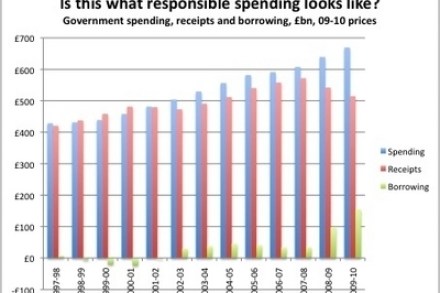
In today’s spending review, George Osborne was absolutely right to hold the line on eliminating the structural deficit within one parliamentary term. In the Emergency Budget released earlier this year the coalition won fiscal credibility (and breathing space from international financial markets) by setting that goal. Failing to follow through on this goal at the first sign of difficulty would have damaged the government’s credibility and reputation in the eyes of international markets.   The Chancellor was also absolutely right to highlight the need for public service reform and to look to the welfare budget to provide some large and early savings. The government spends more on welfare than on

Labour’s historic mistake

I’ve already mentioned George Osborne’s interview with the Telegraph, but it certainly merits another. As Ben Brogan says, Osborne is in a rich vein of ‘election that never was’ form. As befits the inveterate schemer, Osborne’s tactical grasp is impressive. He is quietly vociferous about Labour’s ‘historic mistake’ in electing Ed Miliband. Revealing senior Tories’ continued respect for the electoral tenets of Blairism, he says: “They have chosen to move off the historic centre ground of British politics. I’ve seen more pictures of Neil Kinnock on television in the past week than I’ve seen in 20 years. That’s old politics.” The old politics is the preserve of captive minds, wedded

Why Cameron’s conference speech is vital

Forget Ed Miliband’s promise of ‘optimism’ – a mantra that became so repetitive it had me reaching for the Scotch and revolver. Philip Collins has delivered a far more cutting verdict on David Cameron’s obsession with austerity. He writes (£): ‘Conservatives such David Cameron are not philosophers. The question to ask of Mr Cameron is not: what does he believe? It is: what problems does he inherit? Mr Cameron really does just want to fix the roof. The reason he wants to fix the roof is because it’s broken. The value he brings to this task is the insight that it is better to be dry than wet. He’s simple

When Brown beat Blair in an election

With the merry dance of shadow cabinet elections upon us, it’s a good time to look back on the last time Labour went through all this. There’s a useful list of all the results from the 1992 Parliament here, but here’s my summary of some of the more eyecatching outcomes: 1) Gordon Brown, from hero to zero (to Chancellor). In 1992, Gordon Brown came top of the shadow Cabinet rankings. By 1996, he had dropped to 14th. And bear in mind that the number of MPs standing fell from 53 to 26 over the same time. As we all know, though, he still made it to the Chancellorship.   2)

The penny drops

David Miliband is a tease. The speech he just gave was one of his best: it was self-deprecating, had gravitas, humour, and he spoke down to the Tories, telling William Hague what statesmanship was about. A monstrous conceit, CoffeeHousers may argue, but a Labour leader needs a bit of that; to make out that he’s the real leader-in-waiting, up against lightweights. There was his trademark little bit of grit in the speech: he praised the troops, the Afghan mission and criticised Cameron for reducing British diplomacy to trade missions (Con Coughlin made the same point in a Spectator cover piece recently). My point: that this was a measurably better speech

From the archives: Labour election special

A double hit from the Spectator archives, this week, in recognition of events in Labour land. The first is a recent piece, by Andrew Gilligan, on why the battle between Ken and Oona – now resolved, of course – is the real battle for Labour’s soul. And the second is Boris’s take on Blair’s election to the Labour leadership back in 1994. Enjoy, as they say. The real battle for Labour’s soul, Andrew Gilligan, The Spectator, 11 September 2010 This summer’s election to choose a new deputy regional sales manager of the Co-op, sorry, a new leader of the Labour party, has rather obviously failed to set the nation on

A tale of two statesmen and a wary industry

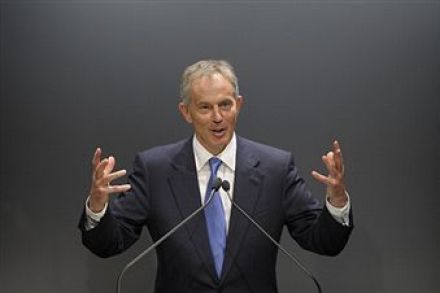
The only readable part of Tony Blair’s Lawrentian romp of a memoir, is the epilogue. He explains why the state must be trimmed in the future and how globalisation is affecting global polities, and all expressed with languid charm and an air of self-deprecation which he has acquired on the road to riches. No wonder he’s the toast of Washington, the UN and Beijing – he’s the model of the Modern English Gentleman, a real pukka sahib. Gordon Brown, meanwhile, has travelled to the UN to attend a meeting on tackling poverty. After a decade of enduring Bono at his most self-righteous, poverty is not yet history. Aid agencies and

A charismatic narcissist

In equal measure, this book is fascinating and irritating. The ‘Hi, guys!’ style grates throughout. From this, it is tempting to conclude that Tony Blair is incorrigibly insincere. But that is not the whole story. Although Blair is no friend to truth or self-knowledge, this is an involuntary study in self-revelation. The most revealing sentence is a throwaway line, in which he tells us that we are all psychological vagrants. That is the clue to his character. It is certainly impossible to read this book without wanting to psychoanalyse the author. So here goes. He comes across as a potent mixture of insecurity and certitude. Always prone to self-doubt, he