Syria

Isis bride Shamima Begum should be allowed home

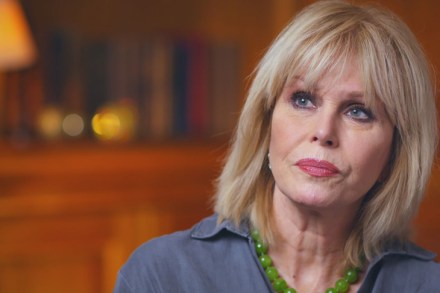
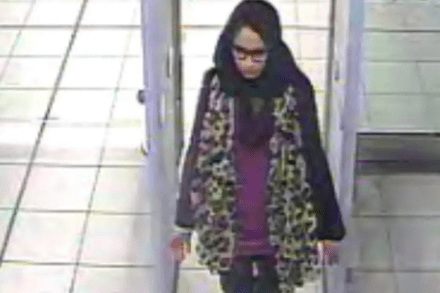
So, what do you reckon then about the jihadi bride, Shamima Begum, unearthed by the Times’ Anthony Loyd in a refugee camp in Syria? Should she be brought back home for an NHS delivery for her imminent baby – with the cops hovering backstage – or left to stew in a Syrian refugee camp, to give birth in the same conditions as other mothers-to-be? I may be misjudging my readers here, but I fancy I can discern which way most of us would want to go. But the first thing to say about all this is that this wretched 19-year old is about the least important aspect of the Isis situation.
Yet again, bluff and bombast are Trump’s policy

From our US edition

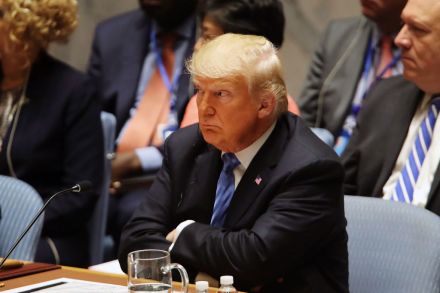
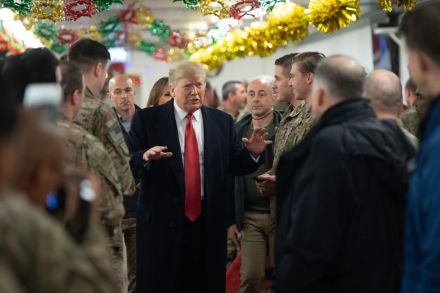
Well, well, well. So President Trump isn’t serious about Syria. Sen. Lindsey Graham has announced that President Trump is pondering his declaration that its time to bring the boys back from the wasteland of Syria within 30-days. ‘I think we’re in a pause situation,’ Graham said on Sunday. Trump himself tweeted, ‘we’re slowly sending our troops back home to be with their families, while at the same time fighting ISIS remnants...’ This is classic Trump. Announce a bold policy, create a furor — and then move on. Disarm North Korea? Extract real concessions from Canada and Mexico? Improve relations with Russia? Bulky China into a trade deal on American terms? Build a wall?

donald trump bluff bombast

How much wilder can the Trump v Deep State fight get?

From our US edition

On Christmas Eve, President Trump spoke to a seven-year-old girl called Collman Lloyd. ‘Are you still a believer in Santa?’ he asked her, ‘coz at seven, it’s marginal, right?’ Perfect. Pure Trump. It was OK, though. Later, little Collman told reporters that she still believed, despite what the leader of the free world had said to her. Trump didn’t manage to shake a seven-year-old’s faith in Santa. But, in another surprise declaration over Christmas, he announced that American troops would be leaving Syria. It happened ‘very fast,’ as Trump likes to say. He took a call from the Turkish leader, President Erdogan.

trump deep state

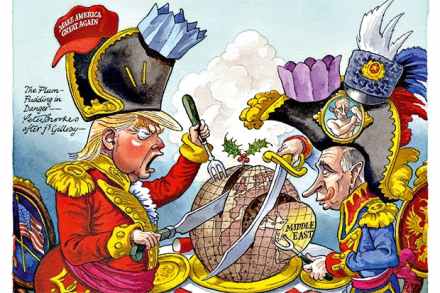
Trump’s Mideast carve-up

From our US edition

If any other president than Donald Trump had announced the withdrawal of American troops from Syria, he would be lauded for a strategic wisdom rare among American presidents, and for that even rarer achievement, fulfilling a campaign promise. Instead, he is attacked by Democrats and Republicans alike. That alone suggest that he is doing something right. The truth is, American foreign policy experts have been consistently wrong about the Middle East for decades. Who, apart from the culprits of George W. Bush’s wars, seriously believes that Iraq ever was a nation, rather than a cobbled-together state? Who, apart from the apologists of Obama’s appeasement, seriously believes that Iran has no ambitions as a nuclear-tipped empire?

carve

Trump’s sudden Syria pullout reveals his administration’s chaos – and misguided priorities

From our US edition

President Donald J. Trump’s surprise announcement on Wednesday that he is withdrawing the US military from Syria has shaken the Washington, DC, foreign policy establishment like a thunderclap. While there have been nods of approval from skeptics about American interventionism in the Middle East, that’s a rare breed inside the Beltway. Instead, DC foreign policy mavens, most of whom espouse neo-flavored beliefs (whether neoliberal or neoconservative) reacted with derision and horror to Trump’s proposed withdrawal from Syria’s terrible fratricide, ongoing for almost eight years. These media and think-tank denizens, once derided as ‘the Blob’ by Obama’s White House, have spoken with one voice, and it’s sharply critical of the president.

donald trump syria pullout
war machine

Donald Trump is a man of peace – his enemies are a war machine

From our US edition

Donald Trump is the only peace president the United States has had since the end of the Cold War, and his enemies hate him for it. ‘Peace president’ is a relative term, of course, but as yet there is no Trump war comparable to George H.W. Bush’s Persian Gulf War, Bill Clinton’s war against Yugoslavia, George W. Bush’s invasions of Afghanistan and Iraq, and Barack Obama’s gruesome regime-change bungle in Libya. Instead, the most conspicuous foreign-policy achievement of the Trump administration to date is de-escalation on the Korean Peninsula, along with the stamping out of ISIS.

syria

Ignore the hawks, Trump’s Syria withdrawal is bold and brave

From our US edition

Warmongers on the Left and Right are united in their fury at President Donald Trump’s extraordinarily bold and brave decision immediately to begin withdrawing all US troops from Syria. For those of us who prefer peace, it is a sure sign that Trump deserves our unconditional support and gratitude, no matter how we view the rest of his presidency. After all, the only other time Trump united the neocons and liberal hawks was when he launched a futile cruise missile barrage last year at an empty Syrian airfield in response to an alleged chemical weapons attack against civilians.

Hunter, scholar, boaster, dreamer

The Assyrians placed sculptures of winged human-headed bulls (lamassus) at the entrances to their capital at Nineveh, in modern Mosul, to ward off evil. The mighty lamassu to the right of the Nergal Gate had been on guard for some 2,700 years when Isis vandals took a drill to it in 2015 and blew away its face. Today a copy, crafted out of date syrup cans, stands on the Fourth Plinth in Trafalgar Square. It wears the oblong beard and proud look of the Assyrian kings. The original sculpture dated to the time of Sennacherib, who ruled Assyria from 705 to 681 BC, and transformed Nineveh into a magnificent metropolis. No stranger himself to violent desecration, he made his eldest son king of Babylon, but went on the rampage when the Babylonians rebelled and had the ruler dispatched.

Bad blood

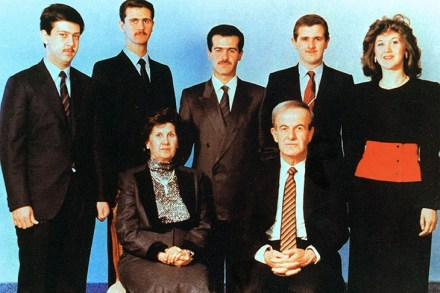
‘How did this mild-mannered eye doctor end up killing hundreds of thousands of people?’ someone wondered about Bashar al-Assad in BBC2’s extraordinary three-part documentary A Dangerous Dynasty: House of Assad (BBC2, Saturday). It’s a question we’ve all occasionally pondered as the Syrian body count rose — 500,000 thus far — and as six million refugees fled the country. The answer is so lurid and complex that it could have come from one of Shakespeare’s tragedies. Chinless, studious, polite Bashar was never meant to become president of Syria. His thuggish military officer father Hafez, who seized power in 1970, had earmarked the job for his dashing equestrian soldier son Bassel.

Syria Notebook

In order to avoid the Labour conference and yet more predictable media attacks on Jeremy Corbyn, I escaped late last month to Syria, where children were returning to school after the summer holidays. Large tracts of the country have recently been liberated from the control of jihadi groups, meaning that in some places children are going back to school for the first time in five years. At Sinjar elementary school in Idlib province, I found the local headmaster painting the school sign. Five years ago rebels gave him the choice of closing down or being killed. He was confined to his house while the school buildings were converted into an arsenal.

Trump’s phony anti-globalism should fool no-one

From our US edition

It was fitting that Donald Trump’s blustery speech at the United Nations this week, in which he defiantly denounced ‘the ideology of globalism,’ came just one day after his top adviser John Bolton vowed limitless American military commitment to yet another global conflict. Bolton had essentially declared that US forces would be in Syria for perpetuity, or ‘as long as Iranian troops are outside Iranian borders.’ Though this deployment was never formally debated, voted on by Congress, or subjected to a modicum of public scrutiny, Bolton saw fit to announce that US troops would remain there for an open-ended mission with no termination date.

donald trump anti-globalism

‘People don’t care which weapon kills them’

 Beirut 'The planes have already hit the hospitals', said an aid worker. 'They always do that first' The customs man wore a white linen suit. He had a large moustache. His ample belly touched the edge of his desk. The scent of cardamom wafted over as a tiny cup of coffee was placed in front of him. I was not offered one. This was Beirut airport in the summer of 2011. We were travelling on to Syria, next door, where a civil war was beginning. The customs man lazily flicked through my passport and took another sip of coffee. ‘Everything will be seized,’ he announced with satisfaction. Television cameras, satellite phones and flak jackets were taken away.

The rehabilitation of Assad

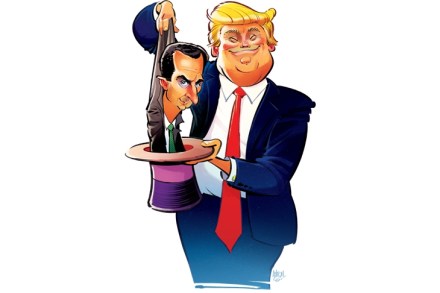
Amid the confusion and the almost deafening cries of treachery and collusion over Donald Trump’s relations with Russia, few noticed the most tangible outcome of this week’s Helsinki summit. In the lead-up to his face-to-face talk with Vladimir Putin, senior US and Russian diplomats — in close coordination with leaders from mutual ally Israel — brokered a deal among all the warring parties (bar the Islamist terrorists) finally to end the devastating seven-year Syrian civil war. As is often the case with Trump, the hype tends to drown out the message but it was there for anyone paying close enough attention. The US, Russians and Israelis have agreed on a solution to Syria. His name is Bashar al-Assad.

Putin says he’s making Russia great again. In reality, it’s crumbling

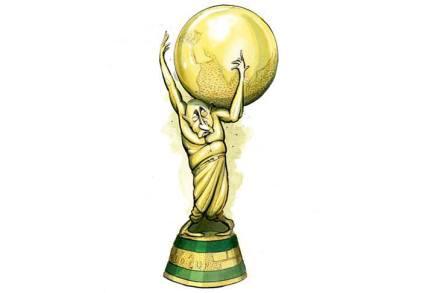
This is Putin’s time. Next week, the Fifa World Cup kicks off in Moscow, and the Kremlin has spared no expense to showcase Vladimir Putin’s new Russia as a vibrant, safe and strong nation. Half a million visitors will be welcomed — with the Russian press reporting that the notorious ‘Ultra’ hooligans have been officially warned to behave themselves or face the full wrath of the state. Despite four years of rock-bottom oil prices, Putin has nonetheless found the cash to build or refurbish a dozen new stadiums. Moscow has undergone a two-year city-wide facelift that has left it looking cleaner, fresher and more prosperous than any European capital I have seen.

Putin’s rot

This is Putin’s time. Next week, the Fifa World Cup kicks off in Moscow, and the Kremlin has spared no expense to showcase Vladimir Putin’s new Russia as a vibrant, safe and strong nation. Half a million visitors will be welcomed — with the Russian press reporting that the notorious ‘Ultra’ hooligans have been officially warned to behave themselves or face the full wrath of the state. Despite four years of rock-bottom oil prices, Putin has nonetheless found the cash to build or refurbish a dozen new stadiums. Moscow has undergone a two-year city-wide facelift that has left it looking cleaner, fresher and more prosperous than any European capital I have seen.

What drama

One sphere that podcasts have so far not much penetrated is drama. Audible.co.uk is itching to develop its own brand but so far has limited itself to producing audiobooks read by a galaxy of stars. Recording plays is expensive, requires an understanding of studio techniques and a cast of actors who have learnt how to play to the microphone, not an auditorium. Only the BBC has as yet the necessary experience and resources, with its own repertory company and team of spot-effects experts and sound designers.

Portrait of the Week – 19 April 2018

Home Amber Rudd, the Home Secretary, apologised in Parliament for the treatment of immigrants from the Commonwealth from before 1971, known as the ‘Windrush generation’ (after the Empire Windrush, the ship that brought West Indian workers to England in 1948). The 1971 Immigration Act allowed Commonwealth citizens then living in the United Kingdom indefinite leave to remain, but the Home Office kept no records of these. Some had lost their jobs, others had been refused National Health Service treatment, and others threatened with deportation. Theresa May, the Prime Minister, apologised to Caribbean heads of government who were in London for the Commonwealth Heads of Government Meeting.

We have a moral duty to mistrust the government on Syria

Almost two years have passed since Sir John Chilcot produced his 12-volume report on the lessons of the Iraq war. We collectively promised to learn the lessons. Last weekend it was as if the Chilcot report never happened. Britain, cheered on by a bellicose press and a largely docile Parliament, launched airstrikes that showed the same disregard for due process against which Chilcot warned. Remember what Chilcot told us: 'The judgements about the severity of the threat posed by Iraq’s weapons of mass destruction – WMD – were presented with a certainty that was not justified.' He concluded: 'the UK chose to join the invasion of Iraq before the peaceful options for disarmament had been exhausted. Military action at that time was not a last resort.

Theresa May now has authority for further military action

Aside from the need to act swiftly and with an element of surprise when striking Syria's chemical weapons capability, it is still fair to say that Number 10's preferred option was not to have a vote before the strikes took place at the weekend. David Cameron's experience in 2013 of failing to get parliamentary consent for action has left institutional bruising which means everyone is now cautious of asking MPs for approval, despite the fact that the Commons has in fact consented to air strikes both in Syria and Iraq since that failed vote. Parliamentary recess did make it much more convenient to avoid such a vote, and there was certainly no appetite for the government to push for one retrospectively.

Windrush, Syria and the miserable state of British politics

What a dismal week this has been for British politics. And it is still only Wednesday. The distinguishing feature of this political moment is its shabbiness. The two stories dominating the news this week, Windrush and Syria, each demonstrate as much.  The Windrush scandal – it ceased being a saga some time ago – is shameful. But it is not simply a question of Home Office incompetence (some of which is only, when dealing with matters of significant complexity, to be expected) but, worse, one of Home Office vindictiveness. It is a feature of the system, not a bug within it. A system which, quite deliberately, excises humanity and common sense from its calculations and concentrates, instead, on box-ticking and raw numbers.