Supreme court

Pro-lifers, it’s time for civil disobedience

From our US edition

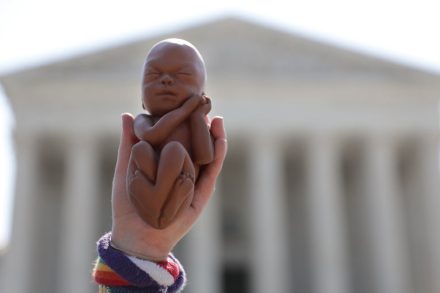
The Supreme Court has ruled in June Medical Services, LLC v. Russo that the dismemberment and removal of unborn human lives was more important than a woman’s right to a high standard of care. From now on, no reasonable person can view the pro-life movement’s strategy — voting Republican, often with noses held and hoping that some future conservative majority will defend life — as anything but a failure. The foul spirit of Anthony Kennedy’s ‘mystery’ has possessed John Roberts and will no doubt possess some other ‘conservative’ host after him. Matthew Walther suggests a new strategy for the pro-life movement: if you believe that the Court’s rulings on abortion are illegitimate, you should act on your belief.
burial

Abort stare decisis

From our US edition

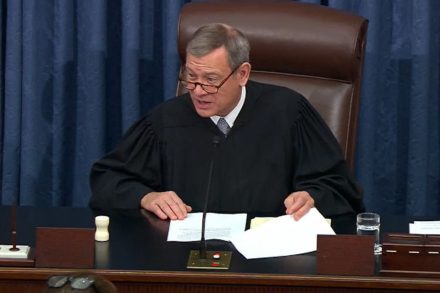
The conservative legal movement has again been bludgeoned. The culprit, as has far too often been the case, is once more the Supreme Court’s most mercurial chief justice, John Roberts. In June Medical Services LLC v. Russo, a 5-4 Court majority enjoined Louisiana’s enforcement of its law that would require abortionists to have admitting privileges at a hospital within 30 miles of a prenatal abattoir. The Court’s four liberals, ever-reliable in their outcome-oriented efforts to further the progressive political agenda, wrote for a pro-abortion plurality. Roberts, for his part, wrote a separate opinion concurring in the judgment — notwithstanding the fact he dissented in a virtually analogous Texas case, Whole Women’s Health v.

john roberts stare decisis

The conservative legal movement is dead

From our US edition

Imagine if Sonia Sotomayor, once she got on the Supreme Court, started ruling like Clarence Thomas. I know, I know, that’s like something out of The Twilight Zone or the Babylon Bee. But try to picture it. There’d be riots on the campus of every school she’d attended, and likely in DC, too. Democrats would drawing up articles of impeachment, and speaking of packing the court. And whatever social justice thinktank vets SCOTUS appointees for the Democratic National Committee would start chopping off heads. Scapegoats would be piling up on the unemployment line like pork chops at a slaughterhouse. But that’s precisely what just happened with Neil Gorsuch (and less, surprisingly, John Roberts) in the Bostock decision.

legal

Why banking on judges is a poor strategy

From our US edition

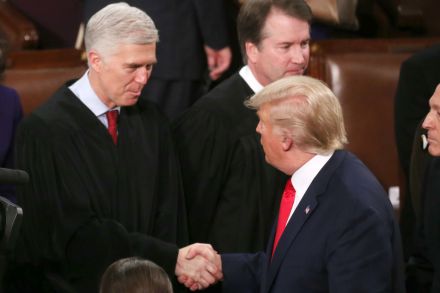
Monday’s Supreme Court decision in Bostock v. Clayton County was massively significant for two reasons. As a legal matter, the ruling determined that the prohibition on ‘sex discrimination’ in the Civil Rights Act of 1964 makes it illegal to fire an employee on the basis of sexual orientation or gender identity. As a political matter, the ruling flipped the entire legislative strategy of the GOP political class — which relied exclusively on judges to enact and protect all of their priorities — on its head.The majority opinion was authored by none other than Justice Neil Gorsuch, nominated by President Trump and confirmed by the Republican Senate in 2017.

judges

Espinoza v. Montana is about families, not religion

From our US edition

These days, 'school choice' has become such a polarizing term that many bristle at the mere mention of it. Up to this point, discussions have centered on public charters vs. traditional public schools, yet talk about religious schools has been largely left to the periphery. But that will soon change, once we hear the outcome of a potentially landmark education case that’s currently before the Supreme Court. And if tradition holds, bitter political arguments over the outcome are certain to overlook the most important stakeholders — the children and their parents.The case, Espinoza v.

espinoza

Why secession beckons

From our US edition

The craziness of our politics makes you wonder what’s round the bend. After the ‘resistance’, the pussy hats, the non-stop crises and the permanent impeachment, what could be the next shoe to drop? The answer is a breakup of the country, as I argue in my new book, American Secession.Americans have never been more divided, and we’re ripe for secession. The bitterness, the gridlock, the growing tolerance of violence, invite us to think that we’d be happier were we two different countries. In all the ways that matter, save for the naked force of law, we are already two nations.And if that’s where we are today, where might we be in an easily imaginable future, where Trump wins reelection and gets a couple more appointments to the Supreme Court.

split

What could go wrong for Donald Trump in 2020?

From our US edition

What are the four things that can go blooey for President Trump in the next year? First, he can get mired in a new Middle East war — the very thing he promised to avoid. The much-ballyhooed pullout from Syria turned out to be none at all. Now turmoil in Iraq, not a North Korean nuclear launch, turns out to be the Christmas present Trump didn’t want to receive. American strikes against the Kataib Hezbollah militia have got Iraq and, by extension, Iran, in a hugger-mugger. Trump could be on a slope toward further escalation with Iran that is as slippery as an oil slick. The hawks in Trump’s administration will exult; his nationalist followers, blanch. Second, there’s the economy. So far it’s humming along on a sugar high of tax cuts and deficit spending.

wrong

Could a sex-strike solve Brexit?

Last week the Lawyers Group of the charity Classics for All held its fifth moot (cf. ‘meet’) in the Supreme Court, under the stern gaze of Lady Arden. Previous moots have tried Socrates, Brutus and Cassius, Antigone, and Verres, corrupt governor of Sicily. The Romans put such moots at the heart of their education. The purpose was to teach men how to win the political — and, even more, legal —battles necessary to climb the greasy pole to power. Pupils would be asked to make the best case they could for or against the sides involved in historical or mythical situations (suasoriae, e.g. ‘did Orestes legally kill his mother?’, ‘Should the Romans have destroyed Carthage?’) and invented ones (controversiae).

Paul Dacre: Do I regret the ‘Enemies of the people’ front page? Hell no!

So what to make of the extreme language, veering from the histrionic to the hysterical, dominating political discourse? The words ‘surrender’, ‘treachery’ and ‘sabotage’ ricochet around Westminster. According to Jacob Rees-Mogg, the Supreme Court’s verdict is a ‘constitutional coup’. For the Sun it’s ‘an incendiary coup by political judges’. David Cameron describes Michael Gove as a ‘foam-flecked Faragist’. Boris Johnson is painted as the Antichrist. All of which puts into perspective my own somewhat hackneyed contribution to this lexicon of acrimony.

Letters: We must grasp the dangers of cannabis before it’s too late

On judging the judges Sir: The spectacle of judges questioning essentially political decisions is not an edifying one. But we should be slow to dismiss the importance of the role of judicial review. Dr Ekins is justifiably troubled by the escalation of appeals to the Supreme Court in politically sensitive terrain. (‘Judgment day: the danger of courts taking over politics’, 21 September), but there are a number of positive features of this always contentious activity. First, it is the proper responsibility of the judiciary to determine the moral principles which underpin our law and to apply them as they do the law itself. Secondly, judicial review is a powerful check on the tyranny of the majority.

The balance of power in our constitution has been lost

Until recently, we used to comfort ourselves with the thought that the United Kingdom’s uncodified constitution was a great national strength. We didn’t need guidance laid down in one document because precedence, compromise and common sense were enough to ensure the smooth operation of power. As soon as a document is written, power passes from democratic institutions to courts where activist judges can interpret these documents in a political way. In Britain, this is not meant to happen. Our legal system has been seen, world over, as politically neutral, one of the most trustworthy in the world. So what are we to make of a Supreme Court granting itself powers over the government? The courts used to refuse to adjudicate political squabbles, so why have they started now?

Has the Supreme Court handed Boris Johnson a Brexit escape route?

The Supreme Court's judgement is the latest constitutional perversion after the Benn act. But ironically it may assist the Government in achieving its objective of Britain leaving the EU by 31 October, without having to seek an extension to the Article 50 process. In paragraph 34, the Supreme Court states that its 'proper function' under our constitution is to give effect to the separation of powers (which justifies court intervention in relation to prorogation). Then, in what appears to be an innocuous sentence in paragraph 55, it says that it is to be “remember[ed] always that the actual task of governing is for the executive and not for Parliament or the courts.” Yet the Benn Act manifestly contradicts this principle.

The torture chamber: how opposition MPs plan to humiliate Boris

When Jeremy Corbyn declared at Labour conference that his party would only allow an election once no deal had been taken off the table, MPs began to wonder if it could be put off until the new year. The Prime Minister’s tormentors can’t agree when exactly they would like to go to the country, but all agree that there are plenty of ways to torture Boris Johnson. It’s as good a way as any to pass the time. The Tories no longer have a working majority, so these opposition MPs — aided by activist Speaker John Bercow — now hold the power. What will they do? Well, the Conservatives are meant to be gathering in Manchester this weekend for their annual meeting. However, opposition MPs plan to vote against any conference recess.

There is only one law: there must be no Brexit

You’re surprised? Really? What are you surprised by? The specifics — that 11 non-elected, mostly public-school-educated judges, and doubtlessly Remainers I’d guess, should put the final nail into the lid of Brexit? Yeah, sure — that knocked me for six. Never saw that coming. Or was it the generality that surprised you — we’re not getting Brexit after all? If it’s the latter, I don’t think there’s much hope for you. What seemed to me fairly plain on 24 June 2016 — that they, meaning our liberal establishment, would never let it happen — became an absolute certainty by the turn of this year. By January it was either no Brexit or Brexit in name only.

Why the Court’s ruling may help Boris Johnson

In one respect Gina Miller is right. Today’s Supreme Court decision is bigger than Brexit. We are now in a civil war without bullets – between two sides who both claim to be fighting for democracy but who have very different ideas of what it entails. In the one corner are those who believe that democracy is where the electorate vote for something in a plebiscite and then government carries out its instructions; in the other corner are those who believe that democracy is Parliament and the courts acting together in what they see as the best interests of the people. As I have written here before, the correct term for what the latter group advocate, and what was demonstrated in the show of power by the Supreme Court this morning is Kritarchy, rule by judges.

Brexiteers should cheer the Supreme Court

Ignore, with great respect, the people telling you today that the justices of the Supreme Court have waded into politics, exceeded their mandate and involved themselves in matters that belong to elected officials not the judiciary. Take five minutes to read the Court’s judgement on Boris Johnson’s prorogation of Parliament, where you will find a crystal-clear elucidation of principles that everyone – but perhaps especially those who favour leaving the EU – should celebrate and defend. Before I get to that, it appears to be necessary to point out what the Court has not done and not said. The judges have not ruled that Boris Johnson lied to the Queen, even though many people who really should know better are saying this. David Lammy, for instance: https://twitter.

Corbyn to address Labour conference this afternoon

Time was when the box office attraction at Labour conference was going to be Tom Watson's speech this afternoon. The biggest drama would be activists who planned to walk out in protest at the deputy leader's constant undermining of Jeremy Corbyn. That was before the Supreme Court verdict, of course, and now Corbyn will be speaking at 4pm, having moved his speech forward from tomorrow so that he can head back to Westminster in time for parliament returning. But there's still some internal drama playing out: Labour's press team said Tom Watson would be speaking tomorrow afternoon to close conference, but Watson almost immediately said he wouldn't do this as he also wanted to be back in parliament. 'I'll have to save the speech until the next conference,' he said.

Why the Supreme Court’s Brexit case is so crucial

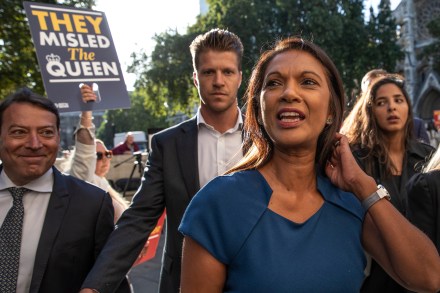
The opening session of the epic Supreme Court hearing into whether Boris Johnson misled the Queen and broke the law when proroguing parliament did not disappoint. Because Lord Pannick, for one of the plaintiffs Gina Miller, captured with the clinical precision of a brain surgeon quite what is at stake. Summing up, he asked the law ladies and lords to consider that if they were to conclude there is no case for the PM to answer, a future PM might well feel licensed to suspend parliament for six months or a year, as and when MPs become bothersome, rather than “just” the five weeks Johnson has chosen to shut down parliament? What is at stake, Pannick implied, is the role and power of the courts to prevent a PM choosing to become an elected dictator.

Blow for Boris as parliament may return early

The Court of Session’s verdict that prorogation is unlawful is a major headache for Boris Johnson. It makes the Supreme Court’s decision on the matter, and the court will hear the case on Tuesday, much more unpredictable. There is now a significant chance that parliament will have to be recalled. The Supreme Court will hear all the various cases on prorogation at the same time on Tuesday, remember the government won in the High Court in London. But it will adjudicate these cases in line with the law of the court from which they came. So, it will decide the case from the Court of Session according to Scottish Law and the one from the High Court according to English law. This raises the possibility of them deciding it is legal under English law but not Scots.