Socialism

The eve of the Bernie-Warren online battle

From our US edition

The great ‘Bernie vs. Warren’ online wars have yet to fully commence, and the current state of affairs resembles something like an uneasy pre-conflict standoff. No tentative pact between the candidates themselves can last forever and early shots have already been fired from their respective squadrons: small skirmishes or drills that precede the outright warfare. Political prognosticators tend to lump Bernie and Warren into the same generic ‘progressive’ category, but for their most committed backers — the ones who will be in the online trenches — the differences are vast and unbridgeable. For the devout socialists, Bernie represents a once-in-a-generation (or even lifetime) opportunity.

bernie sanders elizabeth warren

The next election will be a referendum – on Corbynism

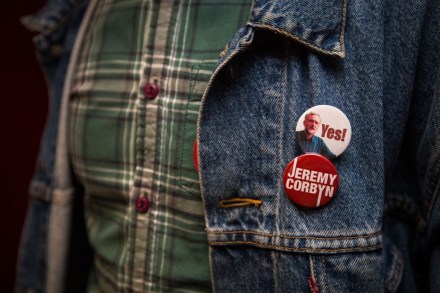
The next general election will have been precipitated by, and will inevitably be fought over, Brexit. Yet it will also be the fiercest battle of ideas for more than a generation. Britain must choose between economic liberalism and a command economy, between a smallish state and a domineering one. This would be a crucial choice at any time, but the implications of Brexit make it more so. Jeremy Corbyn supported leaving the EU in 1975 for the same reason he can’t quite denounce Brexit now: a parliament that takes back control can be far more radical. And his Labour party has plenty of radicalism in mind. Even though Labour occupies a lowly position in the polls, Corbyn remains overwhelmingly the main challenger to Boris Johnson and his warring Conservatives.

How to baffle the boycott brigade

From our US edition

The march to war! The beat of keyboards resounded across the land as thousands of our brave xirs in black answered their nation’s call to arms last weekend. They were men, women, and miscellaneous, briefly leaving behind all the comforts of a boozy brunch or Saturday morning Etsy shopping spree in order to defend democracy against fascism at whatever the cost. Flabby in body but firm in spirit, prepared to conquer any obstacle in their path, this civilian army, joined by the fearless allies in Hollywood led by General Chrissy Teigen arrived at the Twitter front to defend our way of life from Hospitaliano! axis forces.

olive garden boycott

Rise of the comrade babies

From our US edition

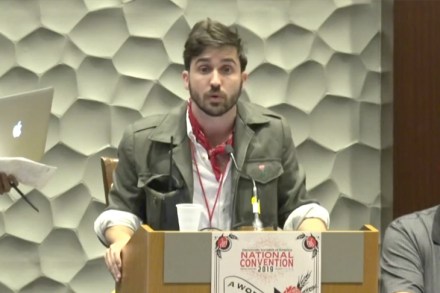
If you elected to build a library dedicated to the subject of Human Folly, the place would end up as wide as the Grand Canyon and as tall as the Burj Khalifa. Plenty of space then, for a modest pamphlet on the activities of the Democratic Socialists of America, who held their National Convention last week in Atlanta. Socialism – or something that calls itself socialism – has returned to America. There are some good reasons for this turn to the left, among them a justifiable anger with a feckless ruling class that is shared by the Trumpian right. Thomas Frank continues to argue persuasively (and ineffectually) that a populist turn to the left – not open borders advocacy and more managerialism – are the best way to beat President Trump.

dsa

High life | 18 July 2019

Athens Standing right below the Acropolis, where pure democracy began because public officials were elected by lot, I try to imagine if random political selection would be a good thing today. The answer is a resounding yes. Both Socrates and Aristotle questioned fundamental norms and values, and if they were alive today they would certainly question our acceptance of career politicians who have never had any other profession. (Corbyn, Biden… I could go on.) Socrates was sceptical about many things, especially the arts, because he believed they led us away from the truth. Yet nowadays so-called ‘artists’ influence public opinion as never before. The fact that even numbskull rappers have a say and can affect public opinion means that election by lot should be a must.

Shouldn’t AOC have Googled Jeremy Corbyn?

From our US edition

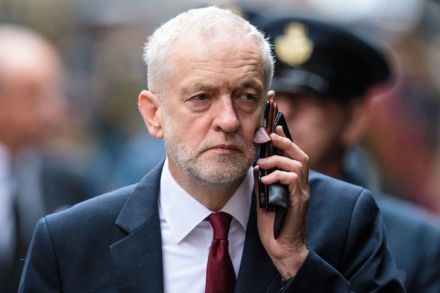
They don’t have jobs, they can’t afford a house, but millennials have one thing going for them: They’ve finally found their Ronnie and Maggie, the political match-up to define their era. British Labour leader Jeremy Corbyn and Alexandria Ocasio-Cortez have held what the latter calls ‘a lovely and wide-reaching’ phone conversation and followed it up with some Twitter gushing about progressiveness and stuff. Quoth Corbyn: https://twitter.com/jeremycorbyn/status/1092174819154710528?s=21 And the reply: https://twitter.com/aoc/status/1092210825228636161?s=21 One of the benefits of centrism collapsing is that left-leaning politicians no longer sound like human resources consultants.

aoc

Chapo Trap House’s revolution fizzles

From our US edition

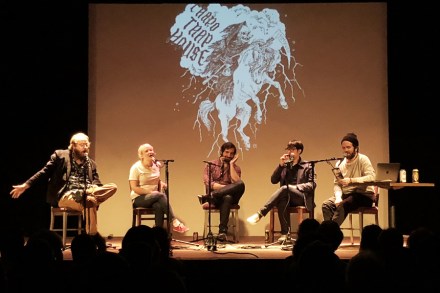
The socialists behind the immensely successful podcast ‘Chapo Trap House’ have now released a book, The Chapo Guide to Revolution. A satirical attack on liberals and conservatives, as well as a sincere case for democratic socialism, it is often funny and sometimes instructive. The book has good jibes about the foaming rage of right-wing keyboard warriors and the affectations of conservative intellectuals. Chapo satire often flounders on its contradictions, though. The Chapo crew enjoy mocking the appearances of liberal and conservative figures, for example, yet their photographs suggest that if they want such jokes to be effective they should confine themselves to non-visual forms of media.

chapo trap house

Of course the young like socialism – they’re taught to

It beggars belief that Jeremy Corbyn can, with a straight face, announce that capitalism has failed and we’d all be better off under socialism. ‘The super-rich are on borrowed time,’ he said at the Labour party conference. He’s going to tax the rich until their pips squeak, overlooking the fact that the coalition government’s decision to lower the top rate of tax from 50 per cent to 45 per cent actually boosted tax revenues. The taxes paid by the top 1 per cent of income earners are now responsible for 28 per cent of the total tax take, higher than it ever was under Labour.

The facts about the Venezuelan economy

Contrary to the impression given by Jason Mitchell, Venezuela does not have a socialist economy (‘Maduro’s madness’, 25 August). It has a ‘mixed’ economy (and therein lies some of its problems; such as food hoarding by private companies hostile to the regime). The private sector is large, and involved in numerous sectors within the economy; food distribution, pharmaceuticals and so on. The US sanctions against Venezuela have always been about regime change, and these sanctions amount to a blockade of the country. US and European banks have refused to handle Venezuelan payments for medical supplies, and pharmaceutical companies have refused to issue export certificates for cancer drugs — therefore stopping them being imported into Venezuela.

Maduro’s madness

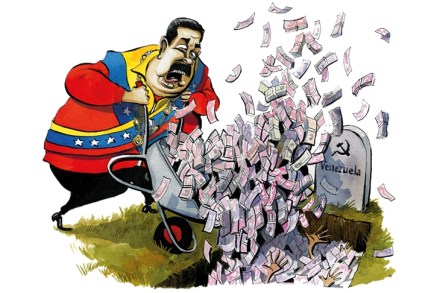
Imagine if Theresa May suddenly announced that her government was going to devalue the pound by 96 per cent; increase the minimum wage by 6,000 per cent; pay the wage increases for millions of businesses for three months; tie the pound to a mythical cryptocurrency; prepared for petrol rationing; and impose a 0.7 per cent tax on big financial transactions. It would be seen either as an act of lunacy, of a collapsing country — or both. For the long-suffering people of Venezuela, it’s just the latest stage of their country’s grand socialist experiment. President Nicolás Maduro has just issued a new currency, called ‘sovereign bolivars’. The original idea was that the currency would be like the old one, but with three zeros lopped off.

Real life | 24 May 2018

‘What a fabulous tan, where did you get it? said one of my fellow lunch guests as we entered the women’s powder room of a Mayfair hotel. I get this a lot. I want to talk about where I have wintered, or summered, or springed, because although I am poor I am lucky enough to mix with people who are not, and I love people who are not. I will defend them to the death. The poorer I get, the more capitalist I become. I can trace my attraction to Trump directly along the lines of my diminishing bank account and mounting credit card bills. I think it is to do with the fact that when one encounters poverty it is so unutterably awful that one can bear it only by taking refuge in the knowledge that somewhere else there are people who are comfortable, some fabulously so.

The mystery of socialism’s enduring appeal

One of the mysteries of our age is why socialism continues to appeal to so many people. Whether in the Soviet Union, China, Eastern Europe, North Korea, Cuba, Vietnam, Cambodia or Venezuela, it has resulted in the suppression of free speech, the imprisonment of political dissidents and, more often than not, state-sanctioned mass murder. Socialist economics nearly always produce widespread starvation, something we were reminded of last week when the President of Venezuela urged people not to be squeamish about eating their rabbits. That perfectly captures the trajectory of nearly every socialist experiment: it begins with the dream of a more equal society and ends with people eating their pets. Has there ever been an ideology with a more miserable track record?

India in a day

Bold programming by the powers-that-be at Radio 4 meant it was possible to listen to all seven episodes of Ayeesha Menon’s adaptation of Salman Rushdie’s Midnight’s Children in a single day on Tuesday, exactly 70 years since independent India was born, and Pakistan created. Four and three-quarter hours of meticulously crafted drama (directed by Tracey Neale and Emma Harding) ingeniously slotted into episodes of different lengths throughout the day, some just 15 minutes, others a full hour (the adapter having to create and sustain pace in a variety of ways to suit the different lengths).

To a young Corbynista

Dear John, I really hope you won’t be offended by this letter from your uncle. I have nothing but respect for you and I would hate to damage the friendly relationship we have had since I first met you when you were six years old. I understand from your aunt that you voted Labour in the latest election and that you are a ‘Corbynista’. In fact even your aunt herself — a lifelong Tory as far as I know — has been saying how nice Jeremy Corbyn is and how much better he handled the Grenfell Tower tragedy than Theresa May did. Of course, you can vote for whoever you like and it’s none of my business. But I take the risk of irritating you because I would like to tell you why I did not vote for Corbyn.

Meritocracy isn’t fair

I’ve just made a programme for Radio 4 about the populist revolts that swept Britain and America last year. Were they predicted in a book written by my father, Michael Young, almost 60 years ago? I’m thinking of The Rise of the Meritocracy, a dystopian satire that imagines a 21st-century Britain governed by a highly educated technocratic elite. Eventually, the intellectual and moral hubris of these Masters of the Universe is too much for ordinary people and they’re overthrown in a bloody revolution in 2034. It often surprises people to learn that my father’s critique of meritocracy was underpinned by his belief that human differences are rooted in genetics, a view many on the left associate with neo-liberal economics and the libertarian right.

The winged rabbit who made me a Tory

His father’s dental cast, writes Graham Greene near the beginning of The Power and the Glory ‘had been [Trench’s] favourite toy: they tried to tempt him with Meccano, but fate had struck’. Trench is a dentist, trapped by his chosen profession in a godforsaken Central American hellhole. Greene ponders the way, when we are very young, that chance events, objects or people may become father to the man. ‘We should be thankful we cannot see the horrors and degradations lying around our childhood, in cupboards and bookshelves, everywhere.’ Too true. Pookie made me a Tory. My new copy of Pookie Puts the World Right has arrived. I’d lost the old one, but tracked down another on the internet.

Revolution now and then

Maxim Gorky was trumpeted as ‘the great proletarian writer’ by Soviet critics, who considered his novel The Mother one of the most significant books of the 20th century. Completed in 1906, after Gorky had already been recognised internationally, it is based on the events of 1902, when the workers of Sormovo, a factory settlement near Gorky’s native city of Nizhny Novgorod, held what we’d now call a ‘mass anti-capitalist protest’. The demonstration was brutally dispersed and, after a trial that stirred Russia, six of its organisers were sentenced to life in exile. The October Revolution was still 15 years away. The book starts with a description of the settlement’s bleak life, filled with hard work and hard drinking.

Lessons from Utopia

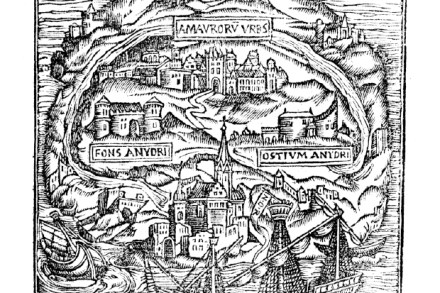
As anniversaries go, the timing could hardly be more apt. As Europe braces itself for the next Islamist attack, the next assault on our civilisation, a season of events marks the 500th birthday of a book that outlined an enlightened vision of the ideal society. Utopia 2016 is a year-long celebration of Thomas More’s Utopia at London’s Somerset House, where the Royal Society and the Royal Academy used to meet. Somerset House is a building that encapsulates the free-thinking values of the Enlightenment, and More’s Utopia is a book that encapsulates the Renaissance sensibilities that built it. We all know what sort of society Isis wants (the clue’s in the name), but what sort of society do we want? What rights are we defending?

Jeremy Corbyn comes to Scotland and discovers he has nothing to say

When all else fails, I suppose, you can just plead for mercy. That appears to be the message emanating from the Scottish Labour party's conference in Perth this weekend. The theme, Kezia Dugdale says, is "Take a fresh look" at Labour. OK. [Awkward silence.] Now what? The thing is, you see, that "Take a fresh look" has been the unofficial theme of every meeting of the Scottish Conservative and Unionist party since, oh, at least 1997. When you are reduced to pinching lines from the Scottish Tories you are probably in a position similar to the lost traveller seeking directions to Limerick who was told "Well, I wouldn't start from here". Here is where Labour are however and here is nowhere good.

Socialist Cluedo

What a load of manipulative, hysterical tosh is An Inspector Calls. It wasn’t a work with which I was familiar till I saw the latest TV adaptation. Now, of course, I see exactly why the luvvies — see, for example, Stephen Daldry’s highly acclaimed early 1990s National Theatre revival — adore it so. It confirms everything they think they know about the world: rich people bad, heartless, oppressive; poor people the long-suffering and saintly salt of the earth. In case you’ve not had the pleasure, J.B. Priestley’s play is like a socialist game of Cluedo: a lovely innocent young working-class woman has died and the toffs all dunnit.