Scotland

Letters | 11 May 2017

It’s a Unionist revival Sir: Contrary to Alex Massie’s claims, there is no rebirth of Scottish Conservatism in Scotland (‘Queen of Scots’, 6 May). Rather, there is a strident Unionist vote from 2014 that has found its home in the Scottish Conservative and Unionist party — the latter part being the key. Mr Massie makes the error of confusing support for Unionism with support for Conservatism. It is widely acknowledged that Ruth Davidson and the Scottish Conservatives have no discernible policies or philosophy other than opposing a second independence referendum.

The SNP’s muddled education policy is failing Scottish kids

I am afraid that whenever a politician asks to be judged on their record, it is sensible to assume this reflects a confidence they won’t be. At the very least such promises are hostages to future headlines. Take, for instance, Nicola Sturgeon’s boast that education  - and specifically closing the gap between the best and worst schools in Scotland - is her top priority. Judge me on this, she said. Well, OK.  Today the SNP government published the results of the latest Scottish Survey of Literacy and Numeracy and, as has become annually predictable, they make for depressing reading. While standards of reading have remained relatively constant amongst both primary and secondary pupils, there has been a sharp decline in writing ability.

The Tory revival in Scotland belongs to the Unionists

Well, then. It turns out that the revival of the Scottish Conservative and Unionist party is a real thing. Last year, the party won 31 seats at the Scottish parliament elections, supplanting Labour as the second force in Scottish politics. This week, it became the second largest party in local government across Scotland. The Tories are a party reborn, the beneficiaries of an increasingly polarised political landscape. It may be ironic that Ruth Davidson’s party benefits from the SNP’s dominance but there you have it. Caveats apply, of course. The voting system used in Scottish council elections helps the Tories. The single transferable vote is a very different beast to first past the post. That makes mapping these election results onto the general election a risky endeavour.

The Spectator’s Notes | 4 May 2017

Guy Verhofstadt, the European Parliament’s main Brexit negotiator, tweeted on Monday: ‘Any #Brexit deal requires a strong & stable understanding of the complex issues involved. The clock is ticking — it’s time to get real.’ This was on the same day as media reports — allegedly leaked by associates of Jean-Claude Juncker, the European Commission president — criticised Theresa May for her naivety about Brexit talks at the dinner she gave Mr Juncker last week. These tactics are intended to affect our general election. By throwing Mrs May’s campaign slogan adjectives ‘strong and stable’ back in her face, Mr Verhofstadt was goading her at the decisive moment of her political career. So were the friends of Mr Juncker.

Letters | 27 April 2017

Aid is not the answer Bill Gates says he is a huge fan of capitalism and trade (Save Aid!, 22 April) but then spoils it by repeating the received wisdom about aid: ‘If you care at all about conditions in Africa – the population explosion, measles, polio — then don’t suggest there is a private-sector solution to these problems. It’s outrageous.’ No. It is not outrageous. A vigorous private sector is the only answer to African development. I have spent my life in Africa, working in 18 of its countries, usually deep in the bush. I have watched numerous aid programmes fail once the external funding is removed, and have spent much time thinking about and discussing why this should be so.

Uniting the kingdom

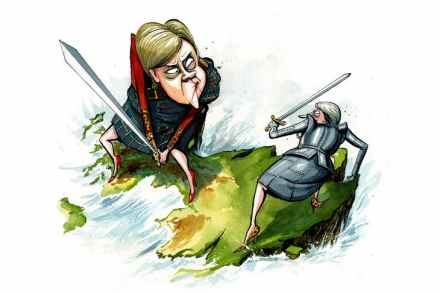
When launching the Scottish National Party’s election campaign, Nicola Sturgeon said the word ‘Tory’ 20 times in 20 minutes. For much of her political lifetime, it has been used by the SNP as the dirtiest word in Scottish politics. Nationalists have long liked to portray the Conservatives as the successors to Edward Longshanks: an occupying army with little affinity for the people they were trying to govern. But things are changing fast in Scotland. Amid the other political dramas of the past few months, the revival of Tory support north of the border has gone relatively unnoticed. They had only one MP after the last election, but a poll this week puts them on 33 per cent in Scotland — enough to win 12 seats.

How to vote to save the Union

When launching the Scottish National Party’s election campaign, Nicola Sturgeon said the word ‘Tory’ 20 times in 20 minutes. For much of her political lifetime, it has been used by the SNP as the dirtiest word in Scottish politics. Nationalists have long liked to portray the Conservatives as the successors to Edward Longshanks: an occupying army with little affinity for the people they were trying to govern. But things are changing fast in Scotland. Amid the other political dramas of the past few months, the revival of Tory support north of the border has gone relatively unnoticed. They had only one MP after the last election, but a poll this week puts them on 33 per cent in Scotland — enough to win 12 seats.

Can Labour become a truly national party again?

The latest polling marmalade dropper comes from Wales. Labour have won a majority of Welsh seats in every general election for the past eighty-odd years. But the latest Welsh Political Barometer, the most respected poll there, has the Tories on 40 per cent and on course to win 21 seats to Labour’s 15. This poll combined with the fact that Labour is now down to one MP in Scotland shows how difficult it will be for the party to win a UK-wide majority again. They will have to do it without the inbuilt advantage that their Celtic strength used to provide them with. If May can succeed in realigning British politics in this election and flip lots of Labour seats in the North and the Midlands, then it will become even harder for Labour.

Theresa May’s election gamble is paying off

Everything you need to know about the current state of the polls is summed up by the fact that one which puts the Tories at 40 per cent, a level that they haven’t hit in a general election for a quarter of a century, and 11 points clear is presented as a blow to them. Now, the reason that the Mail on Sunday has done this is because other polls have the Tories so far ahead that a mere 11 point lead looks rather anaemic. ComRes has the Tories at a jaw-dropping 50 per cent, with Labour on 25 per cent. YouGov puts the Tories on 48 per cent, and 23 points ahead. Interestingly, it also finds that May is more trusted than Corbyn on the NHS suggesting that even Labour’s banker issue won’t save it this time.

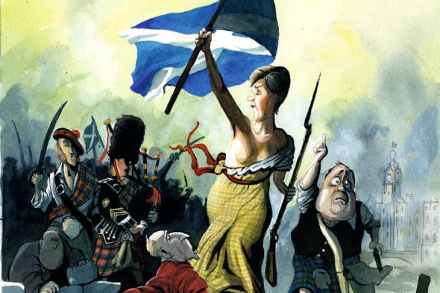
The strange rebirth of Scottish Conservatism

At the time of their 1997 wipeout, the Scottish Tories were at least hated. When I was reporting from the Scottish Parliament some 14 years later, things were even worse: there was curiosity, even pity, for Tory supporters. One Tory MSP told me the party should rename itself "the effing Tories" because that's what they had become known as. Voting Conservative was no longer seen as a giant evil, more a harmless perversion - like cross-dressing (or cricket). Then Ruth Davidson came along, then Jeremy Corbyn, then the SNP with its obsession with referenda - and now, everything has changed. The above graph shows the latest voting intention in Scotland, with the Tories soaring above Labour and winning the support of a third of Scots.

There is something grubby about Theresa May’s snap election

Since I suggested last July that Theresa May, newly anointed as leader of the Conservative and Unionist party and Prime Minister of the United Kingdom of Great Britain and Northern Ireland, should call an election to both establish her own legitimacy and allow the country an argument over the kind of Brexit it preferred, it would be unseemly to now deplore her belated decision to go to the country.  Happily, there remain many other things that may be deplored. Far from the least of these is the manner in which the Prime Minister has made her case for an election. It’s not her fault, you see, that she has (correctly, in my view) gone back on her word. She remains a pretty straight kinda gal, you know.

The general election will be a vote on Scottish independence

'Now is not the time' except, apparently, when now is the time. The reasons for engineering a general election are many and obvious. The current government is tolerated, not welcomed. Theresa May needs a mandate of her own. A thumping Tory majority - the only conceivable outcome of any dash to the country - will not hugely strengthen her position with Britain’s erstwhile european friends and partners, but it will secure her position on the domestic front. For Labour, too, this is an opportunity to lance a boil: it will, or should at any rate, end the Jeremy Corbyn era. For their part, the Liberal Democrats should welcome the opportunity to make their pro-EU - or, rather, anti-Brexit - pitch to the electorate.

Scotland Office to the Scottish Government: get on with the day job

Although a government statement on the labour market statistics for Scotland doesn't on the surface sound like the juiciest news release of the day, today's has proved rather revealing. With unemployment in Scotland down by 15,000 in the period December 2016 to February 2017, the Scottish unemployment rate has fallen to 4.5 per cent -- below the rate of 4.7 per cent for the whole of the UK. You might expect the Scotland Office press release to trumpet this good news but instead it turns its guns on the SNP -- pointing to the fact that the Scots employment rate decreased by 0.1 percentage points over the quarter to 73.4 per cent. The rate is below the UK average of 74.6 per cent.

Letters | 30 March 2017

No blanket solution Sir: Paul Collier is right to say that the refugee crisis will not be solved with tents and food alone (‘The camps don’t work’, 25 March). But context is everything, and aid remains vital. In middle-income countries such as Jordan and Lebanon, getting refugees into jobs is essential. Businesses are part of the jigsaw. So is government legislation to ensure, for example, that refugees get work permits or can register as self-employed. So too are labour market interventions that generate incentives to get refugees working. However, in fragile and impoverished states that lack functioning markets and governments, different forms of aid are required.

North Berwick

My home town is better than yours. Don’t take my word for it. This month North Berwick was crowned ‘best place to live’, at least in Scotland, thanks in part to its good schools, community spirit and low crime. The news hasn’t come as a surprise to locals — it’s a town perched between an extinct volcano and the North Sea on the south shore of the Firth of Forth, so we know it’s something special. But there’s more to us than pretty streets, beaches and fish and chips. The first thing to note about North Berwick is that it is in Scotland. This may seem obvious, but it’s often confused with Berwick-upon-Tweed, 40 miles south in England.

Scottish parliament votes for a second referendum – but Theresa May is unlikely to sway

The Scottish Parliament has voted 69-59 for a second Scottish independence referendum. This is no surprise. But it does lend more force to Nicola Sturgeon’s demand for a second referendum. She can now say that she has her parliament behind her when she presents the UK government with her request for a Section 30 order. Don’t expect Theresa May to move position though: she’ll stick to her line that ‘now is not the time’ for a second vote on independence. The UK government has been, privately, delighted at how May’s position has gone down in Scotland. They feel that there is no groundswell of support for another referendum, something that has been backed up by the polls.

Theresa May’s Brexit speech in Scotland, full transcript

It is very good to be with you here with you today, and particularly to be able to thank you all for the work you do on behalf of the Government and on behalf of the British people. Vital work that helps millions around the world and speaks strongly to the values that we share as a country. And it is vital work. Not just because the things you do here have a material impact on the lives of some of the poorest and most vulnerable people around the world. But also because the work you do here – in conjunction with your colleagues at the Department for International Development in London – says something important about Britain. It says that we are a kind and generous country.

Letters | 23 March 2017

Speaking for Scotland Sir: I wonder if it is wise of Charles Moore (Notes, 18 March) to assume — as so many do — that because they lost the independence referendum back in 2014, the Nationalists do not speak for Scotland? In the following general election Scottish voting virtually wiped out every political party north of the border, other than the SNP. Might it not be wiser to assume that the Scots had thought again? Ian Olson Aberdeen Birds, gangs and economics Sir: Simon Barnes is correct in his implication that the trapping and harvesting of small birds by criminal gangs in Cyprus is enough to make the average Briton squeamish (‘Little birds, big trouble’, 18 March). However, while this may be so, the current system of enforcement is clearly failing.

An independent London would be a Thatcherite dystopia

Tottenham MP David Lammy has been writing in the Evening Standard about how it makes sense now for London to become a 'city-state', following Brexit: Over the course of the next two years as the reality of Brexit begins to bite, the economic, social and political cleavages between London and other parts of the country will become more pronounced. London’s status as a de facto city-state will become clearer and the arguments for a London city-state to forge a more independent path will become stronger. I've argued before that there is an increasingly strong case for London leaving the union because the aspirations of Londoners and the people of England are diverging so much.

Andrew ‘Calamity’ Cooper – the man who blew Remain – in talks to take on Scotland project

Scottish nationalists may want to get the champagne at the ready. Word reaches Steerpike that Andrew 'Calamity' Cooper - the serial bungler whose last project was the EU Remain campaign - is being sounded out to lend his expertise to Scots trying to save the union. The SNP want a referendum within two years; Theresa May has said 'not yet' but plans are being made by unionists. Unsurprisingly, Cooper has been at a bit of a loose end since the EU campaign. A campaign is currently being set up in preparation of a second independence referendum -- with the working title 'New Direction'.