Science fiction

Bookends: Saving JFK

Stephen King’s latest novel is a time-travel fantasy about the assassination of John F. Kennedy. At almost 750 pages, 11.22.63 is drawn-out even by blockbuster standards. Critics have bemoaned its surfeit of period detail (bobby socks, Hula Hoops, big-finned cars). I rather enjoyed it. King, now an august-looking 64, is a writer of towering cleverness, whose fiction manages to appeal to a reading public both popular and serious. Much of what passes these days for literary fiction is mere creative writing. Give me genre fiction (John le Carré, Martin Cruz Smith) any day. A fiction without a story — Kings knows — is scarcely worth its weight in paper. Before King was the emperor of bestsellerdom he studied English at the University of Maine (his birthplace). 11.22.

S is for Speculative

Margaret Atwood has written 20 novels, of which three (The Handmaid’s Tale, Oryx and Crake and The Year of the Flood) are science fiction. Indeed, the first— and far the best of them — won the inaugural Arthur C. Clarke award, Britain’s chief prize for books in the genre. She has, however, long resisted any description of her work as science fiction, for which she was mildly upbraided by Ursula K. Le Guin a couple of years ago. Le Guin wrote that Atwood’s distinction between her own novels, which she maintains feature things which are possible, and may even have happened already, and SF, in which things happen that aren’t possible today, was pointless.

Dark, moral and lyrical

A story in Edna O’Brien’s new collection — her 24th book since 1960 — shows us a mother and daughter who are thrilled to be taking tea with the Coughlans, posh new arrivals in their rural west of Ireland parish. A story in Edna O’Brien’s new collection — her 24th book since 1960 — shows us a mother and daughter who are thrilled to be taking tea with the Coughlans, posh new arrivals in their rural west of Ireland parish. But the afternoon is a washout: their haughty hostess has a neck rash and is too distracted for chit-chat. Trudging home, the girl suddenly craves tinned peaches. No, says her mother, ‘it would be an extravagance’; perhaps another day.

Architect of cool

More than quarter of a century later, 1984 remains firmly fixed in the future, fiction having provided a more vivid view than our memories of the year which actually happened. Even so, a couple of things from the real, boring 1984 were memorable: Apple introduced the Macintosh personal computer (with a celebrated advertisement based on Nineteen Eighty-Four) and William Gibson published his first novel, Neuromancer, which popularised the idea of ‘cyberspace’, a term he had minted. Both seemed like science fiction then. Apple’s machine, with its 128 kilobytes, now seems antediluvian.

Hero of the counterculture

Michael Moorcock’s career is indisputably heroic. Michael Moorcock’s career is indisputably heroic. At a rate of up to 15,000 words a day, rudimentarily equipped with exercise books, bottles of Quink and a leaky Osmiroid, he has written, among other things, novels by the score, some of which — The Cornelius Quartet, The Colonel Pyat sequence — are among the most ambitious, interesting and funny to have been published since the war. He is not taken as seriously as he might be, though, because most of the rest of his fiction is in the despised and dreaded genre of SF.

A cosmic comedy

Not long ago I had an email from a friend, wondering if I’d yet read the new Ian McEwan. Not long ago I had an email from a friend, wondering if I’d yet read the new Ian McEwan. ‘Talk about a bolt from the blue,’ she said. ‘McEwan does slapstick. I never saw that coming.’ She added (unfairly, I thought) that you might class On Chesil Beach as slapstick of an unintentional sort, but her point holds. Here, in a book around a scientific theme of considerable seriousness — global warming and renewable energy — McEwan has written the closest thing he’s ever done to a farce. Told in three chunks, spaced at intervals between 2000 and 2009, Solar is the story of a Nobel-prize-winning physicist on a slow slide to disaster.

Liobams lying with rakunks

Set in the future, The Year of the Flood tells the story of the build-up to and aftermath of a pandemic known as the Waterless Flood, which all but eradicates the human race. The environment the survivors are left with is extremely inhospitable: Earth’s natural resources are long depleted, and the flora and fauna that remain are made up of genetically spliced, hybrid organisms such as rakunks (rats crossed with skunks), pigoons (hybrid pigs resembling balloons because they’re stuffed with duplicate human transplant organs), and liobams (lions forced not just to lie down with lambs but to integrate with them biologically) — not to mention soydines, chickeanpeas and beananas.

The wide blue yonder

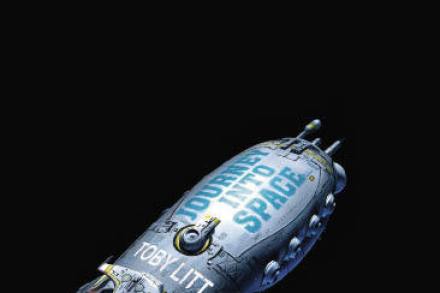
Toby Litt begins the titles of his books with consecutive letters of the alphabet and takes delight in shifting style and genre. He has now reached J, and science fiction. There has been a flurry recently of ‘literary’ writers trying their hands at SF. For the most part, the complaint raised against these efforts is that they may be better written than most of science fiction, but they aren’t much cop as science fiction. Anyway, science fiction need not be badly written: fans are fond of quoting Sturgeon’s Law (after the science fiction writer Theodore Sturgeon) — ‘Ninety per cent of SF is crud, but then 90 per cent of everything is crud’. The corollary is that even the badly written stuff must offer something special to succeed.