Russia

A short history of language in Ukraine

From our UK edition

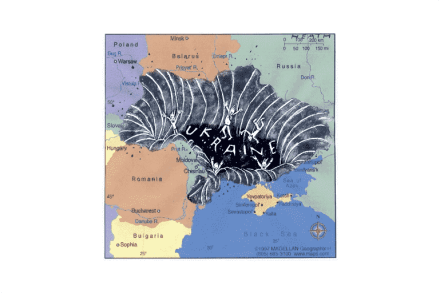
After six months of war in Ukraine, most observers agree that the roots of Russian aggression lie in the country’s deep-rooted attitudes to culture and history. In line with Russia’s nationalist traditions, Putin denies any place for a separate Ukrainian identity. The Ukrainians, in contrast, see themselves as a proud nation with their own history, culture, centuries long struggle for independence, and, of course, language. And while Ukrainian has been dismissed as a dialect of Russian in Moscow, it in fact has a long history – and is very much a language in its own right. That independence can be seen in the genesis of the word ‘Ukraine’ itself.
Will Nato accept Ukraine?

From our UK edition

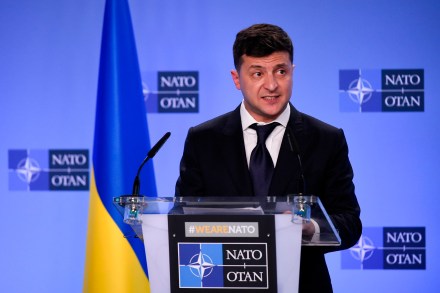
Shortly after the invasion of Ukraine, Volodymyr Zelensky made an offer to Vladimir Putin. Ukraine would drop its ambition to join Nato and would instead stay neutral, he said. It would not align with the West, in exchange for an end to hostilities. It was a sincere offer, and unpopular with Ukrainians. Yet it was significant: Putin had cited Ukraine’s Nato ambitions as the main reason for the invasion, saying it showed the West was somehow threatening Russia. But today, that offer ended and Zelensky is seeking the ‘accelerated’ Nato accession granted to Finland and Sweden this year. Will Nato accept? Jens Stoltenberg, Nato Secretary-General, dodged the question when asked today.

Europe’s descent into deindustrialisation

From our UK edition

The rapid economic collapse that Britain is facing is simply an accelerated version of what the whole of Europe is about to go through; unsustainable borrowing to fund the gap between high energy prices and what households can actually afford. With the sabotage of the Nord Stream pipeline, there is now no feasible way back. Europe can no longer physically import Russian gas – prices will remain high until Europe builds more energy capacity, which could take years. What is likely to come of this? High energy prices will render European manufacturing uncompetitive. European manufacturers will be forced to pass through the higher energy costs in the form of higher prices and consumers will find it cheaper to buy products from countries with normal energy prices.

Why Putin might have attacked Nord Stream

As the world wonders what happened to the Nord Stream 1 and 2 pipelines, many suspect that Russian President Vladimir Putin is behind the sabotage. At first glance, it appears strange that Russia would damage pipelines that its own companies run. But Putin has several possible reasons for carrying out the attack. One reason could be that Gazprom (the Russian state-owned gas giant) wants to avoid paying penalties for failing to fulfill its contractual obligations. Since August 31, Russia has halted gas exports via both Nord Stream pipelines, which follows a similar move in July where the Kremlin cited erroneous maintenance issues as the cause of the short shutdown that month.

War has come home to Russia

From our UK edition

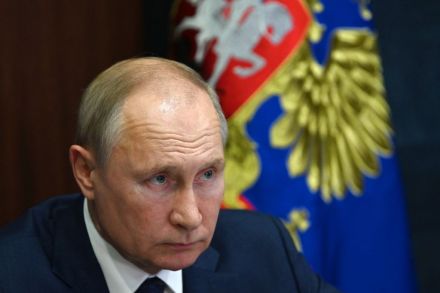
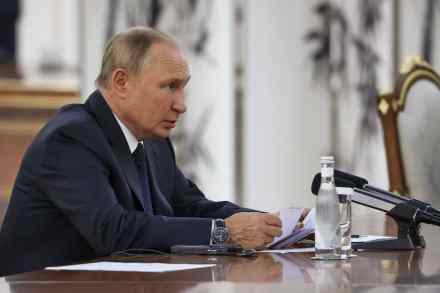
Moscow A week of somewhat mixed messages from the Kremlin. One day Vladimir Putin opened Europe’s largest Ferris wheel and presided over citywide celebrations of Moscow’s 875th anniversary, full of calm and good cheer and mentioning the war only in passing. A few days later he appeared on national TV telling the world that he was ‘not bluffing’ about using nuclear weapons and announcing a partial mobilisation. Putin has never fought a contested election in his life, so he’s never been a great one for the common touch. But in his latest address he looked as pale and dead-eyed as Nosferatu. Russians know better than most that the more strenuously something is officially denied, the more likely it is to happen.

Did Russia sabotage its own pipelines?

From our UK edition

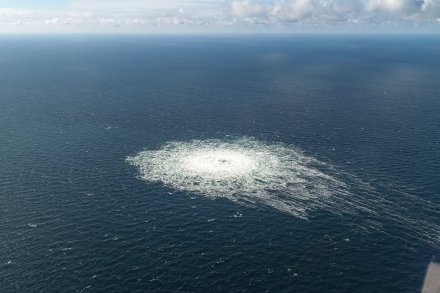
It almost seems worthy of the opening scene in a Bond film. Vital Russian gas pipelines running beneath the Baltic Sea close to Denmark and Sweden are the victims of sabotage. The two countries have warned of leaks from both Nord Stream 1 and 2 after seismologists suggested there had been underwater explosions. No one wants to claim credit for the deed – yet. Who is the Blofeld behind this dastardly scheme? Former Polish foreign minister Radek Sikorski, no fan of Russia, sardonically declared on Twitter, ‘Thank you, USA’. That set the conspiracy theorists off. As has a video resurfacing of Joe Biden in February promising America would put an end to Nord Stream 2.  Who is the Blofeld behind this dastardly scheme?

Life among the Russian refuseniks

From our UK edition

Yerevan, Armenia It was getting dark outside Yerevan Airport when I arrived, but there were still a dozen flights from Russia yet to land. Groups of young men in their twenties and thirties were milling around the terminal building, stacking suitcases onto trolleys, changing money and working out what to do next. Armenia is one of the few countries they can still fly to since much of the western world closed its skies to Russian planes; it is almost alone in not requiring them to have visas. ‘I’m just here for a holiday,’ one weary traveller carrying four heavy bags insists, ‘everything is fine in Moscow.’ Others are more up front about their reasons for leaving.

Liz Truss showed up Biden at the UN

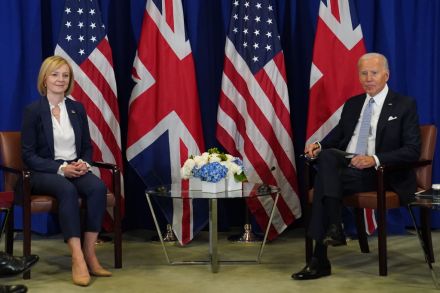
British prime minister Liz Truss’s speech at the United Nations this week was spot-on. It was clear, concise and left no question that the UK would do everything in its power to lead in the defense of the West and its values. President Biden’s address, by contrast, left you feeling overwhelmed and unsatisfied. That's not to say he failed to speak about Ukraine — he spent a reasonable amount of time on it — but the substance just was not there. Truss made a clear commitment to continue to “sustain or increase... military support to Ukraine, for as long as it takes,” a concrete and actionable statement. Though Biden issued a ringing condemnation of Putin’s war, he only made a vague pledge to “stand in solidarity against Russia’s aggression.

Was Nato expansion worth the risk?

From our UK edition

This is an important and topical book. Mary Sarotte traces the difficult course of Russia’s relations with Europe and the United States during the decade which followed the fall of the Berlin wall in 1989, a period which saw Russia’s brief dalliance with democracy and Nato’s advance to the frontiers of the old Soviet Union. The story has been told before, but never so fully or so well. In a remarkable historical coup, Sarotte has persuaded the German foreign ministry to open its archives to her, and the Americans to declassify thousands of documents previously closed to researchers. When Vladimir Putin’s spokesman Dmitry Peskov was moved to denounce so much disclosure of confidential diplomatic material, it became obvious that Sarotte was on to something.

Russia isn’t just losing influence in Ukraine

If Vladimir Putin’s goal is to reestablish Russian influence, his ambitions are on track for another major setback. Far less high-profile than the war in Ukraine, a slow and quiet revolution has been brewing south of Russia’s borders in Central Asia and the Caucasus. These nations, members of the former Soviet Union, have traditionally been in Russia’s sphere of influence. That, however, is now changing. At the start of the year, it looked like Russia was ascendant. Putin had over 150,000 troops waiting to invade Ukraine, and was receiving a steady stream of Western visitors pleading with him to step back. When Kazakhstan was engulfed in popular protests, Putin stepped in and deployed about 2,500 Russian troops after an appeal by the Kazakh president to help quell the unrest.

Is this really the moment to scrap bankers’ bonuses?

From our UK edition

Chancellor Kwasi Kwarteng – keen to sharpen the City’s competitive edge, we’re told – wants to remove the legislative cap, imported from Brussels in 2014, that limits bankers’ bonuses to 100 per cent of their base salary, or up to 200 per cent with shareholder approval. That raises interesting questions. Was the cap a good idea in the first place? If not, why wasn’t it binned as soon as we left the EU? Is now the ideal moment to do so? And are bankers still a breed of greedy bastards? The answer to the first question is certainly not. This column called the cap a ‘boneheaded’ measure that would merely provoke wily moneymen to find ways of gaming an unwelcome restraint on their wealth.

Exhausted by America’s culture of fear

When I try to sleep at night, I can't relax. I blearily turn on the TV, but I can't change the channel. My TV is telling me I am going to die, maybe from Covid (they say there's a new variant, you know, called Monkeypox); maybe from climate change because it is likely already too late. Before I drown because of climate change, I'll be hungry because supply chains don't work anymore, and inflation is stripping away my purchasing power, and some sort of fascist coup will happen, and I'll probably have to wear all gray clothes all the time like in the dystopian movies. Then there are the TV diseases, bowel disorders and skin problems that medicines I can't afford might fix except side effects can include blindness, paralysis, saying thingstoofasttounderstandanditallisjustablur of fear.

What’s behind Putin’s no-show?

From our UK edition

Has Vladimir Putin carried out a cynical stunt, or ducked out of a seismic decision? That’s the debate among Kremlinologists tonight, as the Russian President failed to show up for a planned 8 p.m. address to the Russian people. Faced with catastrophic losses of territory in north-east Ukraine, a weaker Putin has been considering his options. One that has been suggested is fully mobilising the population to fight, and introducing martial law, which the State Duma (parliament) proposed today. Men aged between 18 and 65 would be banned from leaving the country. Today also saw the announcement of referendums on Russian annexation for the Luhansk and Donetsk regions of Ukraine, as my colleague Lisa Haseldine reported.

Putin and Xi herald a rising authoritarian axis

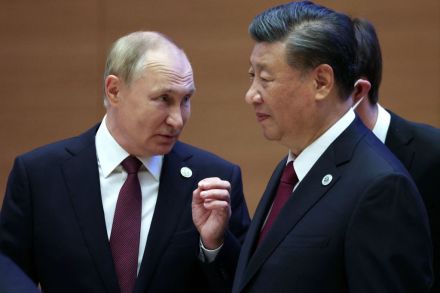
Russian President Vladimir Putin and Chinese President Xi Jinping met in Uzbekistan during this week’s Shanghai Cooperation Organization (SCO) summit — and a lot had happened since their last meeting. With the Russian Army on the back-foot in Ukraine and its economy forecasted to contract by over 4 percent in 2022, Putin is in a far worse position. Whether this impacted the meeting is hard to tell, though Putin indicated that Xi had “questions and concerns about [Ukraine].” Nevertheless, both countries expressed support for one another, touching on their respective concerns. Xi stated that China wanted to work with Russia “to set an example of a responsible world power,” a jab at the Western powers that both countries are positioning themselves against.

On the front lines of Europe’s newest war

From our UK edition

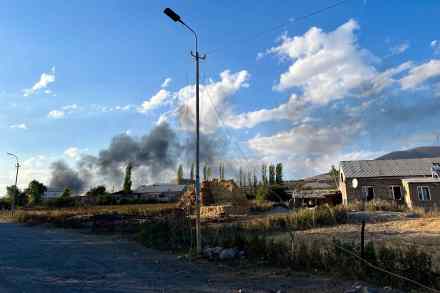
Sotk, Armenia A group of Armenian soldiers stand guard on the road towards the village. ‘It’s not safe to go ahead,’ one says, slinging his Kalashnikov across his shoulder and motioning for our van to pull over. ‘They were shelling the highway just 15 minutes ago.’ In the distance, there’s the unmistakable thunder of artillery and smoke rising from the side of the mountains. Beyond them is the border with Azerbaijan from where, in the early hours of Tuesday morning, a massive barrage was unleashed on towns and cities across Armenia. The offensive is the most dramatic escalation since the two former Soviet republics fought a brutal and bloody war two years ago, leaving more than 5,000 dead on both sides.

More mad than Vlad: Russia’s ultra-nationalist threat

From our UK edition

‘Russia without Putin!’ was the cry of Muscovites who turned out to protest against Vladimir Putin’s return to the presidency for a third term in December 2011. Crowds 100,000 strong chanted their opposition on Moscow’s Academician Sakharov Prospect – as symbolically named a venue as you could wish for – as riot police stood calmly by. There was anger in the crowd. But there was hope, too, not least because the massive protest was officially sanctioned. One after another, prominent opposition politicians such as Ilya Yashin, Boris Nemtsov and Alexei Navalny denounced Putin from a stage provided by the city authorities. Today the memory of those protests seems to belong to a different age of Russia. Yashin and Navalny are in jail.

How Russia is forcibly relocating Ukrainian civilians

With the stunning, rapid advance of its military against the Russians, Ukraine has shot back into the headlines. The focus is, understandably, on the battlefield, but the happenings behind the lines deserve attention too. Since the first weeks of the war, information has trickled in about Russia’s massive, criminal attempts to relocate Ukrainian civilians. While much of the situation in the Russian-occupied regions of Ukraine remains murky, what is known provides a rough outline. Russia’s attempt at social control in Ukraine consists of two key elements: filtration and forced relocation.

Vladimir’s no good, very bad week

The Ukraine war’s first seven months have been a long slog, with high costs in both men and material. Then, over the last week of combat, that suddenly changed. While casualties undoubtedly remained high on both sides, the Ukrainian army’s surprise counteroffensive in the northeast shattered Russia’s defensive lines and culminated in the most humiliating Russian tactical defeat since its forces were pushed out of Kyiv in April. While Russian President Vladimir Putin was celebrating the opening of a new Ferris wheel in Moscow, his troops 534 miles to the south were dropping their weapons and retreating.

russia realities
kharkiv

Ukraine’s incredible success turns the tables on Russia

Ukraine’s swift counter-offensive has captured more territory in four days than Russia’s huge army did in six months. The victories go beyond the 3,000 kilometers of liberated land. The Ukrainians have managed to break and scatter the enemy army across city after city in Kharkiv (in the country’s northeast) and are now moving swiftly into Luhansk (in the north Donbas region). Russian commanders have abandoned major cities and supply hubs, forfeited their hard-won control of vital rail lines and highways, and fled eastward for their lives. Their soldiers have dropped their guns and abandoned vast stores of heavy weaponry, from tanks to anti-aircraft batteries. It has been a complete rout. How did Ukraine accomplish this swift and unexpected victory?

I’ve become a war addict

From our UK edition

It is an almost unquestioned orthodoxy that war is hell, and that every needless death in a needless war diminishes our common stock of humanity. It’s curious, though, how we're able to hold that conviction alongside a positively visceral excitement at watching the Ukrainian counter-offensive carve its way through the Kharkiv Oblast. Some 3,000 square kilometres have been recaptured: Ukrainian troops are moving through their own land at such a clip that they’ve made more progress in three days than the massed might of the Russian invaders have since April. I’ve been eating it up. Haven’t you? The images of abandoned armour, the fuel dumps, the sullen faces of Russian commanders rounded up as prisoners of war.